The short answer
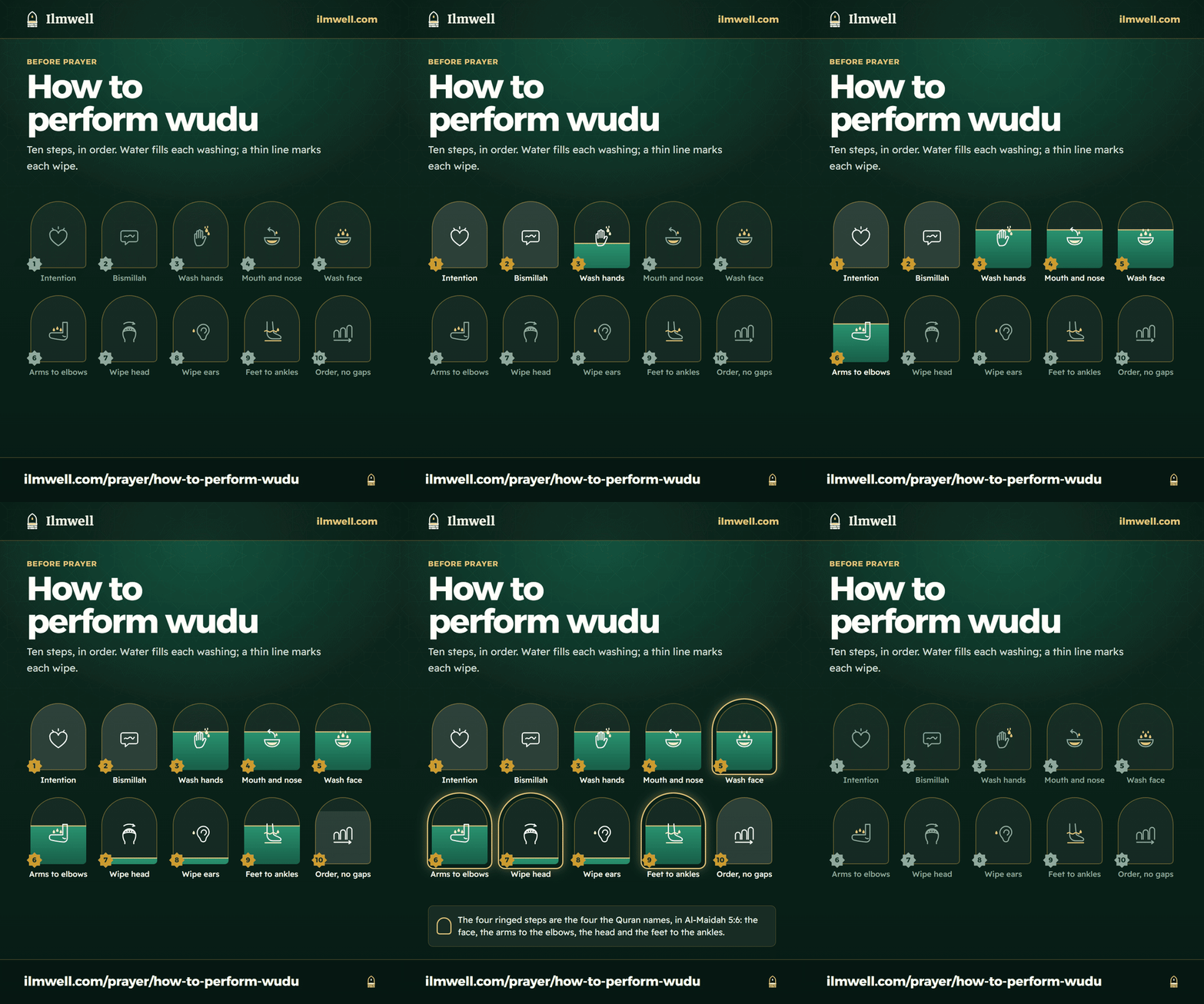
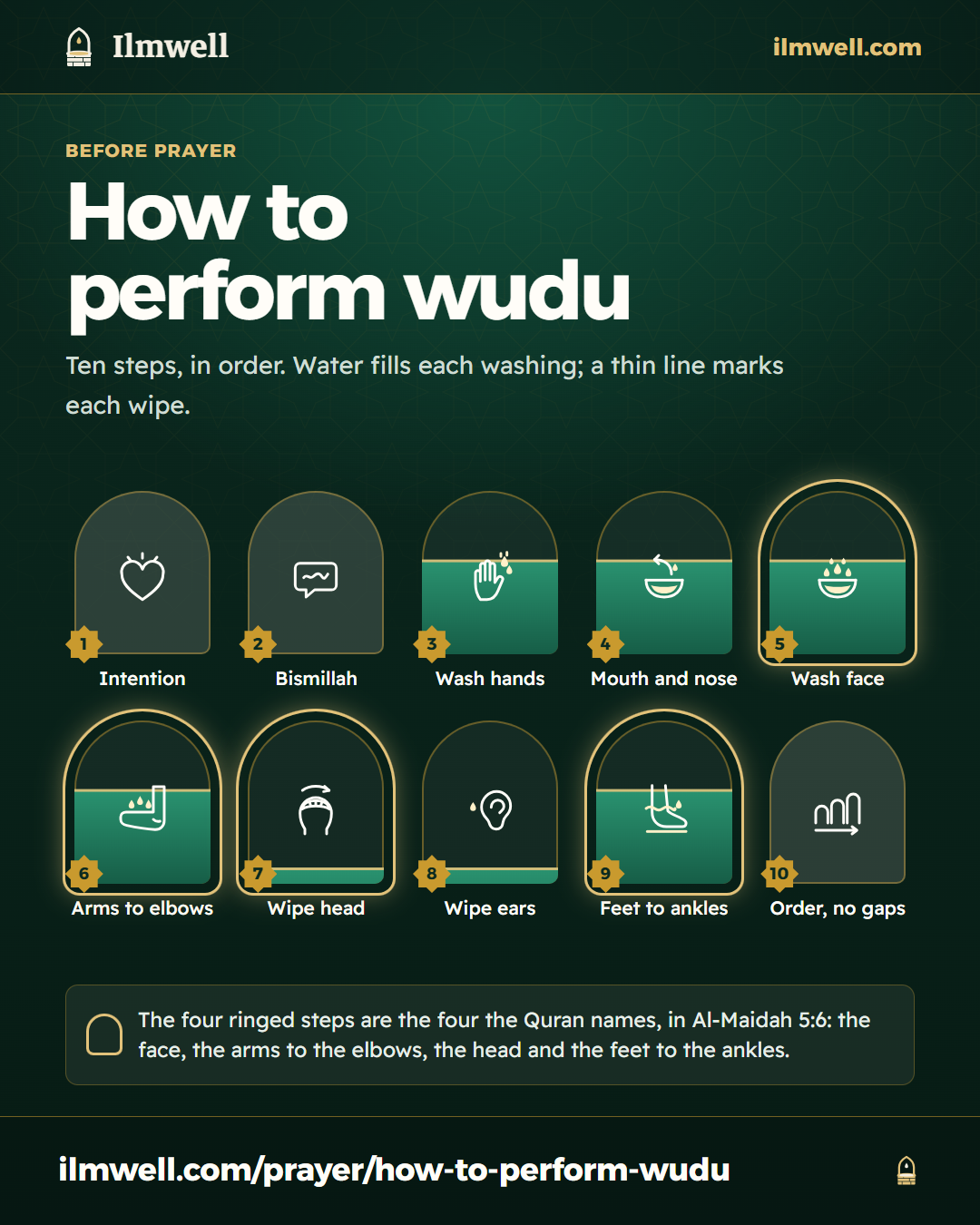
To perform wudu, make the intention, then wash your face and your arms to the elbows, wipe your head, and wash your feet to the ankles. All four schools require those four parts, because the Quran names them in Al-Maidah 5:6. They differ on the intention, the order and the rest, shown step by step below.
How do you perform wudu, step by step?
Make the intention
In your heart, intend that this wudu is for prayer or for purity. Nothing needs to be said aloud.
Hanafi: al-Hidayah's base text calls it recommended and al-Marghinani's comment calls it sunnah. Shafi'i and Maliki: Minhaj al-Talibin and al-Qawanin al-Fiqhiyyah list it first among the obligations. Hanbali: al-Mughni makes it a condition of every purification.
Say bismillah
Say "Bismillah" (in the name of Allah) as you begin.
Hanafi: al-Hidayah's base text calls it sunnah, and al-Marghinani judges recommended the sounder view. Maliki: al-Qawanin al-Fiqhiyyah counts it among the merits (fada'il), a step below sunnah. Hanbali: al-Rawd al-Murbi' makes it required when you remember it, and forgiven if you forget.
Wash your hands
Wash both hands up to the wrists three times, between the fingers too.
Hanbali: al-Rawd al-Murbi' makes washing them three times required after a night's sleep that breaks wudu.
Rinse your mouth and nose
Rinse your mouth three times, then draw water into your nose and blow it out three times.
Hanbali: al-Rawd al-Murbi' counts the mouth and nose as part of the face.
Wash your face
Wash the whole face from the hairline to the chin and from ear to ear, three times. Once is the required part.
Maliki: al-Qawanin al-Fiqhiyyah also requires rubbing the water over the skin with the hand (dalk).
Wash your arms
Wash the right arm, then the left, from the fingertips up to and including the elbows, three times.
Wipe your head
With wet hands, wipe over the head from the front to the back and return.
How much: a quarter of the head in al-Hidayah (Hanafi); any part in Minhaj al-Talibin (Shafi'i); the whole head in al-Qawanin al-Fiqhiyyah (Maliki) and al-Rawd al-Murbi' (Hanbali).
Wipe your ears
Wipe inside the ears with the index fingers and behind them with the thumbs.
Hanbali: al-Rawd al-Murbi' counts the ears as part of the head.
Wash your feet
Wash the right foot, then the left, up to and including the ankles, three times, between the toes too.
Keep the order, without long gaps
Do the steps in this order, and do not let one part dry before you wash the next.
Hanafi: both are sunnah, the order in al-Hidayah and continuity in Bada'i' al-Sana'i'. Shafi'i: Minhaj al-Talibin requires the order and makes continuity sunnah. Maliki: al-Qawanin al-Fiqhiyyah requires continuity when you remember and are able, and makes the order sunnah. Hanbali: al-Rawd al-Murbi' requires both.
How each step is done follows the school works: the intention made in the heart, in al-Rawd al-Murbi' 8; washing the hands to the wrist, the mouth and then the nose three times each, and running water between the fingers and toes, in al-Hidayah 1; washing three times and starting with the right, in Minhaj al-Talibin 4; wiping the head from the front to the back and returning, in al-Qawanin al-Fiqhiyyah 6 and al-Rawd al-Murbi' 8; the index fingers inside the ears and the thumbs over their outsides, in al-Rawd al-Murbi' 8; and not letting a washed part dry before the next, in al-Rawd al-Murbi' 8 and Bada'i' al-Sana'i' 3.
What does your school count as required?
Pick your school to see only its column, or keep all four side by side.
Required means the wudu is not valid without it in that school's work, whether the work calls it an obligation or a condition. Sunnah means it completes the wudu without being required; where a school's work ranks a step lower, as recommended or as a merit, the note on that step says so.
In the Hanafi school
Required 4: Face, Arms, Head and Feet.
Sunnah 7: Intention, Bismillah, Hands, Mouth and nose, Ears, Order and Continuity.
In the Shafi'i school
Required 6: Intention, Face, Arms, Head, Feet and Order.
Sunnah 5: Bismillah, Hands, Mouth and nose, Ears and Continuity.
In the Maliki school
Required 6: Intention, Face, Arms, Head, Feet and Continuity.
Sunnah 5: Bismillah, Hands, Mouth and nose, Ears and Order.
In the Hanbali school
Required 10: Intention, Bismillah, Mouth and nose, Face, Arms, Head, Ears, Feet, Order and Continuity.
Sunnah 1: Hands.
| Step | Hanafi | Shafi'i | Maliki | Hanbali |
|---|---|---|---|---|
| Intention | Sunnah | Required | Required | Required |
| Bismillah | Sunnah | Sunnah | Sunnah | Required |
| Hands | Sunnah | Sunnah | Sunnah | Sunnah |
| Mouth and nose | Sunnah | Sunnah | Sunnah | Required |
| Face | Required | Required | Required | Required |
| Arms | Required | Required | Required | Required |
| Head | Required | Required | Required | Required |
| Ears | Sunnah | Sunnah | Sunnah | Required |
| Feet | Required | Required | Required | Required |
| Order | Sunnah | Required | Sunnah | Required |
| Continuity | Sunnah | Sunnah | Required | Required |
Where each school says it:
Where does wudu come from in the Quran?
The four required parts are named in the Quran, in the sixth verse of Surah Al-Maidah. In our words: when you stand for prayer, wash your faces and your arms to the elbows, wipe your heads, and wash your feet to the ankles.
يَـٰٓأَيُّهَا ٱلَّذِينَ ءَامَنُوٓا۟ إِذَا قُمْتُمْ إِلَى ٱلصَّلَوٰةِ فَٱغْسِلُوا۟ وُجُوهَكُمْ وَأَيْدِيَكُمْ إِلَى ٱلْمَرَافِقِ وَٱمْسَحُوا۟ بِرُءُوسِكُمْ وَأَرْجُلَكُمْ إِلَى ٱلْكَعْبَيْنِ ۚ وَإِن كُنتُمْ جُنُبًا فَٱطَّهَّرُوا۟ ۚ وَإِن كُنتُم مَّرْضَىٰٓ أَوْ عَلَىٰ سَفَرٍ أَوْ جَآءَ أَحَدٌ مِّنكُم مِّنَ ٱلْغَآئِطِ أَوْ لَـٰمَسْتُمُ ٱلنِّسَآءَ فَلَمْ تَجِدُوا۟ مَآءً فَتَيَمَّمُوا۟ صَعِيدًا طَيِّبًا فَٱمْسَحُوا۟ بِوُجُوهِكُمْ وَأَيْدِيكُم مِّنْهُ ۚ مَا يُرِيدُ ٱللَّهُ لِيَجْعَلَ عَلَيْكُم مِّنْ حَرَجٍ وَلَـٰكِن يُرِيدُ لِيُطَهِّرَكُمْ وَلِيُتِمَّ نِعْمَتَهُۥ عَلَيْكُمْ لَعَلَّكُمْ تَشْكُرُونَ
The sunnahs, such as washing three times and rinsing the mouth and nose, are listed in each school's own work, which grounds them in how the Prophet Muhammad, peace be upon him, made wudu. Al-Hidayah, for example, gives as the reason for rinsing the mouth and nose that he did both consistently 1.
I spent my teens thinking wudu was a quick splash. A teacher at our mosque watched me do it once and asked me to slow down and do it in order. It took two minutes instead of thirty seconds, and I have not gone back.
Try it: the order and the four parts
Picture teaching your little brother wudu at the bathroom sink, with the floor getting a wash of its own. Here are three quick checks on the order and the four required parts, for you or for him.
1Which comes first: washing the face or washing the arms?
Answer: The face. The face comes first, then the arms to the elbows, in the order Al-Maidah 5:6 gives them.
2Which of these is wiped with a wet hand rather than washed?
Answer: The head. The head is wiped: a wet hand passed over it. The face, arms and feet are washed.
3Which four parts do all four schools count as required?
Answer: Face, arms, head, feet. Face, arms to the elbows, head and feet to the ankles: the four the Quran names.
Common mix-ups
- Washing three times is sunnah in al-Hidayah, Minhaj al-Talibin and al-Rawd al-Murbi', and a merit in al-Qawanin al-Fiqhiyyah 1486. Once, done fully, is what makes the wudu valid: al-Rawd al-Murbi' allows washing once 8.
- Where the schools differ, follow the school you were taught, or the scholar you trust.
- Wiping the head means a wet hand passed over it, not washing the hair: al-Hidayah defines wiping as touching with water, where washing makes the water flow 1.
Questions people ask
Are the wudu steps different for women?
No. There are no separate female wudu steps: the steps, and what each school counts as required, are the same for women and men.
What if there is no water for wudu?
The same verse, Al-Maidah 5:6, says that if you do not find water, you purify with clean earth instead, wiping the face and hands. This is called tayammum, and it has its own guide.
Is wudu the same as ablution?
Yes. Ablution, or ablutions, is the usual English word for wudu, also spelt wudhu: the washing before prayer.
Sources
Each school position and each sunnah step comes from that school's own work, read in Arabic and named here with the page. The Quran text is from Tanzil.
- 1
Al-Marghinani, in al-Hidayah, gives the obligations of wudu as washing the three limbs and wiping a quarter of the head, and lists washing the hands, saying bismillah, rinsing the mouth and nose, wiping the ears, washing three times and keeping the order as sunnah in his school.
- 2
Al-Marghinani, in al-Hidayah, gives the base text that it is recommended for the one making wudu to intend purification, and comments that intention in wudu is a sunnah in his school and fard for al-Shafi'i, with the Hanafi reasoning.
- 3
Al-Kasani, in Bada'i' al-Sana'i', lists continuity (muwalat) among the sunnahs of wudu and reports that Malik holds it to be fard.
- 4
Al-Nawawi, in Minhaj al-Talibin, gives six obligations of wudu, including wiping any part of the head and the order, and lists bismillah, washing the hands, rinsing the mouth and nose, washing three times, wiping the whole head then the ears, starting with the right and continuity among its sunnahs.
- 5
Al-Nawawi, in Minhaj al-Talibin, says the obligations of wudu are six, the first being the intention, which must be joined to the start of washing the face.
- 6
Ibn Juzayy, in al-Qawanin al-Fiqhiyyah, requires wiping the whole head, continuity when one remembers and is able, and rubbing with the hand, lists six sunnahs of wudu (washing the hands, rinsing the mouth, drawing water into the nose, blowing it out, wiping the ears, and the order) and counts bismillah among its merits (fada'il).
- 7
Ibn Juzayy, in al-Qawanin al-Fiqhiyyah, lists intention first among the six obligations (fara'id) of wudu, and says it is required in wudu and ghusl for Malik and al-Shafi'i, unlike Abu Hanifa.
- 8
Al-Buhuti, in al-Rawd al-Murbi', makes bismillah required when one remembers it, washing the hands three times sunnah (required after a night's sleep that breaks wudu), and gives six obligations of wudu: the face with the mouth and nose, the arms, the whole head with the ears, the feet, the order and continuity.
- 9
Ibn Qudamah, in al-Mughni, says intention is among the conditions of purification from every kind of ritual impurity, so no wudu, ghusl or tayammum is valid without it, and reports the opposing view of al-Thawri and the people of opinion for purification with water.
- Q
Quran Arabic for Al-Maidah 5:6.
Tanzil Project Uthmani text, CC BY 3.0. English: adapted from Marmaduke Pickthall's translation (1930), modernised and checked against modern translations.
Next
For your own situation, ask a scholar you trust.
Join the email list
New guides by email, now and then. No spam, and you can leave at any time.
Ilmwell is free and kept going by readers. See how to support it.