The short answer
Alhamdulillah means "all praise is for Allah". The words open Al-Fatihah 1:2, the verse after Bismillah in the Quran's first chapter. Muslims say it after a sneeze and after eating, as the hadith below teach, and on hard days as well as good ones.
How is Alhamdulillah written in Arabic?
Al-Fatihah 1:2
ٱلْحَمْدُ لِلَّهِ
al-ḥamdu lillāh
All praise is for Allah
Two words: al-ḥamdu, all praise, and lillāh, for Allah. To copy and paste the Arabic text, use the button under it.
What does Alhamdulillah mean?
Arabic reads right to left, so the first word is on the right.
- ٱلْحَمْدُal-ḥamduthe praise, all praise"Al" (the) makes it complete: not some praise, all of it.
- لِلَّهِlillāhis for Allah, belongs to Allah"Li" (for, belonging to) joined to "Allah".
If you have said Alhamdulillah for twenty years without knowing what the "al" does, you are in good company: it is the part that turns some praise into all of it.
In Arabic, ḥamd is praise. Thanks (shukr) answers a gift; praise can also be for someone's qualities. That is why the phrase fits a bad day as well as a good one.
Alhamdulillahi rabbil alamin
The full verse goes on: al-ḥamdu lillāhi rabbi l-ʿālamīn, "Praise be to Allah, Lord of the Worlds". This longer form is the one recited in Al-Fatihah.
How do you pronounce Alhamdulillah?
alḥamdulillāh
- ḥ is a breathy h from the throat, softer than clearing your throat and stronger than an English h.
- lil leans into a doubled l: lil-lāh, not li-lah.
- lāh is long. Hold the a, as in "father".
Listen and repeat. A recorded pronunciation by a fluent reciter is coming. We do not use a synthetic voice for Arabic.
When do Muslims say Alhamdulillah?
After you sneeze
Alhamdulillah
All praise is for Allah.
Whoever hears you replies "Yarhamuk Allah" (may Allah have mercy on you), and you answer "Yahdikumullahu wa yuslihu balakum" (may Allah guide you and set your affairs right).
1AuthenticSahih al-Bukhari 6224
After eating or drinking
Alhamdulillah
All praise is for Allah, for the food or drink.
The Prophet Muhammad, peace be upon him, said Allah is pleased with the person who eats or drinks and then praises Him for it.
2AuthenticSahih Muslim 2734
When you wake up
The waking dua
الْحَمْدُ لِلَّهِ الَّذِي أَحْيَانَا بَعْدَ مَا أَمَاتَنَا وَإِلَيْهِ النُّشُورُ
Al-hamdu lillahi alladhi ahyana ba'da ma amatana wa ilayhi al-nushur
Praise is for Allah, who gave us life after He caused us to die, and to Him is the resurrection.
"Caused us to die" here means sleep: the same narration gives the words for going to bed.
3AuthenticSahih al-Bukhari 6312
When you see something you like
Alhamdulillahi alladhi bi-ni'matihi tatimmu al-salihat
الْحَمْدُ لِلَّهِ الَّذِي بِنِعْمَتِهِ تَتِمُّ الصَّالِحَاتُ
Praise is for Allah, by whose favour good things are completed.
When you see something you dislike
Alhamdulillahi 'ala kulli hal
الْحَمْدُ لِلَّهِ عَلَى كُلِّ حَالٍ
Praise is for Allah in every situation.
This is what people usually mean by "alhamdulillah for everything". It is also written "ala kulli haal".
When someone asks how you are
"Alhamdulillah, good"
Many Muslims answer this way. It is a widespread habit of praising Allah, not a fixed wording from a specific hadith. In Urdu and Punjabi you will often hear "shukar alhamdulillah", adding shukar (thanks).
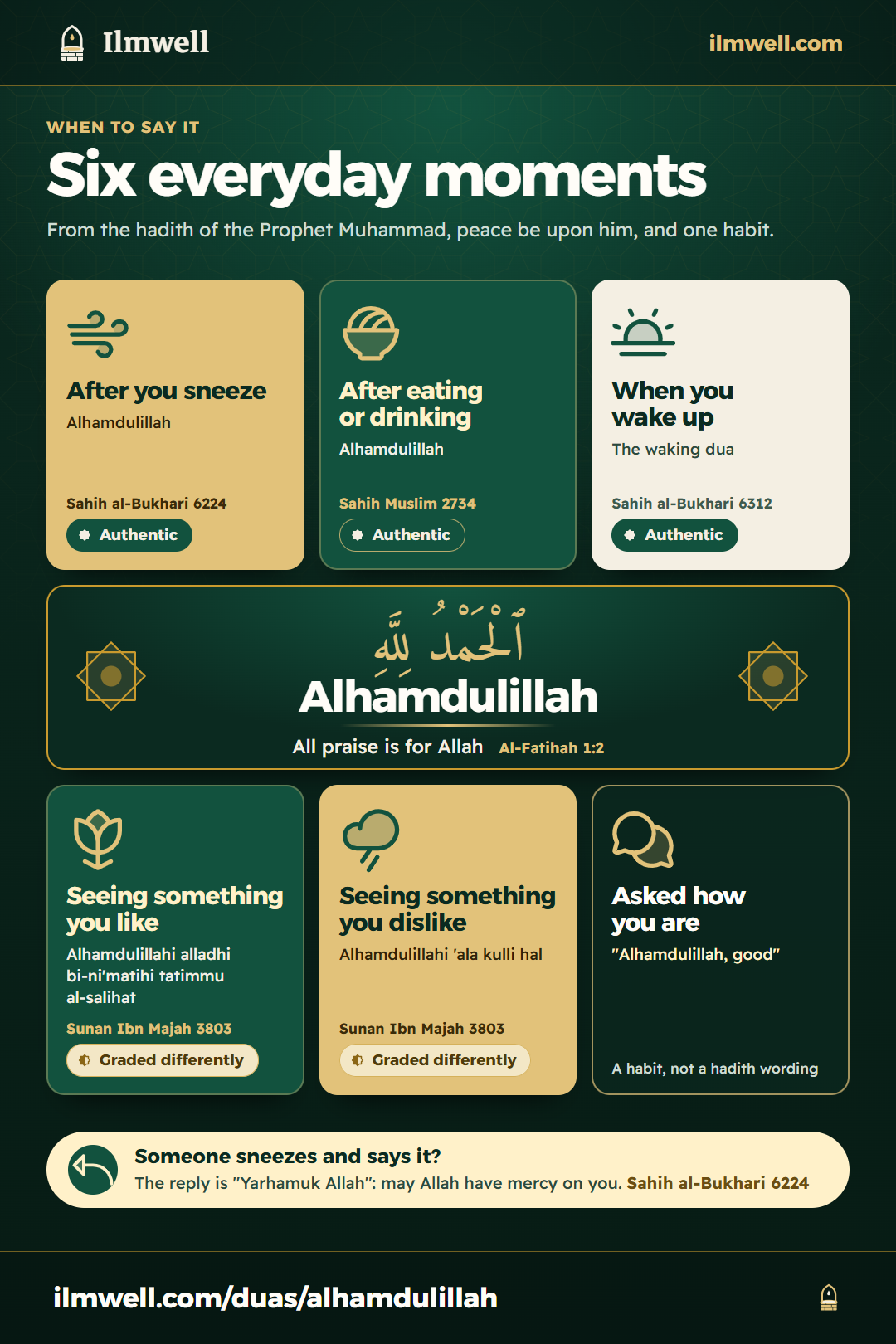
Where does each moment come from? All six in one picture
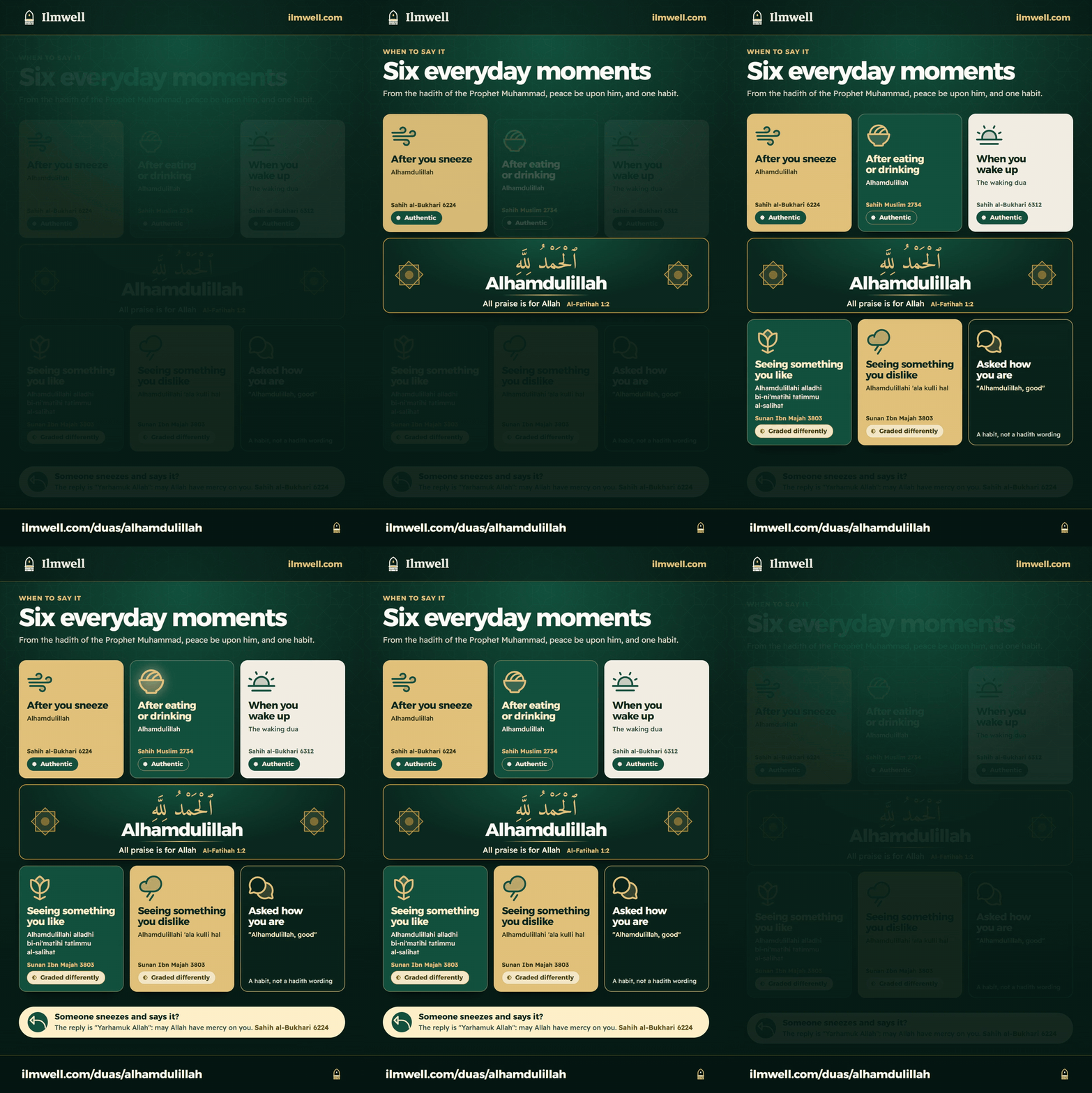
Six everyday moments for Alhamdulillah, all praise is for Allah (Al-Fatihah 1:2): after you sneeze (Sahih al-Bukhari 6224), after eating or drinking (Sahih Muslim 2734) and on waking (Sahih al-Bukhari 6312), each authentic. Then seeing something you like or dislike (Sunan Ibn Majah 3803, graded differently), being asked how you are (a habit, not a hadith wording), and the reply to a sneeze: Yarhamuk Allah, may Allah have mercy on you.
The six moments and where each comes from, as a card to save or send.
Posting it on your own site? Link back to this guide; the code under "Use it on your own site" does it in one line.
My mum answered "how are you?" with Alhamdulillah almost every single time, even on days she obviously wasn't fine. As a kid I thought it was just a habit. It was years before I understood she was choosing those words on purpose.
Try it: what would you say?
Four everyday moments. Pick an answer; each one explains itself.
1You sneeze in the middle of a family dinner. What do you say?
Answer: Alhamdulillah. After a sneeze you praise Allah. Source 1
2Your friend sneezes and says "Alhamdulillah". What do you say back?
Answer: Yarhamuk Allah. "Yarhamuk Allah" means "may Allah have mercy on you". Your friend then answers "Yahdikumullahu wa yuslihu balakum". Source 1
3You finish a meal. What fits?
Answer: Alhamdulillah. Praising Allah after food and drink is something He is pleased with. Source 2
4You get disappointing news. What can you say?
Answer: Alhamdulillahi 'ala kulli hal. "Praise is for Allah in every situation." Praising Allah is not only for good days. The narration with this exact wording is graded differently by scholars; see source 4. Source 4
Why does Alhamdulillah matter?
ٱلْحَمْدُ لِلَّهِ رَبِّ ٱلْعَـٰلَمِينَ
The Prophet, peace be upon him, said that alhamdulillah fills the scale, and that subhanallah and alhamdulillah together fill what is between the heavens and the earth.
5AuthenticSahih Muslim 223
He also said the best remembrance is la ilaha illallah (there is no god but Allah), and the best supplication is alhamdulillah.
6AuthenticJami' at-Tirmidhi 3383graded hasan
The Quran describes the people of Paradise ending their call with the same words: al-hamdu lillahi rabbi al-'alamin.
Yunus 10:10
Show Yunus 10:10 in full
دَعْوَىٰهُمْ فِيهَا سُبْحَـٰنَكَ ٱللَّهُمَّ وَتَحِيَّتُهُمْ فِيهَا سَلَـٰمٌ ۚ وَءَاخِرُ دَعْوَىٰهُمْ أَنِ ٱلْحَمْدُ لِلَّهِ رَبِّ ٱلْعَـٰلَمِينَ
Their prayer therein will be: Glory be to You, O Allah! and their greeting therein will be: Peace. And the conclusion of their prayer will be: Praise be to Allah, Lord of the Worlds!
Common mix-ups
- It is not only for good things. Muslims praise Allah on hard days too.
- Alhamdulillah praises Allah. Subhanallah declares Him far above any fault. Mashallah is said when admiring something good. They are different phrases for different moments.
- Alhamdulillah and "Alhamdulillahi rabbil alamin" are the same praise; the longer form adds "Lord of the Worlds".
Questions people ask
How do you reply when someone says Alhamdulillah?
After a sneeze, you reply "Yarhamuk Allah", may Allah have mercy on you, as Sahih al-Bukhari 6224 (graded sahih) teaches, and they answer "Yahdikumullahu wa yuslihu balakum". At other times the sources on this page give no fixed reply; many people simply say Alhamdulillah too.
What does Alhamdulillah for everything mean?
It is the English way of saying "Alhamdulillahi 'ala kulli hal" (also written ala kulli haal): praise is for Allah in every situation. The wording is reported from the Prophet, peace be upon him, in Sunan Ibn Majah 3803, which is graded differently.
How do you spell Alhamdulillah?
Alhamdulillah is the most common English spelling. Alhamdulilah, Alhamdullilah, Alhumdulillah, Alhumdulilah and Al-hamdu lillah are other ways of writing the same two Arabic words.
Sources
Every claim on this page comes from one of these. Gradings are reported with the scholar's name; we do not grade hadith ourselves.
- 1
The Prophet told a person who sneezes to say al-hamdu lillah; the one who hears says yarhamuk Allah, and the sneezer replies yahdikumullahu wa yuslihu balakum.
Sahih al-Bukhari 6224 Book 78, Hadith 248
Authentic: in Sahih al-Bukhari
- 2
The Prophet said Allah is pleased with the servant who eats a meal and praises Him for it, or drinks a drink and praises Him for it.
Sahih Muslim 2734 Book 48, Hadith 123
Authentic: in Sahih Muslim
- 3
On waking, the Prophet would say: al-hamdu lillahi alladhi ahyana ba'da ma amatana wa ilayhi al-nushur (praise is for Allah who gave us life after causing us to die, and to Him is the resurrection).
Sahih al-Bukhari 6312 Book 80, Hadith 9
Authentic: in Sahih al-Bukhari
- 4
When the Prophet saw something he liked he would say al-hamdu lillahi alladhi bi-ni'matihi tatimmu al-salihat, and when he saw something he disliked he would say al-hamdu lillahi 'ala kulli hal (praise is for Allah in every state).
Sunan Ibn Majah 3803 Book 33, Hadith 147
Graded differently. Here is who graded it which way:
- SoundAl-Albani, Al-Hakim
- Weak chain, strengthenedShu'ayb al-Arna'ut
- WeakDarussalam, Ibn Baz
See each grading in full, with its wording and where it was given
Scholars disagree about this hadith. Here is how each graded it, so you can follow the scholar you trust.
- Da'if: Darussalam (as shown on sunnah.com)
- صحيح (Sahih): Al-Albani, Sahih al-Jami' 4640 and 4727 (as listed on dorar.net)
- ذكر له شاهدا حسنا (cited a hasan supporting narration for it): Al-Albani, al-Silsila al-Sahiha 265 (as listed on dorar.net)
- يمكن تحسينه (can be graded hasan): Al-Albani, takhrij al-Kalim al-Tayyib 140 (as listed on dorar.net)
- إسناده ضعيف، لكن له شاهد يتقوى به (its chain is weak, but it has a supporting narration that strengthens it): Shu'ayb al-Arna'ut, takhrij Zad al-Ma'ad 2/424 (as listed on dorar.net)
- ضعيف بهذه الطرق (weak through these routes): Ibn Baz, al-Ta'liqat al-Baziyya 'ala Zad al-Ma'ad 330 (as listed on dorar.net)
- صحيح الإسناد (its chain is sahih): Al-Hakim, al-Mustadrak 1864 (as listed on dorar.net)
- 5
The Prophet said al-hamdu lillah fills the scale, and subhan Allah and al-hamdu lillah fill what is between the heavens and the earth.
Sahih Muslim 223 Book 2, Hadith 1
Authentic: in Sahih Muslim
- 6
The Prophet said the best remembrance is la ilaha illallah and the best supplication is al-hamdu lillah.
Jami' at-Tirmidhi 3383 Book 48, Hadith 14
Authentic: hasan gharib (Al-Tirmidhi); Hasan (Darussalam); Hasan (Al-Albani); its chain is hasan (Shu'ayb al-Arna'ut); its chain is sahih (Al-Hakim)
- Q
Quran Arabic for Al-Fatihah 1:2 (the Arabic in the scroll and the word cards) and Yunus 10:10, and their English.
Tanzil Project Uthmani text, CC BY 3.0. English: adapted from Marmaduke Pickthall's translation (1930), modernised and checked against modern translations.
Next
- Mashallah: meaning and when to say itPhrase lesson
- What to say after sneezing: the complete exchangeGuide
- Subhanallah: meaning and everyday contextsPhrase lesson
- Al-Fatihah: meaning and understanding what you reciteQuran lesson
- Start at Alif: Islam basicsThe beginner path
For your own situation, ask a scholar you trust.
Join the email list
New guides by email, now and then. No spam, and you can leave at any time.
Ilmwell is free and kept going by readers. See how to support it.