The short answer
Surah Yaseen is surah 36 of the Quran: 83 verses about the messengers, the signs in creation and the raising of the dead (Yaseen 36:12, 36:51, meaning surah 36, verses 12 and 51). Most narrations about its virtues are graded weak or worse; one report, that the Prophet Muhammad, peace be upon him, recited it in the Fajr (dawn) prayer, is graded sahih.
Surah Yaseen in Arabic: the full text
Yaseen 36:1 to 83
يسٓ ١ وَٱلْقُرْءَانِ ٱلْحَكِيمِ ٢ إِنَّكَ لَمِنَ ٱلْمُرْسَلِينَ ٣ عَلَىٰ صِرَٰطٍ مُّسْتَقِيمٍ ٤ تَنزِيلَ ٱلْعَزِيزِ ٱلرَّحِيمِ ٥ لِتُنذِرَ قَوْمًا مَّآ أُنذِرَ ءَابَآؤُهُمْ فَهُمْ غَـٰفِلُونَ ٦ لَقَدْ حَقَّ ٱلْقَوْلُ عَلَىٰٓ أَكْثَرِهِمْ فَهُمْ لَا يُؤْمِنُونَ ٧ إِنَّا جَعَلْنَا فِىٓ أَعْنَـٰقِهِمْ أَغْلَـٰلًا فَهِىَ إِلَى ٱلْأَذْقَانِ فَهُم مُّقْمَحُونَ ٨ وَجَعَلْنَا مِنۢ بَيْنِ أَيْدِيهِمْ سَدًّا وَمِنْ خَلْفِهِمْ سَدًّا فَأَغْشَيْنَـٰهُمْ فَهُمْ لَا يُبْصِرُونَ ٩ وَسَوَآءٌ عَلَيْهِمْ ءَأَنذَرْتَهُمْ أَمْ لَمْ تُنذِرْهُمْ لَا يُؤْمِنُونَ ١٠ إِنَّمَا تُنذِرُ مَنِ ٱتَّبَعَ ٱلذِّكْرَ وَخَشِىَ ٱلرَّحْمَـٰنَ بِٱلْغَيْبِ ۖ فَبَشِّرْهُ بِمَغْفِرَةٍ وَأَجْرٍ كَرِيمٍ ١١ إِنَّا نَحْنُ نُحْىِ ٱلْمَوْتَىٰ وَنَكْتُبُ مَا قَدَّمُوا۟ وَءَاثَـٰرَهُمْ ۚ وَكُلَّ شَىْءٍ أَحْصَيْنَـٰهُ فِىٓ إِمَامٍ مُّبِينٍ ١٢ وَٱضْرِبْ لَهُم مَّثَلًا أَصْحَـٰبَ ٱلْقَرْيَةِ إِذْ جَآءَهَا ٱلْمُرْسَلُونَ ١٣ إِذْ أَرْسَلْنَآ إِلَيْهِمُ ٱثْنَيْنِ فَكَذَّبُوهُمَا فَعَزَّزْنَا بِثَالِثٍ فَقَالُوٓا۟ إِنَّآ إِلَيْكُم مُّرْسَلُونَ ١٤ قَالُوا۟ مَآ أَنتُمْ إِلَّا بَشَرٌ مِّثْلُنَا وَمَآ أَنزَلَ ٱلرَّحْمَـٰنُ مِن شَىْءٍ إِنْ أَنتُمْ إِلَّا تَكْذِبُونَ ١٥ قَالُوا۟ رَبُّنَا يَعْلَمُ إِنَّآ إِلَيْكُمْ لَمُرْسَلُونَ ١٦ وَمَا عَلَيْنَآ إِلَّا ٱلْبَلَـٰغُ ٱلْمُبِينُ ١٧ قَالُوٓا۟ إِنَّا تَطَيَّرْنَا بِكُمْ ۖ لَئِن لَّمْ تَنتَهُوا۟ لَنَرْجُمَنَّكُمْ وَلَيَمَسَّنَّكُم مِّنَّا عَذَابٌ أَلِيمٌ ١٨ قَالُوا۟ طَـٰٓئِرُكُم مَّعَكُمْ ۚ أَئِن ذُكِّرْتُم ۚ بَلْ أَنتُمْ قَوْمٌ مُّسْرِفُونَ ١٩ وَجَآءَ مِنْ أَقْصَا ٱلْمَدِينَةِ رَجُلٌ يَسْعَىٰ قَالَ يَـٰقَوْمِ ٱتَّبِعُوا۟ ٱلْمُرْسَلِينَ ٢٠ ٱتَّبِعُوا۟ مَن لَّا يَسْـَٔلُكُمْ أَجْرًا وَهُم مُّهْتَدُونَ ٢١ وَمَا لِىَ لَآ أَعْبُدُ ٱلَّذِى فَطَرَنِى وَإِلَيْهِ تُرْجَعُونَ ٢٢ ءَأَتَّخِذُ مِن دُونِهِۦٓ ءَالِهَةً إِن يُرِدْنِ ٱلرَّحْمَـٰنُ بِضُرٍّ لَّا تُغْنِ عَنِّى شَفَـٰعَتُهُمْ شَيْـًٔا وَلَا يُنقِذُونِ ٢٣ إِنِّىٓ إِذًا لَّفِى ضَلَـٰلٍ مُّبِينٍ ٢٤ إِنِّىٓ ءَامَنتُ بِرَبِّكُمْ فَٱسْمَعُونِ ٢٥ قِيلَ ٱدْخُلِ ٱلْجَنَّةَ ۖ قَالَ يَـٰلَيْتَ قَوْمِى يَعْلَمُونَ ٢٦ بِمَا غَفَرَ لِى رَبِّى وَجَعَلَنِى مِنَ ٱلْمُكْرَمِينَ ٢٧ ۞ وَمَآ أَنزَلْنَا عَلَىٰ قَوْمِهِۦ مِنۢ بَعْدِهِۦ مِن جُندٍ مِّنَ ٱلسَّمَآءِ وَمَا كُنَّا مُنزِلِينَ ٢٨ إِن كَانَتْ إِلَّا صَيْحَةً وَٰحِدَةً فَإِذَا هُمْ خَـٰمِدُونَ ٢٩ يَـٰحَسْرَةً عَلَى ٱلْعِبَادِ ۚ مَا يَأْتِيهِم مِّن رَّسُولٍ إِلَّا كَانُوا۟ بِهِۦ يَسْتَهْزِءُونَ ٣٠ أَلَمْ يَرَوْا۟ كَمْ أَهْلَكْنَا قَبْلَهُم مِّنَ ٱلْقُرُونِ أَنَّهُمْ إِلَيْهِمْ لَا يَرْجِعُونَ ٣١ وَإِن كُلٌّ لَّمَّا جَمِيعٌ لَّدَيْنَا مُحْضَرُونَ ٣٢ وَءَايَةٌ لَّهُمُ ٱلْأَرْضُ ٱلْمَيْتَةُ أَحْيَيْنَـٰهَا وَأَخْرَجْنَا مِنْهَا حَبًّا فَمِنْهُ يَأْكُلُونَ ٣٣ وَجَعَلْنَا فِيهَا جَنَّـٰتٍ مِّن نَّخِيلٍ وَأَعْنَـٰبٍ وَفَجَّرْنَا فِيهَا مِنَ ٱلْعُيُونِ ٣٤ لِيَأْكُلُوا۟ مِن ثَمَرِهِۦ وَمَا عَمِلَتْهُ أَيْدِيهِمْ ۖ أَفَلَا يَشْكُرُونَ ٣٥ سُبْحَـٰنَ ٱلَّذِى خَلَقَ ٱلْأَزْوَٰجَ كُلَّهَا مِمَّا تُنۢبِتُ ٱلْأَرْضُ وَمِنْ أَنفُسِهِمْ وَمِمَّا لَا يَعْلَمُونَ ٣٦ وَءَايَةٌ لَّهُمُ ٱلَّيْلُ نَسْلَخُ مِنْهُ ٱلنَّهَارَ فَإِذَا هُم مُّظْلِمُونَ ٣٧ وَٱلشَّمْسُ تَجْرِى لِمُسْتَقَرٍّ لَّهَا ۚ ذَٰلِكَ تَقْدِيرُ ٱلْعَزِيزِ ٱلْعَلِيمِ ٣٨ وَٱلْقَمَرَ قَدَّرْنَـٰهُ مَنَازِلَ حَتَّىٰ عَادَ كَٱلْعُرْجُونِ ٱلْقَدِيمِ ٣٩ لَا ٱلشَّمْسُ يَنۢبَغِى لَهَآ أَن تُدْرِكَ ٱلْقَمَرَ وَلَا ٱلَّيْلُ سَابِقُ ٱلنَّهَارِ ۚ وَكُلٌّ فِى فَلَكٍ يَسْبَحُونَ ٤٠ وَءَايَةٌ لَّهُمْ أَنَّا حَمَلْنَا ذُرِّيَّتَهُمْ فِى ٱلْفُلْكِ ٱلْمَشْحُونِ ٤١ وَخَلَقْنَا لَهُم مِّن مِّثْلِهِۦ مَا يَرْكَبُونَ ٤٢ وَإِن نَّشَأْ نُغْرِقْهُمْ فَلَا صَرِيخَ لَهُمْ وَلَا هُمْ يُنقَذُونَ ٤٣ إِلَّا رَحْمَةً مِّنَّا وَمَتَـٰعًا إِلَىٰ حِينٍ ٤٤ وَإِذَا قِيلَ لَهُمُ ٱتَّقُوا۟ مَا بَيْنَ أَيْدِيكُمْ وَمَا خَلْفَكُمْ لَعَلَّكُمْ تُرْحَمُونَ ٤٥ وَمَا تَأْتِيهِم مِّنْ ءَايَةٍ مِّنْ ءَايَـٰتِ رَبِّهِمْ إِلَّا كَانُوا۟ عَنْهَا مُعْرِضِينَ ٤٦ وَإِذَا قِيلَ لَهُمْ أَنفِقُوا۟ مِمَّا رَزَقَكُمُ ٱللَّهُ قَالَ ٱلَّذِينَ كَفَرُوا۟ لِلَّذِينَ ءَامَنُوٓا۟ أَنُطْعِمُ مَن لَّوْ يَشَآءُ ٱللَّهُ أَطْعَمَهُۥٓ إِنْ أَنتُمْ إِلَّا فِى ضَلَـٰلٍ مُّبِينٍ ٤٧ وَيَقُولُونَ مَتَىٰ هَـٰذَا ٱلْوَعْدُ إِن كُنتُمْ صَـٰدِقِينَ ٤٨ مَا يَنظُرُونَ إِلَّا صَيْحَةً وَٰحِدَةً تَأْخُذُهُمْ وَهُمْ يَخِصِّمُونَ ٤٩ فَلَا يَسْتَطِيعُونَ تَوْصِيَةً وَلَآ إِلَىٰٓ أَهْلِهِمْ يَرْجِعُونَ ٥٠ وَنُفِخَ فِى ٱلصُّورِ فَإِذَا هُم مِّنَ ٱلْأَجْدَاثِ إِلَىٰ رَبِّهِمْ يَنسِلُونَ ٥١ قَالُوا۟ يَـٰوَيْلَنَا مَنۢ بَعَثَنَا مِن مَّرْقَدِنَا ۜ ۗ هَـٰذَا مَا وَعَدَ ٱلرَّحْمَـٰنُ وَصَدَقَ ٱلْمُرْسَلُونَ ٥٢ إِن كَانَتْ إِلَّا صَيْحَةً وَٰحِدَةً فَإِذَا هُمْ جَمِيعٌ لَّدَيْنَا مُحْضَرُونَ ٥٣ فَٱلْيَوْمَ لَا تُظْلَمُ نَفْسٌ شَيْـًٔا وَلَا تُجْزَوْنَ إِلَّا مَا كُنتُمْ تَعْمَلُونَ ٥٤ إِنَّ أَصْحَـٰبَ ٱلْجَنَّةِ ٱلْيَوْمَ فِى شُغُلٍ فَـٰكِهُونَ ٥٥ هُمْ وَأَزْوَٰجُهُمْ فِى ظِلَـٰلٍ عَلَى ٱلْأَرَآئِكِ مُتَّكِـُٔونَ ٥٦ لَهُمْ فِيهَا فَـٰكِهَةٌ وَلَهُم مَّا يَدَّعُونَ ٥٧ سَلَـٰمٌ قَوْلًا مِّن رَّبٍّ رَّحِيمٍ ٥٨ وَٱمْتَـٰزُوا۟ ٱلْيَوْمَ أَيُّهَا ٱلْمُجْرِمُونَ ٥٩ ۞ أَلَمْ أَعْهَدْ إِلَيْكُمْ يَـٰبَنِىٓ ءَادَمَ أَن لَّا تَعْبُدُوا۟ ٱلشَّيْطَـٰنَ ۖ إِنَّهُۥ لَكُمْ عَدُوٌّ مُّبِينٌ ٦٠ وَأَنِ ٱعْبُدُونِى ۚ هَـٰذَا صِرَٰطٌ مُّسْتَقِيمٌ ٦١ وَلَقَدْ أَضَلَّ مِنكُمْ جِبِلًّا كَثِيرًا ۖ أَفَلَمْ تَكُونُوا۟ تَعْقِلُونَ ٦٢ هَـٰذِهِۦ جَهَنَّمُ ٱلَّتِى كُنتُمْ تُوعَدُونَ ٦٣ ٱصْلَوْهَا ٱلْيَوْمَ بِمَا كُنتُمْ تَكْفُرُونَ ٦٤ ٱلْيَوْمَ نَخْتِمُ عَلَىٰٓ أَفْوَٰهِهِمْ وَتُكَلِّمُنَآ أَيْدِيهِمْ وَتَشْهَدُ أَرْجُلُهُم بِمَا كَانُوا۟ يَكْسِبُونَ ٦٥ وَلَوْ نَشَآءُ لَطَمَسْنَا عَلَىٰٓ أَعْيُنِهِمْ فَٱسْتَبَقُوا۟ ٱلصِّرَٰطَ فَأَنَّىٰ يُبْصِرُونَ ٦٦ وَلَوْ نَشَآءُ لَمَسَخْنَـٰهُمْ عَلَىٰ مَكَانَتِهِمْ فَمَا ٱسْتَطَـٰعُوا۟ مُضِيًّا وَلَا يَرْجِعُونَ ٦٧ وَمَن نُّعَمِّرْهُ نُنَكِّسْهُ فِى ٱلْخَلْقِ ۖ أَفَلَا يَعْقِلُونَ ٦٨ وَمَا عَلَّمْنَـٰهُ ٱلشِّعْرَ وَمَا يَنۢبَغِى لَهُۥٓ ۚ إِنْ هُوَ إِلَّا ذِكْرٌ وَقُرْءَانٌ مُّبِينٌ ٦٩ لِّيُنذِرَ مَن كَانَ حَيًّا وَيَحِقَّ ٱلْقَوْلُ عَلَى ٱلْكَـٰفِرِينَ ٧٠ أَوَلَمْ يَرَوْا۟ أَنَّا خَلَقْنَا لَهُم مِّمَّا عَمِلَتْ أَيْدِينَآ أَنْعَـٰمًا فَهُمْ لَهَا مَـٰلِكُونَ ٧١ وَذَلَّلْنَـٰهَا لَهُمْ فَمِنْهَا رَكُوبُهُمْ وَمِنْهَا يَأْكُلُونَ ٧٢ وَلَهُمْ فِيهَا مَنَـٰفِعُ وَمَشَارِبُ ۖ أَفَلَا يَشْكُرُونَ ٧٣ وَٱتَّخَذُوا۟ مِن دُونِ ٱللَّهِ ءَالِهَةً لَّعَلَّهُمْ يُنصَرُونَ ٧٤ لَا يَسْتَطِيعُونَ نَصْرَهُمْ وَهُمْ لَهُمْ جُندٌ مُّحْضَرُونَ ٧٥ فَلَا يَحْزُنكَ قَوْلُهُمْ ۘ إِنَّا نَعْلَمُ مَا يُسِرُّونَ وَمَا يُعْلِنُونَ ٧٦ أَوَلَمْ يَرَ ٱلْإِنسَـٰنُ أَنَّا خَلَقْنَـٰهُ مِن نُّطْفَةٍ فَإِذَا هُوَ خَصِيمٌ مُّبِينٌ ٧٧ وَضَرَبَ لَنَا مَثَلًا وَنَسِىَ خَلْقَهُۥ ۖ قَالَ مَن يُحْىِ ٱلْعِظَـٰمَ وَهِىَ رَمِيمٌ ٧٨ قُلْ يُحْيِيهَا ٱلَّذِىٓ أَنشَأَهَآ أَوَّلَ مَرَّةٍ ۖ وَهُوَ بِكُلِّ خَلْقٍ عَلِيمٌ ٧٩ ٱلَّذِى جَعَلَ لَكُم مِّنَ ٱلشَّجَرِ ٱلْأَخْضَرِ نَارًا فَإِذَآ أَنتُم مِّنْهُ تُوقِدُونَ ٨٠ أَوَلَيْسَ ٱلَّذِى خَلَقَ ٱلسَّمَـٰوَٰتِ وَٱلْأَرْضَ بِقَـٰدِرٍ عَلَىٰٓ أَن يَخْلُقَ مِثْلَهُم ۚ بَلَىٰ وَهُوَ ٱلْخَلَّـٰقُ ٱلْعَلِيمُ ٨١ إِنَّمَآ أَمْرُهُۥٓ إِذَآ أَرَادَ شَيْـًٔا أَن يَقُولَ لَهُۥ كُن فَيَكُونُ ٨٢ فَسُبْحَـٰنَ ٱلَّذِى بِيَدِهِۦ مَلَكُوتُ كُلِّ شَىْءٍ وَإِلَيْهِ تُرْجَعُونَ ٨٣
This is the complete surah, all 83 verses, each ending with its number. To copy and paste the Arabic text, use the button under the scroll. Like most surahs it is printed under Bismillah, which is not counted among its verses. The name is also spelt Yasin, Ya Sin, Surat Yaseen and Sura Yasin: all are surah 36.
What is Surah Yaseen about?
Here it is in five passages, our division by subject. They are a messenger and a warning, a town that rejected its messengers, the signs in creation, the Day of the Shout and the trumpet, and an answer to the question of who will revive dead bones. Each passage below is summarised from its own verses; what they mean in detail belongs to tafsir (Quran commentary).
| Verses | Passage | What the verses say |
|---|---|---|
| 1 to 12 | The messenger and the warning | An oath by the wise Quran that the one addressed is among those sent; a warning to a people whose fathers were not warned; "We bring the dead to life" and record what they send ahead (36:12). |
| 13 to 32 | The people of the town | A town rejects two messengers and then a third. A man comes running from the far end of the city to back them and is told "Enter paradise"; one Shout ends the town (36:29). |
| 33 to 47 | The signs in creation | The dead earth brought to life, night stripped of day, the sun and moon each floating in an orbit, the laden ship; and people who turn away from every sign. |
| 48 to 68 | The Shout and the Day | One Shout, the trumpet, the dead rising from their graves; the people of paradise and the guilty set apart; mouths sealed while hands speak and feet bear witness (36:65). |
| 69 to 83 | Who will revive the bones? | "We have not taught him (Muhammad) poetry" (36:69); cattle as a provision; man asks who will revive rotted bones, and the answer is the One who produced them at first (36:78 to 79); "Be! and it is" (36:82). |
Surah Yaseen in English and transliteration, verse by verse
Read Surah Yaseen online here in full, one verse at a time: the Arabic, a simple transliteration (the Roman English spelling of the Arabic sounds) and the English translation. Apostrophes mark the throat sounds and hamza; doubled letters are held a little longer.
Listen and repeat. Audio by a fluent human reciter is coming. We do not use a synthetic voice for the Quran.
Surah Yaseen (36), 83 verses. ilmwell.com/quran/yasin/
Verses 1 to 12: the messenger and the warning
- 1
يسٓ
Ya sin
Ya Sin.
- 2
وَٱلْقُرْءَانِ ٱلْحَكِيمِ
Wal-qur'anil-hakim
By the wise Quran,
- 3
إِنَّكَ لَمِنَ ٱلْمُرْسَلِينَ
Innaka laminal-mursalin
Indeed, you are of those sent
- 4
عَلَىٰ صِرَٰطٍ مُّسْتَقِيمٍ
'Ala siratim-mustaqim
On a straight path,
- 5
تَنزِيلَ ٱلْعَزِيزِ ٱلرَّحِيمِ
Tanzilal-'azizir-rahim
A revelation of the Mighty, the Merciful,
- 6
لِتُنذِرَ قَوْمًا مَّآ أُنذِرَ ءَابَآؤُهُمْ فَهُمْ غَـٰفِلُونَ
Litundhira qawmam-ma undhira aba'uhum fahum ghafilun
That you may warn a folk whose fathers were not warned, so they are heedless.
- 7
لَقَدْ حَقَّ ٱلْقَوْلُ عَلَىٰٓ أَكْثَرِهِمْ فَهُمْ لَا يُؤْمِنُونَ
Laqad haqqal-qawlu 'ala aktharihim fahum la yu'minun
Already has the judgement, (for their infidelity) proved true of most of them, for they do not believe.
- 8
إِنَّا جَعَلْنَا فِىٓ أَعْنَـٰقِهِمْ أَغْلَـٰلًا فَهِىَ إِلَى ٱلْأَذْقَانِ فَهُم مُّقْمَحُونَ
Inna ja'alna fi a'naqihim aghlalan fahiya ilal-adhqani fahum muqmahun
Indeed, We have put on their necks iron collars reaching to the chins, so that they are made stiff-necked.
- 9
وَجَعَلْنَا مِنۢ بَيْنِ أَيْدِيهِمْ سَدًّا وَمِنْ خَلْفِهِمْ سَدًّا فَأَغْشَيْنَـٰهُمْ فَهُمْ لَا يُبْصِرُونَ
Wa ja'alna mim bayni aydihim saddaw-wa min khalfihim saddan fa-aghshaynahum fahum la yubsirun
And We have set a bar before them and a bar behind them, and (thus) have covered them so that they do not see.
- 10
وَسَوَآءٌ عَلَيْهِمْ ءَأَنذَرْتَهُمْ أَمْ لَمْ تُنذِرْهُمْ لَا يُؤْمِنُونَ
Wa sawa'un 'alayhim a-andhartahum am lam tundhirhum la yu'minun
Whether you warn them or you warn them not, it is alike for them, for they do not believe.
- 11
إِنَّمَا تُنذِرُ مَنِ ٱتَّبَعَ ٱلذِّكْرَ وَخَشِىَ ٱلرَّحْمَـٰنَ بِٱلْغَيْبِ ۖ فَبَشِّرْهُ بِمَغْفِرَةٍ وَأَجْرٍ كَرِيمٍ
Innama tundhiru manit-taba'adh-dhikra wa khashiyar-rahmana bil-ghayb, fabashshirhu bimaghfiratiw-wa ajrin karim
You warn only him who follows the Reminder and fears the Beneficent in secret. To him bear tidings of forgiveness and a rich reward.
- 12
إِنَّا نَحْنُ نُحْىِ ٱلْمَوْتَىٰ وَنَكْتُبُ مَا قَدَّمُوا۟ وَءَاثَـٰرَهُمْ ۚ وَكُلَّ شَىْءٍ أَحْصَيْنَـٰهُ فِىٓ إِمَامٍ مُّبِينٍ
Inna nahnu nuhyil-mawta wa naktubu ma qaddamu wa atharahum, wa kulla shay'in ahsaynahu fi imamim-mubin
Indeed, We it is Who bring the dead to life. We record that which they send before (them), and their footprints. And all things We have kept in a clear Register.
Verses 13 to 32: the people of the town
- 13
وَٱضْرِبْ لَهُم مَّثَلًا أَصْحَـٰبَ ٱلْقَرْيَةِ إِذْ جَآءَهَا ٱلْمُرْسَلُونَ
Wadrib lahum mathalan as-habal-qaryati idh ja'ahal-mursalun
Coin for them a similitude: The people of the city when those sent (from Allah) came to them;
- 14
إِذْ أَرْسَلْنَآ إِلَيْهِمُ ٱثْنَيْنِ فَكَذَّبُوهُمَا فَعَزَّزْنَا بِثَالِثٍ فَقَالُوٓا۟ إِنَّآ إِلَيْكُم مُّرْسَلُونَ
Idh arsalna ilayhimuth-nayni fakadhdhabuhuma fa'azzazna bithalithin faqalu inna ilaykum mursalun
When We sent to them two, and they denied them both, so We reinforced them with a third, and they said: Indeed, we have been sent to you.
- 15
قَالُوا۟ مَآ أَنتُمْ إِلَّا بَشَرٌ مِّثْلُنَا وَمَآ أَنزَلَ ٱلرَّحْمَـٰنُ مِن شَىْءٍ إِنْ أَنتُمْ إِلَّا تَكْذِبُونَ
Qalu ma antum illa basharum-mithluna wa ma anzalar-rahmanu min shay'in in antum illa takdhibun
They said: You are but mortals like us. The Beneficent has revealed nothing. You do but lie!
- 16
قَالُوا۟ رَبُّنَا يَعْلَمُ إِنَّآ إِلَيْكُمْ لَمُرْسَلُونَ
Qalu rabbuna ya'lamu inna ilaykum lamursalun
They answered: Our Lord knows that we are indeed sent to you,
- 17
وَمَا عَلَيْنَآ إِلَّا ٱلْبَلَـٰغُ ٱلْمُبِينُ
Wa ma 'alayna illal-balaghul-mubin
And our duty is but plain conveyance (of the message).
- 18
قَالُوٓا۟ إِنَّا تَطَيَّرْنَا بِكُمْ ۖ لَئِن لَّمْ تَنتَهُوا۟ لَنَرْجُمَنَّكُمْ وَلَيَمَسَّنَّكُم مِّنَّا عَذَابٌ أَلِيمٌ
Qalu inna tatayyarna bikum, la'il-lam tantahu lanarjumannakum wa layamassannakum minna 'adhabun alim
(The people of the city) said: We see an ill omen in you. If you do not desist, we shall surely stone you, and grievous torture will befall you at our hands.
- 19
قَالُوا۟ طَـٰٓئِرُكُم مَّعَكُمْ ۚ أَئِن ذُكِّرْتُم ۚ بَلْ أَنتُمْ قَوْمٌ مُّسْرِفُونَ
Qalu ta'irukum ma'akum, a'in dhukkirtum, bal antum qawmum-musrifun
They said: Your evil augury be with you! Is it because you are reminded (of the truth)? Rather, you are perverse folk!
- 20
وَجَآءَ مِنْ أَقْصَا ٱلْمَدِينَةِ رَجُلٌ يَسْعَىٰ قَالَ يَـٰقَوْمِ ٱتَّبِعُوا۟ ٱلْمُرْسَلِينَ
Wa ja'a min aqsal-madinati rajuluy-yas'a, qala ya qawmit-tabi'ul-mursalin
And there came from the uttermost part of the city a man running. He cried: O my people! Follow those who have been sent!
- 21
ٱتَّبِعُوا۟ مَن لَّا يَسْـَٔلُكُمْ أَجْرًا وَهُم مُّهْتَدُونَ
Ittabi'u mal-la yas'alukum ajraw-wa hum muhtadun
Follow those who ask of you no fee, and who are rightly guided.
- 22
وَمَا لِىَ لَآ أَعْبُدُ ٱلَّذِى فَطَرَنِى وَإِلَيْهِ تُرْجَعُونَ
Wa ma liya la a'budul-ladhi fatarani wa ilayhi turja'un
For what cause should I not serve Him Who has created me, and to Whom you will be brought back?
- 23
ءَأَتَّخِذُ مِن دُونِهِۦٓ ءَالِهَةً إِن يُرِدْنِ ٱلرَّحْمَـٰنُ بِضُرٍّ لَّا تُغْنِ عَنِّى شَفَـٰعَتُهُمْ شَيْـًٔا وَلَا يُنقِذُونِ
A-attakhidhu min dunihi alihatan iy-yuridnir-rahmanu bidurril-la tughni 'anni shafa'atuhum shay'aw-wa la yunqidhun
Shall I take (other) gods in place of Him when, if the Beneficent should wish me any harm, their intercession will avail me nothing, nor can they save?
- 24
إِنِّىٓ إِذًا لَّفِى ضَلَـٰلٍ مُّبِينٍ
Inni idhal-lafi dalalim-mubin
Then truly I should be in error manifest.
- 25
إِنِّىٓ ءَامَنتُ بِرَبِّكُمْ فَٱسْمَعُونِ
Inni amantu birabbikum fasma'un
Indeed, I have believed in your Lord, so hear me!
- 26
قِيلَ ٱدْخُلِ ٱلْجَنَّةَ ۖ قَالَ يَـٰلَيْتَ قَوْمِى يَعْلَمُونَ
Qiladkhulil-jannah, qala ya layta qawmi ya'lamun
It was said (to him): Enter paradise. He said: Would that my people knew,
- 27
بِمَا غَفَرَ لِى رَبِّى وَجَعَلَنِى مِنَ ٱلْمُكْرَمِينَ
Bima ghafara li rabbi wa ja'alani minal-mukramin
With what (munificence) my Lord has pardoned me and made me of the honoured ones!
- 28
۞ وَمَآ أَنزَلْنَا عَلَىٰ قَوْمِهِۦ مِنۢ بَعْدِهِۦ مِن جُندٍ مِّنَ ٱلسَّمَآءِ وَمَا كُنَّا مُنزِلِينَ
Wa ma anzalna 'ala qawmihi mim ba'dihi min jundim-minas-sama'i wa ma kunna munzilin
We did not send down against his people after him a host from heaven, nor do We ever send.
- 29
إِن كَانَتْ إِلَّا صَيْحَةً وَٰحِدَةً فَإِذَا هُمْ خَـٰمِدُونَ
In kanat illa sayhataw-wahidatan fa-idha hum khamidun
It was but one Shout, and suddenly they were extinct.
- 30
يَـٰحَسْرَةً عَلَى ٱلْعِبَادِ ۚ مَا يَأْتِيهِم مِّن رَّسُولٍ إِلَّا كَانُوا۟ بِهِۦ يَسْتَهْزِءُونَ
Ya hasratan 'alal-'ibad, ma ya'tihim mir-rasulin illa kanu bihi yastahzi'un
Ah, the anguish for the bondmen! Never did a messenger come to them but they mocked him!
- 31
أَلَمْ يَرَوْا۟ كَمْ أَهْلَكْنَا قَبْلَهُم مِّنَ ٱلْقُرُونِ أَنَّهُمْ إِلَيْهِمْ لَا يَرْجِعُونَ
Alam yaraw kam ahlakna qablahum minal-quruni annahum ilayhim la yarji'un
Have they not seen how many generations We destroyed before them, which indeed returned not to them;
- 32
وَإِن كُلٌّ لَّمَّا جَمِيعٌ لَّدَيْنَا مُحْضَرُونَ
Wa in kullul-lamma jami'ul-ladayna muhdarun
But all, without exception, will be brought before Us.
Verses 33 to 47: the signs in creation
- 33
وَءَايَةٌ لَّهُمُ ٱلْأَرْضُ ٱلْمَيْتَةُ أَحْيَيْنَـٰهَا وَأَخْرَجْنَا مِنْهَا حَبًّا فَمِنْهُ يَأْكُلُونَ
Wa ayatul-lahumul-ardul-maytatu ahyaynaha wa akhrajna minha habban faminhu ya'kulun
A token to them is the dead earth. We revive it, and We bring forth from it grain so that they eat thereof;
- 34
وَجَعَلْنَا فِيهَا جَنَّـٰتٍ مِّن نَّخِيلٍ وَأَعْنَـٰبٍ وَفَجَّرْنَا فِيهَا مِنَ ٱلْعُيُونِ
Wa ja'alna fiha jannatim-min nakhiliw-wa a'nabiw-wa fajjarna fiha minal-'uyun
And We have placed therein gardens of the date-palm and grapes, and We have caused springs of water to gush forth therein,
- 35
لِيَأْكُلُوا۟ مِن ثَمَرِهِۦ وَمَا عَمِلَتْهُ أَيْدِيهِمْ ۖ أَفَلَا يَشْكُرُونَ
Liya'kulu min thamarihi wa ma 'amilat-hu aydihim, afala yashkurun
That they may eat of the fruit thereof, and their hands made it not. Will they not, then, give thanks?
- 36
سُبْحَـٰنَ ٱلَّذِى خَلَقَ ٱلْأَزْوَٰجَ كُلَّهَا مِمَّا تُنۢبِتُ ٱلْأَرْضُ وَمِنْ أَنفُسِهِمْ وَمِمَّا لَا يَعْلَمُونَ
Subhanal-ladhi khalaqal-azwaja kullaha mimma tumbitul-ardu wa min anfusihim wa mimma la ya'lamun
Glory be to Him Who created all the sexual pairs, of that which the earth grows, and of themselves, and of that which they do not know!
- 37
وَءَايَةٌ لَّهُمُ ٱلَّيْلُ نَسْلَخُ مِنْهُ ٱلنَّهَارَ فَإِذَا هُم مُّظْلِمُونَ
Wa ayatul-lahumul-laylu naslakhu minhun-nahara fa-idha hum muzlimun
A token to them is night. We strip it of the day, and suddenly they are in darkness.
- 38
وَٱلشَّمْسُ تَجْرِى لِمُسْتَقَرٍّ لَّهَا ۚ ذَٰلِكَ تَقْدِيرُ ٱلْعَزِيزِ ٱلْعَلِيمِ
Wash-shamsu tajri limustaqarril-laha, dhalika taqdirul-'azizil-'alim
And the sun runs on to a resting-place for him. That is the measuring of the Mighty, the Wise.
- 39
وَٱلْقَمَرَ قَدَّرْنَـٰهُ مَنَازِلَ حَتَّىٰ عَادَ كَٱلْعُرْجُونِ ٱلْقَدِيمِ
Wal-qamara qaddarnahu manazila hatta 'ada kal-'urjunil-qadim
And for the moon We have appointed mansions till she returns like an old shrivelled palm-leaf.
- 40
لَا ٱلشَّمْسُ يَنۢبَغِى لَهَآ أَن تُدْرِكَ ٱلْقَمَرَ وَلَا ٱلَّيْلُ سَابِقُ ٱلنَّهَارِ ۚ وَكُلٌّ فِى فَلَكٍ يَسْبَحُونَ
Lash-shamsu yambaghi laha an tudrikal-qamara wa lal-laylu sabiqun-nahar, wa kullun fi falakiy-yasbahun
It is not for the sun to overtake the moon, nor does the night outstrip the day. They float each in an orbit.
- 41
وَءَايَةٌ لَّهُمْ أَنَّا حَمَلْنَا ذُرِّيَّتَهُمْ فِى ٱلْفُلْكِ ٱلْمَشْحُونِ
Wa ayatul-lahum anna hamalna dhurriyyatahum fil-fulkil-mashhun
And a token to them is that We bear their offspring in the laden ship,
- 42
وَخَلَقْنَا لَهُم مِّن مِّثْلِهِۦ مَا يَرْكَبُونَ
Wa khalaqna lahum mim-mithlihi ma yarkabun
And have created for them the like of it, on which they ride.
- 43
وَإِن نَّشَأْ نُغْرِقْهُمْ فَلَا صَرِيخَ لَهُمْ وَلَا هُمْ يُنقَذُونَ
Wa in nasha' nughriqhum fala sarikha lahum wa la hum yunqadhun
And if We will, We drown them, and there is no help for them, neither can they be saved;
- 44
إِلَّا رَحْمَةً مِّنَّا وَمَتَـٰعًا إِلَىٰ حِينٍ
Illa rahmatam-minna wa mata'an ila hin
Unless by mercy from Us and as comfort for a while.
- 45
وَإِذَا قِيلَ لَهُمُ ٱتَّقُوا۟ مَا بَيْنَ أَيْدِيكُمْ وَمَا خَلْفَكُمْ لَعَلَّكُمْ تُرْحَمُونَ
Wa idha qila lahumuttaqu ma bayna aydikum wa ma khalfakum la'allakum turhamun
When it is said to them: Beware of that which is before you and that which is behind you, that perhaps you may find mercy (they are heedless).
- 46
وَمَا تَأْتِيهِم مِّنْ ءَايَةٍ مِّنْ ءَايَـٰتِ رَبِّهِمْ إِلَّا كَانُوا۟ عَنْهَا مُعْرِضِينَ
Wa ma ta'tihim min ayatim-min ayati rabbihim illa kanu 'anha mu'ridin
Never came a token of the tokens of their Lord to them, but they did turn away from it!
- 47
وَإِذَا قِيلَ لَهُمْ أَنفِقُوا۟ مِمَّا رَزَقَكُمُ ٱللَّهُ قَالَ ٱلَّذِينَ كَفَرُوا۟ لِلَّذِينَ ءَامَنُوٓا۟ أَنُطْعِمُ مَن لَّوْ يَشَآءُ ٱللَّهُ أَطْعَمَهُۥٓ إِنْ أَنتُمْ إِلَّا فِى ضَلَـٰلٍ مُّبِينٍ
Wa idha qila lahum anfiqu mimma razaqakumul-lahu qalal-ladhina kafaru lilladhina amanu anut'imu mal-law yasha'ul-lahu at'amahu in antum illa fi dalalim-mubin
And when it is said to them: Spend of that which Allah has provided for you, those who disbelieve say to those who believe: Shall we feed those whom Allah, if He willed, would feed? You are in nothing else than error manifest.
Verses 48 to 68: the Shout and the Day
- 48
وَيَقُولُونَ مَتَىٰ هَـٰذَا ٱلْوَعْدُ إِن كُنتُمْ صَـٰدِقِينَ
Wa yaquluna mata hadhal-wa'du in kuntum sadiqin
And they say: When will this promise be fulfilled, if you are truthful?
- 49
مَا يَنظُرُونَ إِلَّا صَيْحَةً وَٰحِدَةً تَأْخُذُهُمْ وَهُمْ يَخِصِّمُونَ
Ma yanzuruna illa sayhataw-wahidatan ta'khudhuhum wa hum yakhissimun
They await but one Shout, which will surprise them while they are disputing.
- 50
فَلَا يَسْتَطِيعُونَ تَوْصِيَةً وَلَآ إِلَىٰٓ أَهْلِهِمْ يَرْجِعُونَ
Fala yastati'una tawsiyataw-wa la ila ahlihim yarji'un
Then they cannot make bequest, nor can they return to their own folk.
- 51
وَنُفِخَ فِى ٱلصُّورِ فَإِذَا هُم مِّنَ ٱلْأَجْدَاثِ إِلَىٰ رَبِّهِمْ يَنسِلُونَ
Wa nufikha fis-suri fa-idha hum minal-ajdathi ila rabbihim yansilun
And the trumpet is blown and suddenly from the graves they hasten to their Lord,
- 52
قَالُوا۟ يَـٰوَيْلَنَا مَنۢ بَعَثَنَا مِن مَّرْقَدِنَا ۜ ۗ هَـٰذَا مَا وَعَدَ ٱلرَّحْمَـٰنُ وَصَدَقَ ٱلْمُرْسَلُونَ
Qalu ya waylana mam ba'athana mim-marqadina, hadha ma wa'adar-rahmanu wa sadaqal-mursalun
Crying: Woe upon us! Who has raised us from our place of sleep? This is that which the Beneficent did promise, and the messengers spoke truth.
- 53
إِن كَانَتْ إِلَّا صَيْحَةً وَٰحِدَةً فَإِذَا هُمْ جَمِيعٌ لَّدَيْنَا مُحْضَرُونَ
In kanat illa sayhataw-wahidatan fa-idha hum jami'ul-ladayna muhdarun
It is but one Shout, and behold them brought together before Us!
- 54
فَٱلْيَوْمَ لَا تُظْلَمُ نَفْسٌ شَيْـًٔا وَلَا تُجْزَوْنَ إِلَّا مَا كُنتُمْ تَعْمَلُونَ
Fal-yawma la tuzlamu nafsun shay'aw-wa la tujzawna illa ma kuntum ta'malun
This day no soul is wronged in anything; nor are you requited anything except what you used to do.
- 55
إِنَّ أَصْحَـٰبَ ٱلْجَنَّةِ ٱلْيَوْمَ فِى شُغُلٍ فَـٰكِهُونَ
Inna as-habal-jannatil-yawma fi shughulin fakihun
Indeed, those who merit paradise this day are happily employed,
- 56
هُمْ وَأَزْوَٰجُهُمْ فِى ظِلَـٰلٍ عَلَى ٱلْأَرَآئِكِ مُتَّكِـُٔونَ
Hum wa azwajuhum fi zilalin 'alal-ara'iki muttaki'un
They and their wives, in pleasant shade, on thrones reclining;
- 57
لَهُمْ فِيهَا فَـٰكِهَةٌ وَلَهُم مَّا يَدَّعُونَ
Lahum fiha fakihatuw-wa lahum ma yadda'un
Theirs the fruit (of their good deeds) and theirs (all) that they ask;
- 58
سَلَـٰمٌ قَوْلًا مِّن رَّبٍّ رَّحِيمٍ
Salamun qawlam-mir-rabbir-rahim
The word from a Merciful Lord (for them) is: Peace!
- 59
وَٱمْتَـٰزُوا۟ ٱلْيَوْمَ أَيُّهَا ٱلْمُجْرِمُونَ
Wamtazul-yawma ayyuhal-mujrimun
But stand apart, O you guilty, this day!
- 60
۞ أَلَمْ أَعْهَدْ إِلَيْكُمْ يَـٰبَنِىٓ ءَادَمَ أَن لَّا تَعْبُدُوا۟ ٱلشَّيْطَـٰنَ ۖ إِنَّهُۥ لَكُمْ عَدُوٌّ مُّبِينٌ
Alam a'had ilaykum ya bani adama al-la ta'budush-shaytan, innahu lakum 'aduwwum-mubin
Did I not charge you, O you sons of Adam, that you do not worship the devil - indeed, he is your open foe!
- 61
وَأَنِ ٱعْبُدُونِى ۚ هَـٰذَا صِرَٰطٌ مُّسْتَقِيمٌ
Wa ani'buduni, hadha siratum-mustaqim
But that you worship Me? That was the right path.
- 62
وَلَقَدْ أَضَلَّ مِنكُمْ جِبِلًّا كَثِيرًا ۖ أَفَلَمْ تَكُونُوا۟ تَعْقِلُونَ
Wa laqad adalla minkum jibillan kathira, afalam takunu ta'qilun
Yet he has led astray of you a great multitude. Had you then no sense?
- 63
هَـٰذِهِۦ جَهَنَّمُ ٱلَّتِى كُنتُمْ تُوعَدُونَ
Hadhihi jahannamul-lati kuntum tu'adun
This is hell which you were promised (if you followed him).
- 64
ٱصْلَوْهَا ٱلْيَوْمَ بِمَا كُنتُمْ تَكْفُرُونَ
Islawhal-yawma bima kuntum takfurun
Burn therein this day because you disbelieved.
- 65
ٱلْيَوْمَ نَخْتِمُ عَلَىٰٓ أَفْوَٰهِهِمْ وَتُكَلِّمُنَآ أَيْدِيهِمْ وَتَشْهَدُ أَرْجُلُهُم بِمَا كَانُوا۟ يَكْسِبُونَ
Al-yawma nakhtimu 'ala afwahihim wa tukallimuna aydihim wa tashhadu arjuluhum bima kanu yaksibun
This day We seal up their mouths, and their hands speak out to Us and their feet bear witness as to what they used to earn.
- 66
وَلَوْ نَشَآءُ لَطَمَسْنَا عَلَىٰٓ أَعْيُنِهِمْ فَٱسْتَبَقُوا۟ ٱلصِّرَٰطَ فَأَنَّىٰ يُبْصِرُونَ
Wa law nasha'u latamasna 'ala a'yunihim fastabaqus-sirata fa-anna yubsirun
And had We willed, We truly could have quenched their eyesight so that they should struggle for the way. Then how could they have seen?
- 67
وَلَوْ نَشَآءُ لَمَسَخْنَـٰهُمْ عَلَىٰ مَكَانَتِهِمْ فَمَا ٱسْتَطَـٰعُوا۟ مُضِيًّا وَلَا يَرْجِعُونَ
Wa law nasha'u lamasakhnahum 'ala makanatihim famastata'u mudiyyaw-wa la yarji'un
And had We willed, We truly could have fixed them in their place, making them powerless to go forward or turn back.
- 68
وَمَن نُّعَمِّرْهُ نُنَكِّسْهُ فِى ٱلْخَلْقِ ۖ أَفَلَا يَعْقِلُونَ
Wa man nu'ammirhu nunakkis-hu fil-khalq, afala ya'qilun
He whom We bring to old age, We reverse him in creation (making him go back to weakness after strength). Have you then no sense?
Verses 69 to 83: who will revive the bones?
- 69
وَمَا عَلَّمْنَـٰهُ ٱلشِّعْرَ وَمَا يَنۢبَغِى لَهُۥٓ ۚ إِنْ هُوَ إِلَّا ذِكْرٌ وَقُرْءَانٌ مُّبِينٌ
Wa ma 'allamnahush-shi'ra wa ma yambaghi lah, in huwa illa dhikruw-wa qur'anum-mubin
And We have not taught him (Muhammad) poetry, nor is it fitting for him. This is nothing else than a Reminder and a Lecture making plain,
- 70
لِّيُنذِرَ مَن كَانَ حَيًّا وَيَحِقَّ ٱلْقَوْلُ عَلَى ٱلْكَـٰفِرِينَ
Liyundhira man kana hayyaw-wa yahiqqal-qawlu 'alal-kafirin
To warn whoever lives, and that the word may be fulfilled against the disbelievers.
- 71
أَوَلَمْ يَرَوْا۟ أَنَّا خَلَقْنَا لَهُم مِّمَّا عَمِلَتْ أَيْدِينَآ أَنْعَـٰمًا فَهُمْ لَهَا مَـٰلِكُونَ
Awalam yaraw anna khalaqna lahum mimma 'amilat aydina an'aman fahum laha malikun
Have they not seen how We have created for them of Our handiwork the cattle, so that they are their owners,
- 72
وَذَلَّلْنَـٰهَا لَهُمْ فَمِنْهَا رَكُوبُهُمْ وَمِنْهَا يَأْكُلُونَ
Wa dhallalnaha lahum faminha rakubuhum wa minha ya'kulun
And have made them subservient to them, so that some of them they have for riding, some for food?
- 73
وَلَهُمْ فِيهَا مَنَـٰفِعُ وَمَشَارِبُ ۖ أَفَلَا يَشْكُرُونَ
Wa lahum fiha manafi'u wa masharib, afala yashkurun
Benefits and (various) drinks have they from them. Will they not then give thanks?
- 74
وَٱتَّخَذُوا۟ مِن دُونِ ٱللَّهِ ءَالِهَةً لَّعَلَّهُمْ يُنصَرُونَ
Wattakhadhu min dunil-lahi alihatal-la'allahum yunsarun
And they have taken (other) gods beside Allah, in order that they may be helped.
- 75
لَا يَسْتَطِيعُونَ نَصْرَهُمْ وَهُمْ لَهُمْ جُندٌ مُّحْضَرُونَ
La yastati'una nasrahum wa hum lahum jundum-muhdarun
It is not in their power to help them; but they (the worshippers) are to them a host in arms.
- 76
فَلَا يَحْزُنكَ قَوْلُهُمْ ۘ إِنَّا نَعْلَمُ مَا يُسِرُّونَ وَمَا يُعْلِنُونَ
Fala yahzunka qawluhum, inna na'lamu ma yusirruna wa ma yu'linun
So let not their speech grieve you (O Muhammad). Indeed, We know what they conceal and what they proclaim.
- 77
أَوَلَمْ يَرَ ٱلْإِنسَـٰنُ أَنَّا خَلَقْنَـٰهُ مِن نُّطْفَةٍ فَإِذَا هُوَ خَصِيمٌ مُّبِينٌ
Awalam yaral-insanu anna khalaqnahu min nutfatin fa-idha huwa khasimum-mubin
Has not man seen that We have created him from a drop of seed? Yet suddenly he is an open opponent.
- 78
وَضَرَبَ لَنَا مَثَلًا وَنَسِىَ خَلْقَهُۥ ۖ قَالَ مَن يُحْىِ ٱلْعِظَـٰمَ وَهِىَ رَمِيمٌ
Wa daraba lana mathalaw-wa nasiya khalqah, qala may-yuhyil-'izama wa hiya ramim
And he has coined for Us a similitude, and has forgotten the fact of his creation, saying: Who will revive these bones when they have rotted away?
- 79
قُلْ يُحْيِيهَا ٱلَّذِىٓ أَنشَأَهَآ أَوَّلَ مَرَّةٍ ۖ وَهُوَ بِكُلِّ خَلْقٍ عَلِيمٌ
Qul yuhyihal-ladhi ansha'aha awwala marrah, wa huwa bikulli khalqin 'alim
Say: He will revive them Who produced them at the first, for He is Knower of every creation,
- 80
ٱلَّذِى جَعَلَ لَكُم مِّنَ ٱلشَّجَرِ ٱلْأَخْضَرِ نَارًا فَإِذَآ أَنتُم مِّنْهُ تُوقِدُونَ
Alladhi ja'ala lakum minash-shajaril-akhdari naran fa-idha antum minhu tuqidun
Who has appointed for you fire from the green tree, and behold! you kindle from it.
- 81
أَوَلَيْسَ ٱلَّذِى خَلَقَ ٱلسَّمَـٰوَٰتِ وَٱلْأَرْضَ بِقَـٰدِرٍ عَلَىٰٓ أَن يَخْلُقَ مِثْلَهُم ۚ بَلَىٰ وَهُوَ ٱلْخَلَّـٰقُ ٱلْعَلِيمُ
Awa laysal-ladhi khalaqas-samawati wal-arda biqadirin 'ala ay-yakhluqa mithlahum, bala wa huwal-khallaqul-'alim
Is not He Who created the heavens and the earth Able to create the like of them? Yes, that He is! for He is the All-Wise Creator,
- 82
إِنَّمَآ أَمْرُهُۥٓ إِذَآ أَرَادَ شَيْـًٔا أَن يَقُولَ لَهُۥ كُن فَيَكُونُ
Innama amruhu idha arada shay'an ay-yaqula lahu kun fayakun
But His command, when He intends a thing, is only that He says to it: Be! and it is.
- 83
فَسُبْحَـٰنَ ٱلَّذِى بِيَدِهِۦ مَلَكُوتُ كُلِّ شَىْءٍ وَإِلَيْهِ تُرْجَعُونَ
Fasubhanal-ladhi biyadihi malakutu kulli shay'iw-wa ilayhi turja'un
Therefore Glory be to Him in Whose hand is the dominion over all things! To Him you will be brought back.
Quran text from the Tanzil Project (tanzil.net, CC BY 3.0). English: adapted from Marmaduke Pickthall's translation (1930), modernised and checked against modern translations. Transliteration: Ilmwell.
I heard Yasin a lot growing up, mostly at family gatherings. I could follow the rhythm but not the meaning. Reading it slowly in English was a completely different experience.
Try it: what does it say?
Four quick questions on the verses and the reports. Each answer explains itself.
1Who came running from the far end of the city?
Answer: A man who urged his people to follow the messengers. Verse 20: "a man running" who told his people to follow those who had been sent.
2In verses 78 and 79, what does man ask?
Answer: Who will bring rotted bones back to life. Verse 78: "Who will revive these bones when they have rotted away?" Verse 79 answers: "He will revive them Who produced them at the first".
3What is the moon likened to in verse 39?
Answer: An old shrivelled palm-leaf. It returns, after its mansions, like an old shrivelled palm-leaf.
4Which report about Yaseen is graded sahih?
Answer: The Prophet recited it in the Fajr prayer. Musnad Ahmad 16396 is graded sahih. The other two rest on reports graded weak, fabricated or graded differently. Source 1
What are the benefits of Surah Yaseen?
A man of Madinah heard the Prophet recite Yaseen in the Fajr prayer (Musnad Ahmad 16396, graded sahih), though that report gives no reward. Ibn Mas'ud, may Allah be pleased with him, reported a tenfold reward for each letter of any surah (Jami' at-Tirmidhi 2910, graded sahih or hasan). The claims made for Yaseen alone follow, each with its grade.
1AuthenticMusnad Ahmad 16396
2AuthenticJami' at-Tirmidhi 2910
| What people say | Source | Grade |
|---|---|---|
| Yaseen is the heart of the Quran; reciting it once is recorded as reciting the Quran ten times | Jami' at-Tirmidhi 2887 Source 3 | Weak to fabricated |
| Yaseen is the heart of the Quran; whoever recites it wanting Allah and the Last Home is forgiven | Musnad Ahmad 20300 Source 4 | Graded differently |
| Recite Yaseen over your dying | Sunan Abi Dawud 3121 Source 5 | Graded differently |
| Recite it near your dying (a narrator adds: meaning Yaseen) | Sunan Ibn Majah 1448 Source 6 | Weak |
| No one dies with Yaseen recited near him without Allah making it easy for him | al-Silsila al-Da'ifa 5219 Source 7 | Weak to fabricated |
| Whoever visits his parents' graves on Friday and recites Yaseen is forgiven | Ibn 'Adi, al-Kamil fi Du'afa' al-Rijal 6/260 Source 9 | Weak to fabricated |
| Whoever enters a graveyard and recites Yaseen, it is lightened for those buried there | al-Silsila al-Da'ifa 1246 Source 10 | Weak to fabricated |
| Whoever recites Yaseen in a night, seeking the face of Allah, is forgiven | Sahih Ibn Hibban 2574 Source 12 | Graded differently |
| Whoever recites Yaseen at the start of the day has his needs met (a Follower's report: from the generation after the companions) | Mishkat al-Masabih 2177 Source 13 | Weak |
| Yaseen is for whatever it is recited for | No collection given Source 15 | No reliable basis |
Some common practices rest on no narration graded sahih or hasan. Our search of two hadith databases on 21 October 2026 found none for a set number of recitations, such as 7 or 41. It found none either for pausing at the seven verses that end in "mubin", or for verse 9 as a protection (source 16).
Is the hadith "Yaseen is the heart of the Quran" authentic?
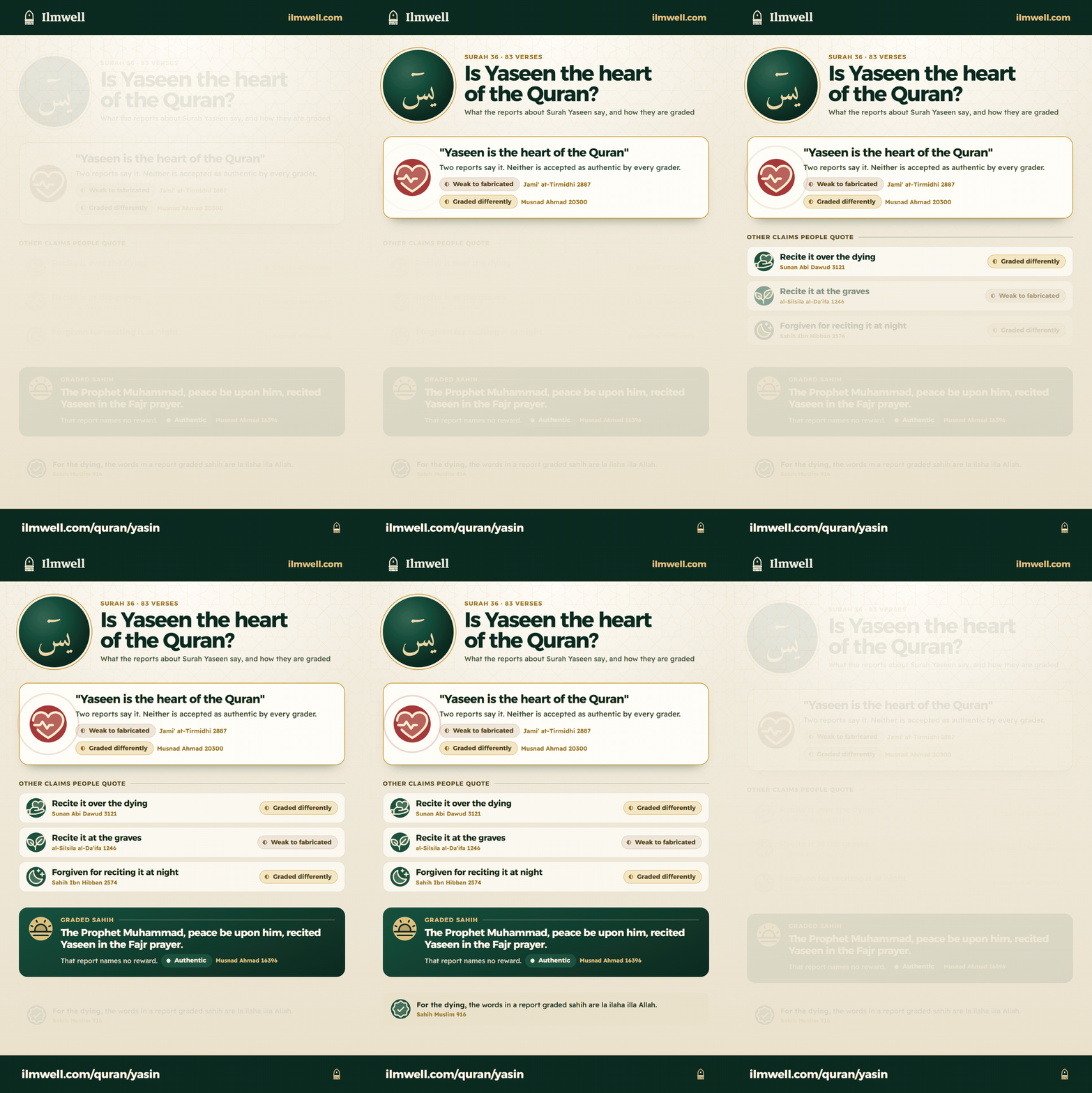
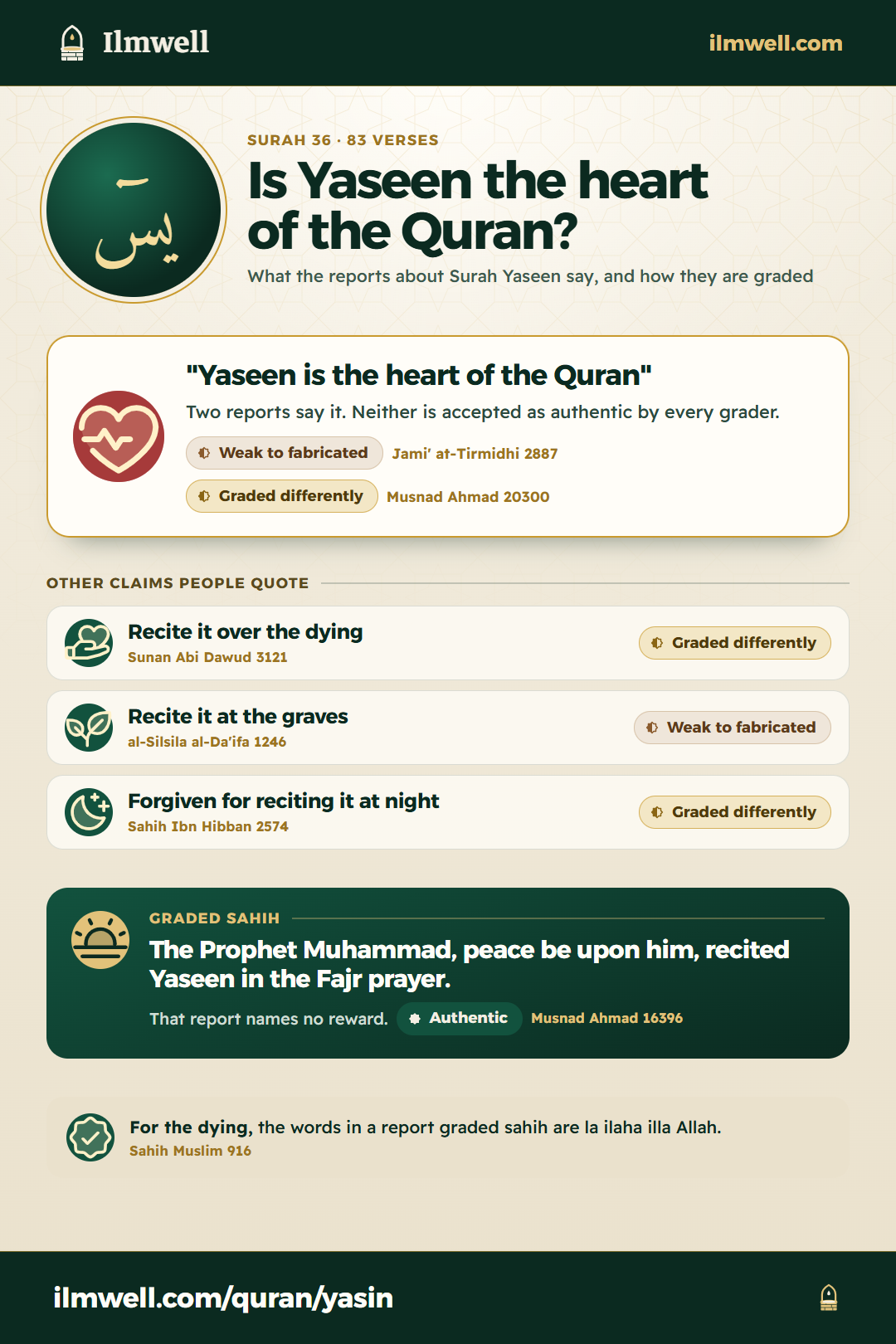
Neither report is accepted as authentic by every grader. In the first, Anas ibn Malik, may Allah be pleased with him, reported that the Prophet said everything has a heart, and the heart of the Quran is Yaseen. Whoever recites it, he said, Allah records as reciting the Quran ten times (Jami' at-Tirmidhi 2887). Every grading on record calls it weak or fabricated: eight graders say weak and two say fabricated.
3Weak to fabricated Jami' at-Tirmidhi 2887
In the second, Ma'qil ibn Yasar, may Allah be pleased with him, reported a longer saying. It ends: Yaseen is the heart of the Quran, no man recites it wanting Allah and the Last Home without being forgiven, and recite it over your dying. It is graded differently: one grading accepts its chain, and six graders call it weak.
4Graded differently Musnad Ahmad 20300
So the "heart of the Quran" line and the "ten readings" rest on these two reports alone. The tenfold reward that is graded sahih or hasan is for each letter of any surah: Jami' at-Tirmidhi 2910.
Is Surah Yaseen recited for the dying?
The instruction "recite Yaseen over your dying" is graded differently: two graders accept it, in three gradings, and 11 gradings call it weak. Ma'qil ibn Yasar reported it. The Arabic word, mawtakum, literally means "your dead"; the English on sunnah.com gives "your dying". Sunan Ibn Majah 1448 has the same chain with "recite it near your dying", where the name Yaseen is a narrator's explanation; that wording is graded weak.
5Graded differently Sunan Abi Dawud 3121
A report attributed to the Prophet through Abu al-Darda', may Allah be pleased with him, says that no one dies with Yaseen recited near him without Allah making it easy for him. It is graded fabricated in one grading and weak in another.
7Weak to fabricated al-Silsila al-Da'ifa 5219
What the elders said
A report in Musnad Ahmad tells of Ghudayf ibn al-Harith, may Allah be pleased with him, as he was dying. He asked whether anyone would recite Yaseen. Salih ibn Shurayh recited it, and when he had recited forty of its verses, Ghudayf died. The elders who told the story used to say that when it is recited near a dying person, it is lightened for him. These are the elders' own words, not a saying of the Prophet. Most gradings call the chain hasan, and one calls it weak.
Two reports about reciting Yaseen at graves are graded fabricated or weak: one attributed to Abu Bakr, may Allah be pleased with him, about parents' graves visited on a Friday, and one attributed to Anas about entering a graveyard. Whether reciting the Quran benefits the dead is a separate question of fiqh (Islamic law).
9Weak to fabricated Ibn 'Adi, al-Kamil fi Du'afa' al-Rijal 6/260
10Weak to fabricated al-Silsila al-Da'ifa 1246
The words for the dying in a report graded sahih are la ilaha illa Allah. Abu Sa'id al-Khudri, may Allah be pleased with him, reported that the Prophet said to prompt the dying to say them (Sahih Muslim 916, graded sahih).
11AuthenticSahih Muslim 916
Is reciting Yaseen at night or in the morning authentic?
Neither is accepted as sahih by every grader. Jundub, may Allah be pleased with him, reported that the Prophet said whoever recites Yaseen in a night, seeking the face of Allah, is forgiven: two graders accept it and two call it weak. A Friday-night version is graded very weak (source 16). 'Ata' ibn Abi Rabah, a Follower (of the generation after the companions), said it reached him that the Prophet said whoever recites Yaseen at the start of the day has his needs met. The report names no companion, and its one grading calls it weak for that reason.
12Graded differently Sahih Ibn Hibban 2574
For a night recitation graded sahih, see the last two verses of Al-Baqarah: whoever recites them in a night, they will suffice him (Sahih al-Bukhari 5009, graded sahih).
14AuthenticSahih al-Bukhari 5009
How can I print Surah Yaseen or save it as a PDF?
Use the two print buttons above the verses: one prints the Arabic alone, the other the Arabic with transliteration and English, each verse numbered. To keep a Surah Yaseen PDF, choose Save as PDF in the print window. There is no PDF or image file to download, and the Arabic is not colour coded for tajweed (the rules of recitation).
Common mix-ups
- Ya and Sin are two letters of the Arabic alphabet, and verse 1 is those two letters alone. What they mean is a question for tafsir.
- "Yaseen is for whatever it is recited for" is a saying, not a hadith: every grader on record says it has no reliable basis (source 15).
Questions people ask
Which para is Surah Yaseen in?
Surah Yaseen runs across two juz (para): verses 1 to 27 are in juz 22 and verses 28 to 83 are in juz 23, by the Tanzil division. It is surah 36, with 83 verses, and the Tanzil metadata lists it as Makkan.
What is Surah Yaseen ayat 9?
Verse 9 reads: "And We have set a bar before them and a bar behind them, and (thus) have covered them so that they do not see." It belongs to the opening passage about people who do not believe. Our search found no narration graded sahih or hasan that tells people to recite it for protection (source 16).
Is there an Urdu translation of Surah Yaseen here?
Not yet. Ilmwell is in English, so this page gives the English translation with the Arabic and a transliteration.
Sources
Every claim on this page comes from one of these. Gradings are reported with the scholar's name; we do not grade hadith ourselves.
- 1
A man of Madinah prayed behind the Prophet and heard him recite Qaf and Yasin in the Fajr prayer.
Musnad Ahmad 16396 Musnad Ahmad 16396 (Shu'ayb al-Arna'ut's numbering), as dorar.net cites it
Authentic: sahih (Shu'ayb al-Arna'ut); its chain is sahih by Muslim's conditions (Al-Albani). Remarks: its narrators are narrators of the Sahih (Muhammad ibn Yusuf al-Salihi)
- 2
Ibn Mas'ud reported that the Prophet said whoever recites a letter of the Book of Allah has a good deed for it, and a good deed counts as ten like it; he gave Alif Lam Mim as three letters: Alif, Lam and Mim.
Jami' at-Tirmidhi 2910 Book 45, Hadith 36
Authentic: Hasan (Darussalam); hasan sahih, gharib by this route (Al-Tirmidhi); Sahih (Al-Albani); Sahih (Shu'ayb al-Arna'ut); its chain is sahih or hasan or close to them, by the key in his introduction (Al-Mundhiri); its chain is hasan (Ibn Baz). Remarks: it has several routes from Ibn Mas'ud (Al-Shawkani)
- 3
Anas reported that the Prophet said everything has a heart, the heart of the Quran is Yasin, and whoever recites Yasin, Allah records for him for reciting it the reciting of the Quran ten times.
Jami' at-Tirmidhi 2887 Book 45, Hadith 13
Weak to fabricated: graders differ on how weak it is. Here is who graded it which way:
- WeakDarussalam, Al-Tirmidhi, Ibn al-'Arabi, Ibn Kathir, Mulla 'Ali al-Qari, Al-Mundhiri, Al-Dimyati, Muhammad Jar Allah al-Sa'di
- FabricatedAhmad ibn Hanbal, Al-Albani
- Other remarksSiddiq Hasan Khan, Al-Dhahabi, Al-Mizzi, Al-Zayla'i, Al-Daraqutni
See each grading in full, with its wording and where it was given
Scholars disagree about this hadith. Here is how each graded it, so you can follow the scholar you trust.
- Da'if: Darussalam (as shown on sunnah.com)
- هَذَا حَدِيثٌ غَرِيبٌ لاَ نَعْرِفُهُ إِلاَّ مِنْ حَدِيثِ حُمَيْدِ بْنِ عَبْدِ الرَّحْمَنِ وَبِالْبَصْرَةِ لاَ يَعْرِفُونَ مِنْ حَدِيثِ قَتَادَةَ إِلاَّ مِنْ هَذَا الْوَجْهِ وَهَارُونُ أَبُو مُحَمَّدٍ شَيْخٌ مَجْهُولٌ (gharib: known only through Humayd ibn 'Abd al-Rahman; he calls Harun Abu Muhammad an unknown shaykh): Al-Tirmidhi, Jami' at-Tirmidhi 2887
- هذا كلام موضوع (this is fabricated speech; said of the opening line from Anas): Ahmad ibn Hanbal, in al-Khallal, al-Muntakhab min al-'Ilal 97 (as listed on dorar.net)
- ضعيف (Da'if): Ibn al-'Arabi, 'Aridat al-Ahwadhi 6/35 (as listed on dorar.net)
- لا يصح لضعف إسناده (not authentic, because its chain is weak): Ibn Kathir, Tafsir al-Quran al-Azim 6/547 (as listed on dorar.net)
- ضعيف، وبه يُعمَل في الفضائل بلا خلاف. (weak; he adds that such a report is acted on for virtues without disagreement): Mulla 'Ali al-Qari, al-Hirz al-Thamin 3/1436 (as listed on dorar.net)
- [ لا يتطرق إليه احتمال التحسين] (it does not admit being graded hasan): Al-Mundhiri, al-Targhib wal-Tarhib 2/319 (as listed on dorar.net)
- سنده سقيم [كما نص على ذلك في المقدمة] (its chain is unsound, by the key in his introduction): Al-Dimyati, al-Matjar al-Rabih 199 (as listed on dorar.net)
- ضعيف (Da'if): Muhammad Jar Allah al-Sa'di, al-Nawafih al-'Atira 76 (as listed on dorar.net)
- موضوع (Mawdu', fabricated): Al-Albani, Da'if al-Tirmidhi 2887 (as listed on dorar.net)
- موضوع (Mawdu', fabricated): Al-Albani, Da'if al-Targhib 885 (as listed on dorar.net)
- موضوع (Mawdu', fabricated): Al-Albani, Hidayat al-Ruwat 2089 (as listed on dorar.net)
- موضوع (Mawdu', fabricated): Al-Albani, Da'if al-Jami' 1935 (as listed on dorar.net)
- موضوع (Mawdu', fabricated; his wording: whoever recites it, it is as if he recited the Quran ten times): Al-Albani, al-Silsila al-Da'ifa 169 (as listed on dorar.net)
- في إسناده هارون أبو محمد، وهو شيخ مجهول (in its chain is Harun Abu Muhammad, an unknown shaykh): Siddiq Hasan Khan, Fath al-Bayan 11/267 (as listed on dorar.net)
- [فيه هارون أبو محمد متهم] (Harun Abu Muhammad, who is accused, is in it): Al-Dhahabi, Mizan al-I'tidal 4/288 (as listed on dorar.net)
- [فيه] هارون أبو محمد قال الترمذي مجهول (Harun Abu Muhammad is in it; al-Tirmidhi called him unknown): Al-Mizzi, Tahdhib al-Kamal 19/210 (as listed on dorar.net)
- [فيه] هارون أبو محمد قال الترمذي شيخ مجهول (Harun Abu Muhammad is in it; al-Tirmidhi called him an unknown shaykh): Al-Zayla'i, takhrij al-Kashshaf 3/170 (as listed on dorar.net)
- تفرد به سليمان بن الربيع عن عن همام عن مقاتل وإنما يعرف هذا من رواية الحسن بن سالم عن هارون بن أبي محمد عن مقاتل (a remark on which narrators carry this route): Al-Daraqutni, Atraf al-Ghara'ib 1/217 (as listed on dorar.net)
- 4
Ma'qil ibn Yasar reported that the Prophet said, in a longer narration about Al-Baqarah, that Yasin is the heart of the Quran, that no man recites it wanting Allah and the Last Home without being forgiven, and to recite it over their dying.
Musnad Ahmad 20300 Musnad Ahmad 20300 (Shu'ayb al-Arna'ut's numbering), as dorar.net cites it
Graded differently. Here is who graded it which way:
- SoundAl-Mundhiri
- WeakShu'ayb al-Arna'ut, Al-Albani, Ibn Baz, Ibn 'Uthaymin, Al-Busiri, Al-Mardawi
- Other remarksAl-Mundhiri, Al-Haythami, Al-Shawkani, Siddiq Hasan Khan, Al-Daraqutni
See each grading in full, with its wording and where it was given
Scholars disagree about this hadith. Here is how each graded it, so you can follow the scholar you trust.
- إسناده ضعيف (its chain is weak): Shu'ayb al-Arna'ut, takhrij al-Musnad 20300 (as listed on dorar.net)
- [إسناده صحيح أو حسن أو ما قاربهما] (its chain is sahih or hasan or close to them, by the key in his introduction): Al-Mundhiri, al-Targhib wal-Tarhib 2/319, the Yasin wording (as listed on dorar.net)
- [هو] عن رجل عن معقل (it is from an unnamed man, from Ma'qil): Al-Mundhiri, al-Targhib wal-Tarhib 2/313 (as listed on dorar.net)
- ضعيف (Da'if): Al-Albani, Da'if al-Targhib 884, the Yasin wording (as listed on dorar.net)
- منكر (munkar: rejected): Al-Albani, al-Silsila al-Da'ifa 6843, the whole narration (as listed on dorar.net)
- ضعيف (Da'if): Ibn Baz, Majmu' al-Shuruh al-Fiqhiyya 14/15 (as listed on dorar.net)
- ضعيف لا يصح (weak, not authentic): Ibn 'Uthaymin, Fatawa Nur 'ala al-Darb 2/599 (as listed on dorar.net)
- إسناده ضعيف، وله شاهد (its chain is weak; it has a supporting report): Al-Busiri, Ithaf al-Khira al-Mahara 6/258 (as listed on dorar.net)
- وهو إسناد مجهول (it is an unknown chain): Al-Mardawi, Kifayat al-Mustaqni' 308 (as listed on dorar.net)
- فيه راو لم يسم ، وبقية رجاله رجال الصحيح (a narrator in it is not named; the rest are narrators of the Sahih): Al-Haythami, Majma' al-Zawa'id 6/314 (as listed on dorar.net)
- ذكر له أحمد إسنادين أحدهما فيه مجهول (Ahmad gave it two chains, one of them with an unknown narrator): Al-Shawkani, Fath al-Qadir 4/504 (as listed on dorar.net)
- ذكر له أحمد إسنادين أحدهما فيه مجهول والآخر ذكر فيه عن أبي عثمان، وقال ليس بالنهدي عن أبيه عن معقل. (Ahmad gave it two chains, one with an unknown narrator and the other through Abu Uthman, not al-Nahdi): Siddiq Hasan Khan, Fath al-Bayan 11/268 (as listed on dorar.net)
- تَفَرَّدَ بهِ مُعْتَمِر، عَن أَبِيه، عن رجل، عَن أَبِيه عنه بهذه الألفاظ وغيره يرويه عن سُلَيمان التَّيمِيّ مختصرا. (a remark that one narrator alone carries this full wording): Al-Daraqutni, Atraf al-Ghara'ib 2/141 (as listed on dorar.net)
- 5
Ma'qil ibn Yasar reported that the Prophet said: recite Yasin over your dying (mawtakum).
Sunan Abi Dawud 3121 Book 21, Hadith 33
Graded differently. Here is who graded it which way:
- SoundIbn Hibban, Al-Shawkani
- WeakAl-Albani, Al-Shawkani, Shu'ayb al-Arna'ut, Al-Daraqutni, Ibn Baz, Ibn 'Uthaymin, Al-Mardawi
- Other remarksAbu Dawud, Ibn Hajar
See each grading in full, with its wording and where it was given
Scholars disagree about this hadith. Here is how each graded it, so you can follow the scholar you trust.
- ضعيف (Da'if): Al-Albani (as shown on sunnah.com, Sunan Abi Dawud 3121)
- سكت عنه [وقد قال في رسالته لأهل مكة كل ما سكت عنه فهو صالح] (silent about it; he said whatever he is silent about is fit): Abu Dawud, Sunan Abi Dawud 3121 (as listed on dorar.net)
- أخرجه في صحيحه (included in his Sahih): Ibn Hibban, Sahih Ibn Hibban 3002 (as listed on dorar.net)
- صحيح (sahih): Ibn Hibban (his grading as Ibn Hajar reports it, Bulugh al-Maram 151) (as listed on dorar.net)
- [حسن كما قال في المقدمة] (hasan, by the rule in his introduction for reports he passes without comment): Ibn Hajar, Hidayat al-Ruwat 2/188 (as listed on dorar.net)
- حسن (hasan): Al-Shawkani, al-Fath al-Rabbani 9/4502 (as listed on dorar.net)
- أعل (it was declared defective): Al-Shawkani, al-Durari al-Mudiyya 131 (as listed on dorar.net)
- إسناده ضعيف لجهالة أبي عثمان، وليس هو بالنهدى، ولاضطرابه (its chain is weak, because Abu 'Uthman (not al-Nahdi) is unknown, and because the chain is inconsistent): Shu'ayb al-Arna'ut, takhrij Sahih Ibn Hibban 3002 (as listed on dorar.net)
- ضعيف الإسناد مجهول المتن ولا يصح في الباب حديث (weak chain, unknown text; nothing in this chapter is authentic): Al-Daraqutni (as cited in al-Munawi, Fayd al-Qadir 2/67) (as listed on dorar.net)
- فيه ضعف (it has weakness): Ibn Baz, Fatawa Nur 'ala al-Darb 13/433 (as listed on dorar.net)
- ضعيف (Da'if): Ibn Baz, Fatawa Nur 'ala al-Darb 14/261 (as listed on dorar.net)
- ضعيف (Da'if): Ibn Baz, Majmu' Fatawa Ibn Baz 13/93 (as listed on dorar.net)
- ضعيف (Da'if): Ibn Baz, Majmu' al-Shuruh al-Fiqhiyya 14/15 (as listed on dorar.net)
- ضعيف (Da'if): Ibn 'Uthaymin, Majmu' Fatawa Ibn 'Uthaymin 17/74 (as listed on dorar.net)
- فيه نظر (questionable): Ibn 'Uthaymin, Fatawa Nur 'ala al-Darb 2/600 (as listed on dorar.net)
- وهو إسناد مجهول (it is an unknown chain): Al-Mardawi, Kifayat al-Mustaqni' 308 (as listed on dorar.net)
- 6
Ma'qil ibn Yasar reported that the Prophet said: recite it near your dying; a narrator explains that this means Yasin.
Sunan Ibn Majah 1448 Book 6, Hadith 16
Weak: Da'if (Darussalam); Da'if (Al-Albani). Remarks: Yahya ibn Sa'id and others reported it from Sulayman al-Taymi as Ma'qil's own words; he prefers Ibn al-Mubarak's report from the Prophet, since an addition from a trustworthy narrator is accepted (Al-Hakim)
- 7
A report attributed to Abu al-Darda' says that no one dies with Surah Yasin recited near him without Allah making it easy for him.
al-Silsila al-Da'ifa 5219 al-Albani, al-Silsila al-Da'ifa 5219, where this wording is graded, as dorar.net lists it
Weak to fabricated: graders differ on how weak it is. Here is who graded it which way:
- WeakAl-Busiri
- FabricatedAl-Albani
- Other remarksAl-Albani
See each grading in full, with its wording and where it was given
Scholars disagree about this hadith. Here is how each graded it, so you can follow the scholar you trust.
- موضوع (Mawdu', fabricated): Al-Albani, al-Silsila al-Da'ifa 5219 (as listed on dorar.net)
- سنده ضعيف، وله شاهد (its chain is weak; it has a supporting report): Al-Busiri, Ithaf al-Khira al-Mahara 2/431 (as listed on dorar.net)
- [فيه] بعض المتروكين والمتهمين (some abandoned and accused narrators are in it): Al-Albani, Irwa' al-Ghalil 3/152 (as listed on dorar.net)
- في إسناده من يضع الحديث (one who fabricates hadith is in its chain; his wording: recited at his head): Al-Albani, al-Ayat al-Bayyinat 22 (as listed on dorar.net)
- 8
The elders (al-mashyakha) reported that they were with Ghudayf ibn al-Harith al-Thumali as he was dying; he asked whether anyone would recite Yasin; Salih ibn Shurayh al-Sakuni recited it and when he reached forty of its verses Ghudayf died. The elders used to say that when it is recited near the dying person, it is lightened for him by it.
Musnad Ahmad 16969 Musnad Ahmad 16969 (Shu'ayb al-Arna'ut's numbering), as dorar.net cites it
Graded differently. Here is who graded it which way:
- SoundShu'ayb al-Arna'ut, Ibn Hajar, Al-Albani
- Weak chain, strengthenedAl-Albani
- WeakAl-Albani
- Other remarksAl-Haythami
See each grading in full, with its wording and where it was given
Scholars disagree about this hadith. Here is how each graded it, so you can follow the scholar you trust.
- إسناده حسن (its chain is hasan): Shu'ayb al-Arna'ut, takhrij al-Musnad 16969 (as listed on dorar.net)
- إسناده حسن (its chain is hasan): Ibn Hajar, al-Isaba fi Tamyiz al-Sahaba 3/187 (as listed on dorar.net)
- [إسناده حسن] (its chain is hasan): Al-Albani, al-Silsila al-Da'ifa 11/363 (as listed on dorar.net)
- إسناده صحيح إلى غضيف بن الحارث رضي الله عنه ورجاله ثقات غير المشيخة فإنهم لم يسموا فهم مجهولون لكن جهالتهم تنجبر بكثرتهم لا سيما وهم من التابعين (its chain to Ghudayf ibn al-Harith is sahih; the elders are not named and so are unknown, but their number makes up for it, especially as they were Followers): Al-Albani, Irwa' al-Ghalil 3/151 (as listed on dorar.net)
- ضعيف مقطوع (weak; maqtu': the words of a later generation, not the Prophet): Al-Albani, Irwa' al-Ghalil 3/152 (as listed on dorar.net)
- فيه من لم يسم (a narrator in it is not named): Al-Haythami, Majma' al-Zawa'id 2/324 (as listed on dorar.net)
- 9
A report attributed to Abu Bakr says that whoever visits the grave of his parents, or one of them, on Friday and recites Yasin is forgiven.
Ibn 'Adi, al-Kamil fi Du'afa' al-Rijal 6/260 Ibn 'Adi, al-Kamil 6/260, as dorar.net cites it
Weak to fabricated: graders differ on how weak it is. Here is who graded it which way:
- WeakAl-Suyuti, Muhammad Jar Allah al-Sa'di
- FabricatedIbn al-Jawzi, Al-Dhahabi, Al-Albani
- No reliable basisIbn 'Adi, Ibn al-Qaysarani
- Other remarksAl-Sakhawi, Al-Dhahabi
See each grading in full, with its wording and where it was given
Scholars disagree about this hadith. Here is how each graded it, so you can follow the scholar you trust.
- بهذا الإسناد باطل ليس له أصل (with this chain, false, without basis): Ibn 'Adi, al-Kamil fi al-Du'afa' 6/260 (as listed on dorar.net)
- أورده في كتاب الموضوعات (listed it in his book of fabricated reports): Ibn al-Jawzi, al-Mawdu'at 3/555 (as listed on dorar.net)
- 'Amr ibn Ziyad, a fabricator, is in it; listed in his abridgement of the fabricated reports: Al-Dhahabi, Tartib al-Mawdu'at 307 (as listed on dorar.net)
- باطل (false): Ibn al-Qaysarani, Dhakhirat al-Huffaz 4/2289 (as listed on dorar.net)
- موضوع (Mawdu', fabricated): Al-Albani, Da'if al-Jami' 5606 (as listed on dorar.net)
- موضوع (Mawdu', fabricated; the longer wording): Al-Albani, al-Silsila al-Da'ifa 50 (as listed on dorar.net)
- ضعيف (Da'if): Al-Suyuti, al-Jami' al-Saghir 8698 (as listed on dorar.net)
- ضعيف (Da'if): Muhammad Jar Allah al-Sa'di, al-Nawafih al-'Atira 382 (as listed on dorar.net)
- [فيه] عمرو بن زياد يتهم بوضع الحديث وله شاهد ('Amr ibn Ziyad is accused of fabricating hadith; it has a supporting report): Al-Sakhawi, al-Ajwiba al-Mardiyya 1/171 (as listed on dorar.net)
- [فيه عمرو بن زياد ذكر من جرحه] ('Amr ibn Ziyad is in it; he lists those who criticised him): Al-Dhahabi, Mizan al-I'tidal 3/261 (as listed on dorar.net)
- 10
A report attributed to Anas says that whoever enters the graveyards and recites Surah Yasin, it is lightened for them that day, and he has good deeds by the number of those buried there.
al-Silsila al-Da'ifa 1246 al-Albani, al-Silsila al-Da'ifa 1246, where this wording is graded, as dorar.net lists it
Weak to fabricated: graders differ on how weak it is. Here is who graded it which way:
- WeakAl-Albani, Al-Mubarakfuri, Al-Sakhawi
- FabricatedAl-Albani
See each grading in full, with its wording and where it was given
Scholars disagree about this hadith. Here is how each graded it, so you can follow the scholar you trust.
- موضوع (Mawdu', fabricated): Al-Albani, al-Silsila al-Da'ifa 1246 (as listed on dorar.net)
- موضوع (Mawdu', fabricated): Al-Albani, al-Ayat al-Bayyinat 64 (as listed on dorar.net)
- لا أصل له في شيء من كتب السنة ثم وقفت على سنده فإذا هو إسناد هالك (no basis in any book of the Sunnah; he later found its chain and calls it a ruined chain): Al-Albani, Ahkam al-Jana'iz 325 (as listed on dorar.net)
- ضعيف (Da'if): Al-Mubarakfuri, Tuhfat al-Ahwadhi 3/78 (as listed on dorar.net)
- أحسبه لا يصح (I reckon it is not authentic): Al-Sakhawi, al-Ajwiba al-Mardiyya 1/169 (as listed on dorar.net)
- 11
Abu Sa'id al-Khudri reported that the Prophet said: prompt your dying to say la ilaha illa Allah.
Sahih Muslim 916 Book 11, Hadith 1
Authentic: in Sahih Muslim
- 12
Jundub reported that the Prophet said: whoever recites Yasin in a night, seeking the face of Allah, is forgiven.
Sahih Ibn Hibban 2574 Sahih Ibn Hibban 2574, as dorar.net cites it
Graded differently. Here is who graded it which way:
- SoundIbn Hibban, Al-Mundhiri
- WeakShu'ayb al-Arna'ut, Al-Albani
See each grading in full, with its wording and where it was given
Scholars disagree about this hadith. Here is how each graded it, so you can follow the scholar you trust.
- أخرجه في صحيحه (included in his Sahih): Ibn Hibban, Sahih Ibn Hibban 2574 (as listed on dorar.net)
- [إسناده صحيح أو حسن أو ما قاربهما] (its chain is sahih or hasan or close to them, by the key in his introduction): Al-Mundhiri, al-Targhib wal-Tarhib 2/319 (as listed on dorar.net)
- [إسناده صحيح أو حسن أو ما قاربهما] (its chain is sahih or hasan or close to them, by the key in his introduction): Al-Mundhiri, al-Targhib wal-Tarhib 2/368 (as listed on dorar.net)
- رجاله ثقات، لكن فيه عنعنة الحسن (its narrators are trustworthy, but al-Hasan reports it with 'from', so his hearing it is not shown): Shu'ayb al-Arna'ut, takhrij Sahih Ibn Hibban 2574 (as listed on dorar.net)
- ضعيف (Da'if): Al-Albani, Da'if al-Targhib 886 (as listed on dorar.net)
- ضعيف (Da'if): Al-Albani, Da'if al-Targhib 973 (as listed on dorar.net)
- ضعيف (Da'if; graded together for the reports from Abu Hurayrah, Jundub, Ibn Mas'ud and Ma'qil): Al-Albani, al-Silsila al-Da'ifa 6623 (as listed on dorar.net)
- 13
'Ata' ibn Abi Rabah said it reached him that the Prophet said: whoever recites Yasin at the start of the day has his needs met. Al-Darimi records it mursal.
Mishkat al-Masabih 2177 Book 8, Hadith 67
Weak: its narrators are trustworthy, so it would be strong were it not mursal (Al-Albani). Remarks: his study of it was not completed (Al-Albani)
- 14
The Prophet said that whoever recites the two verses at the end of Surat al-Baqarah in a night, they will suffice him.
Sahih al-Bukhari 5009 Book 66, Hadith 31
Authentic: in Sahih al-Bukhari
- 15
"Yasin is for whatever it is recited for": graded as having no basis by al-Sakhawi (al-Maqasid al-Hasana 556) and al-Zurqani (Mukhtasar al-Maqasid 1231); "not reported in this wording" by al-Sa'di (al-Nawafih al-'Atira 477); "not a hadith" by al-Ghazzi (Itqan ma Yahsun 2/723); "said to have no basis, or to be fabricated at root" by Mulla 'Ali al-Qari (al-Asrar al-Marfu'a 377). No narrator or collection is given.
dorar.net hadith encyclopedia Read on 21 October 2026. Record: scholarly-yasin-lima-quriat.
- 16
Our search of sunnah.com and the dorar.net encyclopedia, 21 October 2026, for every report about Surah Yaseen listed on this page, a Friday-night version, verse 36:9 and counts of recitations. Found: the reports above with the gradings shown; the Friday-night version graded very weak (al-Albani, al-Silsila al-Da'ifa 5111); for verse 9, only a report from Ibn Ishaq's biography of the Prophet, recorded by al-Bayhaqi (Dala'il al-Nubuwwa 2/469), with no grading of sahih or hasan; no narration with a count of recitations or the seven mubin practice.
sunnah.com and dorar.net Record: search-yasin-virtues, with every search term and result.
- Q
Quran Arabic for Yaseen 36:1 to 83 (the scroll and the verse list), without the Bismillah the Tanzil copy prints at the head of verse 1, its English, and the juz division from the Tanzil metadata.
Tanzil Project Uthmani text and metadata, CC BY 3.0. English: adapted from Marmaduke Pickthall's translation (1930), modernised and checked against modern translations.
Next
- Al-Mulk: themes, meaning and reported virtuesQuran lesson
- The last two verses of Al-Baqarah explainedQuran lesson
- Ayat al-Kursi: meaning and reported virtuesQuran lesson
- Al-Falaq and An-Nas: meaning and contextQuran lesson
- Al-Fatihah: meaning and understanding what you reciteQuran lesson
- Al-Waqiah: meaning and claims about its benefitsQuran lesson
- Al-Kahf: four accounts and their lessonsQuran lesson
- Tajweed for beginners: the first conceptsGuide
- Quran and SurahsThe hub
For your own situation, ask a scholar you trust.
Join the email list
New guides by email, now and then. No spam, and you can leave at any time.
Ilmwell is free and kept going by readers. See how to support it.