The short answer
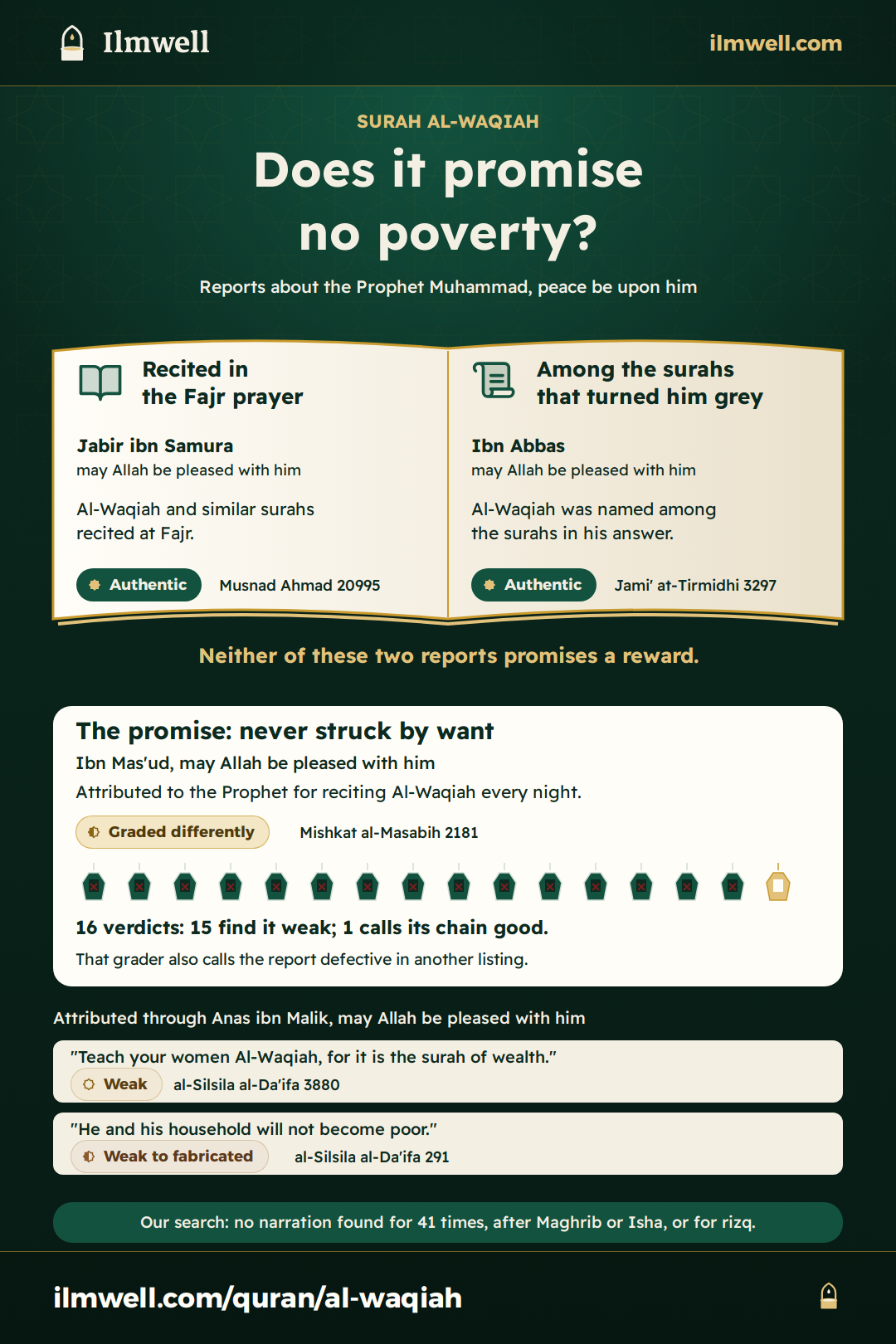
Surah Waqiah is surah 56 of the Quran, 96 verses on the Day of Judgement and the three kinds of people (Al-Waqiah 56:7, meaning surah 56, verse 7). The Prophet Muhammad, peace be upon him, recited it and surahs like it in the Fajr (dawn) prayer (Musnad Ahmad 20995, graded sahih or hasan). Its "never poverty" promise is graded differently, almost all verdicts weak.
How many verses are in Surah Waqiah?
Read it: the full Arabic, verse by verse with English, or print or save as PDF.
| Fact | Surah Al-Waqiah |
|---|---|
| Surah number | 56 of 114 |
| Verses (ayat) | 96 |
| Words | 379, as the Tanzil Arabic text spaces them |
| Pages | 534 to 537 of the 604-page layout, sharing its first page with Ar-Rahman and its last with Al-Hadid |
| Juz (para) | Juz 27, the whole surah |
| Makkan or Madinan | Makkan, in the Tanzil listing (from before the move to Madinah) |
| Name | Al-Waqiah is the word in verse 1, translated "the event" here; the Tanzil metadata gives "The Inevitable" |
What is Surah Waqiah about?
Verse 7 gives the surah its own structure, three kinds of people, and it describes each in turn. Where each passage below starts and ends is our division, to help reading; what the verses mean in detail belongs to tafsir (Quran commentary).
| Verses | Passage | What the verses say |
|---|---|---|
| 1 to 6 | When the event befalls | "When the event befalls" (56:1); the earth shaken with a shock, the hills ground to powder (56:4 to 5). |
| 7 to 10 | Three kinds | "And you will be three kinds" (56:7): those on the right hand, those on the left hand, and the foremost in the race (56:8 to 10). |
| 11 to 26 | The foremost, brought near (one of the three kinds) | "Those are they who will be brought near" (56:11), in gardens of delight; "A multitude of those of old" and a few of later time (56:13 to 14). |
| 27 to 40 | Those on the right hand (one of the three kinds) | Thornless lote-trees, spreading shade, water gushing and fruit in plenty (56:28 to 32); a multitude of those of old and of later time (56:39 to 40). |
| 41 to 56 | Those on the left hand (one of the three kinds) | Scorching wind, scalding water and black smoke (56:42 to 43); they asked whether, once dust and bones, they would be raised again (56:47); "a tree called Zaqqum" (56:52). |
| 57 to 74 | We created you | "We created you" (56:57); questions on "that which you emit", "that which you cultivate", the water you drink and the fire you strike (56:58 to 72). |
| 75 to 82 | An oath by the stars, and a noble Quran | An oath by the places of the stars (56:75) that this is "a noble Quran" in a Book kept hidden (56:77 to 78). |
| 83 to 96 | The moment of death | The soul at the throat of the dying (56:83); then three groups: those brought near, those on the right hand, and the rejecters (56:88 to 94). |
Surah Waqiah full: the Arabic text
Skip the scroll: verse by verse, with English.
Al-Waqiah 56:1 to 96
إِذَا وَقَعَتِ ٱلْوَاقِعَةُ ١ لَيْسَ لِوَقْعَتِهَا كَاذِبَةٌ ٢ خَافِضَةٌ رَّافِعَةٌ ٣ إِذَا رُجَّتِ ٱلْأَرْضُ رَجًّا ٤ وَبُسَّتِ ٱلْجِبَالُ بَسًّا ٥ فَكَانَتْ هَبَآءً مُّنۢبَثًّا ٦ وَكُنتُمْ أَزْوَٰجًا ثَلَـٰثَةً ٧ فَأَصْحَـٰبُ ٱلْمَيْمَنَةِ مَآ أَصْحَـٰبُ ٱلْمَيْمَنَةِ ٨ وَأَصْحَـٰبُ ٱلْمَشْـَٔمَةِ مَآ أَصْحَـٰبُ ٱلْمَشْـَٔمَةِ ٩ وَٱلسَّـٰبِقُونَ ٱلسَّـٰبِقُونَ ١٠ أُو۟لَـٰٓئِكَ ٱلْمُقَرَّبُونَ ١١ فِى جَنَّـٰتِ ٱلنَّعِيمِ ١٢ ثُلَّةٌ مِّنَ ٱلْأَوَّلِينَ ١٣ وَقَلِيلٌ مِّنَ ٱلْـَٔاخِرِينَ ١٤ عَلَىٰ سُرُرٍ مَّوْضُونَةٍ ١٥ مُّتَّكِـِٔينَ عَلَيْهَا مُتَقَـٰبِلِينَ ١٦ يَطُوفُ عَلَيْهِمْ وِلْدَٰنٌ مُّخَلَّدُونَ ١٧ بِأَكْوَابٍ وَأَبَارِيقَ وَكَأْسٍ مِّن مَّعِينٍ ١٨ لَّا يُصَدَّعُونَ عَنْهَا وَلَا يُنزِفُونَ ١٩ وَفَـٰكِهَةٍ مِّمَّا يَتَخَيَّرُونَ ٢٠ وَلَحْمِ طَيْرٍ مِّمَّا يَشْتَهُونَ ٢١ وَحُورٌ عِينٌ ٢٢ كَأَمْثَـٰلِ ٱللُّؤْلُؤِ ٱلْمَكْنُونِ ٢٣ جَزَآءًۢ بِمَا كَانُوا۟ يَعْمَلُونَ ٢٤ لَا يَسْمَعُونَ فِيهَا لَغْوًا وَلَا تَأْثِيمًا ٢٥ إِلَّا قِيلًا سَلَـٰمًا سَلَـٰمًا ٢٦ وَأَصْحَـٰبُ ٱلْيَمِينِ مَآ أَصْحَـٰبُ ٱلْيَمِينِ ٢٧ فِى سِدْرٍ مَّخْضُودٍ ٢٨ وَطَلْحٍ مَّنضُودٍ ٢٩ وَظِلٍّ مَّمْدُودٍ ٣٠ وَمَآءٍ مَّسْكُوبٍ ٣١ وَفَـٰكِهَةٍ كَثِيرَةٍ ٣٢ لَّا مَقْطُوعَةٍ وَلَا مَمْنُوعَةٍ ٣٣ وَفُرُشٍ مَّرْفُوعَةٍ ٣٤ إِنَّآ أَنشَأْنَـٰهُنَّ إِنشَآءً ٣٥ فَجَعَلْنَـٰهُنَّ أَبْكَارًا ٣٦ عُرُبًا أَتْرَابًا ٣٧ لِّأَصْحَـٰبِ ٱلْيَمِينِ ٣٨ ثُلَّةٌ مِّنَ ٱلْأَوَّلِينَ ٣٩ وَثُلَّةٌ مِّنَ ٱلْـَٔاخِرِينَ ٤٠ وَأَصْحَـٰبُ ٱلشِّمَالِ مَآ أَصْحَـٰبُ ٱلشِّمَالِ ٤١ فِى سَمُومٍ وَحَمِيمٍ ٤٢ وَظِلٍّ مِّن يَحْمُومٍ ٤٣ لَّا بَارِدٍ وَلَا كَرِيمٍ ٤٤ إِنَّهُمْ كَانُوا۟ قَبْلَ ذَٰلِكَ مُتْرَفِينَ ٤٥ وَكَانُوا۟ يُصِرُّونَ عَلَى ٱلْحِنثِ ٱلْعَظِيمِ ٤٦ وَكَانُوا۟ يَقُولُونَ أَئِذَا مِتْنَا وَكُنَّا تُرَابًا وَعِظَـٰمًا أَءِنَّا لَمَبْعُوثُونَ ٤٧ أَوَءَابَآؤُنَا ٱلْأَوَّلُونَ ٤٨ قُلْ إِنَّ ٱلْأَوَّلِينَ وَٱلْـَٔاخِرِينَ ٤٩ لَمَجْمُوعُونَ إِلَىٰ مِيقَـٰتِ يَوْمٍ مَّعْلُومٍ ٥٠ ثُمَّ إِنَّكُمْ أَيُّهَا ٱلضَّآلُّونَ ٱلْمُكَذِّبُونَ ٥١ لَـَٔاكِلُونَ مِن شَجَرٍ مِّن زَقُّومٍ ٥٢ فَمَالِـُٔونَ مِنْهَا ٱلْبُطُونَ ٥٣ فَشَـٰرِبُونَ عَلَيْهِ مِنَ ٱلْحَمِيمِ ٥٤ فَشَـٰرِبُونَ شُرْبَ ٱلْهِيمِ ٥٥ هَـٰذَا نُزُلُهُمْ يَوْمَ ٱلدِّينِ ٥٦ نَحْنُ خَلَقْنَـٰكُمْ فَلَوْلَا تُصَدِّقُونَ ٥٧ أَفَرَءَيْتُم مَّا تُمْنُونَ ٥٨ ءَأَنتُمْ تَخْلُقُونَهُۥٓ أَمْ نَحْنُ ٱلْخَـٰلِقُونَ ٥٩ نَحْنُ قَدَّرْنَا بَيْنَكُمُ ٱلْمَوْتَ وَمَا نَحْنُ بِمَسْبُوقِينَ ٦٠ عَلَىٰٓ أَن نُّبَدِّلَ أَمْثَـٰلَكُمْ وَنُنشِئَكُمْ فِى مَا لَا تَعْلَمُونَ ٦١ وَلَقَدْ عَلِمْتُمُ ٱلنَّشْأَةَ ٱلْأُولَىٰ فَلَوْلَا تَذَكَّرُونَ ٦٢ أَفَرَءَيْتُم مَّا تَحْرُثُونَ ٦٣ ءَأَنتُمْ تَزْرَعُونَهُۥٓ أَمْ نَحْنُ ٱلزَّٰرِعُونَ ٦٤ لَوْ نَشَآءُ لَجَعَلْنَـٰهُ حُطَـٰمًا فَظَلْتُمْ تَفَكَّهُونَ ٦٥ إِنَّا لَمُغْرَمُونَ ٦٦ بَلْ نَحْنُ مَحْرُومُونَ ٦٧ أَفَرَءَيْتُمُ ٱلْمَآءَ ٱلَّذِى تَشْرَبُونَ ٦٨ ءَأَنتُمْ أَنزَلْتُمُوهُ مِنَ ٱلْمُزْنِ أَمْ نَحْنُ ٱلْمُنزِلُونَ ٦٩ لَوْ نَشَآءُ جَعَلْنَـٰهُ أُجَاجًا فَلَوْلَا تَشْكُرُونَ ٧٠ أَفَرَءَيْتُمُ ٱلنَّارَ ٱلَّتِى تُورُونَ ٧١ ءَأَنتُمْ أَنشَأْتُمْ شَجَرَتَهَآ أَمْ نَحْنُ ٱلْمُنشِـُٔونَ ٧٢ نَحْنُ جَعَلْنَـٰهَا تَذْكِرَةً وَمَتَـٰعًا لِّلْمُقْوِينَ ٧٣ فَسَبِّحْ بِٱسْمِ رَبِّكَ ٱلْعَظِيمِ ٧٤ ۞ فَلَآ أُقْسِمُ بِمَوَٰقِعِ ٱلنُّجُومِ ٧٥ وَإِنَّهُۥ لَقَسَمٌ لَّوْ تَعْلَمُونَ عَظِيمٌ ٧٦ إِنَّهُۥ لَقُرْءَانٌ كَرِيمٌ ٧٧ فِى كِتَـٰبٍ مَّكْنُونٍ ٧٨ لَّا يَمَسُّهُۥٓ إِلَّا ٱلْمُطَهَّرُونَ ٧٩ تَنزِيلٌ مِّن رَّبِّ ٱلْعَـٰلَمِينَ ٨٠ أَفَبِهَـٰذَا ٱلْحَدِيثِ أَنتُم مُّدْهِنُونَ ٨١ وَتَجْعَلُونَ رِزْقَكُمْ أَنَّكُمْ تُكَذِّبُونَ ٨٢ فَلَوْلَآ إِذَا بَلَغَتِ ٱلْحُلْقُومَ ٨٣ وَأَنتُمْ حِينَئِذٍ تَنظُرُونَ ٨٤ وَنَحْنُ أَقْرَبُ إِلَيْهِ مِنكُمْ وَلَـٰكِن لَّا تُبْصِرُونَ ٨٥ فَلَوْلَآ إِن كُنتُمْ غَيْرَ مَدِينِينَ ٨٦ تَرْجِعُونَهَآ إِن كُنتُمْ صَـٰدِقِينَ ٨٧ فَأَمَّآ إِن كَانَ مِنَ ٱلْمُقَرَّبِينَ ٨٨ فَرَوْحٌ وَرَيْحَانٌ وَجَنَّتُ نَعِيمٍ ٨٩ وَأَمَّآ إِن كَانَ مِنْ أَصْحَـٰبِ ٱلْيَمِينِ ٩٠ فَسَلَـٰمٌ لَّكَ مِنْ أَصْحَـٰبِ ٱلْيَمِينِ ٩١ وَأَمَّآ إِن كَانَ مِنَ ٱلْمُكَذِّبِينَ ٱلضَّآلِّينَ ٩٢ فَنُزُلٌ مِّنْ حَمِيمٍ ٩٣ وَتَصْلِيَةُ جَحِيمٍ ٩٤ إِنَّ هَـٰذَا لَهُوَ حَقُّ ٱلْيَقِينِ ٩٥ فَسَبِّحْ بِٱسْمِ رَبِّكَ ٱلْعَظِيمِ ٩٦
This is the complete Al-Waqiah (also written Surat Waqiah, Sura Waqia, Surah Waqiya or Surah e Waqiah), each verse ending with its number; to copy and paste the Arabic text, use the button under the scroll. The Bismillah printed above it is not counted among its verses.
Surah Waqiah in English and transliteration, verse by verse
Read Surah Waqiah online here in full: each verse in Arabic, a simple transliteration (the Arabic sounds in English letters, sometimes called Roman English) and the English translation. Apostrophes mark the throat sounds and hamza; doubled letters are held a little longer.
Listen and repeat. Audio by a fluent human reciter is coming. We do not use a synthetic voice for the Quran.
Surah Al-Waqiah (56), 96 verses. ilmwell.com/quran/al-waqiah/
Verses 1 to 6: When the event befalls
- 1
إِذَا وَقَعَتِ ٱلْوَاقِعَةُ
Idha waqa'atil-waqi'ah
When the event befalls -
- 2
لَيْسَ لِوَقْعَتِهَا كَاذِبَةٌ
Laysa liwaq'atiha kadhibah
There is no denying that it will befall -
- 3
خَافِضَةٌ رَّافِعَةٌ
Khafidatur-rafi'ah
Abasing (some), exalting (others);
- 4
إِذَا رُجَّتِ ٱلْأَرْضُ رَجًّا
Idha rujjatil-ardu rajja
When the earth is shaken with a shock
- 5
وَبُسَّتِ ٱلْجِبَالُ بَسًّا
Wa bussatil-jibalu bassa
And the hills are ground to powder
- 6
فَكَانَتْ هَبَآءً مُّنۢبَثًّا
Fakanat haba'am-mumbaththa
So that they become a scattered dust,
Verses 7 to 10: Three kinds
- 7
وَكُنتُمْ أَزْوَٰجًا ثَلَـٰثَةً
Wa kuntum azwajan thalathah
And you will be three kinds:
- 8
فَأَصْحَـٰبُ ٱلْمَيْمَنَةِ مَآ أَصْحَـٰبُ ٱلْمَيْمَنَةِ
Fa-as-habul-maymanati ma as-habul-maymanah
(First) those on the right hand; what of those on the right hand?
- 9
وَأَصْحَـٰبُ ٱلْمَشْـَٔمَةِ مَآ أَصْحَـٰبُ ٱلْمَشْـَٔمَةِ
Wa as-habul-mash'amati ma as-habul-mash'amah
And (then) those on the left hand; what of those on the left hand?
- 10
وَٱلسَّـٰبِقُونَ ٱلسَّـٰبِقُونَ
Was-sabiqunas-sabiqun
And the foremost in the race, the foremost in the race:
Verses 11 to 26: The foremost, brought near
- 11
أُو۟لَـٰٓئِكَ ٱلْمُقَرَّبُونَ
Ula'ikal-muqarrabun
Those are they who will be brought near
- 12
فِى جَنَّـٰتِ ٱلنَّعِيمِ
Fi jannatin-na'im
In gardens of delight;
- 13
ثُلَّةٌ مِّنَ ٱلْأَوَّلِينَ
Thullatum-minal-awwalin
A multitude of those of old
- 14
وَقَلِيلٌ مِّنَ ٱلْـَٔاخِرِينَ
Wa qalilum-minal-akhirin
And a few of those of later time.
- 15
عَلَىٰ سُرُرٍ مَّوْضُونَةٍ
'Ala sururim-mawdunah
On lined couches,
- 16
مُّتَّكِـِٔينَ عَلَيْهَا مُتَقَـٰبِلِينَ
Muttaki'ina 'alayha mutaqabilin
Reclining therein face to face.
- 17
يَطُوفُ عَلَيْهِمْ وِلْدَٰنٌ مُّخَلَّدُونَ
Yatufu 'alayhim wildanum-mukhalladun
There wait on them immortal youths
- 18
بِأَكْوَابٍ وَأَبَارِيقَ وَكَأْسٍ مِّن مَّعِينٍ
Bi-akwabiw-wa abariqa wa ka'sim-mim-ma'in
With bowls and ewers and a cup from a pure spring
- 19
لَّا يُصَدَّعُونَ عَنْهَا وَلَا يُنزِفُونَ
La yusadda'una 'anha wa la yunzifun
From which they get no aching of the head nor any intoxication,
- 20
وَفَـٰكِهَةٍ مِّمَّا يَتَخَيَّرُونَ
Wa fakihatim-mimma yatakhayyarun
And fruit that they prefer
- 21
وَلَحْمِ طَيْرٍ مِّمَّا يَشْتَهُونَ
Wa lahmi tayrim-mimma yashtahun
And flesh of fowls that they desire.
- 22
وَحُورٌ عِينٌ
Wa hurun 'in
And (there are) fair ones with wide, lovely eyes,
- 23
كَأَمْثَـٰلِ ٱللُّؤْلُؤِ ٱلْمَكْنُونِ
Ka-amthalil-lu'lu'il-maknun
Like hidden pearls,
- 24
جَزَآءًۢ بِمَا كَانُوا۟ يَعْمَلُونَ
Jaza'am-bima kanu ya'malun
Reward for what they used to do.
- 25
لَا يَسْمَعُونَ فِيهَا لَغْوًا وَلَا تَأْثِيمًا
La yasma'una fiha laghwaw-wa la ta'thima
There they hear no vain speaking nor recrimination
- 26
إِلَّا قِيلًا سَلَـٰمًا سَلَـٰمًا
Illa qilan salaman salama
(Nothing) but the saying: Peace, (and again) Peace.
Verses 27 to 40: Those on the right hand
- 27
وَأَصْحَـٰبُ ٱلْيَمِينِ مَآ أَصْحَـٰبُ ٱلْيَمِينِ
Wa as-habul-yamini ma as-habul-yamin
And those on the right hand; what of those on the right hand?
- 28
فِى سِدْرٍ مَّخْضُودٍ
Fi sidrim-makhdud
Among thornless lote-trees
- 29
وَطَلْحٍ مَّنضُودٍ
Wa talhim-mandud
And clustered plantains,
- 30
وَظِلٍّ مَّمْدُودٍ
Wa zillim-mamdud
And spreading shade,
- 31
وَمَآءٍ مَّسْكُوبٍ
Wa ma'im-maskub
And water gushing,
- 32
وَفَـٰكِهَةٍ كَثِيرَةٍ
Wa fakihatin kathirah
And fruit in plenty
- 33
لَّا مَقْطُوعَةٍ وَلَا مَمْنُوعَةٍ
La maqtu'atiw-wa la mamnu'ah
Neither out of reach nor yet forbidden,
- 34
وَفُرُشٍ مَّرْفُوعَةٍ
Wa furushim-marfu'ah
And raised couches;
- 35
إِنَّآ أَنشَأْنَـٰهُنَّ إِنشَآءً
Inna ansha'nahunna insha'a
Indeed, We have created them a (new) creation
- 36
فَجَعَلْنَـٰهُنَّ أَبْكَارًا
Faja'alnahunna abkara
And made them virgins,
- 37
عُرُبًا أَتْرَابًا
'Uruban atraba
Loving, of equal age,
- 38
لِّأَصْحَـٰبِ ٱلْيَمِينِ
Li-as-habil-yamin
For those on the right hand;
- 39
ثُلَّةٌ مِّنَ ٱلْأَوَّلِينَ
Thullatum-minal-awwalin
A multitude of those of old
- 40
وَثُلَّةٌ مِّنَ ٱلْـَٔاخِرِينَ
Wa thullatum-minal-akhirin
And a multitude of those of later time.
Verses 41 to 56: Those on the left hand
- 41
وَأَصْحَـٰبُ ٱلشِّمَالِ مَآ أَصْحَـٰبُ ٱلشِّمَالِ
Wa as-habush-shimali ma as-habush-shimal
And those on the left hand: What of those on the left hand?
- 42
فِى سَمُومٍ وَحَمِيمٍ
Fi samumiw-wa hamim
In scorching wind and scalding water
- 43
وَظِلٍّ مِّن يَحْمُومٍ
Wa zillim-miy-yahmum
And shadow of black smoke,
- 44
لَّا بَارِدٍ وَلَا كَرِيمٍ
La baridiw-wa la karim
Neither cool nor refreshing.
- 45
إِنَّهُمْ كَانُوا۟ قَبْلَ ذَٰلِكَ مُتْرَفِينَ
Innahum kanu qabla dhalika mutrafin
Indeed, before this they were effete with luxury
- 46
وَكَانُوا۟ يُصِرُّونَ عَلَى ٱلْحِنثِ ٱلْعَظِيمِ
Wa kanu yusirruna 'alal-hinthil-'azim
And used to persist in the awful sin.
- 47
وَكَانُوا۟ يَقُولُونَ أَئِذَا مِتْنَا وَكُنَّا تُرَابًا وَعِظَـٰمًا أَءِنَّا لَمَبْعُوثُونَ
Wa kanu yaquluna a'idha mitna wa kunna turabaw-wa 'izaman a'inna lamab'uthun
And they used to say: When we are dead and have become dust and bones, shall we then really be raised again,
- 48
أَوَءَابَآؤُنَا ٱلْأَوَّلُونَ
Awa aba'unal-awwalun
And also our forefathers?
- 49
قُلْ إِنَّ ٱلْأَوَّلِينَ وَٱلْـَٔاخِرِينَ
Qul innal-awwalina wal-akhirin
Say (to them, O Muhammad): Indeed, those of old and those of later time
- 50
لَمَجْمُوعُونَ إِلَىٰ مِيقَـٰتِ يَوْمٍ مَّعْلُومٍ
Lamajmu'una ila miqati yawmim-ma'lum
Will all be brought together to the meeting of an appointed day.
- 51
ثُمَّ إِنَّكُمْ أَيُّهَا ٱلضَّآلُّونَ ٱلْمُكَذِّبُونَ
Thumma innakum ayyuhad-dallunal-mukadhdhibun
Then indeed, you, the erring, the deniers,
- 52
لَـَٔاكِلُونَ مِن شَجَرٍ مِّن زَقُّومٍ
La-akiluna min shajarim-min zaqqum
You truly will eat of a tree called Zaqqum
- 53
فَمَالِـُٔونَ مِنْهَا ٱلْبُطُونَ
Famali'una minhal-butun
And will fill your bellies with it;
- 54
فَشَـٰرِبُونَ عَلَيْهِ مِنَ ٱلْحَمِيمِ
Fasharibuna 'alayhi minal-hamim
And on top of it you will drink of boiling water,
- 55
فَشَـٰرِبُونَ شُرْبَ ٱلْهِيمِ
Fasharibuna shurbal-him
Drinking even as the camel drinks.
- 56
هَـٰذَا نُزُلُهُمْ يَوْمَ ٱلدِّينِ
Hadha nuzuluhum yawmad-din
This will be their welcome on the Day of Judgement.
Verses 57 to 74: We created you
- 57
نَحْنُ خَلَقْنَـٰكُمْ فَلَوْلَا تُصَدِّقُونَ
Nahnu khalaqnakum falawla tusaddiqun
We created you. Why then do you not believe?
- 58
أَفَرَءَيْتُم مَّا تُمْنُونَ
Afara'aytum ma tumnun
Have you seen that which you emit?
- 59
ءَأَنتُمْ تَخْلُقُونَهُۥٓ أَمْ نَحْنُ ٱلْخَـٰلِقُونَ
A-antum takhluqunahu am nahnul-khaliqun
Do you create it or are We the Creator?
- 60
نَحْنُ قَدَّرْنَا بَيْنَكُمُ ٱلْمَوْتَ وَمَا نَحْنُ بِمَسْبُوقِينَ
Nahnu qaddarna baynakumul-mawta wa ma nahnu bimasbuqin
We mete out death among you, and We are not to be outrun,
- 61
عَلَىٰٓ أَن نُّبَدِّلَ أَمْثَـٰلَكُمْ وَنُنشِئَكُمْ فِى مَا لَا تَعْلَمُونَ
'Ala an-nubaddila amthalakum wa nunshi'akum fi ma la ta'lamun
From changing your forms and making you what you do not know.
- 62
وَلَقَدْ عَلِمْتُمُ ٱلنَّشْأَةَ ٱلْأُولَىٰ فَلَوْلَا تَذَكَّرُونَ
Wa laqad 'alimtumun-nash'atal-ula falawla tadhakkarun
And truly you know the first creation. Why, then, do you not reflect?
- 63
أَفَرَءَيْتُم مَّا تَحْرُثُونَ
Afara'aytum ma tahruthun
Have you seen that which you cultivate?
- 64
ءَأَنتُمْ تَزْرَعُونَهُۥٓ أَمْ نَحْنُ ٱلزَّٰرِعُونَ
A-antum tazra'unahu am nahnuz-zari'un
Is it you who foster it, or are We the Fosterer?
- 65
لَوْ نَشَآءُ لَجَعَلْنَـٰهُ حُطَـٰمًا فَظَلْتُمْ تَفَكَّهُونَ
Law nasha'u laja'alnahu hutaman fazaltum tafakkahun
If We willed, We truly could make it chaff, then you would not cease to exclaim:
- 66
إِنَّا لَمُغْرَمُونَ
Inna lamughramun
Indeed, we are laden with debt!
- 67
بَلْ نَحْنُ مَحْرُومُونَ
Bal nahnu mahrumun
Rather, we are deprived!
- 68
أَفَرَءَيْتُمُ ٱلْمَآءَ ٱلَّذِى تَشْرَبُونَ
Afara'aytumul-ma'al-ladhi tashrabun
Have you observed the water which you drink?
- 69
ءَأَنتُمْ أَنزَلْتُمُوهُ مِنَ ٱلْمُزْنِ أَمْ نَحْنُ ٱلْمُنزِلُونَ
A-antum anzaltumuhu minal-muzni am nahnul-munzilun
Is it you who shed it from the raincloud, or are We the Shedder?
- 70
لَوْ نَشَآءُ جَعَلْنَـٰهُ أُجَاجًا فَلَوْلَا تَشْكُرُونَ
Law nasha'u ja'alnahu ujajan falawla tashkurun
If We willed We truly could make it bitter. Why then do you not give thanks?
- 71
أَفَرَءَيْتُمُ ٱلنَّارَ ٱلَّتِى تُورُونَ
Afara'aytumun-naral-lati turun
Have you observed the fire which you strike out;
- 72
ءَأَنتُمْ أَنشَأْتُمْ شَجَرَتَهَآ أَمْ نَحْنُ ٱلْمُنشِـُٔونَ
A-antum ansha'tum shajarataha am nahnul-munshi'un
Was it you who made its tree grow, or were We the grower?
- 73
نَحْنُ جَعَلْنَـٰهَا تَذْكِرَةً وَمَتَـٰعًا لِّلْمُقْوِينَ
Nahnu ja'alnaha tadhkiratan wa mata'al-lil-muqwin
We, even We, appointed it a reminder and a comfort for travellers in the wilderness.
- 74
فَسَبِّحْ بِٱسْمِ رَبِّكَ ٱلْعَظِيمِ
Fasabbih bismi rabbikal-'azim
Therefore (O Muhammad), praise the name of your Lord, the Tremendous.
Verses 75 to 82: An oath by the stars, and a noble Quran
- 75
۞ فَلَآ أُقْسِمُ بِمَوَٰقِعِ ٱلنُّجُومِ
Fala uqsimu bimawaqi'in-nujum
Indeed, I swear by the places of the stars -
- 76
وَإِنَّهُۥ لَقَسَمٌ لَّوْ تَعْلَمُونَ عَظِيمٌ
Wa innahu laqasamul-law ta'lamuna 'azim
And indeed, that truly is a tremendous oath, if you only knew -
- 77
إِنَّهُۥ لَقُرْءَانٌ كَرِيمٌ
Innahu laqur'anun karim
That (this) is indeed a noble Quran
- 78
فِى كِتَـٰبٍ مَّكْنُونٍ
Fi kitabim-maknun
In a Book kept hidden
- 79
لَّا يَمَسُّهُۥٓ إِلَّا ٱلْمُطَهَّرُونَ
La yamassuhu illal-mutahharun
Which none touches except the purified,
- 80
تَنزِيلٌ مِّن رَّبِّ ٱلْعَـٰلَمِينَ
Tanzilum-mir-rabbil-'alamin
A revelation from the Lord of the Worlds.
- 81
أَفَبِهَـٰذَا ٱلْحَدِيثِ أَنتُم مُّدْهِنُونَ
Afabihadhal-hadithi antum mud-hinun
Is it this Statement that you scorn,
- 82
وَتَجْعَلُونَ رِزْقَكُمْ أَنَّكُمْ تُكَذِّبُونَ
Wa taj'aluna rizqakum annakum tukadhdhibun
And make denial thereof your livelihood?
Verses 83 to 96: The moment of death
- 83
فَلَوْلَآ إِذَا بَلَغَتِ ٱلْحُلْقُومَ
Falawla idha balaghatil-hulqum
Why, then, when (the soul) comes up to the throat (of the dying)
- 84
وَأَنتُمْ حِينَئِذٍ تَنظُرُونَ
Wa antum hina'idhin tanzurun
And you are at that moment looking
- 85
وَنَحْنُ أَقْرَبُ إِلَيْهِ مِنكُمْ وَلَـٰكِن لَّا تُبْصِرُونَ
Wa nahnu aqrabu ilayhi minkum wa lakil-la tubsirun
And We are nearer to him than you are, but you do not see-
- 86
فَلَوْلَآ إِن كُنتُمْ غَيْرَ مَدِينِينَ
Falawla in kuntum ghayra madinin
Why then, if you are not in bondage (to Us),
- 87
تَرْجِعُونَهَآ إِن كُنتُمْ صَـٰدِقِينَ
Tarji'unaha in kuntum sadiqin
Do you not force it back, if you are truthful?
- 88
فَأَمَّآ إِن كَانَ مِنَ ٱلْمُقَرَّبِينَ
Fa-amma in kana minal-muqarrabin
Thus if he is of those brought near,
- 89
فَرَوْحٌ وَرَيْحَانٌ وَجَنَّتُ نَعِيمٍ
Farawhuw-wa rayhanuw-wa jannatu na'im
Then breath of life, and plenty, and a Garden of delight.
- 90
وَأَمَّآ إِن كَانَ مِنْ أَصْحَـٰبِ ٱلْيَمِينِ
Wa amma in kana min as-habil-yamin
And if he is of those on the right hand,
- 91
فَسَلَـٰمٌ لَّكَ مِنْ أَصْحَـٰبِ ٱلْيَمِينِ
Fasalamul-laka min as-habil-yamin
Then (the greeting) "Peace be to you" from those on the right hand.
- 92
وَأَمَّآ إِن كَانَ مِنَ ٱلْمُكَذِّبِينَ ٱلضَّآلِّينَ
Wa amma in kana minal-mukadhdhibinad-dallin
But if he is of the rejecters, the erring,
- 93
فَنُزُلٌ مِّنْ حَمِيمٍ
Fanuzulum-min hamim
Then the welcome will be boiling water
- 94
وَتَصْلِيَةُ جَحِيمٍ
Wa tasliyatu jahim
And roasting at hell-fire.
- 95
إِنَّ هَـٰذَا لَهُوَ حَقُّ ٱلْيَقِينِ
Inna hadha lahuwa haqqul-yaqin
Indeed, this is certain truth.
- 96
فَسَبِّحْ بِٱسْمِ رَبِّكَ ٱلْعَظِيمِ
Fasabbih bismi rabbikal-'azim
Therefore (O Muhammad) praise the name of your Lord, the Tremendous.
Quran text from the Tanzil Project (tanzil.net, CC BY 3.0). English: adapted from Marmaduke Pickthall's translation (1930), modernised and checked against modern translations. Transliteration: Ilmwell.
As a teenager I was told to read Al-Waqiah regularly, and I did, for a while, because I had heard it was good for me. Years later I found out how little of what I had heard was sourced. It changed the way I check things.
Try it: what does it say?
Three quick questions on the verses. Each answer explains itself.
1In verse 7, how many kinds will people be?
Answer: Three. "And you will be three kinds" (56:7).
2What do verses 58 to 72 ask about?
Answer: What you emit, "that which you cultivate", the water and the fire. Verses 58, 63, 68 and 71 each open "Have you seen" or "Have you observed".
3Which verse is repeated word for word at the end of the surah?
Answer: Verse 74, "praise the name of your Lord, the Tremendous". Verse 96 repeats verse 74 exactly.
What are the benefits of Surah Waqiah?
We found two reports graded authentic that name it, and neither promises a reward. Jabir ibn Samura, may Allah be pleased with him, told his listeners that the Prophet prayed much as they prayed, but lighter, and recited Al-Waqiah and surahs like it in the Fajr prayer. Ibn Abbas, may Allah be pleased with him, reported this exchange. Abu Bakr, may Allah be pleased with him, said to the Prophet, "You have gone grey." The Prophet answered that Hud, Al-Waqiah, Al-Mursalat, 'Amma yatasa'alun and Idhash-shamsu kuwwirat had turned him grey.
1AuthenticMusnad Ahmad 20995
2AuthenticJami' at-Tirmidhi 3297
Reciting it also earns the reward named for any part of the Quran. Ibn Mas'ud, may Allah be pleased with him, reported that the Prophet said whoever recites a letter of the Book of Allah has a good deed for it. A good deed, he said, counts as ten (Jami' at-Tirmidhi 2910, graded sahih or hasan). The claims made for Al-Waqiah alone follow.
3AuthenticJami' at-Tirmidhi 2910
| What is said | Whose words | Source and grade |
|---|---|---|
| Whoever recites Al-Waqiah every night will never be struck by want. | Attributed to the Prophet through Ibn Mas'ud | Graded differently Mishkat al-Masabih 2181 Source 4 |
| The same promise, joined to one for reciting Surah Al-Qiyamah every night. | Attributed to the Prophet through Ibn Abbas | Weak to fabricated al-Silsila al-Da'ifa 290 Source 5 |
| Teach your women Al-Waqiah, for it is the surah of wealth. | Attributed to the Prophet through Anas ibn Malik, may Allah be pleased with him | Weak al-Silsila al-Da'ifa 3880 Source 6 |
| Whoever recites and learns it is not written among the heedless, and he and his household will not become poor. | Attributed to the Prophet through Anas | Weak to fabricated al-Silsila al-Da'ifa 291 Source 7 |
| Recite it 41 times, or after Maghrib or Isha (the sunset and night prayers), for rizq (provision). | No narration found | Our search Source 9 |
Is the hadith "whoever recites Surah Waqiah every night will never face poverty" authentic?
It is graded differently, and almost every verdict calls it weak. Ibn Mas'ud reported that the Prophet said: whoever recites Surah Al-Waqiah every night will never be struck by want (faqah). In the same report, Ibn Mas'ud used to tell his daughters to recite it every night. Mishkat al-Masabih cites it from al-Bayhaqi's Shu'ab al-Iman.
4Graded differently Mishkat al-Masabih 2181
Of the 16 verdicts on record, 15 find it weak: they call it weak, munkar (rejected) or defective, or name a defect in its chain. One calls its chain good, and the grader who gave it calls the report defective in another listing. Three name an unknown narrator in its chain, Abu Shuja' (also given as Shuja').
Ibn Mas'ud and his daughters
A longer wording, cited in al-Futuhat al-Rabbaniyya (3/279; our translation), sets it at Ibn Mas'ud's sickbed. 'Uthman, may Allah be pleased with him, visited and offered a doctor and a stipend, and Ibn Mas'ud turned down both. When 'Uthman said the stipend would be for his daughters, Ibn Mas'ud asked whether he feared poverty for them when he had told them to recite Al-Waqiah every night, and said he heard it from the Prophet. The one note on this wording calls it known by a single route (gharib); it rests on the same disputed report.
Say a forwarded message promises that Surah Waqiah will make you rich. The report it leans on promises something narrower, that want will not strike, and almost all of its graders do not accept it. Reciting it every night is still reciting the Quran, with ten good deeds for each letter (source 3); what the graders question is the promise, not the recitation. For provision, see below.

Is Surah Waqiah for rizq or wealth?
We found no report graded authentic that ties it to rizq (provision) or wealth (source 9). Two reports through Anas call it "the surah of wealth" or promise that the reciter "and his household" will not become poor. The first is graded weak, on three gradings by one grader. The second is graded very weak to fabricated; the one grading on record that covers the poverty line calls it fabricated.
6Weakal-Silsila al-Da'ifa 3880
7Weak to fabricated al-Silsila al-Da'ifa 291
Our search of two hadith databases on 22 October 2026 found no narration that attaches a benefit to reciting it 41 times, after Maghrib or Isha, or for debts (source 9). Reciting it at any time is covered by the general reward (source 3).
The surah's own word for provision comes in verse 82: "And make denial thereof your livelihood?". Ibn Abbas reported that rain fell in the Prophet's time, and the Prophet said some people woke grateful and some disbelieving. The grateful said "This is the mercy of Allah"; some said "Such and such star was right". Then, Ibn Abbas said, verses 75 to 82 were revealed.
8AuthenticSahih Muslim 73
Claims linking seeking forgiveness with wealth draw on Nuh 71:10 to 12, where Nuh, peace be upon him, recounts what he told his people: "Seek pardon of your Lord", who "will help you with wealth and sons". The Astaghfirullah lesson sets out those verses.
Is there a Surah Waqiah PDF?
We do not offer a PDF or image file, but the full surah is here to read online, copy or print. These buttons print the verse list, the Arabic alone or with transliteration and English; choose Save as PDF in the print window to keep a copy, or use your browser's Print command.
Its Arabic is not colour coded for tajweed (the rules of recitation).
Common mix-ups
- "The surah of wealth" is not a name the Quran gives Al-Waqiah. It comes from the report through Anas graded weak.
- Verses 74 and 96 are the same words: "praise the name of your Lord, the Tremendous".
Questions people ask
Which para is Surah Waqiah in?
Juz (para) 27. The whole surah sits inside it, by the Tanzil division: juz 27 runs from Adh-Dhariyat 51:31 to the end of Al-Hadid (57:29).
Sources
Every claim on this page comes from one of these. Gradings are reported with the scholar's name; we do not grade hadith ourselves.
- 1
Jabir ibn Samura said the Prophet prayed much as people pray today but lighter, and in the Fajr prayer he recited Al-Waqiah and surahs like it.
Musnad Ahmad 20995 Musnad Ahmad 20995 (Shu'ayb al-Arna'ut's numbering), as dorar.net cites it
Authentic: sahih through supporting reports (Shu'ayb al-Arna'ut); included in his Sahih (Ibn Hibban); its chain is hasan (Shu'ayb al-Arna'ut); included in his Sahih (Ibn Khuzayma); sahih on Muslim's conditions (Al-Hakim); sahih on Muslim's conditions (Al-Albani); established (Al-Wadi'i); sahih (Ibn Hajar al-'Asqalani); its chain is good; listed with a wording naming Yasin, and in another version Al-Waqiah (Muhammad ibn Yusuf al-Salihi). Remarks: it has Ya'qub ibn Humayd ibn Kasib, whom a group weakened and Ibn Hibban listed as trustworthy; the rest are narrators of the Sahih (Al-Haythami)
- 2
Ibn Abbas reported that Abu Bakr said to the Prophet that he had gone grey, and the Prophet said Hud, Al-Waqiah, Al-Mursalat, 'Amma yatasa'alun and Idhash-shamsu kuwwirat had turned him grey.
Jami' at-Tirmidhi 3297 Book 47, Hadith 349
Authentic: hasan gharib (Al-Tirmidhi); Sahih (Darussalam); sahih (Al-Albani); sahih (Shu'ayb al-Arna'ut); its chain is hasan, and it has supporting reports (Shu'ayb al-Arna'ut); its chain is sahih (Muhammad ibn Yusuf al-Salihi); sahih; for a wording without the last surah (Ibn Daqiq al-'Id); sahih on al-Bukhari's conditions; for a wording without Al-Mursalat (Al-Hakim). Remarks: a sound mursal, but described as inconsistent; about the route from 'Ikrimah without Ibn Abbas (Al-Sakhawi); a sound mursal, but described as inconsistent; about the route from 'Ikrimah without Ibn Abbas (Al-'Ajluni); a sound mursal, but described as inconsistent; about the route from 'Ikrimah without Ibn Abbas (Ibn Hajar al-'Asqalani)
- 3
Ibn Mas'ud reported that the Prophet said whoever recites a letter of the Book of Allah has a good deed for it, and a good deed counts as ten like it; he gave Alif Lam Mim as three letters: Alif, Lam and Mim.
Jami' at-Tirmidhi 2910 Book 45, Hadith 36
Authentic: Hasan (Darussalam); hasan sahih, gharib by this route (Al-Tirmidhi); Sahih (Al-Albani); Sahih (Shu'ayb al-Arna'ut); its chain is sahih or hasan or close to them, by the key in his introduction (Al-Mundhiri); its chain is hasan (Ibn Baz). Remarks: it has several routes from Ibn Mas'ud (Al-Shawkani)
- 4
Ibn Mas'ud reported that the Prophet said: whoever recites Surah Al-Waqiah every night will never be struck by want (faqah); Ibn Mas'ud used to tell his daughters to recite it every night. Mishkat al-Masabih cites it from al-Bayhaqi's Shu'ab al-Iman. It is graded differently: one grading calls its chain good, and every other verdict found calls it weak, munkar (rejected) or defective.
Mishkat al-Masabih 2181 Book 8, Hadith 71
Graded differently. Here is who graded it which way:
- SoundAl-Zayla'i
- WeakAhmad ibn Hanbal, Abu Hatim al-Razi, Ibn Abi Hatim, Al-Daraqutni, Al-Zayla'i, Al-'Iraqi, Al-Suyuti, Al-Albani, Ibn 'Uthaymin, Al-Dhahabi, Ibn 'Abd al-Hadi
- Other remarksAl-Albani, Al-Dhahabi, Al-Munawi, Shu'ayb al-Arna'ut, Ibn Hajar al-'Asqalani, 'Abd al-Haqq al-Ishbili
See each grading in full, with its wording and where it was given
Scholars disagree about this hadith. Here is how each graded it, so you can follow the scholar you trust.
- لم تتمّ دراسته (his study of it was not completed): Al-Albani (as shown on sunnah.com, Mishkat al-Masabih 2181)
- منكر (munkar, rejected): Ahmad ibn Hanbal, as cited in al-'Ilal al-Mutanahiya 1/112 (as listed on dorar.net)
- منكر (munkar, rejected): Ahmad ibn Hanbal, as cited in al-Muntakhab min al-'Ilal lil-Khallal 95 (as listed on dorar.net)
- منكر (munkar, rejected): Ahmad ibn Hanbal, as cited in Fayd al-Qadir 6/201 (as listed on dorar.net)
- [ضعيف] (weak, dorar.net's summary of his verdict): Abu Hatim al-Razi, as cited in Fayd al-Qadir 6/201 (as listed on dorar.net)
- [ضعيف] (weak, dorar.net's summary of his verdict): Ibn Abi Hatim, as cited in Fayd al-Qadir 6/201 (as listed on dorar.net)
- [ضعيف] (weak, dorar.net's summary of his verdict): Al-Daraqutni, as cited in Fayd al-Qadir 6/201 (as listed on dorar.net)
- معلول (defective): Al-Zayla'i, as cited in Fayd al-Qadir 6/201 (as listed on dorar.net)
- إسناده جيد (its chain is good): Al-Zayla'i, Takhrij al-Kashshaf 3/412 (as listed on dorar.net)
- إسناده ضعيف (its chain is weak): Al-'Iraqi, Takhrij al-Ihya' 1/450 (as listed on dorar.net)
- ضعيف (Da'if): Al-Suyuti, al-Jami' al-Saghir 8923 (as listed on dorar.net)
- ضعيف (Da'if): Al-Albani, al-Silsila al-Da'ifa 289 (as listed on dorar.net)
- ضعيف (Da'if): Al-Albani, Da'if al-Jami' 5773 (as listed on dorar.net)
- ضعيف (Da'if): Al-Albani, Hidayat al-Ruwat 2122 (as listed on dorar.net)
- ضعيف (Da'if): Ibn 'Uthaymin, Fatawa Nur 'ala al-Darb 2/578 (as listed on dorar.net)
- فيه شجاع لا يدرى من هو (it has Shuja', and it is not known who he is): Al-Dhahabi, Talkhis al-'Ilal al-Mutanahiya 40 (as listed on dorar.net)
- ليس له إسناد أو له إسناد ولا يحتج بمثله النقاد من أهل العلم (it has no chain, or a chain of a kind the critics do not accept as proof): Ibn 'Abd al-Hadi, Risala Latifa fi Ahadith Da'ifa 44 (as listed on dorar.net)
- فيه أبو شجاع نكرة لا يعرف (it has Abu Shuja', an unknown narrator): Al-Dhahabi, Mizan al-I'tidal 4/536 (as listed on dorar.net)
- فيه شجاع عن أبي ظبية قال أحمد بن حنبل لا أعرفهما (it has Shuja' from Abu Zabya; Ahmad ibn Hanbal said: I do not know them): Al-Dhahabi, Mizan al-I'tidal 2/265 (as listed on dorar.net)
- فيه أبو شجاع قال الذهبي نكرة لا يعرف (it has Abu Shuja'; al-Dhahabi said he is unknown): Al-Munawi, Fayd al-Qadir 6/201 (as listed on dorar.net)
- في سنده أبو شجاع قال الذهبي في الميزان نكرة لا يعرف (its chain has Abu Shuja'; al-Dhahabi said in al-Mizan he is unknown): Shu'ayb al-Arna'ut, takhrij Minhaj al-Qasidin 61 (as listed on dorar.net)
- غريب (gharib, known by a single route): Ibn Hajar al-'Asqalani, Nata'ij al-Afkar 3/262 (as listed on dorar.net)
- غريب (gharib, known by a single route): Ibn Hajar al-'Asqalani, as cited in al-Futuhat al-Rabbaniyya 3/279, for the longer wording with 'Uthman's visit (as listed on dorar.net)
- اختلف فيه على شجاع وشيخه (narrators differ over Shuja' and his teacher): Ibn Hajar al-'Asqalani, al-Kafi al-Shaf 278 (as listed on dorar.net)
- سكت عنه (silent about it; he said in his introduction that his silence means it is sound when it has no defect): 'Abd al-Haqq al-Ishbili, al-Ahkam al-Wusta 4/337 (as listed on dorar.net)
- 5
A report attributed to the Prophet through Ibn Abbas says that whoever recites Al-Waqiah every night will never be struck by want, and whoever recites 'La uqsimu bi-yawmil-qiyamah' (Al-Qiyamah) every night will meet Allah with his face like the full moon. It is graded very weak to fabricated.
al-Silsila al-Da'ifa 290 Al-Albani, al-Silsila al-Da'ifa 290, as dorar.net lists it
Weak to fabricated: graders differ on how weak it is. Here is who graded it which way:
- WeakAl-Shawkani, Ibn Hajar al-'Asqalani
- FabricatedAl-Albani
See each grading in full, with its wording and where it was given
Scholars disagree about this hadith. Here is how each graded it, so you can follow the scholar you trust.
- موضوع (Mawdu', fabricated): Al-Albani, al-Silsila al-Da'ifa 290 (as listed on dorar.net)
- في إسناده متروك (its chain has an abandoned narrator): Al-Shawkani, al-Fawa'id al-Majmu'a 311 (as listed on dorar.net)
- إسناده ضعيف جداً (its chain is very weak; for the first half, from Ibn Abbas): Ibn Hajar al-'Asqalani, Nata'ij al-Afkar 3/264 (as listed on dorar.net)
- 6
A report attributed to the Prophet through Anas ibn Malik says: teach your women Surat al-Waqi'ah, for it is the surah of wealth (al-ghina). It is graded weak.
al-Silsila al-Da'ifa 3880 Al-Albani, al-Silsila al-Da'ifa 3880, as dorar.net lists it
Weak: Da'if (Al-Albani)
- 7
A report attributed to the Prophet through Anas ibn Malik says that whoever recites Al-Waqiah and learns it is not written among the heedless, and neither he nor his household will become poor. It is graded very weak to fabricated; the one grading found that covers the poverty line calls it fabricated.
al-Silsila al-Da'ifa 291 Al-Albani, al-Silsila al-Da'ifa 291, as dorar.net lists it
Weak to fabricated: graders differ on how weak it is. Here is who graded it which way:
- WeakIbn Hajar al-'Asqalani
- FabricatedAl-Albani
See each grading in full, with its wording and where it was given
Scholars disagree about this hadith. Here is how each graded it, so you can follow the scholar you trust.
- موضوع (Mawdu', fabricated): Al-Albani, al-Silsila al-Da'ifa 291 (as listed on dorar.net)
- إسناده ضعيف جداً (its chain is very weak; for the first half): Ibn Hajar al-'Asqalani, Nata'ij al-Afkar 3/264 (as listed on dorar.net)
- 8
Ibn Abbas reported that rain fell in the Prophet's time and the Prophet said some people woke grateful and some disbelieving: some said 'this is the mercy of Allah', others 'such and such star was right'; then Al-Waqiah 56:75 to 82 was revealed.
Sahih Muslim 73 Book 1, Hadith 140
Authentic: in Sahih Muslim
- 9
Our search of sunnah.com and the dorar.net encyclopedia, 22 October 2026, for reports about the virtues of Surah Al-Waqiah, including counts of recitation (41, 40), recitation after Maghrib or Isha, provision (rizq), wealth and poverty. Found: the reports listed on this page with the gradings shown; a wording joined to 'in the musabbihat is a verse like a thousand' (al-Mundhiri, al-Targhib 2/369, not found in the original sources; al-Albani, Da'if al-Targhib 977, weak); no narration giving a count, a time after Maghrib or Isha, or a method for provision, wealth or debts. Ibn Mas'ud's report of surahs the Prophet paired in one rak'ah names it by its opening words, 'Idha waqa'at', with Nun (Sunan Abi Dawud 1396); that list is graded differently: 'Abd al-Haqq al-Ishbili, sahih chain by his introduction; al-Albani, sahih without the list of surahs; Abu Dawud silent.
sunnah.com and dorar.net Record: search-waqiah-virtues, with every search term and result.
- Q
Quran Arabic for Al-Waqiah 56:1 to 96 (the scroll and the verse list), without the Bismillah the Tanzil copy prints at the head of verse 1, and its English; the English of Nuh 71:10 and 71:12. Surah number, verse count, Makkan listing, English name, juz and page divisions from the Tanzil metadata; the word count from the Tanzil text.
Tanzil Project Uthmani text and metadata, CC BY 3.0. English: adapted from Marmaduke Pickthall's translation (1930), modernised and checked against modern translations.
Next
- Surah Yaseen: Arabic, English and the narrations about its virtuesQuran lesson
- Al-Mulk: themes, meaning and reported virtuesQuran lesson
- Surah Al-Baqarah: meaning, themes and learningQuran lesson
- Ayat al-Kursi: meaning and reported virtuesQuran lesson
- Astaghfirullah: meaning and seeking forgivenessPhrase lesson
- Ar-Rahman: themes and meaningQuran lesson
- Al-Kahf: four accounts and their lessonsQuran lesson
- Quran and SurahsThe hub
For your own situation, ask a scholar you trust.
Join the email list
New guides by email, now and then. No spam, and you can leave at any time.
Ilmwell is free and kept going by readers. See how to support it.