The short answer
Ayatul Kursi in English, from Al-Baqarah 2:255 (surah 2, verse 255), opens: "Allah! There is no deity except Him, the Alive, the Self-Sustaining." In Sahih Muslim 810, graded sahih, the Prophet Muhammad, peace be upon him, confirmed it as the greatest verse in the Book of Allah. The full Arabic, transliteration and translation follow.
Ayatul Kursi in Arabic and English
Al-Baqarah 2:255
ٱللَّهُ لَآ إِلَـٰهَ إِلَّا هُوَ ٱلْحَىُّ ٱلْقَيُّومُ ۚ لَا تَأْخُذُهُۥ سِنَةٌ وَلَا نَوْمٌ ۚ لَّهُۥ مَا فِى ٱلسَّمَـٰوَٰتِ وَمَا فِى ٱلْأَرْضِ ۗ مَن ذَا ٱلَّذِى يَشْفَعُ عِندَهُۥٓ إِلَّا بِإِذْنِهِۦ ۚ يَعْلَمُ مَا بَيْنَ أَيْدِيهِمْ وَمَا خَلْفَهُمْ ۖ وَلَا يُحِيطُونَ بِشَىْءٍ مِّنْ عِلْمِهِۦٓ إِلَّا بِمَا شَآءَ ۚ وَسِعَ كُرْسِيُّهُ ٱلسَّمَـٰوَٰتِ وَٱلْأَرْضَ ۖ وَلَا يَـُٔودُهُۥ حِفْظُهُمَا ۚ وَهُوَ ٱلْعَلِىُّ ٱلْعَظِيمُ
Allāhu lā ilāha illā huwa l-ḥayyu l-qayyūm, lā taʾkhudhuhū sinatun wa lā nawm, lahū mā fi s-samāwāti wa mā fi l-arḍ, man dha lladhī yashfaʿu ʿindahū illā bi-idhnih, yaʿlamu mā bayna aydīhim wa mā khalfahum, wa lā yuḥīṭūna bi-shayʾin min ʿilmihī illā bimā shāʾ, wasiʿa kursiyyuhu s-samāwāti wa l-arḍ, wa lā yaʾūduhū ḥifẓuhumā, wa huwa l-ʿaliyyu l-ʿaẓīm
Allah! There is no deity except Him, the Alive, the Self-Sustaining. Neither slumber nor sleep overtakes Him. To Him belongs whatever is in the heavens and whatever is in the earth. Who is he that intercedes with Him except by His leave? He knows that which is in front of them and that which is behind them, while they encompass nothing of His knowledge except what He will. His Kursi extends over the heavens and the earth, and He is never weary of preserving them. He is the Sublime, the Tremendous.
Ayatul Kursi, "the verse of the Kursi", is one verse: verse 255 of Surah Al-Baqarah, the second and longest surah of the Quran. The name comes from the word kursi in its seventh phrase. To copy and paste the Arabic text, use the button under it.
What does Ayatul Kursi mean?
The whole verse is about Allah alone. He is living and never sleeps, and everything belongs to Him. No one intercedes with Him except by His permission. His knowledge takes in everything, while no one grasps any of His knowledge except what He wills, and preserving the heavens and the earth never tires Him. Here it is in its nine phrases, with an easy transliteration to read along.
- 1
ٱللَّهُ لَآ إِلَـٰهَ إِلَّا هُوَ ٱلْحَىُّ ٱلْقَيُّومُ
Allahu la ilaha illa huwa, al-hayyul-qayyum
Allah! There is no deity except Him, the Alive, the Self-Sustaining.
Al-hayy is the Living. Al-qayyum comes from the root q-w-m, to stand; this translation gives it as the Self-Sustaining.
- 2
لَا تَأْخُذُهُۥ سِنَةٌ وَلَا نَوْمٌ
La ta'khudhuhu sinatun wa la nawm
Neither slumber nor sleep overtakes Him.
Sinah is drowsiness, the doze before sleep; nawm is sleep itself.
- 3
لَّهُۥ مَا فِى ٱلسَّمَـٰوَٰتِ وَمَا فِى ٱلْأَرْضِ
Lahu ma fis-samawati wa ma fil-ard
To Him belongs whatever is in the heavens and whatever is in the earth.
Word for word: to Him, what is in the heavens and what is in the earth.
- 4
مَن ذَا ٱلَّذِى يَشْفَعُ عِندَهُۥٓ إِلَّا بِإِذْنِهِۦ
Man dhal-ladhi yashfa'u 'indahu illa bi-idhnih
Who is he that intercedes with Him except by His leave?
Shafa'a is intercession: speaking up for someone. Idhn is permission.
- 5
يَعْلَمُ مَا بَيْنَ أَيْدِيهِمْ وَمَا خَلْفَهُمْ
Ya'lamu ma bayna aydihim wa ma khalfahum
He knows that which is in front of them and that which is behind them,
Word for word: what is between their hands and what is behind them.
- 6
وَلَا يُحِيطُونَ بِشَىْءٍ مِّنْ عِلْمِهِۦٓ إِلَّا بِمَا شَآءَ
Wa la yuhituna bi-shay'im min 'ilmihi illa bima sha'
while they encompass nothing of His knowledge except what He will.
'Ilm is knowledge; bima sha' is "by what He wills".
- 7
وَسِعَ كُرْسِيُّهُ ٱلسَّمَـٰوَٰتِ وَٱلْأَرْضَ
Wasi'a kursiyyuhus-samawati wal-ard
His Kursi extends over the heavens and the earth,
Kursi gives the verse its name. Literally the word means a chair or seat, and this translation keeps the word Kursi. What the Kursi is belongs to tafsir (Quran commentary), which a separate page will set out with its sources.
- 8
وَلَا يَـُٔودُهُۥ حِفْظُهُمَا
Wa la ya'uduhu hifzuhuma
and He is never weary of preserving them.
Hifz is guarding and keeping. The same root gives hafiz, the guardian in the bedtime narration below.
- 9
وَهُوَ ٱلْعَلِىُّ ٱلْعَظِيمُ
Wa huwal-'aliyyul-'azim
He is the Sublime, the Tremendous.
Al-'aliyy is the Most High; al-'azim, the Tremendous or Supreme.
How do you recite Ayatul Kursi?
Take it one phrase at a time, as in the list above. The nine phrases are cut where the Arabic text carries a small pause mark (the marks themselves are left out of the list), so the breaks fall in natural places. Once you can say a phrase without looking, add the next.
Listen and repeat. A recording by a fluent human reciter is coming. We do not use a synthetic voice for the Quran.
I was taught Ayat al-Kursi as something to say before bed, and I did, half asleep. It was only when I read it slowly in English that I understood how much is in it. Now I read it before I turn the light off.
Try it: what does it mean?
Five quick questions on the phrases and the reports. Each answer explains itself.
1What does "La ta'khudhuhu sinatun wa la nawm" mean?
Answer: Neither slumber nor sleep overtakes Him. Sinah is drowsiness and nawm is sleep: Allah is never overtaken by either.
2Which phrase is about intercession?
Answer: Man dhal-ladhi yashfa'u 'indahu illa bi-idhnih. "Who is he that intercedes with Him except by His leave?" Shafa'a is intercession; idhn is permission.
3Which line gives the verse its name?
Answer: Wasi'a kursiyyuhus-samawati wal-ard. "His Kursi extends over the heavens and the earth": the line names the Kursi.
4Where is Ayatul Kursi in the Quran?
Answer: Al-Baqarah 2:255. It is verse 255 of Surah Al-Baqarah, the second surah.
5Which way of reciting it comes from a narration graded sahih?
Answer: When you go to bed. The bedtime narration is in Sahih al-Bukhari 2311, graded sahih. The other two are graded fabricated or have no reliable basis. Source 2
What are the benefits of Ayatul Kursi?
Three reports about Ayatul Kursi are graded sahih or hasan. It is the greatest verse in the Book of Allah, reciting it at bedtime brings a guardian from Allah until morning, and a report about reciting it in the house says no devil will come near. Others are graded differently or weak, and some popular claims have no reliable basis. Here is each claim with its source and grade.
| What people say | Source | Grade |
|---|---|---|
| It is the greatest verse in the Book of Allah | Sahih Muslim 810 Source 1 | Authentic |
| Recite it when you go to bed: a guardian from Allah stays with you and no devil comes near you until morning | Sahih al-Bukhari 2311 Source 2 | Authentic |
| Recite it after every prescribed prayer and only death stands between you and Paradise | Special Virtues 13, as listed on sunnah.com Source 3 | Graded differently |
| Recite it in your house and no devil or anything else will come near you | Jami' at-Tirmidhi 2880 Source 4 | Authentic |
| It is the chief of the verses of the Quran | Jami' at-Tirmidhi 2878 Source 5 | Graded differently |
| Recite it with the opening of Surah Ghafir in the morning and you are protected until evening | Jami' at-Tirmidhi 2879 Source 6 | Weak |
| Recite it three times: once protects you, twice your family, three times your neighbourhood | No collection given Source 7 | No reliable basis |
| Recite it 100 times in a special prayer on a day of Rajab (a month of the Islamic calendar) and you will see your place in Paradise before you die | Listed in books of fabricated reports Source 8 | Fabricated |
Ayat al-Kursi in one picture
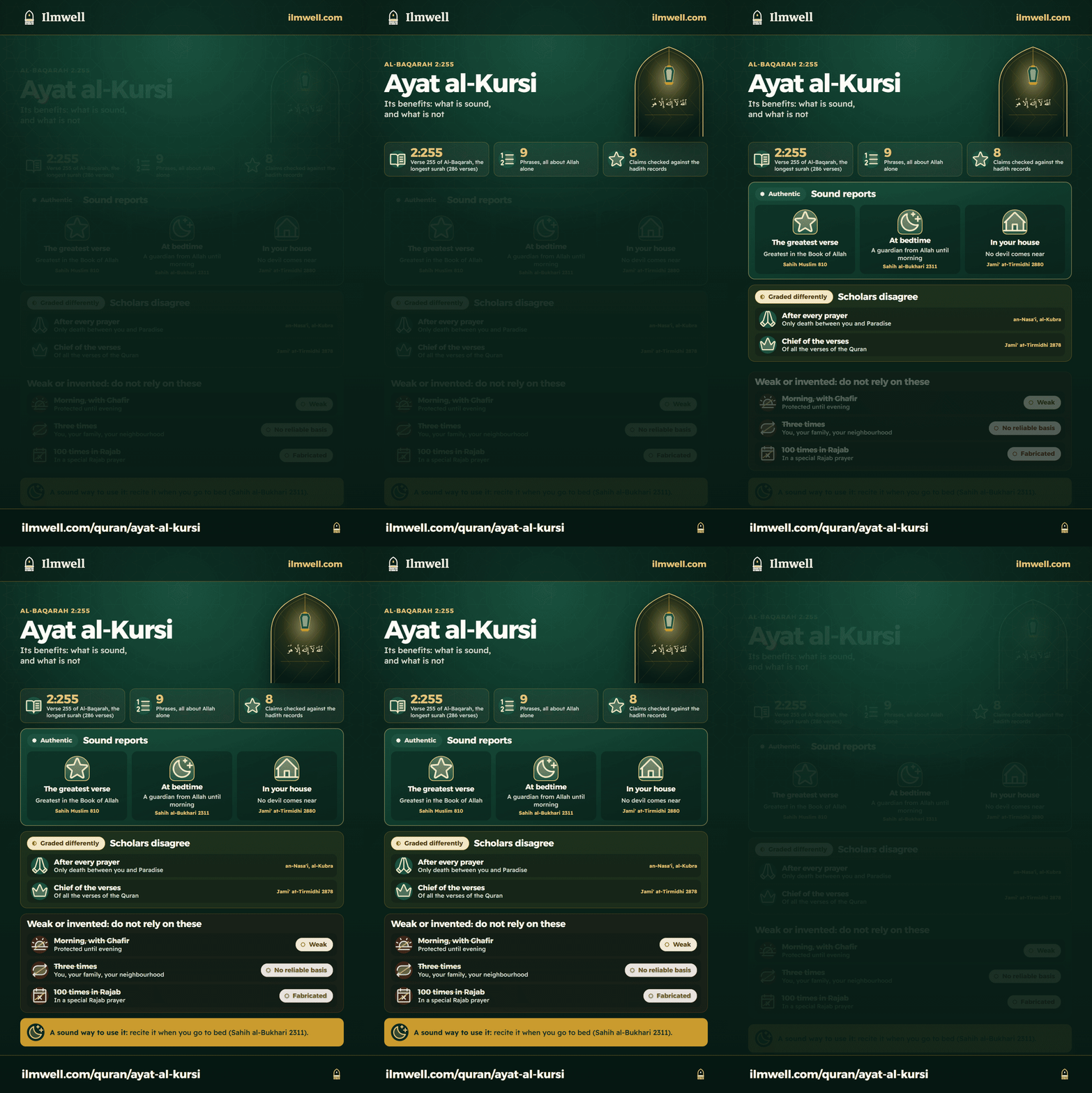
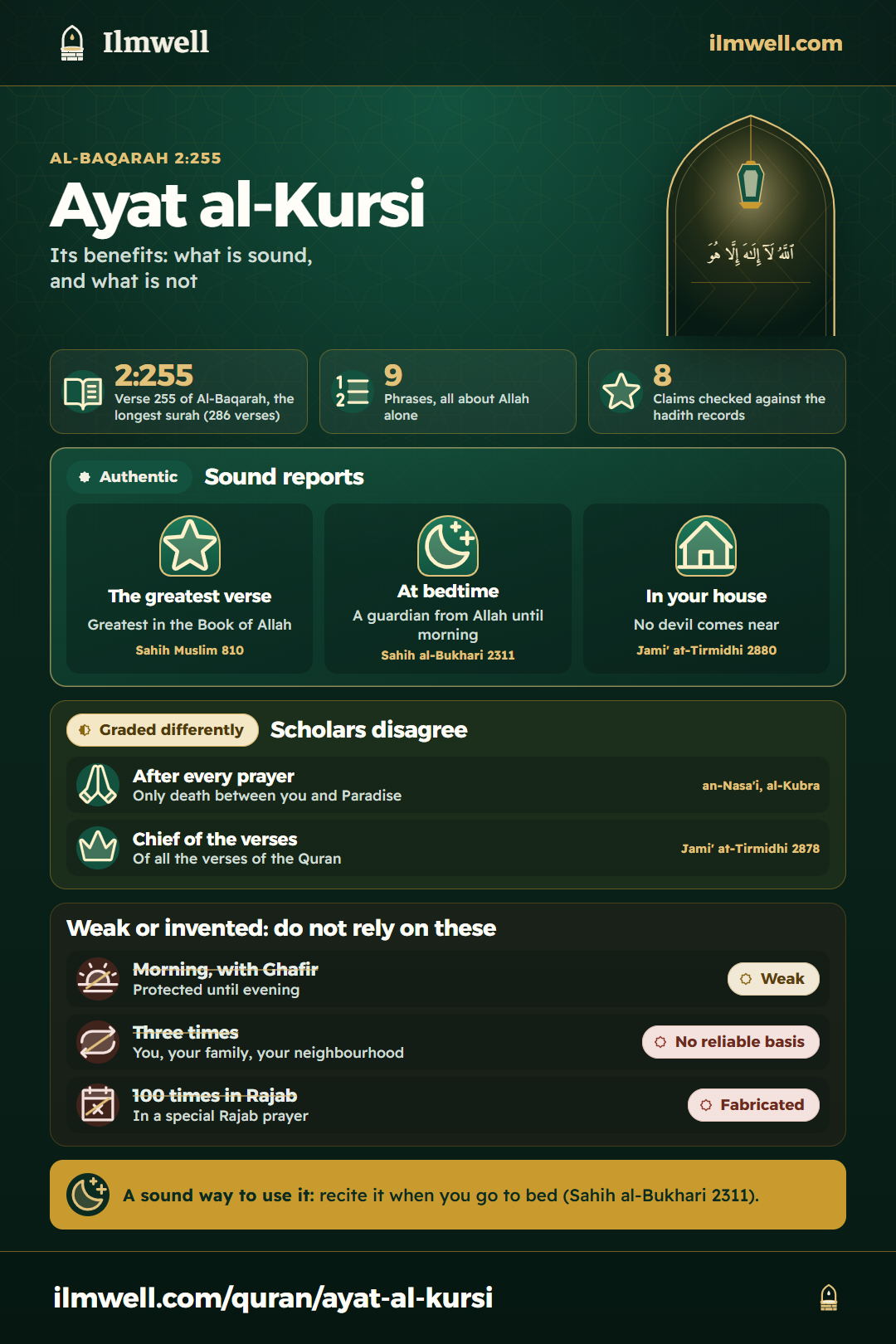
Ayat al-Kursi infographic. Al-Baqarah 2:255, the verse in nine phrases, eight claims checked against the hadith records. Sound reports, graded authentic: the greatest verse in the Book of Allah (Sahih Muslim 810); at bedtime, a guardian from Allah until morning (Sahih al-Bukhari 2311); in your house, no devil comes near (Jami' at-Tirmidhi 2880). Graded differently: after every prayer, only death between you and Paradise; chief of the verses of the Quran. Weak or invented, do not rely on these: morning with Ghafir, protected until evening (weak); three times for you, your family and your neighbourhood (no reliable basis); 100 times in a special Rajab prayer (fabricated). A sound way to use it: recite it when you go to bed.
The whole page in one picture: the facts, the sound reports, the disputed ones and the claims to drop. Save it, print it, or share it.
Posting it on your own site? Link back to this guide; the code under "Use it on your own site" does it in one line.
Why is Ayatul Kursi called the greatest verse?
Because the Prophet confirmed it when one of his companions named it. He asked Ubayy ibn Ka'b, may Allah be pleased with him, which verse of the Book of Allah that he knew was the greatest, calling him by his kunya (a name of the form "father of"), Abu al-Mundhir. Ubayy said that Allah and His Messenger know best. Asked a second time, he answered with the opening words of this verse: Allahu la ilaha illa huwa al-hayyul-qayyum. The Prophet struck him on the chest and said, "By Allah, may knowledge be a joy to you, Abu al-Mundhir."
1AuthenticSahih Muslim 810
A separate report calls it the chief of the verses of the Quran. That one is graded differently, mostly weak, so the verse's standing rests on the narration in Sahih Muslim.
Where does reciting Ayatul Kursi before sleep come from?
From a story told by Abu Huraira, may Allah be pleased with him, in Sahih al-Bukhari 2311, graded sahih. The Prophet put him in charge of guarding the zakat (obligatory charity) of Ramadan. Someone came and began scooping up handfuls of the food, so Abu Huraira caught him and said he would take him to the Prophet. The man pleaded that he was in need and had a family to support, and Abu Huraira let him go. In the morning the Prophet asked what his captive had done, and said the man had lied and would come back.
He came back, pleaded the same way, promised not to return, and was let go again; the Prophet said the same. On the third night Abu Huraira caught him again and said he would take him to the Prophet: this was the last of three times he had promised not to return and then come back.
The man offered to teach him words by which Allah would benefit him. When you go to bed, he said, recite Ayat al-Kursi from its start to the end of the verse. A guardian from Allah will then stay with you, and no devil will come near you until morning. Abu Huraira told the Prophet, who said the man had told him the truth, though he was a liar. Did he know whom he had been speaking to for three nights? Abu Huraira did not. "That was a devil," the Prophet said.
2AuthenticSahih al-Bukhari 2311
Al-Bukhari records this story with the start of its chain left out, a form called mu'allaq; it is graded sahih. A separate report speaks of reciting it in the morning and evening with the opening of Surah Ghafir (Ghafir 40:1 to 3). That one is graded weak.
Is the hadith about reciting Ayatul Kursi after every prayer authentic?
It is graded differently. Abu Umama, may Allah be pleased with him, reported that the Prophet said whoever recites Ayatul Kursi after every prescribed prayer (salah), nothing keeps him from entering Paradise except death. Most gradings call it sahih. One early scholar listed it among fabricated reports, which a later scholar rejected, and one modern scholar said its authenticity is open to question.
3Graded differently Special Virtues of the Quran's Chapters and Verses 13originally in an-Nasa'i, al-Sunan al-Kubra 9848
So the after-prayer report is widely accepted but not agreed on. For a recitation graded sahih without dispute, see the bedtime narration in Sahih al-Bukhari 2311.
Can reciting Ayatul Kursi protect a house?
One report speaks of a house, and it is graded hasan or sahih. Abu Ayyub al-Ansari, may Allah be pleased with him, kept dates in a small storeroom. A ghoul kept coming to take from them. Twice he caught it and let it go when it swore not to return. The third time it told him: recite Ayat al-Kursi in your house, and no devil or anything else will come near you. The Prophet said it had told the truth, though it was a liar.
4AuthenticJami' at-Tirmidhi 2880
In both stories the words about protection come from the one who was caught, and the Prophet confirmed them. A line often shared online, that reciting it three times protects you, then your family, then your neighbourhood, has no reliable basis: its only grading on record calls it false (source 7). None of these narrations mentions hanging the verse in a car or a home, or wearing it. The two authentic reports about protection both speak of reciting it: in the house (Jami' at-Tirmidhi 2880, graded hasan or sahih) and when you go to bed (Sahih al-Bukhari 2311, graded sahih).
Common mix-ups
- It is one verse, not a surah. "Surah Kursi" is a common name for it, but it is verse 255 of Surah Al-Baqarah.
- Verses 256 and 257 follow it in the Quran, but they are separate verses. The bedtime narration describes one verse: recite it from its start to the end of the verse.
- The "4 Quls" often printed beside it are four short surahs that open with qul (say): Al-Kafirun, Al-Ikhlas, Al-Falaq and An-Nas. They are separate from Ayatul Kursi.
- In the authentic bedtime narration, the guardian is for the person reciting, until morning.
Questions people ask
Is Ayatul Kursi a surah?
No. Ayatul Kursi is one verse (ayah): verse 255 of Surah Al-Baqarah, the second surah of the Quran. People sometimes call it "Surah Kursi", but in Sahih Muslim 810, graded sahih, the Prophet, peace be upon him, speaks of it as a verse.
What does Kursi mean?
Kursi is the word that names the verse, in the line "wasi'a kursiyyuhus-samawati wal-ard". Literally it means a chair or seat, and the translation on this page keeps the word Kursi. What the Kursi is belongs to tafsir (Quran commentary); a separate page will set out the commentary with its sources.
How many times do you recite Ayatul Kursi?
The bedtime narration in Sahih al-Bukhari 2311, graded sahih, says to recite it when you go to bed and gives no number. The report about reciting it after every prescribed prayer is graded differently. Our search of two hadith databases on 20 October 2026 found no narration graded sahih or hasan that gives a count such as 7, 41, 100 or 1,000; the count reports it did find, such as 100 recitations in a Rajab prayer, are graded fabricated, false or very weak (source 9).
How do you spell Ayatul Kursi?
Ayatul Kursi is the most common English spelling. Ayat al-Kursi, Ayat ul Kursi, Ayat Kursi and Aytul Kursi are other ways of writing the same Arabic name, which means "the verse of the Kursi".
Sources
Every claim on this page comes from one of these. Gradings are reported with the scholar's name; we do not grade hadith ourselves.
- 1
Asked by the Prophet which verse of the Book of Allah was the greatest, Ubayy ibn Ka'b answered with Ayat al-Kursi, and the Prophet struck his chest and said, may knowledge be a joy to you.
Sahih Muslim 810 Book 6, Hadith 313
Authentic: in Sahih Muslim
- 2
A thief whom Abu Hurayrah caught three nights running taught him to recite Ayat al-Kursi at bedtime, so that a guardian from Allah stays with him and no devil comes near until morning. The Prophet said the thief had told the truth though he was a liar, and that he was a devil.
Sahih al-Bukhari 2311 Book 40, Hadith 11
Authentic: sahih on the conditions of al-Bukhari (Ibn Hajar al-'Asqalani); sahih, well known (Ibn al-Mulaqqin); Sahih (Al-Albani). Remarks: mu'allaq: recorded with the start of its chain left out (Al-Bukhari)
- 3
Abu Umama reported that the Prophet said whoever recites Ayat al-Kursi after every prescribed (maktuba) prayer, nothing prevents him from entering Paradise except death.
Special Virtues of the Quran's Chapters and Verses 13 as listed on sunnah.com; originally an-Nasa'i, al-Sunan al-Kubra 9848
Graded differently. Here is who graded it which way:
- SoundIbn Hibban, Al-Mundhiri, Ibn Kathir, Al-Suyuti, Al-Albani, Ibn Baz
- FabricatedIbn al-Jawzi
- Other remarksIbn Hajar al-'Asqalani, Ibn 'Uthaymin
See each grading in full, with its wording and where it was given
Scholars disagree about this hadith. Here is how each graded it, so you can follow the scholar you trust.
- صحيح (Sahih): Ibn Hibban, by inclusion in his Sahih, as cited by Ibn Hajar in Bulugh al-Maram 97 (as listed on dorar.net)
- [روي] بأسانيد أحدهما صحيح (reported through chains, one of them sahih): Al-Mundhiri, al-Targhib wal-Tarhib 2/374 (as listed on dorar.net)
- إسناده على شرط البخاري (its chain meets the conditions of al-Bukhari): Ibn Kathir, Tafsir al-Quran al-Azim 1/454 (as listed on dorar.net)
- صحيح على شرط البخاري (sahih on the conditions of al-Bukhari): Al-Suyuti, al-La'ali al-Masnu'a 1/230 and al-Nukat 'ala al-Mawdu'at 57 (as listed on dorar.net)
- صحيح (Sahih): Al-Albani, Sahih al-Jami' 6464 and Sahih al-Targhib 1595 (as listed on dorar.net)
- صحيح [بطرقه] (sahih through its routes): Ibn Baz, Majmu' Fatawa Ibn Baz, reference 50/11 as printed on dorar.net
- Fabricated (listed in his al-Mawdu'at, as reported by Ibn Hajar): Ibn al-Jawzi, al-Mawdu'at (reported by Ibn Hajar al-'Asqalani as quoted in Fayd al-Qadir 6/197, listed on dorar.net)
- غفل ابن الجوزي في زعمه وضعه (Ibn al-Jawzi was careless in claiming it fabricated): Ibn Hajar al-'Asqalani, quoted in Fayd al-Qadir 6/197 (as listed on dorar.net)
- في صحته نظر، لكن حسنه بعض أهل العلم (its authenticity is open to question, though some scholars graded it hasan): Ibn 'Uthaymin, Fatawa Nur 'ala al-Darb 4/531 (as listed on dorar.net)
- 4
Abu Ayyub al-Ansari had a store of dates from which a ghoul kept taking; after he caught it and let it go twice, the third time it told him to recite Ayat al-Kursi in his house so that no devil or anything else would come near him, and the Prophet said it had told the truth though it was a liar.
Jami' at-Tirmidhi 2880 Book 45, Hadith 6
Authentic: Hasan (Darussalam); hasan gharib (Al-Tirmidhi); Sahih (Al-Albani); sahih through supporting reports (Al-Albani); its chain is sahih, hasan or close to them (Al-Mundhiri); the chain has some softness, but it is strengthened by others (Ibn Baz)
- 5
Abu Hurayrah reported that the Prophet said everything has a peak, the peak of the Quran is Surah Al-Baqarah, and in it is a verse that is the chief of the verses of the Quran: Ayat al-Kursi.
Jami' at-Tirmidhi 2878 Book 45, Hadith 4
Graded differently. Here is who graded it which way:
- SoundIbn al-Qayyim
- WeakDarussalam, Al-Tirmidhi, Al-Albani, Ibn Kathir
See each grading in full, with its wording and where it was given
Scholars disagree about this hadith. Here is how each graded it, so you can follow the scholar you trust.
- Da'if: Darussalam (as shown on sunnah.com)
- غريب لا نعرفه إلا من حديث حكيم بن جبير، تكلم شعبة فيه (gharib, known only through Hakim ibn Jubayr, whom Shu'ba criticised and weakened): Al-Tirmidhi, Jami' at-Tirmidhi 2878
- ضعيف (Da'if): Al-Albani, Da'if al-Tirmidhi 2878 and Da'if al-Jami' 4725 (as listed on dorar.net)
- فيه ضعف (it has weakness): Ibn Kathir, Tafsir al-Quran al-Azim 1/51 (as listed on dorar.net)
- صحيح (Sahih): Ibn al-Qayyim, al-Manar al-Munif 90 (as listed on dorar.net)
- 6
Abu Hurayrah reported that the Prophet said whoever recites the opening of Ha Mim al-Mu'min up to 'to Him is the journeying' (Ghafir 40:1 to 3) and Ayat al-Kursi in the morning is protected by them until evening, and whoever recites them in the evening is protected until morning.
Jami' at-Tirmidhi 2879 Book 45, Hadith 5
Weak: Da'if (Darussalam); gharib; some scholars criticised the memory of its narrator Abd al-Rahman ibn Abi Bakr (Al-Tirmidhi); Da'if (Al-Albani); its chain is weak (Al-Nawawi); Da'if (Ibn Baz); gharib, and its chain is weak (Ibn Hajar al-'Asqalani). Remarks: hasan, as inferred from his introduction (Ibn Hajar al-'Asqalani)
- 7
The report that reciting Ayat al-Kursi three times protects the reciter, then his family, then his neighbourhood: graded "batil, laysa bi-sahih" (false, not authentic) by Ibn 'Uthaymin, Liqa' al-Bab al-Maftuh 4/582. No collection or narrator is given, and no other grading turned up on 20 October 2026.
dorar.net hadith encyclopedia Record: scholarly-kursi-three-times.
- 8
The Rajab report (fast a day of Rajab, pray, recite Ayat al-Kursi 100 times in the first rakah): graded fabricated by Ibn al-Jawzi (al-Mawdu'at 2/435), Mulla Ali al-Qari (al-Asrar al-Marfu'a 439), al-Shawkani (al-Fawa'id al-Majmu'a 47) and al-Qawuqji (al-Lu'lu' al-Marsu' 186); false by Ibn Hajar (Tabyin al-'Ajab 32); an invented lie by Ibn al-Qayyim (al-Manar al-Munif 77); its chain is darkness, al-Dhahabi (Tartib al-Mawdu'at 161).
dorar.net hadith encyclopedia Record: scholarly-kursi-rajab-hundred.
- 9
Our search for repetition counts: sunnah.com site search and the dorar.net encyclopedia, 20 October 2026, for 3, 7, 40, 41, 100, 300 and 1,000 recitations of Ayat al-Kursi. No narration graded sahih or hasan gave a count; those found were graded fabricated, false or very weak (including sources 7 and 8).
dorar.net hadith encyclopedia Record: search-kursi-counts, with every search term and result.
- Q
Quran Arabic for Al-Baqarah 2:255 (the scroll and the nine phrases) and its English.
Tanzil Project Uthmani text, CC BY 3.0. English: adapted from Marmaduke Pickthall's translation (1930), modernised and checked against modern translations.
Next
For your own situation, ask a scholar you trust.
Join the email list
New guides by email, now and then. No spam, and you can leave at any time.
Ilmwell is free and kept going by readers. See how to support it.