The short answer
To pray istikhara, pray two rak'ahs (units of prayer) other than an obligatory prayer, then say the istikhara dua and name your matter (Sahih al-Bukhari 1166). The Prophet Muhammad, peace be upon him, taught it. The dua asks Allah to decree the matter and ease it if it is good for you, or turn it away if not.
What is the istikhara dua?
This is the dua as Sahih al-Bukhari 1166 gives it, from "Allahumma" to the end. In two places the narrator adds "aw qala", "or he said", with a second wording; that aside is not part of the dua, so the text below and its copy button keep the first wording. Line 9 below shows the second.
Sahih al-Bukhari 1166
اللَّهُمَّ إِنِّي أَسْتَخِيرُكَ بِعِلْمِكَ وَأَسْتَقْدِرُكَ بِقُدْرَتِكَ، وَأَسْأَلُكَ مِنْ فَضْلِكَ الْعَظِيمِ، فَإِنَّكَ تَقْدِرُ وَلاَ أَقْدِرُ وَتَعْلَمُ وَلاَ أَعْلَمُ وَأَنْتَ عَلاَّمُ الْغُيُوبِ، اللَّهُمَّ إِنْ كُنْتَ تَعْلَمُ أَنَّ هَذَا الأَمْرَ خَيْرٌ لِي فِي دِينِي وَمَعَاشِي وَعَاقِبَةِ أَمْرِي فَاقْدُرْهُ لِي وَيَسِّرْهُ لِي ثُمَّ بَارِكْ لِي فِيهِ، وَإِنْ كُنْتَ تَعْلَمُ أَنَّ هَذَا الأَمْرَ شَرٌّ لِي فِي دِينِي وَمَعَاشِي وَعَاقِبَةِ أَمْرِي فَاصْرِفْهُ عَنِّي وَاصْرِفْنِي عَنْهُ، وَاقْدُرْ لِي الْخَيْرَ حَيْثُ كَانَ ثُمَّ أَرْضِنِي بِهِ
Allāhumma innī astakhīruka bi-ʿilmika, wa astaqdiruka bi-qudratika, wa asʾaluka min faḍlika l-ʿaẓīm, fa-innaka taqdiru wa lā aqdiru, wa taʿlamu wa lā aʿlamu, wa anta ʿallāmu l-ghuyūb. Allāhumma in kunta taʿlamu anna hādha l-amra khayrun lī fī dīnī wa maʿāshī wa ʿāqibati amrī, fa-qdurhu lī wa yassirhu lī thumma bārik lī fīh. Wa in kunta taʿlamu anna hādha l-amra sharrun lī fī dīnī wa maʿāshī wa ʿāqibati amrī, fa-ṣrifhu ʿannī wa-ṣrifnī ʿanhu, wa-qdur li l-khayra ḥaythu kāna, thumma arḍinī bih.
1AuthenticSahih al-Bukhari 1166
What is the istikhara dua in English?
The istikhara dua transliteration and meaning, in 14 lines: the Arabic, a plain transliteration, and the English translated from the Arabic.
اللَّهُمَّ إِنِّي أَسْتَخِيرُكَ بِعِلْمِكَ
Allahumma inni astakhiruka bi'ilmika
O Allah, I ask You to choose what is good for me, by Your knowledge,
وَأَسْتَقْدِرُكَ بِقُدْرَتِكَ
wa astaqdiruka biqudratika
and I ask You for ability, by Your power,
وَأَسْأَلُكَ مِنْ فَضْلِكَ الْعَظِيمِ
wa as'aluka min fadlika al-'azim
and I ask You from Your great bounty.
فَإِنَّكَ تَقْدِرُ وَلاَ أَقْدِرُ
fa innaka taqdiru wa la aqdiru
For You are able and I am not able,
وَتَعْلَمُ وَلاَ أَعْلَمُ
wa ta'lamu wa la a'lamu
You know and I do not know,
وَأَنْتَ عَلاَّمُ الْغُيُوبِ
wa anta 'allamu al-ghuyub
and You are the Knower of the unseen.
اللَّهُمَّ إِنْ كُنْتَ تَعْلَمُ أَنَّ هَذَا الأَمْرَ
Allahumma in kunta ta'lamu anna hadha al-amra
O Allah, if You know that this matter
Name your matter here.
خَيْرٌ لِي فِي دِينِي وَمَعَاشِي وَعَاقِبَةِ أَمْرِي
khayrun li fi dini wa ma'ashi wa 'aqibati amri
is good for me in my religion, my livelihood and the outcome of my affairs
أَوْ قَالَ عَاجِلِ أَمْرِي وَآجِلِهِ
aw qala: 'ajili amri wa ajilihi
(or he said: in my affairs now and later)
"Aw qala" ("or he said") is the narrator's words, not part of the dua. The narration gives both wordings: "wa 'aqibati amri" (line 8) or "'ajili amri wa ajilihi".
فَاقْدُرْهُ لِي وَيَسِّرْهُ لِي ثُمَّ بَارِكْ لِي فِيهِ
faqdurhu li wa yassirhu li thumma barik li fihi
then decree it for me, make it easy for me, then bless me in it.
وَإِنْ كُنْتَ تَعْلَمُ أَنَّ هَذَا الأَمْرَ شَرٌّ لِي
Wa in kunta ta'lamu anna hadha al-amra sharrun li
And if You know that this matter is bad for me
The words of line 8 follow. Here the narrator's alternative reads "fi 'ajili amri wa ajilihi", in my affairs now and later.
فَاصْرِفْهُ عَنِّي وَاصْرِفْنِي عَنْهُ
fasrifhu 'anni wasrifni 'anhu
then turn it away from me and turn me away from it,
وَاقْدُرْ لِي الْخَيْرَ حَيْثُ كَانَ
waqdur li al-khayra haythu kana
and decree the good for me wherever it is,
ثُمَّ أَرْضِنِي بِهِ
thumma ardini bihi
then make me content with it.
Where do you name your matter in the istikhara dua?
At "this matter", هَذَا الأَمْرَ (hadha al-amr), as Sahih al-Bukhari 7390 places it: ثُمَّ تُسَمِّيهِ بِعَيْنِهِ, "then you name it specifically".
2AuthenticSahih al-Bukhari 7390
Sahih al-Bukhari 1166, the same hadith, ends وَيُسَمِّي حَاجَتَهُ, "and he names his need", without saying where.
1AuthenticSahih al-Bukhari 1166
Say you have been offered a job in another city, and your list of pros and cons now runs to two pages. When you reach hadha al-amr, you name it: this job in Manchester. The dua then asks about that job, in both halves.
How do you pray istikhara, step by step?
How to do or read istikhara, in four steps, all from the istikhara hadith in Sahih al-Bukhari.
Have the matter in mind
Istikhara is for something you intend to do. The hadith opens: "When one of you intends a matter."
Pray two rak'ahs
Pray two rak'ahs (units of prayer) other than the obligatory prayer, in the hadith's words. It names no surahs to recite in them.
Say the istikhara dua
Then say the istikhara dua above. The hadith gives the order: the two rak'ahs first, then ("thumma") the dua.
Name your matter
Where the dua says "this matter" (hadha al-amr), name what you are deciding: this job, this move, this proposal.
Istikhara in one picture
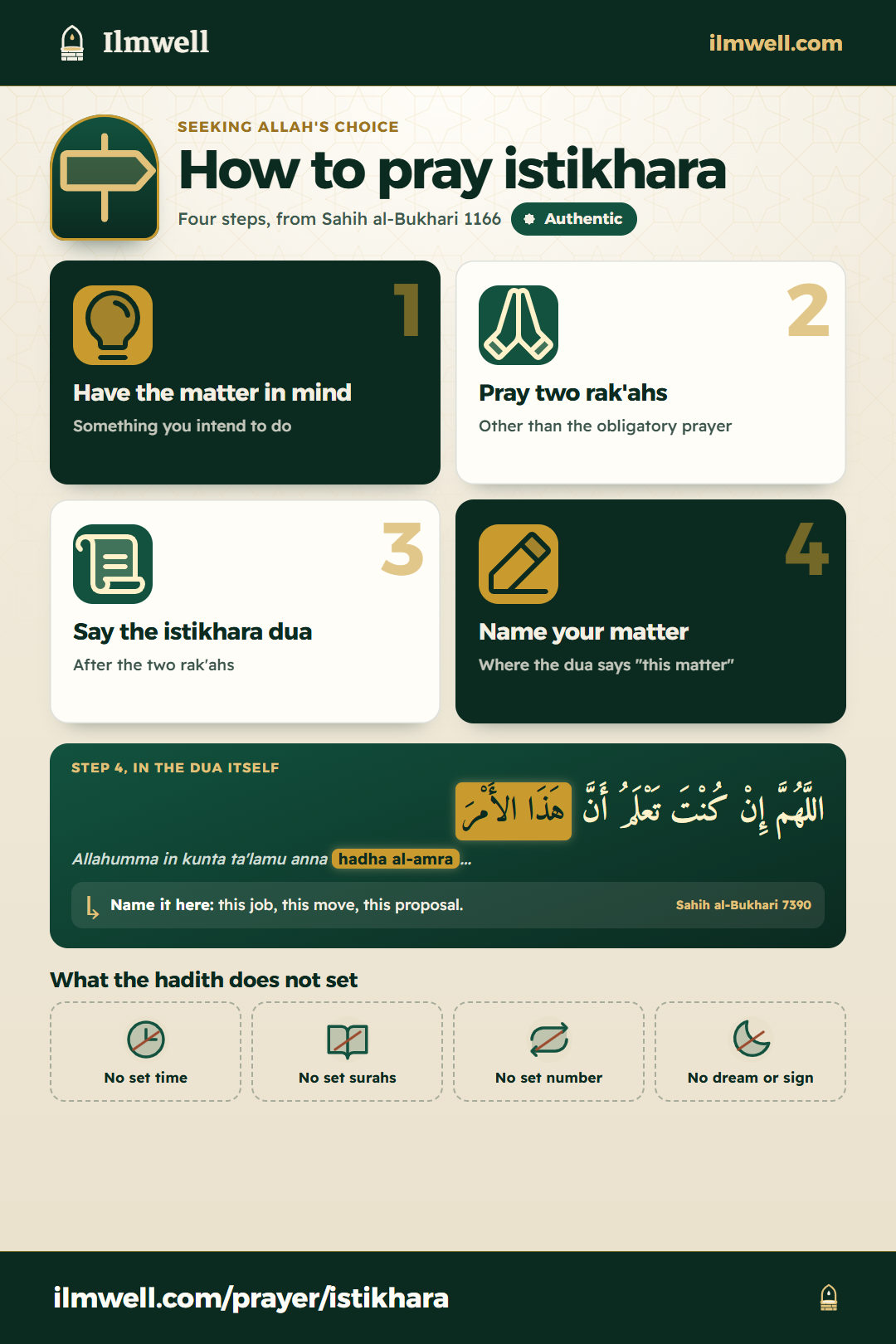
How to pray istikhara, four steps from Sahih al-Bukhari 1166, graded authentic: 1, have the matter in mind, something you intend to do; 2, pray two rak'ahs other than the obligatory prayer; 3, say the istikhara dua after the two rak'ahs; 4, name your matter where the dua says this matter. In the dua: Allahumma in kunta ta'lamu anna hadha al-amra, name it here, this job, this move, this proposal (Sahih al-Bukhari 7390). What the hadith does not set: no set time, no set surahs, no set number, no dream or sign.
The four steps and where to name your matter, in one picture. Save it, print it, or share it.
Posting it on your own site? Link back to this guide; the code under "Use it on your own site" does it in one line.
What is istikhara, and where does it come from?
Istikhara is asking Allah to choose what is good for you; the word shares its root with khayr, "good". It is also spelt istikharah or istakhara. The istikhara prayer is also called salat istikhara or salatul istikhara, and the dua for istikhara is also known as dua istikhara, dua e istikhara or istikhara ki dua.
Jabir ibn 'Abd Allah, may Allah be pleased with him, said the Messenger of Allah taught them istikhara in matters, as he taught them a surah of the Quran. He would say: when one of you intends a matter, let him pray two rak'ahs other than the obligatory prayer, then say the dua. The hadith ends: and he names his need.
1AuthenticSahih al-Bukhari 1166
Al-Bukhari gives the same narration in two more places, and it is also in Sunan Abi Dawud, Jami' at-Tirmidhi, Sunan an-Nasa'i and Sunan Ibn Majah. In Sahih al-Bukhari 7390 the wording is "in all matters".
When to pray istikhara: is there a best time?
Sahih al-Bukhari 1166 names no best time and no number. It ties istikhara to intending a matter.
So the narration names no hour: not after Isha (the night prayer), not before sleep, and no other. Questions about particular times are not answered in this hadith; for your own case, ask a scholar you trust.
1AuthenticSahih al-Bukhari 1166
Is the seven-times istikhara or the short istikhara dua authentic?
Both are graded weak. In al-Jami' al-Saghir 876, a narration attributed to the Prophet through Anas, may Allah be pleased with him, tells someone with a matter in mind to ask his Lord for the better choice seven times, then look at what comes first to his heart, since the good lies there.
إذا هَمَمْتَ بأمرٍ ، فاسْتخرْ رَبَّكَ فيهِ سبعَ مراتٍ ، ثمَّ انظرْ إلى الذي يسبقُ إلى قلبِكَ فإنَّ الخَيرَ فيهِ
A second report, from Abu Bakr, may Allah be pleased with him, says that when the Prophet wanted to do something he would say: اللَّهُمَّ خِرْ لِي وَاخْتَرْ لِي, Allahumma khir li wakhtar li, "O Allah, choose good for me and choose for me". It is often shared as a short istikhara dua.
The istikhara with an authentic grade is the one in the steps above: two rak'ahs, then the full dua, naming your matter.
What decisions is istikhara for?
Any matter. Sahih al-Bukhari 7390 says the Prophet taught istikhara "in all matters". Istikhara for marriage, a job, a move or a purchase: each is a matter you can name in the dua.
2AuthenticSahih al-Bukhari 7390
The dua does not ask for a sign. It leaves the knowing to Allah ("You know and I do not know") and asks for one of two things:
| If the matter is good for you | If it is bad for you | |
|---|---|---|
| The dua asks | Decree it for me, make it easy for me, then bless me in it. | Turn it away from me and turn me away from it, decree the good for me wherever it is, then make me content with it. |
Asking people for advice is not in the istikhara hadith. The Quran mentions it in another setting, addressing the Prophet: consult with them in the matter, and once resolved, put your trust in Allah.
وَشَاوِرْهُمْ فِى ٱلْأَمْرِ ۖ فَإِذَا عَزَمْتَ فَتَوَكَّلْ عَلَى ٱللَّهِ
"...consult with them upon the conduct of affairs. And when you are resolved, then put your trust in Allah." Al Imran 3:159
Do you need a dream or a sign after istikhara?
The istikhara hadith mentions no dream and no sign. We found no narration that links istikhara to a dream, to sleeping after the prayer, or to a sign (source 5). The nearest report, about following what comes first to your heart, is graded weak.
What the dua asks for is in its own words: ease and blessing if the matter is good, being turned away from it if not, and contentment with the good that is decreed. If a dream or a feeling worries you about your decision, ask a scholar you trust.
When I had a big decision to make, someone told me istikhara was about waiting for a dream. I spent a week waiting for one. When I finally learnt the prayer and the dua themselves, they were much simpler than I had imagined.
Try it: the order and the words
Four quick checks on the steps and the dua. Each answer explains itself.
1What comes first in istikhara?
Answer: Two rak'ahs of prayer. The hadith gives the order: two rak'ahs other than the obligatory prayer, then the dua, naming the matter. Source 1
2Where in the dua do you name your matter?
Answer: At "this matter" (hadha al-amr). Sahih al-Bukhari 7390 puts it straight after "this matter": then you name it. Source 2
3If the matter is bad for you, what does the dua ask?
Answer: Turn it away from me, and turn me away from it. Fasrifhu 'anni wasrifni 'anhu: turn it away from me and turn me away from it. Source 1
4How many times does Sahih al-Bukhari 1166 say to repeat istikhara?
Answer: It gives no number. It gives no number, and it mentions no dream. Source 1
Questions people ask
Can someone else pray istikhara for me?
The hadith speaks to the person with the decision: "when one of you intends a matter", and the dua is in the first person throughout: my religion, my livelihood, make me content. It does not describe asking someone else to pray it for you. For your own situation, ask a scholar you trust.
Is the istikhara hadith Bukhari 1162 or 1166?
Both numbers point to the same hadith from Jabir. sunnah.com numbers it Sahih al-Bukhari 1166; other references, such as the dorar.net hadith encyclopedia, number it 1162. Al-Bukhari also gives it at 6382 and 7390 (sunnah.com numbering). On sunnah.com, bukhari:1162 is a different hadith: 'Aisha, may Allah be pleased with her, on the two rak'ahs of Fajr, the dawn prayer.
Sources
Every claim on this page comes from one of these. Gradings are reported with the scholar's name; we do not grade hadith ourselves.
- 1
Jabir said the Prophet taught them istikhara in matters as he taught them a surah of the Quran: when one of you intends a matter, let him pray two rak'ahs other than the obligatory prayer, then say the istikhara dua; the narration ends 'and he names his need'.
Sahih al-Bukhari 1166 Book 19, Hadith 45
Authentic: in Sahih al-Bukhari
- 2
In Jabir's narration in Sahih al-Bukhari 7390, the Prophet taught istikhara 'in all matters', and in the dua the person names the matter right after 'this matter' ('thumma tusammihi bi'aynihi').
Sahih al-Bukhari 7390 Book 97, Hadith 19
Authentic: in Sahih al-Bukhari
- 3
A report attributed to the Prophet through Anas tells a person to make istikhara seven times and then follow what first comes to the heart. Every grading found for it is weak.
Al-Jami' al-Saghir 876 Al-Suyuti, al-Jami' al-Saghir, no. 876, as dorar.net cites it
Weak: weak (Al-Suyuti); very weak (Al-Albani); its chain is very weak (Al-Albani); its chain has a narrator known for severe weakness (Al-'Iraqi); fallen, no proof in it (Al-'Ayni). Remarks: Ibrahim ibn al-Bara' is in its chain; al-Dhahabi said they accused him of fabricating from his father, and he is weak (Al-Munawi)
- 4
Abu Bakr narrated that when the Prophet wanted to do something, he would say: Allahumma khir li wakhtar li (O Allah, choose good for me and choose for me). It is graded weak.
Jami` at-Tirmidhi 3516 Book 48, Hadith 147
Weak: gharib: Zanfal is weak according to the hadith scholars, he alone narrates it and he is not corroborated on it (Al-Tirmidhi); Da'if (Darussalam); its chain is weak (Al-Nawawi); its chain is weak (Ibn Hajar al-'Asqalani); weak (Al-Suyuti); weak (Al-Albani); its chain is weak (Shu'ayb al-Arna'ut); there is weakness in its chain (Al-Shawkani); weak (Muhammad Jar Allah al-Sa'di); Zanfal, who is in it, is not corroborated on this hadith (Al-Bazzar). Remarks: Zanfal ibn 'Abd Allah is not corroborated on what he narrates (Ibn 'Adi); more than one scholar called Zanfal weak (Al-Sakhawi); Zanfal ibn 'Abd Allah is in it, and he is weak (Al-'Ajluni); Zanfal al-'Arafi is in it; al-Daraqutni called him weak (Al-Munawi); Zanfal al-'Arafi is in it; al-Daraqutni said he is weak (Al-San'ani); Zanfal al-'Arafi is in it; Yahya said he is nothing; other istikhara hadith have sound chains (Al-'Uqayli); Zanfal ibn 'Abd Allah al-'Arafi is in it; his hadith is weak (Al-Saji); Zanfal ibn 'Abd Allah is in it; Ibn Ma'in said he is nothing; Abu Hatim and al-Daraqutni said weak (Al-Mizzi); Zanfal is in it; Ibn Hibban said he is not used as proof (Al-Mubarakfuri)
- 5
A search of sunnah.com and the dorar.net hadith encyclopedia on 21 October 2026 found no narration that links istikhara to a dream, to sleeping after the prayer, or to a sign; the nearest report, about following what comes first to the heart after seeking Allah's choice seven times, is graded weak. A search finding, not a grading.
sunnah.com and the dorar.net hadith encyclopedia Record: search-istikhara-dreams, with every search term and result.
- Q
Al Imran 3:159, quoted in part.
Tanzil Project Uthmani text, CC BY 3.0. English: adapted from Marmaduke Pickthall's translation (1930), modernised and checked against modern translations.
Next
For your own situation, ask a scholar you trust.
Join the email list
New guides by email, now and then. No spam, and you can leave at any time.
Ilmwell is free and kept going by readers. See how to support it.