The short answer
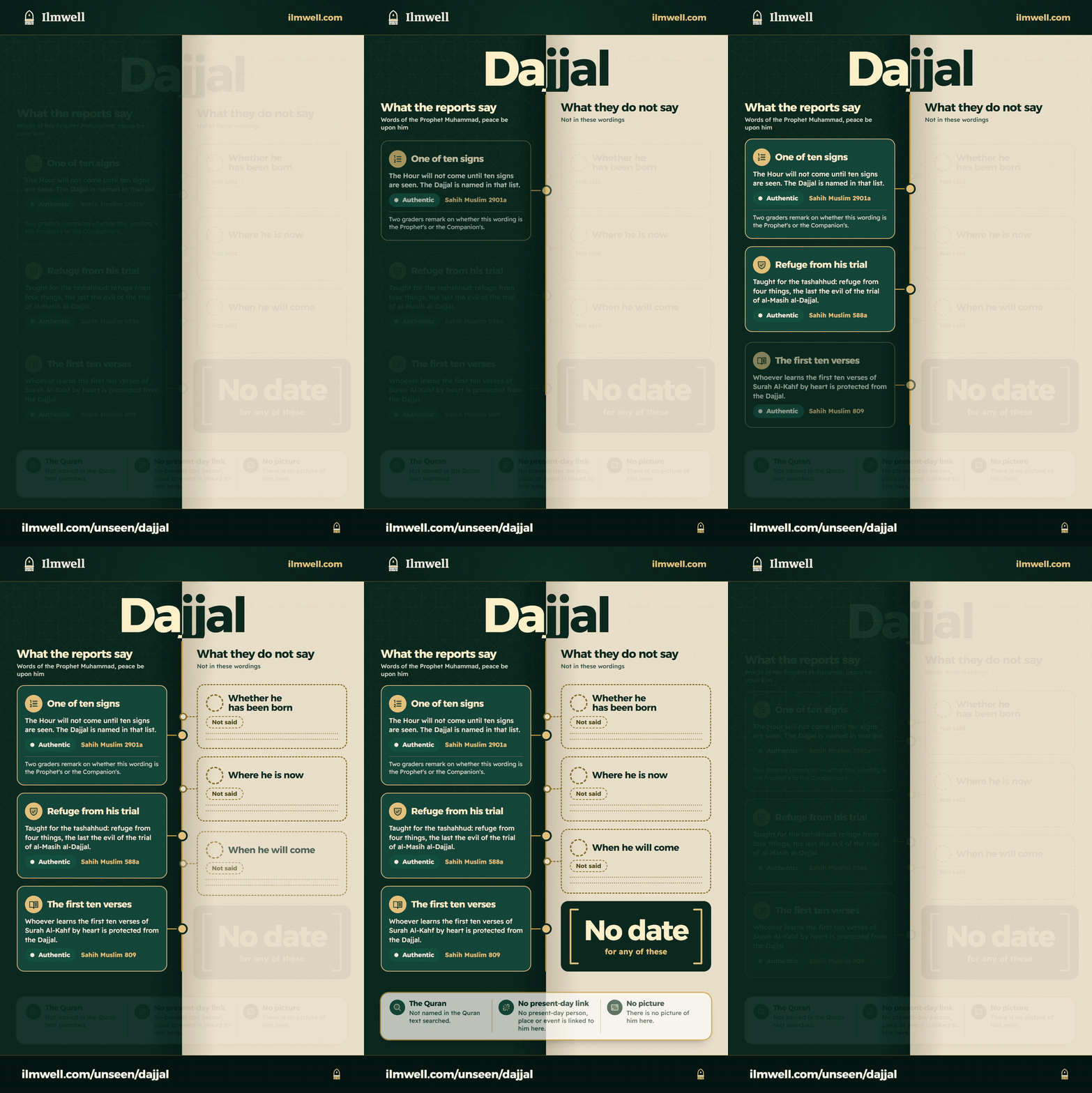
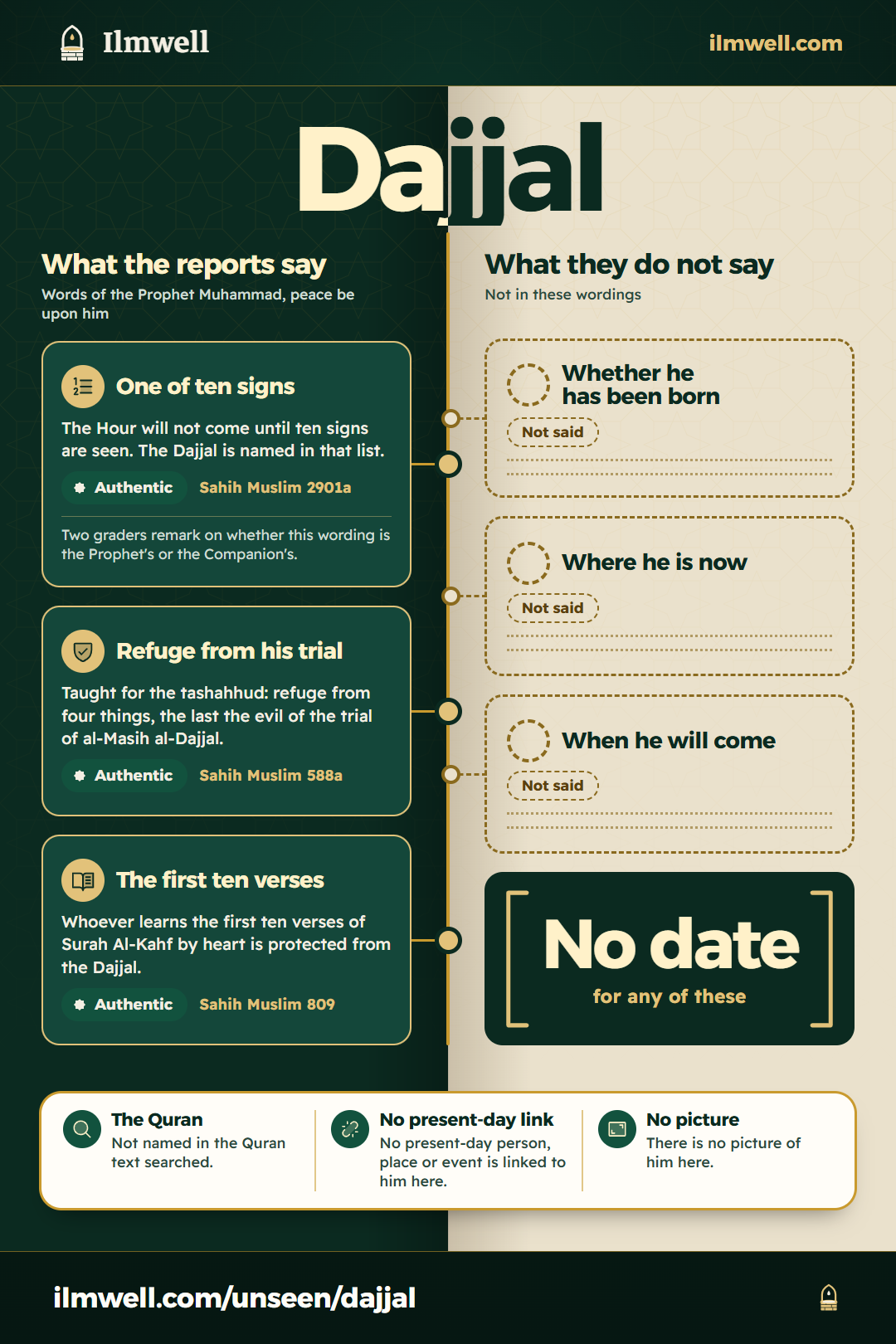
Sahih Muslim 2901a lists the Dajjal among ten signs of the Hour. The cited reports name him, tie reciting Surah Al-Kahf to him, and give no date for his coming. Each report's grade sits beside it, and some are graded differently or weak.
Dajjal in Islam: what do the hadith report?
Hudhayfah ibn Asid al-Ghifari, may Allah be pleased with him, reports that the Prophet Muhammad, peace be upon him, said the Hour will not come until ten signs have been seen, and he named them. The Dajjal is one of the names in that list. The list and its versions are on the signs of the Hour page; the rest is about the Dajjal only.
1AuthenticSahih Muslim 2901a
Two graders, named in the sources list, remark on whether this wording goes back to the Prophet or stops at the Companion, Hudhayfah.
The Dajjal is also named in a supplication taught for the tashahhud, the testimony recited while seated in prayer. Abu Hurayrah, may Allah be pleased with him, reports that the Prophet taught seeking refuge from four things, the last of them the evil of the trial of al-Masih al-Dajjal. The Arabic says "when he says the tashahhud" and does not name which sitting it is.
2AuthenticSahih Muslim 588a
What does Dajjal mean?
Ibn Manzur's dictionary, Lisan al-Arab, says in its entry for the root that a dajil is one who disguises, a great liar, and that the Dajjal is named from it. It calls dajjal a form of intensity, meaning that much lying and confounding come from him, and gives the root sense of dajl as mixing (our translation, vol. 11, pp. 236 to 237). 12
The same entry quotes several lexicographers on why he is called this. Ibn Sida says he is so named because he covers over the truth with falsehood, and gives three more reasons, each introduced with "it has been said": he covers the earth with the great number of his hosts, he covers over people with his disbelief, or he claims lordship, so that he is named for his lying. He says all these meanings are close. Al-Azhari says every great liar is a dajjal, and adds a view introduced with "it has been said": he is so named because he conceals the truth with his lying. Abu al-Abbas, quoted from al-Tahdhib, explains the name one way on one occasion and another way on a second: his travelling through the earth and crossing most of its regions, and his disguising things to people, his confounding and his making falsehood look fair. The entry sets these reasons side by side and chooses none, and no choice is made here either.
What does the report from al-Nawwas say?
A long report about him comes from al-Nawwas ibn Sam'an, may Allah be pleased with him. It describes him at length, and that description is not repeated here. Partway through, the same report says that Isa (Jesus), son of Maryam (Mary), peace be upon them both, catches the Dajjal and kills him. The passages on the Dajjal's forty days, the opening verses of Surah Al-Kahf, the descent of Isa and the killing of the Dajjal, and the Yajuj and Majuj (Gog and Magog) that follow were checked on the Arabic text on sunnah.com. The report as a whole was not compared sentence by sentence or against a print scan.
11AuthenticSahih Muslim 2937a
Which Surah Al-Kahf reports mention the Dajjal?
Abu al-Darda', may Allah be pleased with him, reports three of the Surah Al-Kahf wordings below. In some chains, Al-Mustadrak 2100 is given as the words of Abu Sa'id al-Khudri, may Allah be pleased with him. The table gives each wording, what it says and its label. The graders are named in the sources list only.
| Reference | What the wording says | Label |
|---|---|---|
| Sahih Muslim 809 | Whoever learns the first ten verses of Surah Al-Kahf by heart is protected from the Dajjal. | Authentic |
| Sahih Muslim 809b | The same report by a second chain. One chain says "from the end" of Surah Al-Kahf, and another says "from the beginning". | Graded differently |
| Sahih Muslim 2937 | Whoever of you lives to see him should recite over him the opening verses of Surah Al-Kahf. | Authentic |
| Jami at-Tirmidhi 2886 | Whoever recites three verses from the beginning of Surah Al-Kahf is protected from the Dajjal. | Graded differently |
| Al-Mustadrak 2100 | Whoever recites ten verses from the end of Surah Al-Kahf, and then the Dajjal comes out, he will not be given power over him. | Authentic |
3AuthenticSahih Muslim 809
4Graded differently Sahih Muslim 809b
5AuthenticSahih Muslim 2937
6Graded differently Jami' at-Tirmidhi 2886
7AuthenticAl-Mustadrak 2100
Sahih Muslim 809 and 809b are the same report by two chains. They differ on whether the ten verses come from the beginning or the end. Two gradings (as listed on dorar.net) say the "beginning" wording is the preserved one, and the "end" wording is listed in the sources with the gradings that accept its chain.
The three-verse wording in Jami at-Tirmidhi 2886 is graded differently. Three gradings accept it. One grader, in six gradings, calls it anomalous (shadh, a wording that goes against better-attested ones) or weak, and accepts the report only with "ten verses".
Al-Mustadrak 2100 is graded sahih in the gradings listed on dorar.net. Its attribution differs by chain: some give it as the Prophet's words, and others as Abu Sa'id al-Khudri's own words. The graders note the difference, and both are reported here.
Do the Friday reports mention the Dajjal?
Some reports link Surah Al-Kahf to Friday. Two of them also mention the Dajjal. One is graded very weak or weak; the other is graded not authentic. A report attributed to the Prophet through a narrator named 'Ali says that whoever recites Surah Al-Kahf on Friday is protected for eight days from every trial, and that if the Dajjal comes out, he is protected from him. Its gradings range from very weak to weak, and its label is Weak.
8WeakAl-Silsila al-Da'ifa 2013
A report with no companion named, attributed to the Prophet, gives the same link for Surah Ashab al-Kahf, the surah of the People of the Cave. It says whoever recites it on Friday is forgiven until the next Friday and three days more, and is protected from the trial of the Dajjal. The one grading found calls it not authentic, and its label is Weak.
9WeakAl-Tidhkar fi Afdal al-Adhkar 195
Sunan al-Darimi 3312 records a different Friday report. Abu Sa'id al-Khudri says, in his own words, that whoever recites Surah Al-Kahf on the night of Friday has light shining between him and the Ancient House, the Ka'bah. The wording does not mention the Dajjal. In this wording, the record gives these as Abu Sa'id's words, and the gradings found accept its chain.
10AuthenticSunan ad-Darimi 3312
Our search of sunnah.com and dorar.net on 22 October 2026 found no narration that ties the first or last ten verses to Friday. The ten-verse and three-verse wordings name no day.
Does the Quran name the Dajjal?
Not in the Quran text we searched. No verse of the Tanzil text used on this site contains the Arabic word for the Dajjal. We searched the full text with the diacritics removed, so vowel marks could not hide a match. The reports cited are hadith, not Quran, and they are not treated as Quran.
What do the reports not say?
The wordings above name the Dajjal and describe his trial and the protection against him. They do not say whether he has been born, where he is now, or when he will come, and they give no date for any of these. No present-day person, place or event is linked to him here.
There is no picture of him here. The report from al-Nawwas describes him, and that description is left out.
I first heard about the Dajjal as a child, as something frightening that adults only mentioned in low voices. Years later I read what the narrations actually say, including the reports about the opening verses of Surah Al-Kahf, and I found a calmer way to think about it: read what the narration says and no more.
Try it: three questions
Pick an answer; each one explains itself.
1Which narration says that learning the first ten verses of Surah Al-Kahf protects from the Dajjal?
Answer: Sahih Muslim 809. Sahih Muslim 809 says that whoever learns the first ten verses by heart is protected from the Dajjal. Al-Tirmidhi 2886 names three verses. Al-Darimi 3312 is about the night of Friday and does not mention the Dajjal. Source 3
2Does Sahih Muslim 2901a give a date for the Dajjal?
Answer: No, it gives none. The wording names the signs and gives no date for any of them. Source 1
3How is the three-verse wording in Jami at-Tirmidhi 2886 graded?
Answer: Graded differently. Three gradings accept the three-verse wording. One grader, in six gradings, calls it anomalous or weak. Source 6
Questions people ask
What is the Dajjal in the hadith?
The cited hadith name him in several reports. Sahih Muslim 2901a lists him among ten signs of the Hour. In Sahih Muslim 588a, the Prophet Muhammad, peace be upon him, taught a supplication against the trial of al-Masih al-Dajjal, said when saying the tashahhud. The cited wordings give no date for his coming.
What does Dajjal mean?
The classical dictionary Lisan al-Arab says a dajil is one who disguises, a great liar, and that the Dajjal is named from it. It quotes several reasons for the name and chooses none.
Does the Quran mention the Dajjal?
Not in the Quran text we searched. No verse of the Tanzil text used on this site contains the Arabic word for the Dajjal, in a search with diacritics removed. The reports cited are hadith.
Which surah protects from the Dajjal?
Sahih Muslim 809 says that learning the first ten verses of Surah Al-Kahf by heart protects from the Dajjal, and its label is Authentic. Other reports on the same theme are graded differently or are weak, and each one's label is shown beside it.
Is the Dajjal already born?
The reports cited here do not say whether he has been born or where he is now. No present-day person, place or event is identified with him here.
When will the Dajjal come?
The cited reports give no date for his coming, and no prediction is made here.
Sources
Every claim above comes from one of these. Gradings are reported with the scholar's name; we do not grade hadith ourselves. What was read: the narration text on sunnah.com, as stored in each record's sourceText (read 22 and 23 October 2026). The gradings marked as listed on dorar.net were collected by script from dorar.net and have not been checked against the books. The Lisan al-Arab entry was read directly on shamela.ws on 27 October 2026 and re-read on 29 October 2026. Nothing else was re-opened. The English of Al-Silsila al-Da'ifa 2013, Tidhkar 195, Al-Mustadrak 2100 and Sunan al-Darimi 3312 is an Ilmwell working translation from the Arabic (dorar.net for the first three, sunnah.com for Darimi 3312). The narrator of 2013 is named here only as 'Ali.
- 1
Hudhayfah ibn Asid al-Ghifari reports that the Prophet said the Hour will not come until ten signs have been seen, and names them: the smoke, the Dajjal, the beast, the sun rising from the west, the descent of Isa son of Maryam, Yajuj and Majuj, three sinkings of land (east, west and the Arabian peninsula), and last of these a fire from Yemen that drives people to their place of assembly.
Sahih Muslim 2901a Book 54, Hadith 51
Authentic: in Sahih Muslim (Muslim). Remarks: لم يرفعه غير فرات عن أبي الطفيل من وجه يصح مثله [وروي] موقوفا (Al-Daraqutni); تابع فراتا على رفعه قتادة بسند فيه منكر الحديث وجاء مرفوعا بسند ضعيف (Al-Wadi'i)
- 2
Abu Hurayrah, may Allah be pleased with him, reported that the Prophet said: when any of you says the tashahhud he should seek refuge with Allah from four things, from four things, the first two being the punishment of Hell and the punishment of the grave.
Sahih Muslim 588a Book 5, Hadith 162
Authentic: in Sahih Muslim
- 3
Abu al-Darda' reported that the Prophet said: whoever memorises ten verses from the beginning of Surat al-Kahf is protected from the Dajjal.
Sahih Muslim 809 Book 6, Hadith 311
Authentic: in Sahih Muslim (Muslim); Sahih, in Sahih Muslim 809 as listed on dorar.net (Muslim); its chain is sahih (Al-Hakim); its chain is sahih on the conditions of Muslim (Shu'ayb al-Arna'ut); sahih (Al-Albani); its chain is sahih (Al-Albani); the other wording is anomalous; the preserved wording is this first one (Al-Albani); the first wording, 'from the beginning', is the preserved one (Shu'ayb al-Arna'ut); sahih (Al-'Ajluni); sahih (Ibn al-Qayyim)
- 4
In one chain of the same hadith in Sahih Muslim, Shu'bah's wording says 'from the end of al-Kahf' in place of 'from the beginning'; graded differently.
Sahih Muslim 809b Book 6, Hadith 312
Graded differently. Here is who graded it which way:
- SoundIbn Hibban, Shu'ayb al-Arna'ut
- WeakAl-Albani, Shu'ayb al-Arna'ut
- Other remarksMuslim, Abu Dawud
See each grading in full, with its wording and where it was given
Scholars disagree about this hadith. Here is how each graded it, so you can follow the scholar you trust.
- Recorded in Sahih Muslim as a note on the chain of 809 (Shu'bah's difference), without Muslim endorsing it over the 'beginning' wording: Muslim, by inclusion in his Sahih
- أخرجه في صحيحه (included in his Sahih), wording: whoever recites ten verses from the end of al-Kahf: Ibn Hibban, Sahih Ibn Hibban 786 (as listed on dorar.net)
- إسناده صحيح (its chain is sahih): Shu'ayb al-Arna'ut, takhrij Sahih Ibn Hibban 786 (as listed on dorar.net)
- إسناده صحيح (its chain is sahih), wording: ten verses from the end of al-Kahf: Shu'ayb al-Arna'ut, takhrij al-Musnad 27516 (as listed on dorar.net)
- الرواية الأخرى شاذة والمحفوظ الرواية الأولى (the other wording, 'from the end', is anomalous; the preserved wording is the first): Al-Albani, takhrij Riyad al-Salihin 1028 (as listed on dorar.net)
- الرواية الأولى هي المحفوظة (the first wording, 'from the beginning', is the preserved one): Shu'ayb al-Arna'ut, takhrij Riyad al-Salihin 1021 (as listed on dorar.net)
- Note: Hisham al-Dastawa'i said 'from the closing verses of Surat al-Kahf' and Shu'bah said 'from the end of al-Kahf': Abu Dawud, a note after hadith 4323 of his Sunan (not a grading)
- 5
In the long hadith of al-Nawwas ibn Sam'an about the Dajjal, the Prophet said that whoever of you lives to see him should recite over him the opening verses of Surat al-Kahf.
Sahih Muslim 2937 Book 54, Hadith 134
Authentic: in Sahih Muslim (Muslim); sahih (Al-Albani)
- 6
Abu al-Darda' reported that the Prophet said: whoever recites three verses from the beginning of al-Kahf is protected from the trial of the Dajjal; graded differently.
Jami' at-Tirmidhi 2886 Book 45, Hadith 12
Graded differently. Here is who graded it which way:
- SoundAl-Tirmidhi, Darussalam edition, Al-Suyuti
- WeakAl-Albani
See each grading in full, with its wording and where it was given
Scholars disagree about this hadith. Here is how each graded it, so you can follow the scholar you trust.
- حسن صحيح (hasan sahih): Al-Tirmidhi, Jami' at-Tirmidhi 2886
- Sahih (Darussalam, as shown on sunnah.com): Darussalam edition (as shown on sunnah.com)
- صحيح (sahih): Al-Suyuti, al-Jami' al-Saghir 8912 (as listed on dorar.net)
- صحيح بلفظ من حفظ عشر آيات وهو بلفظ الكتاب شاذ (sahih in the wording 'whoever memorises ten verses'; in this wording, three verses, anomalous): Al-Albani, Sahih al-Tirmidhi 2886 (as listed on dorar.net)
- صحيح بلفظ من حفظ عشر آيات (sahih only in the wording 'ten verses'; listed in his collection of weak reports): Al-Albani, Da'if al-Tirmidhi 2886 (as listed on dorar.net)
- شاذ بهذا اللفظ (anomalous in this wording; sahih with 'ten' in place of 'three'): Al-Albani, Hidayat al-Ruwat 2088 (as listed on dorar.net)
- شاذ (anomalous): Al-Albani, al-Silsila al-Da'ifa 1336 (as listed on dorar.net)
- شاذ (anomalous): Al-Albani, Da'if al-Targhib 883 (as listed on dorar.net)
- ضعيف (weak): Al-Albani, Da'if al-Jami' 5765 (as listed on dorar.net)
- 7
A report from Abu Sa'id al-Khudri says whoever recites Surat al-Kahf as it was revealed will have a light on the Day of Resurrection from where he stands to Makkah, and whoever recites ten verses from its end and then the Dajjal comes out, he will not be given power over him; some chains give it as the Prophet's words, others as Abu Sa'id's.
Al-Mustadrak 2100 al-Mustadrak 2100, as dorar.net cites it
Authentic: sahih on the conditions of Muslim (Al-Hakim); its chain is sahih (Al-Albani); its chain is sahih on the conditions of al-Bukhari and Muslim (Al-Albani); sahih through its other routes (Al-Albani); sahih (Al-Albani); sahih (Ibn al-Mulaqqin); its chain is sahih or hasan or close to them (Al-Mundhiri); a companion's words; its narrators are trustworthy and relied upon (Al-Shawkani). Remarks: silent on it, as Abu Sa'id's words through Qays ibn 'Ubad; his introduction says his narrators are trustworthy (Al-Hakim); its narrators are narrators of the Sahih (Al-Mundhiri); its men are men of the Sahih (Al-Haythami); it is also disputed whether it is the Prophet's words or a companion's (Mulla 'Ali al-Qari); only Yahya ibn Kathir narrated it from Shu'bah as the Prophet's words (Al-Tabarani)
- 8
A report attributed to the Prophet through 'Ali says whoever recites Surat al-Kahf on Friday is protected for eight days from every trial, and if the Dajjal comes out he is protected from him; graded very weak or weak.
Al-Silsila al-Da'ifa 2013 al-Albani, al-Silsila al-Da'ifa 2013, as dorar.net lists it
Weak: very weak (Al-Albani); it has no chain, or a chain of a kind the critics do not rely on (Ibn 'Abd al-Hadi). Remarks: the sound report on this subject is 'whoever memorises ten verses from the beginning of Surat al-Kahf' ('Abd al-Haqq al-Ishbili); it has Abdullah ibn Mus'ab, whom Ibn Ma'in called weak (Shu'ayb al-Arna'ut); included in his selection; under the next entry, 430, he himself flags its narrator 'Abdullah ibn Mus'ab as unknown to al-Bukhari and Ibn Abi Hatim (Al-Diya' al-Maqdisi); it has Abdullah ibn Mus'ab, whom al-Bukhari and Ibn Abi Hatim do not mention (Al-Diya' al-Maqdisi)
- 9
A report attributed to the Prophet by Ishaq ibn 'Abdullah ibn Abi Farwa, with no companion named, calls Surat Ashab al-Kahf a surah escorted by 70,000 angels: whoever recites it on Friday is forgiven to the next Friday and three days more, given a light reaching the sky and kept from the Dajjal's trial; graded not authentic in the one grading found.
Al-Tidhkar fi Afdal al-Adhkar 195 al-Qurtubi, al-Tidhkar fi Afdal al-Adhkar 195, as dorar.net lists it
Weak: not authentic (Al-Qurtubi)
- 10
Abu Sa'id al-Khudri said, in his own words: whoever recites Surat al-Kahf on the night of Friday, light shines for him between him and the Ancient House (the Ka'bah).
Sunan ad-Darimi 3312 Book 23, Hadith 3312 (Arabic reference)
Authentic: its chain is sahih; all its narrators are trustworthy narrators of al-Bukhari and Muslim (Al-Albani); a companion's words; its narrators are trustworthy (Al-Shawkani); sahih or hasan, by the condition he set in his introduction (Ibn al-Mulaqqin). Remarks: as the words of Abu Sa'id al-Khudri (Mulla 'Ali al-Qari); a companion's words; it has Abu Hashim, whom most consider reliable, and the rest of the chain is reliable (Al-Ruba'i); هذا هو المحفوظ موقوفاً (this is the preserved form, as a companion's words), on the wording 'on the day of Friday ... the Ancient House' (Al-Bayhaqi); in all its routes, the narrators of the companion's wording are more precise than those of the Prophet's wording (Ibn Hajar al-Asqalani)
- 11
Al-Nawwas ibn Sam'an reports the Prophet's account: after Isa has killed the Dajjal, Allah tells Isa to bring His servants to al-Tur; Yajuj and Majuj come down from every slope; Isa and his companions are besieged and pray; Allah sends creatures (al-nagaf) that attack their necks, and in the morning they die together, like one soul; Isa and his companions survive; a later part of the same report describes a wind that takes the soul of every believer and Muslim, leaving the worst of people, after which the Hour comes, with no date given.
Sahih Muslim 2937a Book 54, Hadith 134
Authentic: in Sahih Muslim
- 12
Ibn Manzur's Lisan al-Arab, in its entry for the root dal-jim-lam, says a dajil is one who disguises, a great liar, and that the Dajjal is named from it; that dajjal is a form of intensity; that the root sense of dajl is mixing; and quotes several lexicographers on the reasons for the name, without choosing one.
Muhammad ibn Mukarram ibn Manzur al-Ansari (d. 711 AH), Lisan al-Arab, vol. 11, pp. 236 to 237 Dar Sadir edition, as shamela.ws prints its page numbers. Read on shamela.ws on 27 October 2026 and re-read on 29 October 2026; the translation is ours, compared phrase by phrase with the Arabic of the entry on 29 October 2026. Maqayis al-Lugha and Lane's Lexicon were not reached. Record: scholarly-lisan-dajjal.
- S
A search of the Quran text on this site, for the Arabic word for the Dajjal, found no verse that contains it.
Ilmwell team search, 27 October 2026 (search-dajjal-quran) Local search of the Tanzil text used on this site; diacritics removed for the search. Not searched: tafsir and translations.
- T
A search of sunnah.com and dorar.net for Surah Al-Kahf reports, on 22 October 2026, found no narration that ties the first or last ten verses to Friday.
Next
For your own situation, ask a scholar you trust.
Join the email list
New guides by email, now and then. No spam, and you can leave at any time.
Ilmwell is free and kept going by readers. See how to support it.