The short answer
Surah Fatiha in English begins "In the name of Allah, the Beneficent, the Merciful." (Al-Fatihah 1:1, meaning surah 1, verse 1). It is the Quran's seven-verse opening chapter: praise for Allah, then a request to be shown the straight path. The Prophet Muhammad, peace be upon him, called it the greatest surah in the Quran (Sahih al-Bukhari 4474, graded sahih).
What is Surah Fatiha in English, Arabic and transliteration?
Al-Fatihah 1:1 to 7
بِسْمِ ٱللَّهِ ٱلرَّحْمَـٰنِ ٱلرَّحِيمِ ٱلْحَمْدُ لِلَّهِ رَبِّ ٱلْعَـٰلَمِينَ ٱلرَّحْمَـٰنِ ٱلرَّحِيمِ مَـٰلِكِ يَوْمِ ٱلدِّينِ إِيَّاكَ نَعْبُدُ وَإِيَّاكَ نَسْتَعِينُ ٱهْدِنَا ٱلصِّرَٰطَ ٱلْمُسْتَقِيمَ صِرَٰطَ ٱلَّذِينَ أَنْعَمْتَ عَلَيْهِمْ غَيْرِ ٱلْمَغْضُوبِ عَلَيْهِمْ وَلَا ٱلضَّآلِّينَ
Bismi llāhi r-raḥmāni r-raḥīm. Al-ḥamdu lillāhi rabbi l-ʿālamīn. Ar-raḥmāni r-raḥīm. Māliki yawmi d-dīn. Iyyāka naʿbudu wa iyyāka nastaʿīn. Ihdinā ṣ-ṣirāṭa l-mustaqīm. Ṣirāṭa lladhīna anʿamta ʿalayhim ghayri l-maghḍūbi ʿalayhim wa la ḍ-ḍāllīn.
In the name of Allah, the Beneficent, the Merciful. Praise be to Allah, Lord of the Worlds, The Beneficent, the Merciful. Master of the Day of Judgement, You (alone) we worship; You (alone) we ask for help. Show us the straight path, The path of those whom You have favoured; Not the (path) of those who earn Your anger nor of those who go astray.
To copy and paste the Arabic text, use the button under the scroll. The same surah, one verse at a time, with an easy transliteration:
1
بِسْمِ ٱللَّهِ ٱلرَّحْمَـٰنِ ٱلرَّحِيمِ
Bismillahir rahmanir raheem
In the name of Allah, the Beneficent, the Merciful.
2
ٱلْحَمْدُ لِلَّهِ رَبِّ ٱلْعَـٰلَمِينَ
Alhamdu lillahi rabbil 'alameen
Praise be to Allah, Lord of the Worlds.
3
ٱلرَّحْمَـٰنِ ٱلرَّحِيمِ
Ar-rahmanir raheem
The Beneficent, the Merciful.
4
مَـٰلِكِ يَوْمِ ٱلدِّينِ
Maaliki yawmid deen
Master of the Day of Judgement.
5
إِيَّاكَ نَعْبُدُ وَإِيَّاكَ نَسْتَعِينُ
Iyyaka na'budu wa iyyaka nasta'een
You (alone) we worship; You (alone) we ask for help.
6
ٱهْدِنَا ٱلصِّرَٰطَ ٱلْمُسْتَقِيمَ
Ihdinas siratal mustaqeem
Show us the straight path.
7
صِرَٰطَ ٱلَّذِينَ أَنْعَمْتَ عَلَيْهِمْ غَيْرِ ٱلْمَغْضُوبِ عَلَيْهِمْ وَلَا ٱلضَّآلِّينَ
Siratal ladheena an'amta 'alayhim ghayril maghdoobi 'alayhim wa lad daalleen
The path of those whom You have favoured; Not the (path) of those who earn Your anger nor of those who go astray.
You will see it written many ways: Surah Al-Fatiha, Surat al-Fatihah, Sura Fatiha, Surah Fatihah, or just Fatiha. They all mean this chapter.
What does Surah Fatiha mean, verse by verse?
If you have ever reached the end of a rakah (one unit of the prayer) with no memory of the Fatihah you just recited, this is the part that helps. It comes from a hadith qudsi, a narration in which the Prophet reports the words of Allah. Allah said: "I have divided the prayer between Me and My servant into two halves, and My servant will have what he asked for." Allah then answers the servant line by line.
2AuthenticSahih Muslim 395
1Bismillahir rahmanir raheem
In the name of Allah, the Beneficent, the Merciful.
You begin in the name of Allah. Ar-Rahman and ar-Rahim are two of His names, and both come from rahmah, mercy. This page follows the Tanzil numbering, where Bismillah is verse 1; other counts number the verses differently.
2Alhamdu lillahi rabbil 'alameen
Praise be to Allah, Lord of the Worlds.
Hamd is praise. Rabb is Lord, and al-'alameen is the plural of 'alam, world: together, rabbil 'alameen is "Lord of the Worlds".
Allah replies "My servant has praised Me."
3Ar-rahmanir raheem
The Beneficent, the Merciful.
Ar-Rahman and ar-Rahim again: the two names of mercy from Bismillah, straight after "Lord of the Worlds".
Allah replies "My servant has lauded Me."
4Maaliki yawmid deen
Master of the Day of Judgement.
Maalik is master or owner, yawm is day, and ad-deen is rendered judgement or recompense: the Day of Judgement.
Allah replies "My servant has glorified Me." In one telling the reply is: "My servant has entrusted his affairs to Me."
The turn at verse 5. Verses 2 to 4 praise Allah. Verse 5 joins worship and asking for help, and from verse 6 the surah is the servant's request. In the hadith, Allah's replies change at the same point.
5Iyyaka na'budu wa iyyaka nasta'een
You (alone) we worship; You (alone) we ask for help.
In the Arabic, "You" comes before the verb: "You we worship, You we ask for help". That word order is why translations add "alone".
Allah replies "This is between Me and My servant, and My servant will have what he asked for."
6Ihdinas siratal mustaqeem
Show us the straight path.
Ihdina means guide us or show us. As-sirat al-mustaqeem is the straight path. From here the surah becomes a request.
Allah replies "This is for My servant, and My servant will have what he asked for." (said of verses 6 and 7 together)
7Siratal ladheena an'amta 'alayhim ghayril maghdoobi 'alayhim wa lad daalleen
The path of those whom You have favoured; Not the (path) of those who earn Your anger nor of those who go astray.
Verse 7 says whose path you are asking for in verse 6, and whose path it is not.
Here is verse 5 word by word.
Arabic reads right to left, so the first word is on the right.
- إِيَّاكَiyyākaYou alonePlaced before the verb. This word order is why translations add "alone".
- نَعْبُدُnaʿbuduwe worship"We", not "I": the whole line is said in the plural.
- وَإِيَّاكَwa-iyyākaand You alone"Wa" (and) joined to the same word again.
- نَسْتَعِينُnastaʿīnwe ask for helpFrom ʿawn, help.
The surah itself does not name who "those who earn Your anger" and "those who go astray" are. A page on the commentaries, with each view tied to its named work, is coming.
I recited Al-Fatihah in every prayer for years without knowing a word of it. The day I read the English next to the Arabic, I realised I had been asking for guidance several times a day without hearing myself do it.
Try it: what does it mean?
Four questions on what you recite. Pick an answer; each one explains itself.
1You recite "Alhamdu lillahi rabbil alameen". What does Allah say in reply?
Answer: "My servant has praised Me". In the hadith qudsi (a hadith in which the Prophet relates words from Allah) in Sahih Muslim 395, Allah answers the praise of verse 2 with "My servant has praised Me". Source 2
2Which verse does Allah call "between Me and My servant"?
Answer: Iyyaka na'budu wa iyyaka nasta'een. Allah calls verse 5 "between Me and My servant" and says the servant will have what he asked for. Source 2
3What does "ihdinas siratal mustaqeem" mean?
Answer: Show us the straight path. Ihdina is "guide us, show us"; as-sirat al-mustaqeem is "the straight path". It is verse 6.
4Which name for Al-Fatihah means "the Mother of the Quran"?
Answer: Umm al-Quran. Umm al-Quran is the name used in Sahih Muslim 395. Fatihat al-Kitab is "the Opening of the Book"; as-Sab' al-Mathani is "the seven oft-repeated". Source 2
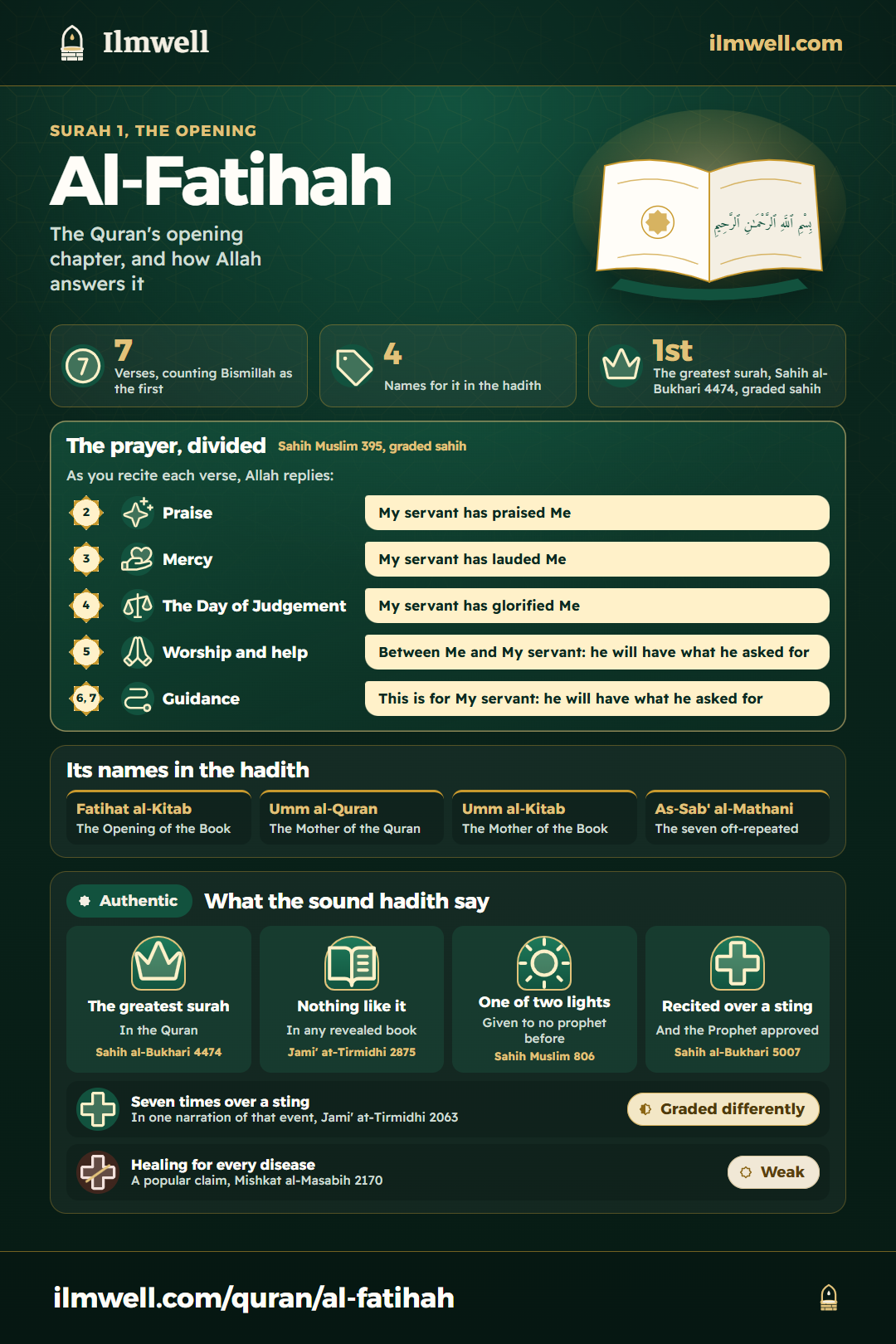
Al-Fatihah in one picture
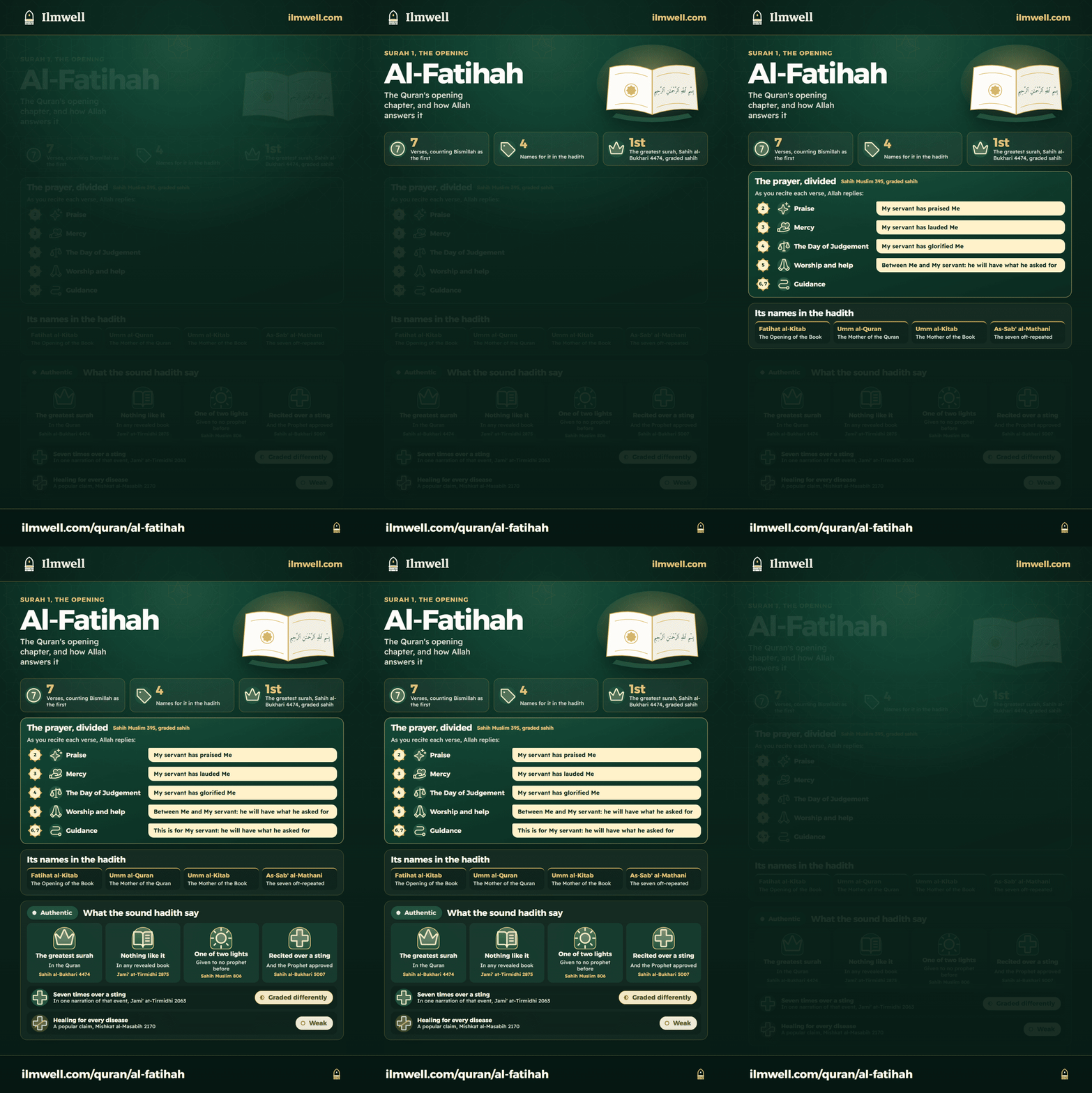
Al-Fatihah infographic. Surah 1, the Opening: 7 verses counting Bismillah, 4 names for it in the hadith, the greatest surah (Sahih al-Bukhari 4474). The prayer, divided, from Sahih Muslim 395: as you recite each verse Allah replies. Verse 2, praise: My servant has praised Me. Verse 3, mercy: My servant has lauded Me. Verse 4, the Day of Judgement: My servant has glorified Me. Verse 5, worship and help: between Me and My servant, he will have what he asked for. Verses 6 and 7, guidance: this is for My servant, he will have what he asked for. Its names: Fatihat al-Kitab, Umm al-Quran, Umm al-Kitab, as-Sab' al-Mathani. Sound hadith: the greatest surah; nothing like it in any revealed book; one of two lights; recited over a sting and the Prophet approved. Seven times over a sting: graded differently. Healing for every disease: weak.
The page in one picture: the facts, Allah's reply to each verse, its names and its virtues by grade. Save it to read before you pray, or share it.
Posting it on your own site? Link back to this guide; the code under "Use it on your own site" does it in one line.
Why is Al-Fatihah recited in every prayer?
The Prophet said there is no prayer for the one who does not recite the Opening of the Book, Al-Fatihah.
3AuthenticSahih al-Bukhari 756
In another narration he said that a prayer in which Umm al-Quran (Al-Fatihah) is not recited is deficient, repeating it three times, and not complete.
2AuthenticSahih Muslim 395
Each rakah of Zuhr. Abu Qatada, may Allah be pleased with him, reported that in the Zuhr (midday) prayer the Prophet recited Al-Fatihah and another surah in each of the first two units (rakahs), and Al-Fatihah in the last two.
4AuthenticSahih al-Bukhari 776
Amin at the end. When the imam says "ghayril maghdoobi 'alayhim wa lad daalleen", the last words of Al-Fatihah, those praying say Amin (also written Ameen). The Prophet said whoever's Amin coincides with the angels' has his past sins forgiven.
5AuthenticSahih al-Bukhari 782
The Prophet said it too. In another narration of the same teaching, Ibn Shihab, one of its narrators, added that the Prophet used to say Amin.
6AuthenticSahih al-Bukhari 780
How this is done in prayer, including behind an imam, is covered in the guide to salah.
What are the other names of Al-Fatihah?
Several names for the surah appear in the hadith. Each one below is used in a narration on this page.
| Name | Meaning | Where it is used |
|---|---|---|
| Fatihat al-Kitab | The Opening of the Book | 3AuthenticSahih al-Bukhari 756 |
| Umm al-Quran | The Mother of the Quran | 2AuthenticSahih Muslim 395 |
| Umm al-Kitab | The Mother of the Book | 9AuthenticSahih al-Bukhari 5007 |
| As-Sab' al-Mathani | The seven oft-repeated (verses) | 1AuthenticSahih al-Bukhari 4474 |
"The seven oft-repeated" uses the wording of a verse in Surah Al-Hijr, and the Prophet applied it to Al-Fatihah in Sahih al-Bukhari 4474, graded sahih.
وَلَقَدْ ءَاتَيْنَـٰكَ سَبْعًا مِّنَ ٱلْمَثَانِى وَٱلْقُرْءَانَ ٱلْعَظِيمَ
What are the benefits of Surah Fatiha?
Several virtues come from authentic hadith. Some popular ones do not. The table keeps them apart, each with its grade.
| What is said about Al-Fatihah | Source and grade |
|---|---|
| The Prophet called it the greatest surah in the Quran. | 1AuthenticSahih al-Bukhari 4474 |
| Nothing like it was revealed in the Tawrah, the Injil, the Zabur or the Furqan. | 7AuthenticJami' at-Tirmidhi 2875 |
| It is one of two lights given to the Prophet and to no prophet before him. | 8AuthenticSahih Muslim 806 |
| Allah replies to its verses as you recite them in prayer, from verse 2 on (verses 6 and 7 together). | 2AuthenticSahih Muslim 395 |
| A companion recited it over a chief who had been stung, and the Prophet approved. | 9AuthenticSahih al-Bukhari 5007 |
| In one narration of that event (a scorpion sting), it was recited over the man seven times. | |
| It holds healing for every disease. | |
| A set reward for reciting it 100 times (no narration found). | 12Not found No narration found in our search |
The greatest surah
Abu Sa'id ibn al-Mu'alla, may Allah be pleased with him, was praying in the mosque when the Prophet called him, and he did not answer. The Prophet reminded him of the Quran's command to answer Allah and His Messenger when called (Al-Anfal 8:24), and said he would teach him the greatest surah in the Quran before he left the mosque. Later, as the Prophet was about to leave, Abu Sa'id reminded him. He said: "Al-hamdu lillahi rabbil 'alameen. It is the seven oft-repeated, and the great Quran I have been given."
1AuthenticSahih al-Bukhari 4474
Nothing like it in any revealed book
The Prophet asked Ubayy ibn Ka'b, may Allah be pleased with him, how he recited in prayer, and Ubayy recited Umm al-Quran. The Prophet swore by the One in whose hand his soul is that nothing like it was revealed in the Tawrah, the Injil, the Zabur (the Torah, the Gospel and the Psalms) or the Furqan (a name of the Quran). It is, he said, seven of the oft-repeated and the great Quran he was given.
7AuthenticJami' at-Tirmidhi 2875
Two lights
Ibn Abbas, may Allah be pleased with him, reported that an angel came down through a gate of heaven opened that day for the first time. He greeted the Prophet and told him to rejoice in two lights given to him that no prophet before him was given: Fatihat al-Kitab and the closing verses of Surah Al-Baqarah. He will not recite a letter of them without being given it.
8AuthenticSahih Muslim 806
Is the hadith "Al-Fatihah is healing for every disease" authentic?
No: it is graded weak. The report that Al-Fatihah holds healing for every disease is mursal, meaning its chain skips the companion who would have heard it from the Prophet.
What is authentic is narrower. Abu Sa'id al-Khudri, may Allah be pleased with him, reported that while travelling, his group came to a tribe whose chief had been stung. One of their men, whom they had not known to do ruqyah (a recitation over someone who is ill), recited Umm al-Kitab over the chief, and he recovered. When they told the Prophet in Madinah, he asked how the man knew it was a ruqyah, and told them to share out what they had been given and keep a share for him.
9AuthenticSahih al-Bukhari 5007
In one narration of this event, Abu Sa'id says he recited al-Hamdu lillah, a name for Al-Fatihah taken from its opening words, over the chief seven times, and the sting is named as a scorpion's. That narration is graded differently, which is why the table shows it apart. It describes one ruqyah for a sting. The narration attaches no reward to reciting Al-Fatihah seven times as a routine.
10Graded differently Jami' at-Tirmidhi 2063
For "Surah Fatiha 100 times", the Ilmwell team searched sunnah.com and dorar.net on 20 October 2026 and found no narration giving a reward for reciting Al-Fatihah 100 times on its own (source 12). The reports with 100 that mention it are longer prayer formulas. The sound virtues are the ones above, starting with the greatest surah.
Ruqyah is a religious practice, not medical treatment. If you or someone you care for is unwell, speak to your GP.
How do you pronounce Surah Fatiha?
Most of it is easy for an English speaker. These are the sounds to slow down for:
- ḥ in raḥmān and al-ḥamdu: a breathy h from the throat, stronger than an English h.
- ʿ in ʿālamīn, naʿbudu and nastaʿīn: a tightening deep in the throat. Do not drop it; naʿbudu is not nabudu.
- ṣ, ṭ and ḍ in ṣirāṭ, maghḍūb and ḍāllīn: heavy versions of s, t and d, said with the tongue pulled back.
- dh in alladhīna: the "th" in "this". gh in ghayri: close to a French r.
- Long vowels (ā, ī, ū) are held, as in ḍāllīn at the very end.
Listen and repeat. A recorded recitation by a fluent human reciter is coming. We do not use a synthetic voice for Quran recitation.
Common mix-ups
- Al-Fatihah and "Alhamdulillah" are different things. Alhamdulillah is the phrase that opens verse 2; Al-Fatihah is the whole seven-verse surah.
- Umm al-Quran, Umm al-Kitab, Fatihat al-Kitab and as-Sab' al-Mathani are all names for this same surah.
- Amin (Ameen) is said when the imam finishes Al-Fatihah (Sahih al-Bukhari 782, graded sahih), but it is not one of its seven verses.
Questions people ask
How many verses are in Surah Fatiha?
Seven. This page follows the Tanzil numbering, where Bismillah is verse 1 and "Siratal ladheena..." is verse 7; other counts number the verses differently. The Prophet, peace be upon him, called Al-Fatihah "the seven oft-repeated" in Sahih al-Bukhari 4474, graded sahih.
Do you say Ameen after Al-Fatihah?
In congregational prayer, Sahih al-Bukhari 782 (graded sahih) reports the Prophet telling people to say Amin (also written Ameen) when the imam says "ghayril maghdoobi alayhim wa lad daalleen", the last words of Al-Fatihah. He said that whoever's Amin coincides with the angels' has his past sins forgiven. How it is done in prayer is covered in the guide to salah.
Do you recite Al-Fatihah behind the imam?
How this is done in prayer, including behind an imam, is covered in the guide to salah. For your own practice, ask a scholar you trust.
Is there a Surah Fatiha PDF with English translation?
Not yet. The full Surah Fatiha with English translation, transliteration and Arabic is on this page, and the Arabic has a copy button. A printable sheet is planned.
What does the word Fatiha mean?
Fatihah means "the opening". The Prophet called the surah Fatihat al-Kitab, the Opening of the Book, in Sahih al-Bukhari 756, graded sahih.
Sources
Every claim on this page comes from one of these. Gradings are reported with the scholar's name; we do not grade hadith ourselves.
- 1
The Prophet called al-hamdu lillahi rabbi al-alamin the greatest surah in the Quran, the seven oft-repeated and the great Quran he was given.
Sahih al-Bukhari 4474 Book 65, Hadith 1
Authentic: in Sahih al-Bukhari
- 2
A prayer without Umm al-Quran is deficient; Allah has divided the prayer between Himself and His servant and answers him verse by verse.
Sahih Muslim 395 Book 4, Hadith 41
Authentic: in Sahih Muslim
- 3
The Prophet said there is no prayer for the one who does not recite the Opening of the Book (Fatihat al-Kitab).
Sahih al-Bukhari 756 Book 10, Hadith 150
Authentic: in Sahih al-Bukhari
- 4
In Zuhr the Prophet recited Umm al-Kitab with another surah in the first two rakahs, and Umm al-Kitab in the last two.
Sahih al-Bukhari 776 Book 10, Hadith 171
Authentic: in Sahih al-Bukhari
- 5
When the imam says ghayri l-maghdubi alayhim wa la d-dallin, say Amin; whoever's Amin matches the angels' is forgiven.
Sahih al-Bukhari 782 Book 10, Hadith 177
Authentic: in Sahih al-Bukhari
- 6
When the imam says Amin, say Amin; Ibn Shihab added that the Prophet used to say Amin.
Sahih al-Bukhari 780 Book 10, Hadith 175
Authentic: in Sahih al-Bukhari
- 7
Nothing like Umm al-Quran was revealed in the Tawrah, the Injil, the Zabur or the Furqan; it is the seven oft-repeated.
Jami' at-Tirmidhi 2875 Book 45, Hadith 1
Authentic: Sahih (Darussalam); hasan sahih (Al-Tirmidhi); Sahih (Al-Albani)
- 8
An angel told the Prophet to rejoice in two lights given to no prophet before him: Al-Fatihah and the end of Al-Baqarah.
Sahih Muslim 806 Book 6, Hadith 305
Authentic: in Sahih Muslim
- 9
A companion recited Umm al-Kitab over a chief who had been stung; he recovered, and the Prophet approved the ruqyah.
Sahih al-Bukhari 5007 Book 66, Hadith 29
Authentic: in Sahih al-Bukhari
- 10
In this route of the same event, Abu Sa'id recited al-hamdu lillah over the stung chief seven times.
Jami' at-Tirmidhi 2063 Book 28, Hadith 28
Graded differently. Here is who graded it which way:
- SoundDarussalam, Al-Tirmidhi, Al-Albani, Ibn Hajar al-'Asqalani
- WeakIbn al-'Arabi, Al-'Iraqi
See each grading in full, with its wording and where it was given
Scholars disagree about this hadith. Here is how each graded it, so you can follow the scholar you trust.
- Sahih: Darussalam (as shown on sunnah.com)
- حسن صحيح (hasan sahih): Al-Tirmidhi, in his Jami' after the hadith (as shown on sunnah.com; dorar.net lists it as hasan)
- صحيح (Sahih): Al-Albani, Sahih al-Tirmidhi 2063 (as listed on dorar.net)
- إسناده صحيح (its chain is sahih): Ibn Hajar al-'Asqalani, Fath al-Bari 7/748 (as listed on dorar.net)
- مشهور وفيه اضطراب (well known, but with inconsistency in its transmission): Ibn al-'Arabi, 'Aridat al-Ahwadhi 4/393 (as listed on dorar.net)
- قد تكلم غير واحد من الأئمة في هذه الرواية (more than one of the imams has criticised this narration): Al-'Iraqi, al-Taqyid wa al-Idah 428 (as listed on dorar.net)
- 11
A mursal report says Fatihat al-Kitab holds healing for every disease; graded weak.
Mishkat al-Masabih 2170 Book 8, Hadith 60
Weak: Da'if (Al-Albani); disconnected (Al-Bayhaqi); mursal, and it has Muhammad ibn Mandah al-Asbahani, of whom Ibn Abi Hatim said he was not truthful (Al-Munawi); besides being mursal, it has Muhammad ibn Mandah al-Asbahani, not truthful in Ibn Abi Hatim's view (Shu'ayb al-Arna'ut). Remarks: a good mursal (Ibn Hajar al-'Asqalani); its narrators are reliable (Al-Suyuti)
- Q
Quran Arabic for Al-Fatihah 1:1 to 7 (the scroll, the verse list and the word cards) and Al-Hijr 15:87, and their English.
Tanzil Project Uthmani text, CC BY 3.0. English: adapted from Marmaduke Pickthall's translation (1930), modernised and checked against modern translations.
- 12
The Ilmwell team's search of sunnah.com and dorar.net on 20 October 2026 found no narration giving a reward for reciting Al-Fatihah 100 times on its own. The reports with 100 that mention Al-Fatihah are composite prayer formulas whose graders on dorar.net call them very weak, without basis, or carried by a narrator called a liar. A search finding, not a grading.
dorar.net hadith encyclopedia Record: search-fatihah-100-times.
Next
For your own situation, ask a scholar you trust.
Join the email list
New guides by email, now and then. No spam, and you can leave at any time.
Ilmwell is free and kept going by readers. See how to support it.