The short answer
Astaghfirullah means "I seek forgiveness from Allah". Asking Allah's forgiveness is called istighfar. The Prophet Muhammad, peace be upon him, said he sought Allah's forgiveness and turned to Him in repentance more than seventy times a day, in Sahih al-Bukhari 6307, graded sahih.
How is Astaghfirullah written in Arabic?
Sahih al-Bukhari 6307
أَسْتَغْفِرُ اللَّهَ
astaghfiru llāh
I seek forgiveness from Allah
What does Astaghfirullah mean?
Arabic reads right to left, so the first word is on the right.
- أَسْتَغْفِرُastaghfiruI seek forgivenessFrom the root gh-f-r. The same root gives istighfar and ghaffār, "Forgiving", in Nuh 71:10.
- اللَّهَAllāhAllahThe one you ask.
What is istighfar?
Istighfar is asking Allah for forgiveness. Astaghfirullah is the everyday wording. A longer form, sayyidul istighfar (often written syed ul istighfar or syed ul astaghfar), has its own lesson.
How do you pronounce Astaghfirullah?
astaghfirullāh
- gh is a soft gargle at the back of the throat, close to a French r.
- The two words run together: astaghfiru plus Allāh becomes astaghfirul-lāh.
- lāh is long. Hold the a, as in "father".
Listen and repeat. A recorded pronunciation by a fluent reciter is coming. We do not use a synthetic voice for Arabic.
What does Astaghfirullah wa atubu ilayh mean?
Sahih al-Bukhari 6307
أَسْتَغْفِرُ اللَّهَ وَأَتُوبُ إِلَيْهِ
astaghfiru llāha wa atūbu ilayh
I seek Allah's forgiveness and turn to Him in repentance
This is the wording the Prophet used in Sahih al-Bukhari 6307 (graded sahih), also written astaghfirullah wa atubu ilaih. Wa atūbu ilayh adds "and I turn to Him in repentance". Turning back to Allah is called tawbah. The Quran puts the two together: "Ask pardon of your Lord and turn to Him repentant".
وَأَنِ ٱسْتَغْفِرُوا۟ رَبَّكُمْ ثُمَّ تُوبُوٓا۟ إِلَيْهِ يُمَتِّعْكُم مَّتَـٰعًا حَسَنًا إِلَىٰٓ أَجَلٍ مُّسَمًّى وَيُؤْتِ كُلَّ ذِى فَضْلٍ فَضْلَهُۥ ۖ وَإِن تَوَلَّوْا۟ فَإِنِّىٓ أَخَافُ عَلَيْكُمْ عَذَابَ يَوْمٍ كَبِيرٍ
How many times a day did the Prophet say Astaghfirullah?
More than seventy in one narration, and a hundred in another:
Abu Hurayrah, may Allah be pleased with him, heard the Prophet swear by Allah that he seeks Allah's forgiveness and turns to Him in repentance more than seventy times a day.
1AuthenticSahih al-Bukhari 6307
Al-Agharr al-Muzani, may Allah be pleased with him, reported the Prophet saying that he seeks Allah's forgiveness a hundred times a day.
2AuthenticSahih Muslim 2702
Both describe the Prophet's own practice. Neither sets a number for anyone else.
Astaghfirullah in one picture
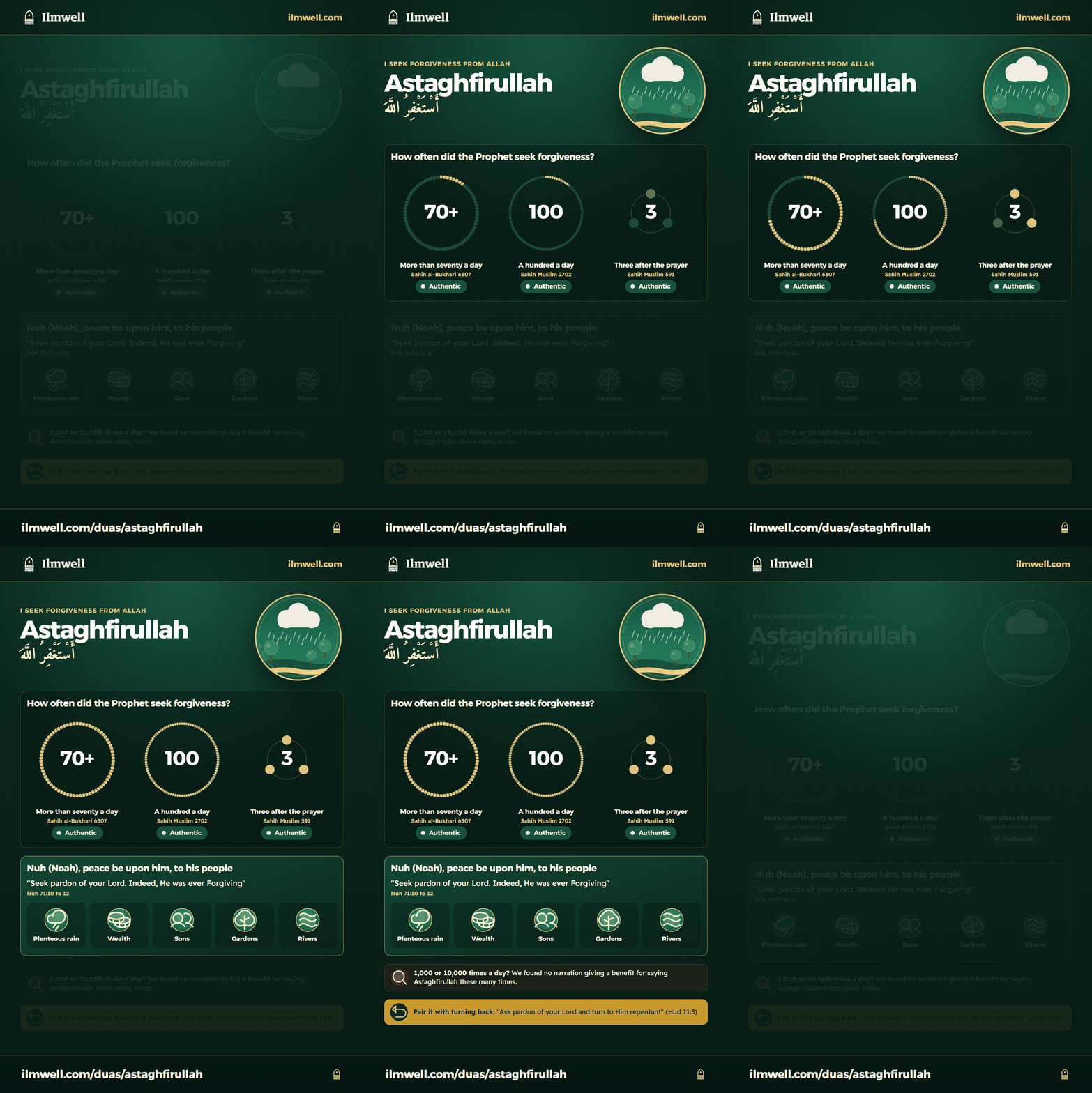
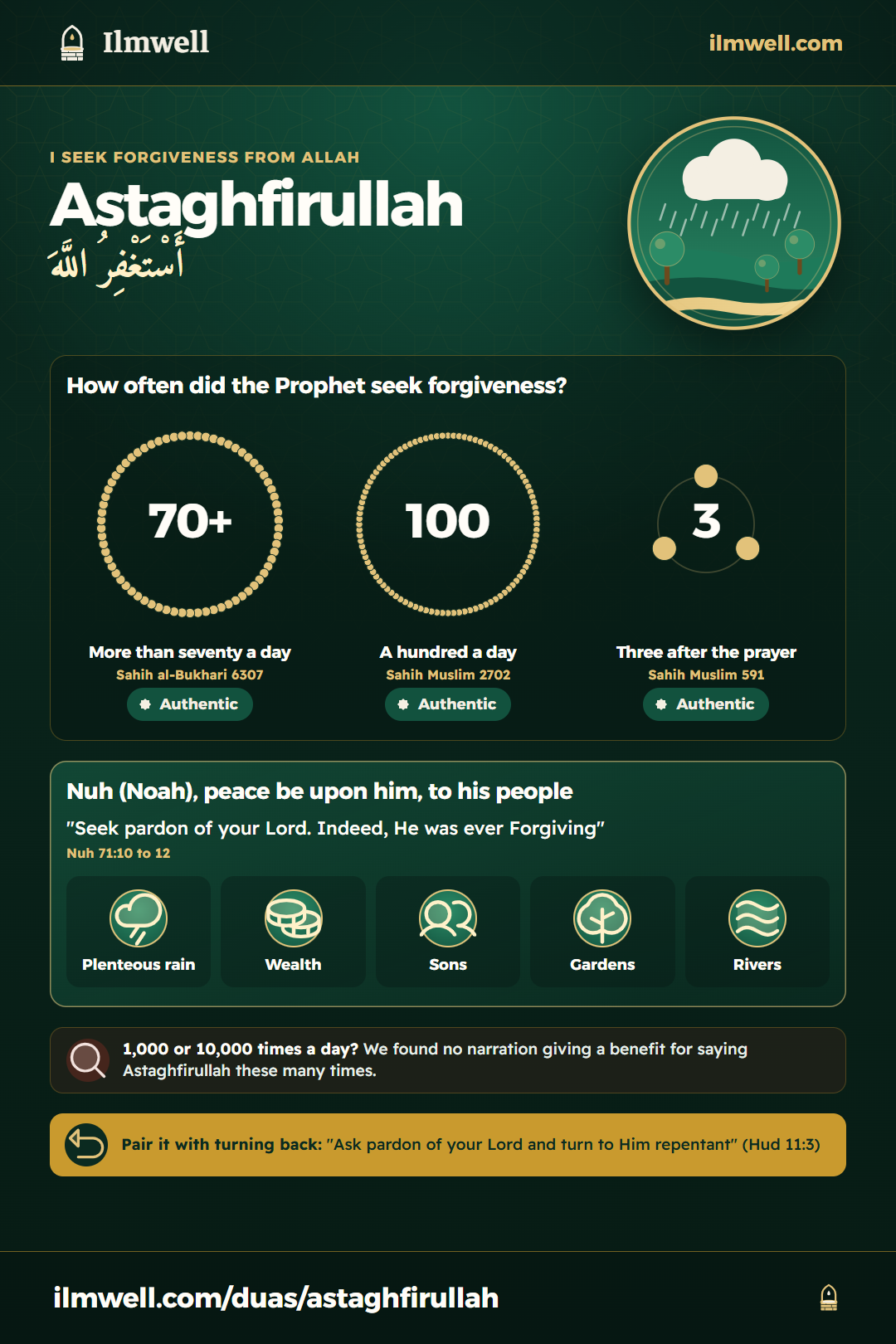
Astaghfirullah infographic: I seek forgiveness from Allah. How often did the Prophet seek forgiveness? More than seventy times a day (Sahih al-Bukhari 6307, authentic); a hundred times a day (Sahih Muslim 2702, authentic); three times after the prayer (Sahih Muslim 591, authentic). Nuh, peace be upon him, to his people: seek pardon of your Lord, indeed He was ever Forgiving; plenteous rain, wealth, sons, gardens and rivers (Nuh 71:10 to 12). 1,000 or 10,000 times a day? We found no narration giving a benefit for these counts. Pair it with turning back: ask pardon of your Lord and turn to Him repentant (Hud 11:3).
The counts, the verse and the myth to drop, in one picture. Save it, print it, or share it.
Posting it on your own site? Link back to this guide; the code under "Use it on your own site" does it in one line.
When do Muslims say Astaghfirullah?
After the prayer
Thawban, may Allah be pleased with him, narrated that when the Prophet finished his prayer, he sought forgiveness three times and said "Allahumma anta al-salam wa minka al-salam, tabarakta dha al-jalali wa al-ikram".
One narrator, al-Walid, asked al-Awza'i, a scholar in the chain, how the seeking of forgiveness was done. He answered: you say "astaghfirullah, astaghfirullah". The wording is al-Awza'i's explanation.
3AuthenticSahih Muslim 591
After a sin
'Ali ibn Abi Talib, may Allah be pleased with him, said Abu Bakr, may Allah be pleased with him, told him what he heard the Prophet say. No servant commits a sin, then purifies himself well, stands and prays two rak'ahs (units of prayer), then seeks Allah's forgiveness, except that Allah forgives him. The narration then quotes Al Imran 3:135.
People call this salat al-istighfar or salat al-tawbah; the narration gives it no name. Al-Tirmidhi's version (406) says "then prays" without a number of rak'ahs.
In the moment
Say you snap at your little brother over the TV remote and regret it a minute later. Astaghfirullah asks Allah's forgiveness right there.
You will also hear it said in shock at something wrong. That is an everyday habit; the narrations above are about seeking forgiveness.
In our house astaghfirullah usually meant "that's enough". I was into my late teens before I heard it said gently, as a quiet way of asking Allah to forgive. It changed what I hear when someone says it.
Try it: what would you say?
Three quick questions. Pick an answer; each one explains itself.
1What does Astaghfirullah mean?
Answer: I seek forgiveness from Allah. Astaghfiru means "I seek forgiveness"; the second word is Allah.
2You have just finished your prayer. In the hadith of Thawban, what did the Prophet do?
Answer: Sought forgiveness three times. He sought forgiveness three times and said "Allahumma anta al-salam wa minka al-salam". Source 3
3A friend says "Ya Hayyu ya Qayyum, bi-rahmatika astaghith". What is your friend asking for?
Answer: Help. Astaghith (also written astaghees) means "I seek help". Astaghfir means "I seek forgiveness". Source 6
What are the benefits of istighfar?
Claims that istighfar brings money or children draw on Nuh 71:10 to 12, where Nuh, peace be upon him, recounts what he told his people. Here are the verses themselves:
فَقُلْتُ ٱسْتَغْفِرُوا۟ رَبَّكُمْ إِنَّهُۥ كَانَ غَفَّارًا يُرْسِلِ ٱلسَّمَآءَ عَلَيْكُم مِّدْرَارًا وَيُمْدِدْكُم بِأَمْوَٰلٍ وَبَنِينَ وَيَجْعَل لَّكُمْ جَنَّـٰتٍ وَيَجْعَل لَّكُمْ أَنْهَـٰرًا
Hud 11:3, above, adds: "He will cause you to enjoy a fair estate until a time appointed".
The hadith about a way out of every distress
A report from Ibn Abbas, may Allah be pleased with him, says the Prophet said that whoever keeps to seeking forgiveness, Allah makes for him a way out of every distress and relief from every worry. It adds that Allah provides for him from where he does not expect. It is graded differently: weak by most of the scholars we found, hasan by others.
5Graded differently Sunan Abi Dawud 1518
Astaghfirullah 1,000 or 10,000 times?
The Ilmwell team searched sunnah.com and the dorar.net hadith encyclopedia on 21 October 2026 and found no narration giving a benefit for saying astaghfirullah 1,000 or 10,000 times (source 7).
The wording the Prophet used himself is Astaghfirullah wa atubu ilayh, in Sahih al-Bukhari 6307, graded sahih.
What does Ya Hayyu Ya Qayyum birahmatika astaghees mean?
It means "O Ever-Living, O Self-Sustaining, by Your mercy I seek help". It asks for help, not forgiveness: astaghīth (often written astaghees) is a different word from astaghfir. Anas ibn Malik, may Allah be pleased with him, said that whenever a matter distressed the Prophet, he would say it.
يَا حَىُّ يَا قَيُّومُ بِرَحْمَتِكَ أَسْتَغِيثُ
6Graded differently Jami' at-Tirmidhi 3524
The two names, al-Hayy and al-Qayyum, also appear in Ayat al-Kursi (Al-Baqarah 2:255).
Common mix-ups
- Astaghfirullah asks forgiveness. Alhamdulillah praises Allah. Mashallah credits His will.
Questions people ask
What is the istighfar dua?
The everyday wording is Astaghfirullah, and the Prophet, peace be upon him, used Astaghfirullah wa atubu ilayh in Sahih al-Bukhari 6307 (graded sahih).
How do you spell Astaghfirullah?
Astaghfirullah is the usual English spelling. Astagfirullah, Astaghfirallah, Astaghfurillah and Astaghfurullah are other ways of writing the same two Arabic words.
Sources
Every claim on this page comes from one of these. Gradings are reported with the scholar's name; we do not grade hadith ourselves.
- 1
Abu Hurayrah heard the Prophet say, swearing by Allah, that he seeks Allah's forgiveness and turns to Him in repentance (astaghfiru Allaha wa atubu ilayh) more than seventy times a day.
Sahih al-Bukhari 6307 Book 80, Hadith 4
Authentic: in Sahih al-Bukhari
- 2
Al-Agharr al-Muzani reported that the Prophet said something comes over his heart, and that he seeks Allah's forgiveness a hundred times a day.
Sahih Muslim 2702 Book 48, Hadith 52
Authentic: in Sahih Muslim
- 3
Thawban reported that when the Prophet finished his prayer he sought forgiveness three times and said 'Allahumma anta al-salam wa minka al-salam, tabarakta dha al-jalali wa al-ikram'; asked how the seeking of forgiveness was, al-Awza'i (a narrator in the chain) said: you say 'astaghfirullah, astaghfirullah'.
Sahih Muslim 591 Book 5, Hadith 171
Authentic: in Sahih Muslim
- 4
Abu Bakr heard the Prophet say that no servant commits a sin, then purifies himself well, stands and prays two rak'ahs, then seeks Allah's forgiveness, except that Allah forgives him; the narration then quotes Al Imran 3:135.
Sunan Abi Dawud 1521 Book 8, Hadith 106
Graded differently. Here is who graded it which way:
- SoundAl-Albani, Shu'ayb al-Arna'ut, Al-Mundhiri, Ibn Muflih, Al-Tirmidhi, Darussalam, Ibn Baz
- WeakAl-Bukhari
- Other remarksAl-Zayla'i, Abu Dawud, Al-'Iraqi
See each grading in full, with its wording and where it was given
Scholars disagree about this hadith. Here is how each graded it, so you can follow the scholar you trust.
- Sahih: Al-Albani (as shown on sunnah.com; also Sahih Abi Dawud 1521 as listed on dorar.net)
- صحيح (Sahih): Al-Albani, Sahih al-Targhib 1621 (as listed on dorar.net)
- إسناده حسن (its chain is hasan): Shu'ayb al-Arna'ut, takhrij Sunan Abi Dawud, no. 1521 (as listed on dorar.net)
- إسناده صحيح أو حسن أو ما قاربهما (its chain is sahih or hasan or close to them): Al-Mundhiri, al-Targhib wa al-Tarhib 2/385 (as listed on dorar.net)
- حسن (Hasan): Ibn Muflih, al-Furu' 2/403 (as listed on dorar.net)
- حديث حسن (hasan): Al-Tirmidhi, in the Arabic text after Jami' at-Tirmidhi 406 (as shown on sunnah.com)
- Hasan: Darussalam, on Jami' at-Tirmidhi 406 (as shown on sunnah.com)
- [فيه] أسماء بن الحكم قال ابن حبان يخطئ وقال البزار مجهول (it contains Asma' ibn al-Hakam: Ibn Hibban said he errs, al-Bazzar said he is unknown): Al-Zayla'i, Takhrij al-Kashshaf 1/429 (as listed on dorar.net)
- لم يرو عن ابن أبي الحر إلا هذا الحديث وحديث آخر ولم يتابع (only this hadith and one other are narrated from him, and he is not corroborated): Al-Bukhari, as quoted in Ibn al-Qayyim, Tahdhib al-Sunan 4/383 (as listed on dorar.net; the same remark on Asma' ibn al-Hakam is quoted in al-Mizzi, Tahdhib al-Kamal 2/533, and Ibn 'Adi, al-Kamil 2/142)
- سكت عنه (he was silent about it, which by his own stated rule means fit to use): Abu Dawud, Sunan Abi Dawud, no. 1521 (as listed on dorar.net)
- [روي] مرفوعاً وموقوفاً (narrated both as the Prophet's words and as a companion's): Al-'Iraqi, Takhrij al-Ihya' 4/58 (as listed on dorar.net)
- ثابت (thabit, established): Ibn Baz, Majmu' Fatawa Ibn Baz 4/226 (as listed on dorar.net)
- ثابت (thabit, established): Ibn Baz, Majmu' Fatawa Ibn Baz 11/421 (as listed on dorar.net)
- ثابت (thabit, established): Ibn Baz, Majmu' Fatawa Ibn Baz 28/441 (as listed on dorar.net)
- إسناده صحيح (its chain is sahih): Ibn Baz, Majmu' Fatawa Ibn Baz 11/424 (as listed on dorar.net)
- صحيح (Sahih): Ibn Baz, Fatawa Nur 'ala al-Darb 11/85 (as listed on dorar.net)
- صحيح (Sahih): Al-Albani, Sahih al-Jami' 5738 (as listed on dorar.net)
- 5
A report from Ibn Abbas says the Prophet said that whoever keeps to seeking forgiveness (man lazima al-istighfar), Allah makes for him a way out of every distress and relief from every worry, and provides for him from where he does not expect.
Sunan Abi Dawud 1518 Book 8, Hadith 103
Graded differently. Here is who graded it which way:
- SoundAl-Mundhiri, Ibn Hajar al-'Asqalani
- WeakAl-Albani, Shu'ayb al-Arna'ut, Al-Mundhiri, Ibn Baz, Sadr al-Din al-Munawi
- Other remarksAbu Dawud, 'Abd al-Haqq al-Ishbili
See each grading in full, with its wording and where it was given
Scholars disagree about this hadith. Here is how each graded it, so you can follow the scholar you trust.
- Da'if: Al-Albani (as shown on sunnah.com; also Da'if Abi Dawud 1518 as listed on dorar.net)
- ضعيف (weak): Al-Albani, Da'if al-Jami' 5829 and Da'if al-Targhib 1145 (as listed on dorar.net)
- إسناده ضعيف (its chain is weak): Shu'ayb al-Arna'ut, takhrij Sunan Abi Dawud, no. 1518 (as listed on dorar.net)
- [فيه] الحكم بن مصعب، ولا يحتج به (it contains al-Hakam ibn Mus'ab, who is not used as proof): Al-Mundhiri, Mukhtasar Sunan Abi Dawud, 1/439 (as listed on dorar.net)
- في إسناده الحكم بن مصعب وهو مجهول (its chain has al-Hakam ibn Mus'ab, who is unknown): Ibn Baz, Hashiyat Bulugh al-Maram 828 (as listed on dorar.net)
- في إسناده الحكم بن مصعب ولا يحتج به (its chain has al-Hakam ibn Mus'ab, who is not used as proof): Sadr al-Din al-Munawi, Kashf al-Manahij 2/290 (as listed on dorar.net)
- لا ينزل عن درجة الحسن (not below the level of hasan, by the rule in his introduction): Al-Mundhiri, al-Targhib wa al-Tarhib 3/57 (as listed on dorar.net)
- حسن (Hasan, by the rule stated in his introduction): Ibn Hajar al-'Asqalani, Hidayat al-Ruwat 2/448 (as listed on dorar.net)
- سكت عنه (he was silent about it, which by his own stated rule means fit to use): Abu Dawud, Sunan Abi Dawud, no. 1518 (as listed on dorar.net)
- سكت عنه (he was silent about it, which by his stated rule indicates soundness if he names no defect): 'Abd al-Haqq al-Ishbili, al-Ahkam al-Wusta 4/317 (as listed on dorar.net)
- 6
Anas ibn Malik said that whenever a matter distressed the Prophet, he would say: 'Ya Hayyu ya Qayyum, bi-rahmatika astaghith' (O Living, O Self-Sustaining, by Your mercy I seek help).
Jami' at-Tirmidhi 3524 Book 48, Hadith 155
Graded differently. Here is who graded it which way:
- SoundDarussalam, Al-Albani
- Weak chain, strengthenedShu'ayb al-Arna'ut
- WeakAl-Suyuti, Ibn Hajar al-'Asqalani, Shu'ayb al-Arna'ut
- Other remarksAl-Tirmidhi
See each grading in full, with its wording and where it was given
Scholars disagree about this hadith. Here is how each graded it, so you can follow the scholar you trust.
- غريب (gharib: known through a single route): Al-Tirmidhi, in the Arabic text after the hadith (as shown on sunnah.com)
- Hasan: Darussalam (as shown on sunnah.com)
- حسن (Hasan): Al-Albani, Sahih al-Tirmidhi 3524 (as listed on dorar.net)
- صحيح (Sahih): Al-Albani, Sahih al-Jami' 4777 (as listed on dorar.net)
- ضعيف (weak): Al-Suyuti, al-Jami' al-Saghir 6768 (as listed on dorar.net)
- في إسناده يزيد بن أبان الرقاشي، وهو ضعيف (its chain has Yazid ibn Aban al-Raqashi, who is weak): Ibn Hajar al-'Asqalani, Nata'ij al-Afkar 2/409 (as listed on dorar.net)
- [فيه] يزيد بن أبان الرقاشي، وهو ضعيف (it contains Yazid ibn Aban al-Raqashi, who is weak): Shu'ayb al-Arna'ut, takhrij Zad al-Ma'ad 4/180 (as listed on dorar.net)
- فيه يزيد الرقاشي، وهو ضعيف، لكن له شاهد يتقوى به الحديث (it contains Yazid al-Raqashi, who is weak, but it has a supporting narration that strengthens it): Shu'ayb al-Arna'ut, takhrij Sharh al-Sunna 5/123 (as listed on dorar.net)
- Q
Quran Arabic for Hud 11:3 and Nuh 71:10 to 12, and their English. Al Imran 3:135 and Al-Baqarah 2:255 are referred to by number.
Tanzil Project Uthmani text, CC BY 3.0. English: adapted from Marmaduke Pickthall's translation (1930), modernised and checked against modern translations.
- 7
Our search for repetition counts: sunnah.com site search and the dorar.net encyclopedia, 21 October 2026, for 1,000 and 10,000 recitations of astaghfirullah. sunnah.com: the first 50 results of each search held no narration pairing seeking forgiveness with 1,000 or 10,000 repetitions (the site search matches any of the words, so results run to thousands of loosely related hadith). dorar.net: the istighfar counts in the narrations returned were seventy a day, a hundred a day (al-Agharr's report, as in Sahih Muslim 2702, and a report from Abu Hurayrah in Hilyat al-Awliya'), twenty on rising from a gathering, and twenty-five (a companion reporting that the Prophet sought forgiveness for him). Larger numbers in the narrations returned (seventy thousand angels seeking forgiveness for someone; a reward for saying la ilaha illallah ten thousand times) are other claims, not counts of saying astaghfirullah. No hadith result gave a benefit for saying astaghfirullah 1,000 or 10,000 times.
dorar.net hadith encyclopedia and sunnah.com Record: search-istighfar-counts, with every search term and result.
Next
- Sayyidul istighfar: words, meaning and contextDua lesson
- Alhamdulillah: meaning, pronunciation and everyday usePhrase lesson
- Mashallah: meaning and when to say itPhrase lesson
- Ayat al-Kursi: meaning and virtuesQuran lesson
- Duas, Remembrance and PhrasesThe hub
For your own situation, ask a scholar you trust.
Join the email list
New guides by email, now and then. No spam, and you can leave at any time.
Ilmwell is free and kept going by readers. See how to support it.