The short answer
Sayyidul istighfar is a supplication for forgiveness taught by the Prophet Muhammad, peace be upon him, in Sahih al-Bukhari 6306, graded sahih. It begins with Allahumma anta Rabbi. The report says whoever says it with certainty by day and dies before evening, or at night and dies before morning, is among the people of Paradise.
What are the words of Sayyidul istighfar?
Shaddad ibn Aws, may Allah be pleased with him, reports that the Prophet said sayyid al-istighfar (also spelt sayyid al istighfar) is to say these words. The name can be translated "the master of seeking forgiveness". It is the report's name for the dua, not the first word you say: the words begin Allahumma anta Rabbi.
Sahih al-Bukhari 6306
اللَّهُمَّ أَنْتَ رَبِّي، لاَ إِلَهَ إِلاَّ أَنْتَ، خَلَقْتَنِي وَأَنَا عَبْدُكَ، وَأَنَا عَلَى عَهْدِكَ وَوَعْدِكَ مَا اسْتَطَعْتُ، أَعُوذُ بِكَ مِنْ شَرِّ مَا صَنَعْتُ، أَبُوءُ لَكَ بِنِعْمَتِكَ عَلَىَّ وَأَبُوءُ لَكَ بِذَنْبِي، فَاغْفِرْ لِي، فَإِنَّهُ لاَ يَغْفِرُ الذُّنُوبَ إِلاَّ أَنْتَ
Allāhumma anta rabbī, lā ilāha illā anta, khalaqtanī wa ana ʿabduka, wa ana ʿalā ʿahdika wa waʿdika mastaṭaʿtu. Aʿūdhu bika min sharri mā ṣanaʿtu. Abū'u laka biniʿmatika ʿalayya wa abū'u laka bidhanbī, faghfir lī fa-innahū lā yaghfirudh-dhunūba illā anta.
O Allah, You are my Lord. There is no god but You. You created me and I am Your servant. I hold to Your covenant and promise as far as I can. I seek Your refuge from the evil of what I have done. I acknowledge Your favour upon me and I acknowledge my sin. Forgive me, for no one forgives sins but You.
1AuthenticSahih al-Bukhari 6306
Latin letters only approximate Arabic. In the transliteration, ʿ stands for the letter ayn (heard in ʿabduka, ʿahdika, waʿdika, mastaṭaʿtu, ṣanaʿtu and ʿalayya) and a line over a vowel marks a long one. Until then, a teacher can correct what letters cannot show.
How can you learn it clause by clause?
Learn one complete clause at a time, then join them in the report's order. The seven segments below are our learning aid. They are not divisions made by the report, and they are not repetitions the report asks for.
| Learning segment | What the words say |
|---|---|
| Allahumma anta Rabbi, la ilaha illa anta | O Allah, You are my Lord; there is no god but You |
| Khalaqtani wa ana ʿabduka | You created me and I am Your servant |
| Wa ana ʿalā ʿahdika wa waʿdika mastaṭaʿtu | I am upon Your covenant and Your promise as much as I am able |
| A'udhu bika min sharri mā ṣanaʿtu | I seek Your refuge from the evil of what I have done |
| Abu'u laka biniʿmatika ʿalayya | I acknowledge Your favour upon me |
| Wa abu'u laka bidhanbi | and I acknowledge my sin |
| Faghfir li, fa innahu la yaghfirudh-dhunuba illa anta | Forgive me, for no one forgives sins but You |
Say the bus is due in four minutes. One clause is easy to carry to the stop; the whole wording in one go is harder. If you lose your place, return to the start of the clause you were on. That is a learning suggestion and no part of what the report says.
When is it said, and what does the report promise?
Sahih al-Bukhari 6306 names two cases, by day and at night, and ties both to certainty: muqinan biha ("being certain of it") by day and wa huwa muqinun biha at night.
| The case in the report | Its stated result |
|---|---|
| Says it by day, being certain of it, and dies that day before evening | He is among the people of Paradise |
| Says it at night, being certain of it, and dies before morning | He is among the people of Paradise |
The report states no other reward and no repetition count, and it does not say what applies to someone who says it without certainty. It says day and night. For how it sits beside other remembrances for the start and end of the day, and the timing explanations given there, see Morning and evening adhkar, which lists it among seven entries. For the everyday phrase, see Astaghfirullah.
Does Sahih al-Bukhari give a second wording?
Yes. Shaddad also reports it in Sahih al-Bukhari 6323 (graded sahih), in a second wording, arranged differently. This is the Arabic of 6323:
Sahih al-Bukhari 6323
اللَّهُمَّ أَنْتَ رَبِّي لاَ إِلَهَ إِلاَّ أَنْتَ، خَلَقْتَنِي وَأَنَا عَبْدُكَ، وَأَنَا عَلَى عَهْدِكَ وَوَعْدِكَ مَا اسْتَطَعْتُ، أَبُوءُ لَكَ بِنِعْمَتِكَ، وَأَبُوءُ لَكَ بِذَنْبِي، فَاغْفِرْ لِي، فَإِنَّهُ لاَ يَغْفِرُ الذُّنُوبَ إِلاَّ أَنْتَ، أَعُوذُ بِكَ مِنْ شَرِّ مَا صَنَعْتُ
Allāhumma anta rabbī, lā ilāha illā anta, khalaqtanī wa ana ʿabduka, wa ana ʿalā ʿahdika wa waʿdika mastaṭaʿtu, abū'u laka biniʿmatika, wa abū'u laka bidhanbī, faghfir lī, fa-innahū lā yaghfirudh-dhunūba illā anta, aʿūdhu bika min sharri mā ṣanaʿtu.
2AuthenticSahih al-Bukhari 6323
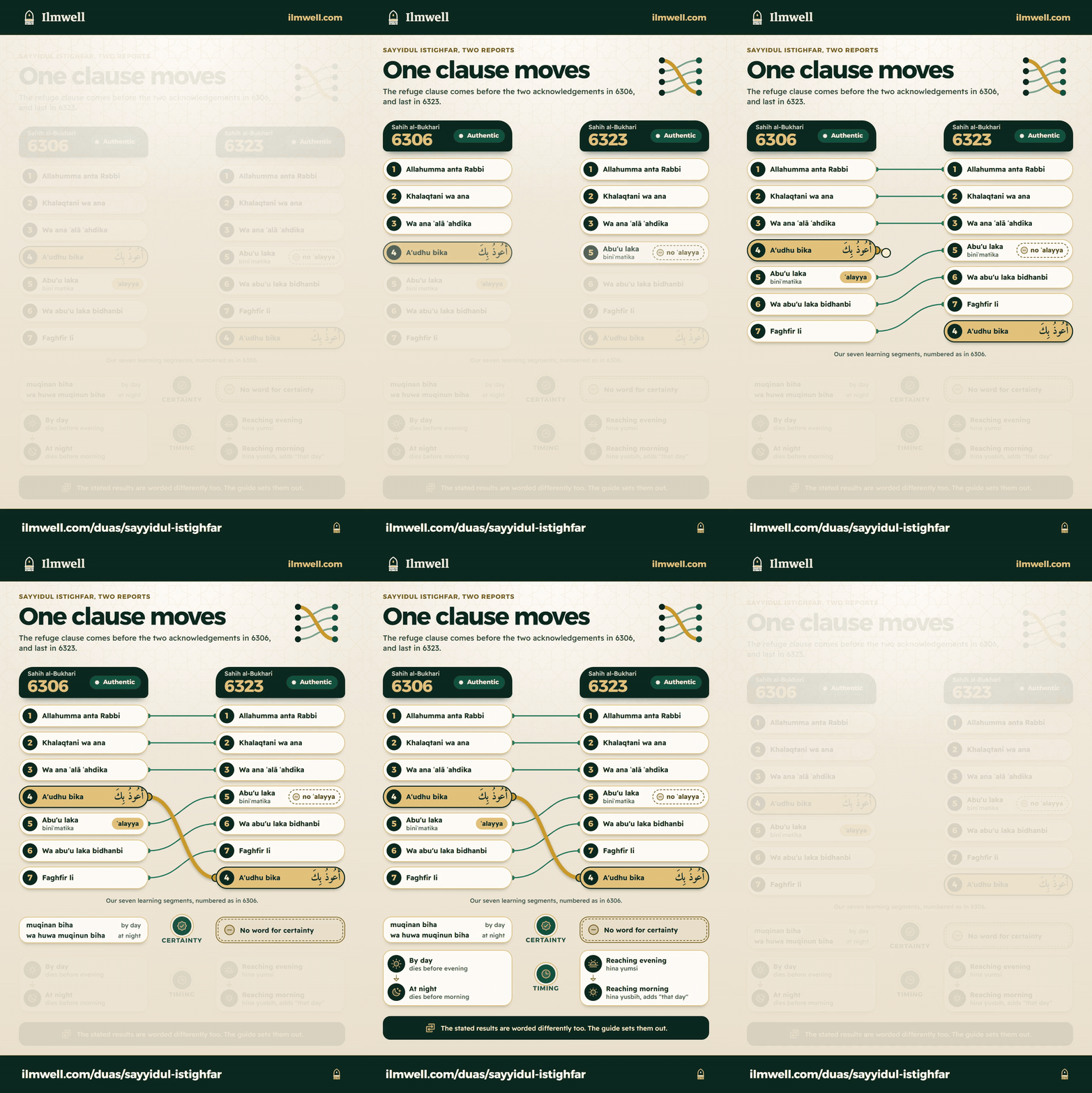
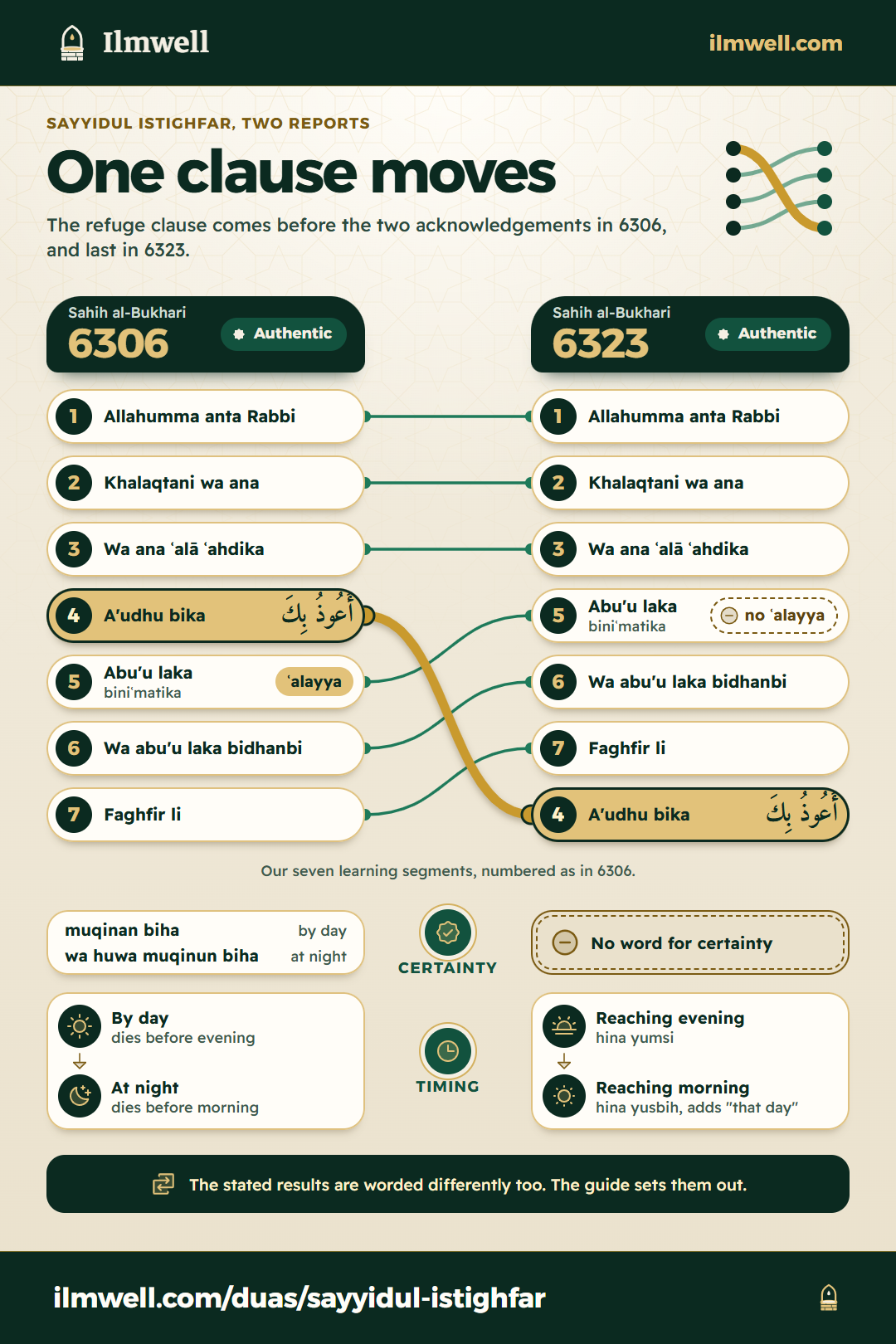
Read side by side on sunnah.com, these are the differences between the two reports:
| Point | Bukhari 6306 | Bukhari 6323 |
|---|---|---|
| Refuge clause (a'udhu bika) | After mastaṭaʿtu and before abū'u laka, before the two acknowledgements | Last clause |
| After bini'matika | Reads 'alayya | No 'alayya |
| Certainty | By day muqinan biha, at night wa huwa muqinun biha | No word for certainty |
| Timing | By day, then at night; dies before evening, before morning | When he reaches the evening (hina yumsi), then the morning (hina yusbih); only the morning case adds "that day" |
| Stated result | He is among the people of Paradise | Evening: he entered Paradise, "or" was among its people; morning: "the like of it" |
The learning table above follows 6306. This page compared only these two reports and did not look for others. If you learnt the other order, check it against the report you learnt it from. This page does not merge the two into one wording.
Sayyidul istighfar was one of those duas I knew by name long before I knew the words. Learning it a clause at a time, and seeing what each clause actually says, made it feel less like a long text to memorise.
Try it: what would you say?
Pick an answer; each one explains itself.
1Which words does the dua itself begin with?
Answer: Allahumma anta Rabbi. Sayyid al-istighfar is the name the report gives it. The words you say begin Allahumma anta Rabbi. Source 1
2What does Sahih al-Bukhari 6306 attach to its promise besides the time?
Answer: Saying it with certainty. The report says by day or at night, being certain of it. It names no count. Source 1
3Which clause closes the wording in Sahih al-Bukhari 6323?
Answer: A'udhu bika min sharri ma sana'tu. In 6323 the refuge clause comes last. In 6306 it comes before the two acknowledgements. Source 2
4Does 6323 include the word 'alayya after bini'matika?
Answer: No. No. 6306 reads bini'matika 'alayya; 6323 reads bini'matika and stops. Source 2
Questions people ask
How is Sayyidul istighfar different from Astaghfirullah?
Astaghfirullah is the everyday phrase for "I seek forgiveness from Allah". Sayyidul istighfar is the longer wording taught in Sahih al-Bukhari 6306 (graded sahih), with its own acknowledgements and request. The Astaghfirullah lesson covers the everyday phrase.
Is there a Bangla version on this page?
No. This page gives the Arabic, a transliteration in English letters and an English meaning. We have not added a Bangla translation because we have no checked source for one.
Sources
Every claim on this page comes from one of these. Gradings are reported with the scholar's name; we do not grade hadith ourselves.
- 1
Shaddad ibn Aws reported the Prophet saying that sayyid al-istighfar (the master of seeking forgiveness) is this wording, and that whoever says it by day with firm conviction and dies that day before evening, or says it at night with firm conviction and dies before morning, is among the people of Paradise.
Sahih al-Bukhari 6306 Book 80, Hadith 3
Authentic: in Sahih al-Bukhari
- 2
Shaddad ibn Aws (may Allah be pleased with him) reported the Prophet teaching the same supplication (sayyid al-istighfar) in a second wording in Sahih al-Bukhari 6323, and the promise is stated for saying it on reaching the evening and on reaching the morning.
Sahih al-Bukhari 6323 Book 80, Hadith 20
Authentic: in Sahih al-Bukhari
Next
For your own situation, ask a scholar you trust.
Join the email list
New guides by email, now and then. No spam, and you can leave at any time.
Ilmwell is free and kept going by readers. See how to support it.