The short answer
Inshallah means "if Allah wills", from the Arabic words in sha' Allah. Muslims say it about plans and hopes: "see you tomorrow, inshallah". The Quran says, in Al-Kahf 18:23 to 24: "And say not of anything: Indeed, I shall do that tomorrow, except if Allah wills."
How do you write inshallah in Arabic?
Al-Kahf 18:69
إِن شَآءَ ٱللَّهُ
in shā'a llāh
If Allah wills
These are the exact words as they appear in Al-Kahf 18:69. To copy and paste inshallah in Arabic, use the button under it.
What does inshallah mean?
In English, inshallah means "if Allah wills", or "Allah willing". It is three Arabic words:
Arabic reads right to left, so the first word is on the right.
- إِنinifSets a condition.
- شَآءَshā'awills, has willedFrom the verb "to will". Mashallah uses the same verb.
- ٱللَّهُAllāhAllahThe one whose will it is.
So "see you tomorrow, inshallah" says: tomorrow, if Allah wills it.
Where does inshallah come from in the Quran?
Al-Kahf 18:23 to 24 speaks of saying you will do something tomorrow:
وَلَا تَقُولَنَّ لِشَا۟ىْءٍ إِنِّى فَاعِلٌ ذَٰلِكَ غَدًا إِلَّآ أَن يَشَآءَ ٱللَّهُ ۚ وَٱذْكُر رَّبَّكَ إِذَا نَسِيتَ وَقُلْ عَسَىٰٓ أَن يَهْدِيَنِ رَبِّى لِأَقْرَبَ مِنْ هَـٰذَا رَشَدًا
The Arabic there is إِلَّآ أَن يَشَآءَ ٱللَّهُ, illā an yashā'a llāh, "except that Allah wills". The exact words people say, in shā'a llāh, come in six verses. The Ilmwell team counted them in the Tanzil text of the Quran on 21 October 2026:
| Verse | Who says it | The words |
|---|---|---|
| Al-Baqarah 2:70 | The people of Musa (Moses), peace be upon him | "if Allah wills, we may be led aright" |
| Yusuf 12:99 | Yusuf (Joseph), peace be upon him | "Come into Egypt safe, if Allah will" |
| Al-Kahf 18:69 | Musa | "Allah willing, you shall find me patient" |
| Al-Qasas 28:27 | The father of the two women, to Musa | "Allah willing, you will find me of the righteous" |
| As-Saffat 37:102 | The son of Ibrahim (Abraham), peace be upon them | "Allah willing, you shall find me of the steadfast" |
| Al-Fath 48:27 | Allah | "You shall indeed enter the Inviolable Place of Worship, if Allah wills" |
Three of them use the same Arabic word, satajiduni, "you will find me", about how the speaker will turn out.
In sha Allah in the Quran, in one picture
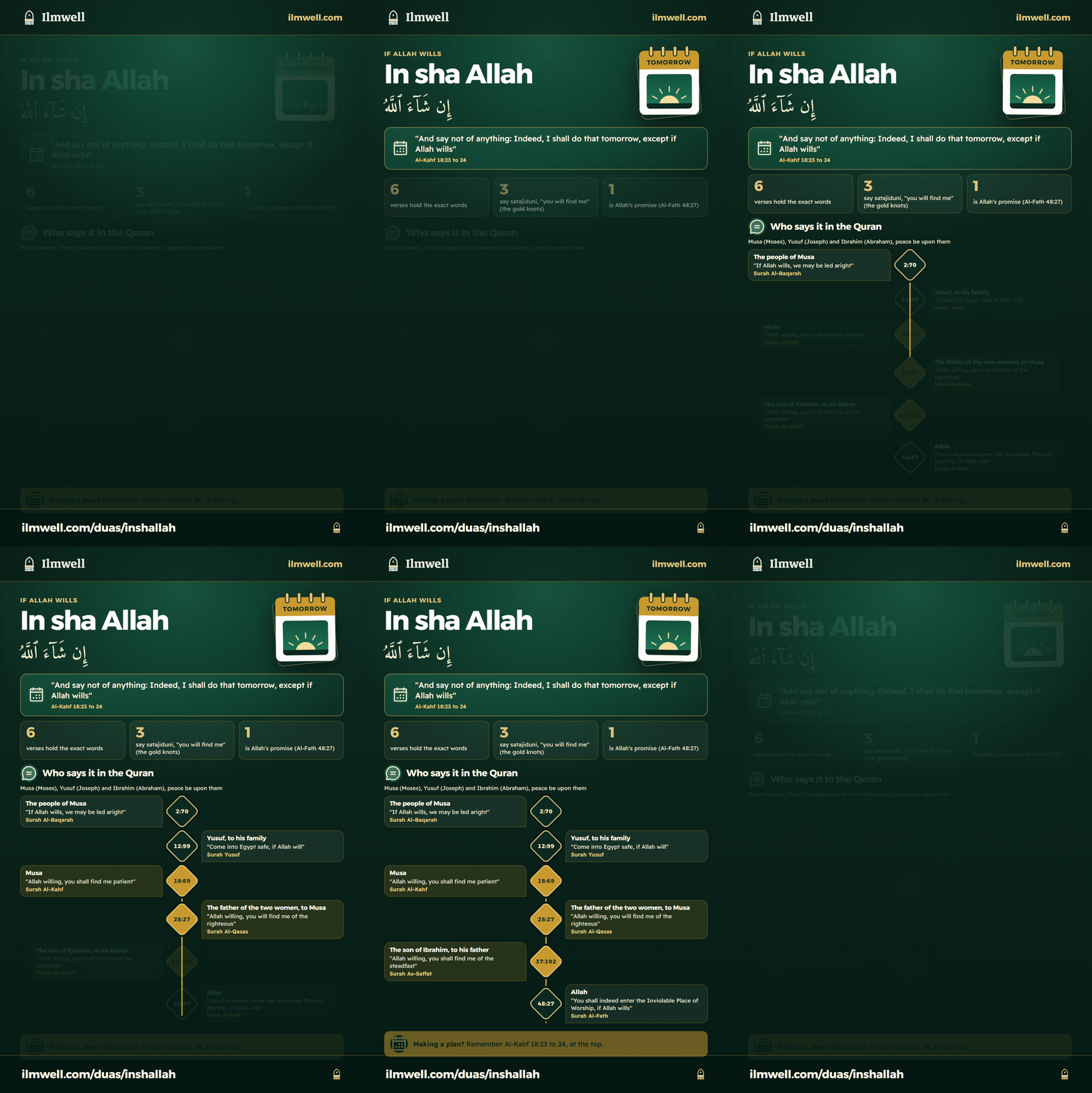
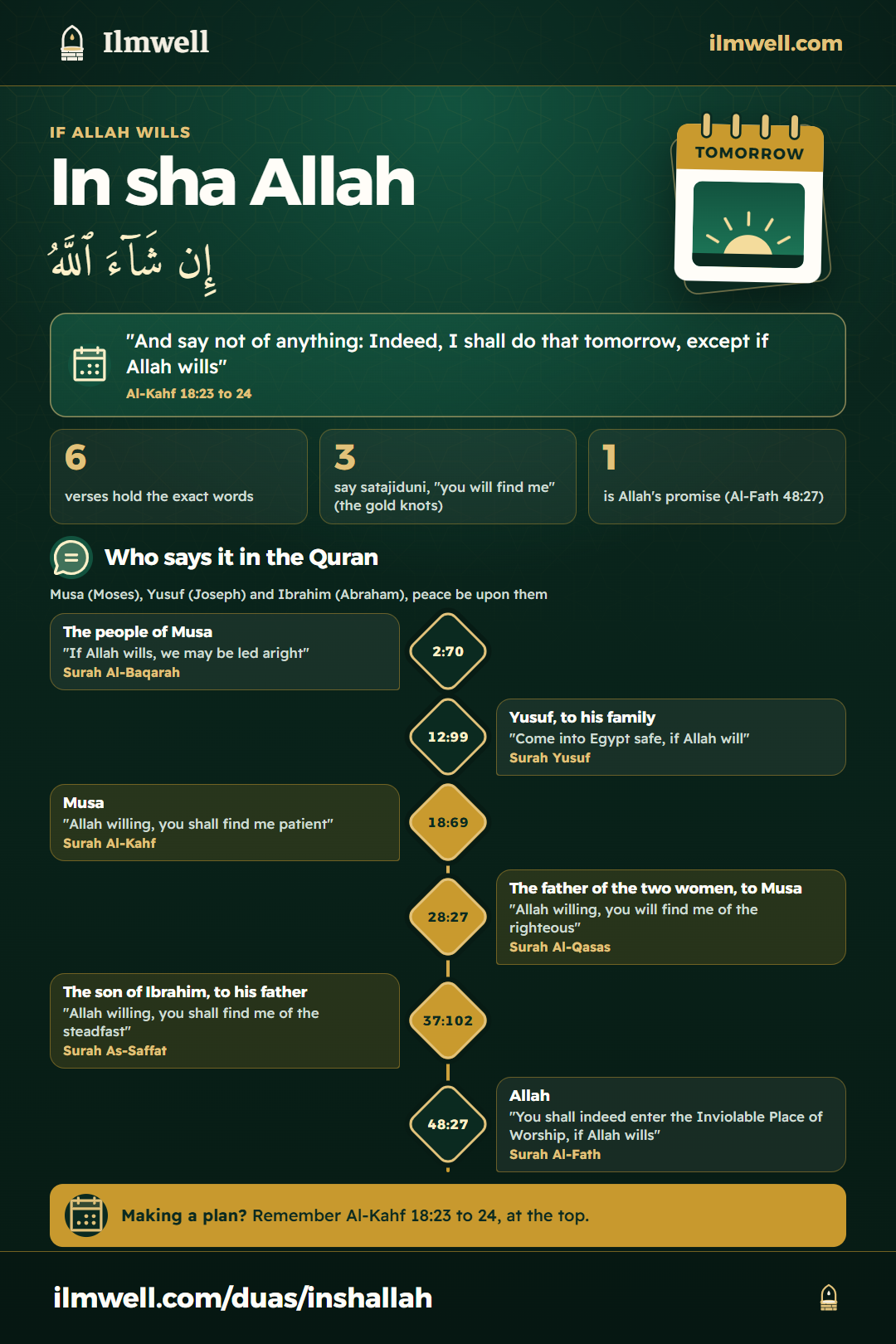
In sha Allah infographic: if Allah wills. Al-Kahf 18:23 to 24: and say not of anything, indeed I shall do that tomorrow, except if Allah wills. Six verses hold the exact words; three say satajiduni, you will find me; one is Allah's promise (Al-Fath 48:27). Who says it: the people of Musa (Al-Baqarah 2:70); Yusuf, to his family (Yusuf 12:99); Musa (Al-Kahf 18:69); the father of the two women, to Musa (Al-Qasas 28:27); the son of Ibrahim, to his father (As-Saffat 37:102); Allah (Al-Fath 48:27). Making a plan? Remember Al-Kahf 18:23 to 24.
The six verses with who says each one, as a picture to save or share.
Posting it on your own site? Link back to this guide; the code under "Use it on your own site" does it in one line.
Is it inshallah or in sha Allah?
Both spell the same three Arabic words in English letters. You will also see insha Allah, inshaAllah, inshaallah and insh'allah. Insha Allah means exactly what inshallah means. None of the sources on this page sets an English spelling.
The six verses write it in Arabic script as three separate words. Written as one word, inshā' is a different word, "creating". Al-Waqi'ah 56:35 uses it, إِنشَآءً: "Indeed, We have created them a (new) creation."
How do you pronounce inshallah?
inshāallāh
- The first syllable, in, is short, as in the English word "in".
- shā has a long a, as in "father", then a short catch in the throat, the sound in the middle of "uh-oh".
- lāh is long and full, with a doubled l: al-lāh.
Listen and repeat. A recorded pronunciation by a fluent reciter is coming. We do not use a synthetic voice for Arabic.
When do Muslims say inshallah?
About something that has not happened yet: a plan, or a hope. The sources give no fixed list. Here are two everyday scenes and two from the hadith.
Making a plan
Your mum asks if you will be home for dinner on Sunday. "I'll be there, inshallah."
Hoping for something
Friday is your cousin's third driving test. "You'll pass this time, inshallah."
Visiting someone who is ill
Ibn Abbas, may Allah be pleased with him, said that whenever the Prophet Muhammad, peace be upon him, visited someone who was ill, he would say: no harm, a purification, if Allah wills.
لاَ بَأْسَ طَهُورٌ إِنْ شَاءَ اللَّهُ
La ba's, tahurun in sha Allah
1AuthenticSahih al-Bukhari 5656
At the graves
Buraydah, may Allah be pleased with him, said the Prophet taught them what to say when they went out to the graves. Their words included: and we, if Allah wills, will indeed follow.
وَإِنَّا إِنْ شَاءَ اللَّهُ لَلَاحِقُونَ
Wa inna in sha Allahu la-lahiqun
2AuthenticSahih Muslim 975
Which hadith is about not saying inshallah?
Abu Hurayrah, may Allah be pleased with him, reported that the Prophet told of Sulayman (Solomon) son of Dawud (David), peace be upon them. Sulayman said he would go round seventy women that night (ninety in another chain), and each would carry (that is, conceive) a horseman who would strive in Allah's cause. His companion said to him: in sha Allah. Sulayman did not say it. None of them carried anything except one, and it was missing one of its two sides. The Prophet said that had he said it, they would have striven in Allah's cause.
3AuthenticSahih al-Bukhari 3424the narration ends: two narrators said ninety, and that is more correct
How do you reply to inshallah?
We found no hadith that sets a reply (source 4). You will often hear inshallah said back, or Ameen, the word said after a dua.
Is it inshallah or mashallah?
Inshallah looks ahead, to plans and hopes. Mashallah, "what Allah wills", is said about good that is already there. The Mashallah lesson sets the two side by side, with an example of each.
A colleague once asked me, half joking, whether inshallah meant no. I laughed, then realised I had earned the question. Since then I try to say it only when I mean it, and to follow through.
Try it: what would you say?
Three questions. Pick an answer; each one explains itself.
1A friend asks if you are coming to football on Saturday. What do you add to "I'll be there"?
Answer: Inshallah. Inshallah, "if Allah wills", goes with plans. Al-Kahf 18:23 to 24 is about saying you will do something tomorrow.
2Your gran is in hospital. What did the Prophet say when he visited someone who was ill?
Answer: La ba's, tahurun in sha Allah. "No harm, a purification, if Allah wills." Ibn Abbas reported it. Source 1
3In the hadith of Sulayman, what did his companion say to him?
Answer: In sha Allah. His companion said in sha Allah, and Sulayman did not say it. Source 3
Questions people ask
What does inshallah khair mean?
Khair (khayr) is Arabic for "good", so inshallah khair means "good, if Allah wills". People say it when they hope something will turn out well.
Can non-Muslims say inshallah?
Inshallah is an Arabic phrase meaning "if Allah wills". None of the sources on this page limits who says it.
Sources
Every claim on this page comes from one of these. Gradings are reported with the scholar's name; we do not grade hadith ourselves.
- 1
Whenever the Prophet visited a sick person, he would say: la ba's, tahurun in sha Allah (no harm, a purification, if Allah wills).
Sahih al-Bukhari 5656 Book 75, Hadith 16
Authentic: in Sahih al-Bukhari
- 2
The Prophet taught his companions what to say when they went out to the graves, including 'wa inna in sha Allahu la-lahiqun' (and we, if Allah wills, will indeed follow).
Sahih Muslim 975 Book 11, Hadith 133
Authentic: in Sahih Muslim
- 3
The Prophet told of Sulayman son of Dawud, who said seventy women would each carry a horseman to strive in Allah's cause. His companion said 'in sha Allah'; Sulayman did not say it, and the Prophet said that had he said it, they would have striven in Allah's cause.
Sahih al-Bukhari 3424 Book 60, Hadith 96
Authentic: in Sahih al-Bukhari
- 4
The Ilmwell team's search of sunnah.com and dorar.net on 21 October 2026 found no narration that sets a reply to someone who says in sha Allah. A search finding, not a grading.
dorar.net hadith encyclopedia Record: search-inshallah-reply, with every search term and result.
- Q
Quran Arabic for Al-Kahf 18:69, shown in the scroll and the word cards. Also Al-Kahf 18:23 to 24, the six verses in the table (Al-Baqarah 2:70, Yusuf 12:99, Al-Kahf 18:69, Al-Qasas 28:27, As-Saffat 37:102, Al-Fath 48:27) and Al-Waqi'ah 56:35, with their English. The count of six is the Ilmwell team's search of the Tanzil text for the three words.
Tanzil Project Uthmani text, CC BY 3.0. English: adapted from Marmaduke Pickthall's translation (1930), modernised and checked against modern translations.
Next
For your own situation, ask a scholar you trust.
Join the email list
New guides by email, now and then. No spam, and you can leave at any time.
Ilmwell is free and kept going by readers. See how to support it.