The short answer
Jazakallah khair means "may Allah reward you with good". It is a thank you, found in Jami' at-Tirmidhi 2035 (graded differently), where the Prophet Muhammad, peace be upon him, said that saying it to a person who did you a kindness goes to the utmost in praise. A common reply is "wa iyyak", a custom.
How is Jazakallah khair written in Arabic?
Jami' at-Tirmidhi 2035, graded differently
جَزَاكَ اللَّهُ خَيْرًا
jazāka llāhu khayran
May Allah reward you with good
This is the wording to one man. It is also spelt Jazak Allah khair, Jazakallahu khairan or Jazakallah khairan; the Arabic is the same. To copy and paste the Arabic, use the button under the scroll.
What does Jazakallah khair mean?
Jazakallah joins two Arabic words: "may Allah reward you". Khair is the Arabic khayran, "good". The meaning of the whole phrase, and of Jazakallahu khairan, is a request to Allah to reward you with good.
Arabic reads right to left, so the first word is on the right.
- جَزَاكَjazākamay He reward youFrom the root j-z-y (source 6).
- اللَّهُAllāhuAllahThe one asked to reward.
- خَيْرًاkhayrangoodThe opposite of sharr, evil (source 7).
In his dictionary of word roots, Mu'jam Maqayis al-Lughah, Ibn Faris (d. 395 AH) describes the root j-z-y as one thing standing in the place of another and repaying it. 6
Where is Jazakallah khair found in the hadith?
A hadith is a recorded report of what the Prophet said or did. Usamah ibn Zayd, may Allah be pleased with him, reports that the Prophet said: whoever has a kindness done to him and says to the one who did it "jazaka Allahu khayran" has gone to the utmost in praise.
1Graded differently Jami' at-Tirmidhi 2035
Graders differ. Nine of the listed graders accept it as hasan (good) or sahih (authentic). Two critics call it munkar (rejected), and one of them also called it fabricated with this chain. The sources list shows who said what. It names no reply.
How do you say Jazakallah khair to a woman or a group?
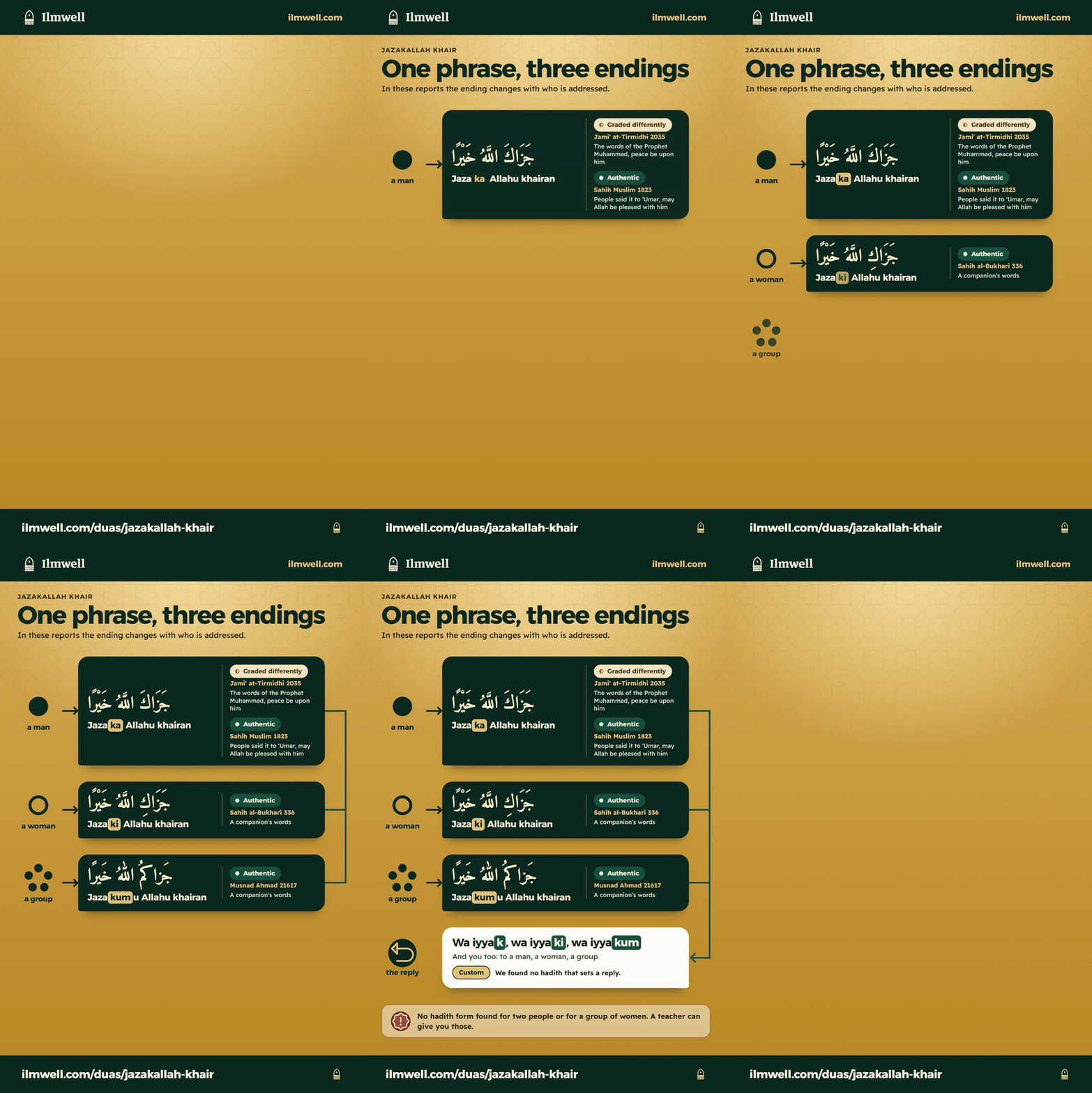
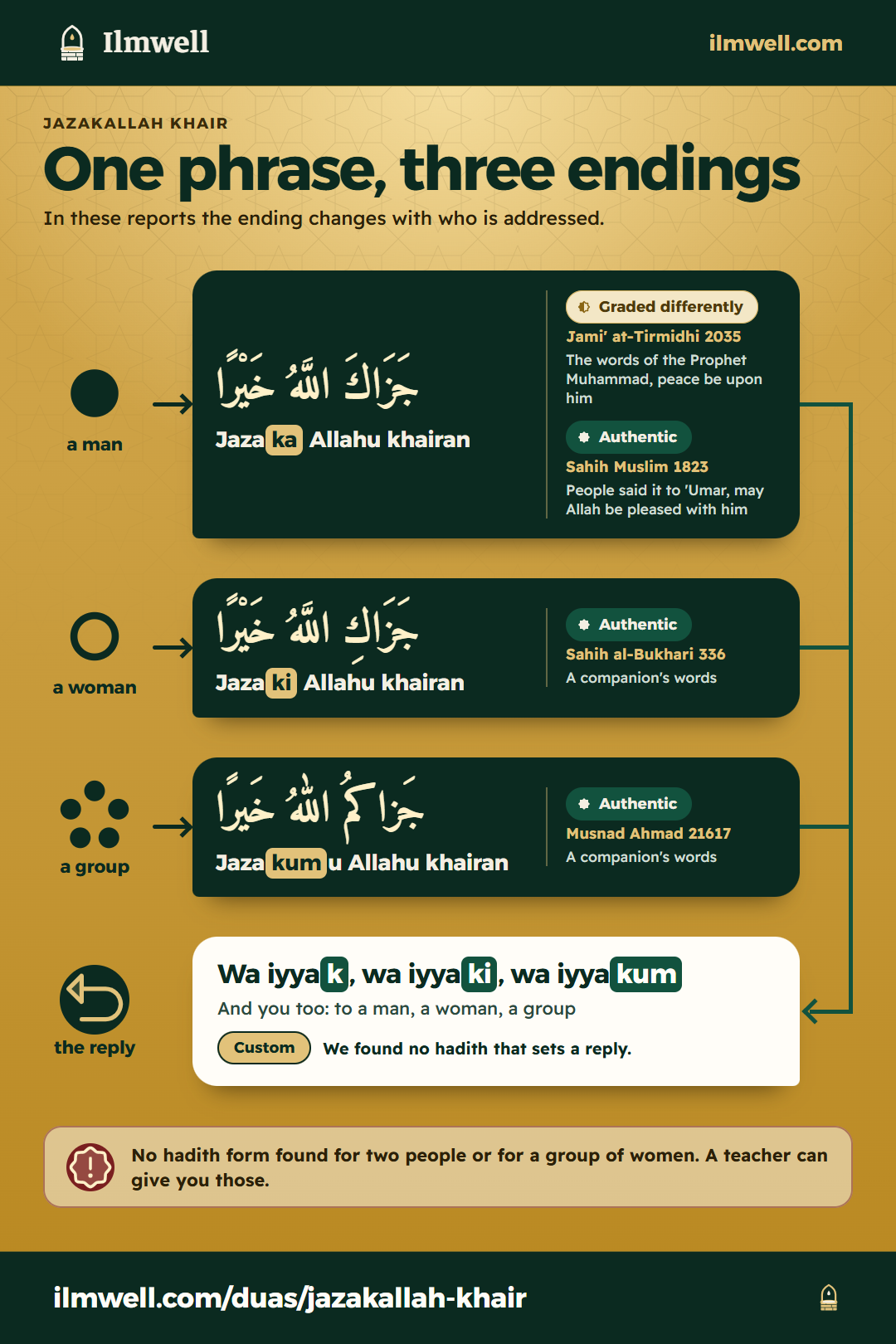
In these reports the ending changes with who is addressed. The form for a man is in the Prophet's words above. The woman's and the group's are each said by a companion (a person who met the Prophet and followed him).
| Speaking to | Arabic | Found in |
|---|---|---|
| A man | جَزَاكَ اللَّهُ خَيْرًاJazaka Allahu khairan | Jami' at-Tirmidhi 2035; also Sahih Muslim 1823 |
| A woman | جَزَاكِ اللَّهُ خَيْرًاJazaki Allahu khairan | Sahih al-Bukhari 336 |
| A group | جَزاكمُ اللهُ خَيرًاJazakumu Allahu khairan, often spelt jazakumullahu khairan | Musnad Ahmad 21617 |
Usayd ibn Hudayr, may Allah be pleased with him, said the woman's form to 'Aisha, may Allah be pleased with her. Abu Bakr, may Allah be pleased with him, said the group form to the Ansar (the Muslims of Madinah). The people said the man's form to 'Umar, may Allah be pleased with him, when he was wounded, in Sahih Muslim 1823, graded sahih.
3AuthenticSahih al-Bukhari 336
4AuthenticMusnad Ahmad 21617Authentic on four gradings of its chain
We found no hadith with a form for two people or for a group of women (source 9, our dorar.net search), so we do not write them out. A teacher can give you those.
How do you pronounce Jazakallah khair?
jazākallāhukhayran
- kh is a rasp from the back of the throat, like the ch in Scottish "loch".
- zā and lā are long: hold the a, as in "father".
- The two words run together: jazā-kal-lāhu.
Listen and repeat. A recorded pronunciation by a fluent reciter is coming. We do not use a synthetic voice for Arabic.
How do you reply to Jazakallah khair?
A plain, common reply is "wa iyyak" to a man, "wa iyyaki" to a woman and "wa iyyakum" to a group, meaning "and you too". It is a custom. We found no hadith that sets a reply (source 9, our dorar.net search), so every reply here is a custom.
| People say | Meaning | Status |
|---|---|---|
| Wa iyyak, wa iyyaki, wa iyyakum | And you too (to a man, a woman, a group) | Custom |
| Wa jazaka Allahu khairan | And may Allah reward you with good | Custom: it returns the same words |
| Ameen | A customary response to a dua | No source |
Say your aunt thanks you for passing her the last of the biryani and writes "Jazakallah khair" in the family chat. She is the one thanking you, so you might write back "wa iyyaki". From an uncle it would be "wa iyyak".
One report records a reply to a different phrase. The servant came back and told 'Aisha, may Allah be pleased with her, that the recipients had said barakallahu fikum (may Allah bless you), a phrase touched on in the Allahumma barik lesson. She answered wa fihim barakallah (and may Allah bless them), and said that we return to them the like of what they said. It is her practice, not the only reply, and it rests on one grading, which accepts its chain.
5AuthenticAl-Kalim al-Tayyib 239
Is Jazakallah khair the same as shukran or thank you?
Shukran is the Arabic word for thank you. Ibn Faris gives the first base of its root, sh-k-r, as shukr: praise of a person for a kindness he does you. 8 The Tirmidhi hadith calls saying Jazakallahu khairan praise (al-thana'). We cite no source that says which to use when.
For years I said "thanks" back whenever someone said Jazakallah khair, because I did not know what people said in return. An auntie at the mosque told me what she says, and I felt a bit daft for never having asked.
Try it: what would you say?
Three quick questions. Pick an answer; each one explains itself.
1A woman neighbour kept your parcel safe. In the hadith wording, which form is said to a woman?
Answer: Jazaki Allahu khairan. In Sahih al-Bukhari 336 (graded sahih), the words said to a woman end in -ki: jazaki. Source 3
2Your friend says Jazakallah khair after you help him move. Did our dorar.net search find a hadith that sets the reply?
Answer: No, so replies are customs. Our dorar.net search on 23 October 2026 found no hadith that sets a reply, so every reply here is a custom (source 9).
3How is the Tirmidhi hadith about Jazakallahu khairan graded?
Answer: Graded differently. Nine of the listed graders accept it and two critics reject it with this chain. Source 1
Sources
Every claim on this page comes from one of these. Gradings are reported with the scholar's name; we do not grade hadith ourselves.
- 1
Usamah ibn Zayd reported that the Prophet said: whoever has a kindness done to him and says to the doer 'jazaka Allahu khayran' (may Allah reward you with good) has gone to the utmost in praise.
Jami' at-Tirmidhi 2035 Book 27, Hadith 141
Graded differently. Here is who graded it which way:
- SoundAl-Tirmidhi, Darussalam, Ibn Hibban, Ibn Hajar al-'Asqalani, Ibn Baz, Shu'ayb al-Arna'ut, Al-Albani, Al-Suyuti, Al-Mundhiri
- WeakAl-Bukhari, Abu Hatim al-Razi
- FabricatedAbu Hatim al-Razi
- Other remarksMuqbil al-Wadi'i, Al-Daraqutni, 'Abd al-Haqq al-Ishbili, Al-Diya' al-Maqdisi
See each grading in full, with its wording and where it was given
Scholars disagree about this hadith. Here is how each graded it, so you can follow the scholar you trust.
- حسن جيد غريب (hasan jayyid gharib): Al-Tirmidhi, in the Arabic text after the hadith (as shown on sunnah.com and listed on dorar.net)
- Hasan: Darussalam (as shown on sunnah.com)
- صحيح (sahih): Ibn Hibban, as cited in Bulugh al-Maram 411 (as listed on dorar.net)
- أخرجه في صحيحه (included in his Sahih): Ibn Hibban, Sahih Ibn Hibban 3413 (as listed on dorar.net)
- [حسن كما قال في المقدمة] (hasan, as he says in the introduction): Ibn Hajar al-'Asqalani, Hidayat al-Ruwat 3/222 (as listed on dorar.net)
- صحيح (sahih): Ibn Hajar al-'Asqalani, al-Futuhat al-Rabbaniyya 5/249 (as listed on dorar.net)
- إسناده صحيح (its chain is sahih): Ibn Baz, Hashiyat Bulugh al-Maram 740 (as listed on dorar.net)
- إسناده صحيح (its chain is sahih): Ibn Baz, Majmu' al-Shuruh al-Fiqhiyya 17/30 (as listed on dorar.net)
- لا بأس به (no harm in it, acceptable): Ibn Baz, Majmu' al-Shuruh al-Fiqhiyya 201/33 (as listed on dorar.net)
- إسناده صحيح على شرط مسلم (its chain is sahih on the condition of Muslim): Shu'ayb al-Arna'ut, takhrij Sahih Ibn Hibban 3413 (as listed on dorar.net)
- إسناده جيد (its chain is good): Shu'ayb al-Arna'ut, takhrij Riyad al-Salihin 1496 (as listed on dorar.net)
- إسناده قوي (its chain is strong): Shu'ayb al-Arna'ut, takhrij Zad al-Ma'ad 2/425 (as listed on dorar.net)
- صحيح (sahih): Al-Albani, Sahih al-Tirmidhi 2035 (as listed on dorar.net)
- صحيح (sahih): Al-Albani, Sahih al-Targhib 969 (as listed on dorar.net)
- صحيح (sahih): Al-Albani, Sahih al-Jami' 6368 (as listed on dorar.net)
- صحيح (sahih): Al-Albani, Sahih al-Mawarid 1739 (as listed on dorar.net)
- إسناده صحيح (its chain is sahih): Al-Albani, Hidayat al-Ruwat 2958 (as listed on dorar.net)
- صحيح (sahih): Al-Suyuti, al-Jami' al-Saghir 8801 (as listed on dorar.net)
- [إسناده صحيح أو حسن أو ما قاربهما] (its chain is sahih or hasan or close to them): Al-Mundhiri, al-Targhib wa al-Tarhib 2/102 (as listed on dorar.net)
- منكر (munkar): Al-Bukhari, al-'Ilal al-Kabir 316, and as cited in Fayd al-Qadir 6/172 (as listed on dorar.net)
- هذا حديث منكر بهذا الإسناد (this hadith is munkar with this chain): Abu Hatim al-Razi, 'Ilal Ibn Abi Hatim 2570, and as cited in al-Ahadith al-Mukhtara 1322 (as listed on dorar.net)
- هذا حديث عندي موضوع بهذا الإسناد (to me this hadith is fabricated with this chain): Abu Hatim al-Razi, 'Ilal Ibn Abi Hatim 2197 (as listed on dorar.net)
- ظاهره الحسن لكن قال أبو حاتم منكر بهذا الإسناد (apparently hasan, but Abu Hatim said munkar with this chain): Muqbil al-Wadi'i, Ahadith Mu'illa 30 (as listed on dorar.net)
- تفرد به سعير بن الخمس عن سليمان التيمي، وتفرد به أبو الجواب الأحوص بن جواب عنه (Su'ayr ibn al-Khimis was alone in it from Sulayman al-Taymi, and Abu al-Jawwab al-Ahwas ibn Jawwab was alone from him): Al-Daraqutni, Atraf al-Gharaib 1/143 (as listed on dorar.net)
- سكت عنه (he was silent on it; in his introduction he says silence means soundness if there is no defect): 'Abd al-Haqq al-Ishbili, al-Ahkam al-Wusta 4/323 (as listed on dorar.net)
- أورده في المختارة (he included it in al-Mukhtara, a selection of reports not in al-Bukhari or Muslim): Al-Diya' al-Maqdisi, al-Ahadith al-Mukhtara 1321 (as listed on dorar.net)
- 2
When 'Umar ibn al-Khattab was wounded, the people praised him and said 'jazaka Allahu khayran' (may Allah reward you with good) to him, as his son 'Abdullah, may Allah be pleased with him, reports.
Sahih Muslim 1823 Book 33, Hadith 13
Authentic: in Sahih Muslim
- 3
After the verse of tayammum was revealed, Usayd ibn Hudayr said to 'Aisha 'jazaki Allahu khayran' (may Allah reward you with good), the form for a woman.
Sahih al-Bukhari 336 Book 7, Hadith 3
Authentic: in Sahih al-Bukhari
- 4
After the Prophet's death, as the speakers of the Ansar spoke about who should lead, Abu Bakr said to the Ansar 'jazakum Allahu khayran' (may Allah reward you with good), the form for a group.
Musnad Ahmad 21617 Musnad Ahmad 21617 (Shu'ayb al-Arna'ut's numbering), as dorar.net cites it
Authentic: its chain is sahih on the condition of Muslim (Shu'ayb al-Arna'ut); sahih on the condition of Muslim (Al-Hakim); on the condition of Muslim (Muqbil al-Wadi'i); its chain is sahih (Al-Dhahabi). Remarks: its men are the men of the Sahih (Al-Haythami); its men are the men of the Sahih (Muhammad ibn Yusuf al-Salihi); despite the quality of its chain it contains things that are denounced (Al-Dhahabi); Zuhayr ibn Ishaq is in it; I hope there is no harm in him (Ibn 'Adi)
- 5
A report about 'Aisha says that when people said 'barakallahu fikum' (may Allah bless you), she answered 'wa fihim barakallah' (and may Allah bless them).
Al-Kalim al-Tayyib 239 Ibn Taymiyya, al-Kalim al-Tayyib, with al-Albani's takhrij, no. 239, as dorar.net cites it
Authentic: its chain is good (Al-Albani)
- 6
Ibn Faris, in Mu'jam Maqayis al-Lughah, says the root j-z-y means one thing standing in the place of another and repaying it (muka'afa), with the examples 'jazaytu fulanan ajzihi jaza'an' (I recompensed so-and-so) and 'jazaytuhu mujazatan'.
Ahmad ibn Faris ibn Zakariyya (d. 395 AH), Mu'jam Maqayis al-Lughah, ed. 'Abd al-Salam Muhammad Harun, 2nd edition, Mustafa al-Babi al-Halabi, Cairo, 1389 to 1392 AH / 1969 to 1972 (shamela.ws numbering follows the print), vol. 1, pp. 455 to 456, entry 'jzy' Read on 23 October 2026. Record: scholarly-ibnfaris-jaza-word.
- 7
Ibn Faris, in Mu'jam Maqayis al-Lughah, says the root kh-y-r has as its origin inclination and leaning towards (al-'atf wa al-mayl), and that khayr is the opposite of sharr, because everyone inclines to it and is drawn to whoever has it.
Ahmad ibn Faris ibn Zakariyya (d. 395 AH), Mu'jam Maqayis al-Lughah, ed. 'Abd al-Salam Muhammad Harun, 2nd edition, Mustafa al-Babi al-Halabi, Cairo, 1389 to 1392 AH / 1969 to 1972 (shamela.ws numbering follows the print), vol. 2, p. 232, entry 'khyr' Read on 23 October 2026. Record: scholarly-ibnfaris-khayr-word.
- 8
Ibn Faris, in Mu'jam Maqayis al-Lughah, says the first of four bases of the root sh-k-r is al-shukr, praise of a person for a kindness he does you (al-thana' 'ala al-insan bi-ma'ruf yuwlikahu).
Ahmad ibn Faris ibn Zakariyya (d. 395 AH), Mu'jam Maqayis al-Lughah, ed. 'Abd al-Salam Muhammad Harun, 2nd edition, Mustafa al-Babi al-Halabi, Cairo, 1389 to 1392 AH / 1969 to 1972 (shamela.ws numbering follows the print), vol. 3, pp. 207 to 208, entry 'shkr' Read on 23 October 2026. Record: scholarly-ibnfaris-shukr-word.
- 9
A search of sunnah.com and the dorar.net hadith encyclopedia on 23 October 2026 found (a) the phrase 'jazaka Allahu khayran' in Sahih Muslim 1823 and its feminine form 'jazaki Allahu khayran' in Sahih al-Bukhari 336, (b) the group form 'jazakum Allahu khayran' in a Musnad Ahmad report of Abu Bakr to the Ansar, and (c) in the dorar.net search only, no narration that sets a reply to someone who says 'jazaka Allahu khayran', and no narration with a form for two people or for a group of women.
Ilmwell team, Search of sunnah.com and dorar.net, Search date 2026-10-23 Read on 23 October 2026. Record: search-jazakallah-hadith.
Next
- Alhamdulillah: meaning, pronunciation and everyday usePhrase lesson
- Allahumma barik: meaning and examplesPhrase lesson
- Mashallah: meaning and when to say itPhrase lesson
- Inshallah: meaning, spelling and usagePhrase lesson
- Bismillah: meaning and when to say itPhrase lesson
- Astaghfirullah: meaning and seeking forgivenessPhrase lesson
- Subhanallah: meaning and everyday contextsPhrase lesson
- The 99 names of Allah: meanings and the listBelief guide
- Assalamu alaikum and walaikum assalam: meaning and replyPhrase lesson
- Duas, Remembrance and PhrasesThe hub
For your own situation, ask a scholar you trust.
Join the email list
New guides by email, now and then. No spam, and you can leave at any time.
Ilmwell is free and kept going by readers. See how to support it.