The short answer
The Home Office's 2018 independent review into sharia law in England and Wales calls sharia "an all encompassing term", including fasting, prayer and worship in general as well as law. Al-Shafi'i, in al-Risalah, names four ways to know its rulings: the Quran, the Sunnah, consensus (ijma) and analogy (qiyas). The review states that sharia councils have no legal status.
شَرِيعَةٍ
What does Sharia mean?
Sharia (also spelt Shariah or Shari'a) is the Arabic word shari'ah. In his dictionary of word roots, Mu'jam Maqayis al-Lughah, Ibn Faris (d. 395 AH, in years of the Islamic calendar counted from the Hijrah) says al-shari'ah is the place where those who drink come down to the water, and that shir'ah and shari'ah in religion are derived from it 3.
The word itself appears in Al-Jathiyah 45:18 (surah 45, verse 18), addressed to the Prophet Muhammad, peace be upon him. In the English, "a clear road of (Our) commandment" translates shari'atin min al-amr.
ثُمَّ جَعَلْنَـٰكَ عَلَىٰ شَرِيعَةٍ مِّنَ ٱلْأَمْرِ فَٱتَّبِعْهَا وَلَا تَتَّبِعْ أَهْوَآءَ ٱلَّذِينَ لَا يَعْلَمُونَ
Two more verses use the same root. Al-Maidah 5:48 says: "For each We have appointed a divine law and a traced-out way." The Arabic there is shir'atan wa minhajan. Ash-Shura 42:13 opens with the verb: "He has ordained for you that religion..."
Where does Sharia law come from?
Classical works on usul al-fiqh (the principles of fiqh) name its sources. Al-Shafi'i (150 to 204 AH) writes in al-Risalah that no one may ever call a thing lawful or unlawful except from knowledge. The way to knowledge, he says, is a report in the Book or the Sunnah, or ijma, or qiyas 4.
| Source | What it is |
|---|---|
| The Quran | The revealed word of Allah. In al-Shafi'i's wording, "the Book". 4 |
| The Sunnah | The teaching and example of the Prophet, known through the hadith (reports of what he said and did). Named beside the Book by al-Shafi'i. 4 |
| Ijma (consensus) | In al-Juwayni's definition, the agreement of the jurists of one age on the ruling of a matter of the Sharia. 7 |
| Qiyas (analogy) | In al-Juwayni's definition, joining a branch case to an original case because of a cause that joins them in the ruling. 7 |
The Quran and the Sunnah are texts; ijma and qiyas, as al-Juwayni defines them, are an agreement of scholars and a method of reasoning. Both are covered in Ijma, qiyas and ijtihad explained (coming soon).
What is the difference between Sharia and fiqh?
In al-Juwayni's definition, fiqh is knowing the Sharia's rulings by ijtihad. In al-Waraqat, al-Juwayni (d. 478 AH) words it as knowledge of the rulings of the Sharia whose way is ijtihad, and defines ijtihad as exerting full effort to reach the goal 5.
The root of fiqh is about understanding. Mu'awiya, may Allah be pleased with him, said in a sermon that he heard the Prophet say that when Allah wants good for someone, He gives him understanding of the religion. The verb, yufaqqihhu, comes from the same root as fiqh (Sahih al-Bukhari 71, graded sahih).
1AuthenticSahih al-Bukhari 71
A judge's striving can miss. 'Amr ibn al-'As, may Allah be pleased with him, heard the Prophet say that a judge who strives to judge and is right has two rewards; one who strives and errs has one (Sahih al-Bukhari 7352, graded sahih).
2AuthenticSahih al-Bukhari 7352
| Sharia | Fiqh | |
|---|---|---|
| The word | A watering place; the religious words are derived from it (Ibn Faris) | Understanding (the verb in Sahih al-Bukhari 71) |
| How each is used | "a clear road of (Our) commandment" (Al-Jathiyah 45:18) | Knowing the rulings reached by ijtihad (al-Juwayni) |
More in What is fiqh (coming soon).
What are the rulings of fiqh called?
Al-Juwayni lists seven in al-Waraqat and defines each by reward and punishment, or by whether an act counts 6.
| Term | In English | According to al-Juwayni |
|---|---|---|
| Wajib | Required | Rewarded for doing it, punished for leaving it |
| Mandub | Recommended | Rewarded for doing it, not punished for leaving it |
| Mubah | Permitted | Neither rewarded nor punished, either way |
| Mahzur | Prohibited | Rewarded for leaving it, punished for doing it |
| Makruh | Disliked | Rewarded for leaving it, not punished for doing it |
| Sahih | Valid | Takes effect and counts |
| Batil | Invalid | Does not take effect or count |
What are the four Sunni schools of Sharia law?
Each school (madhhab) is named after a scholar. Ibn Juzayy (d. 741 AH), a Maliki scholar, writes in al-Qawanin al-Fiqhiyyah that by "the four" he means Malik, al-Shafi'i, Abu Hanifah and Ibn Hanbal, and he calls them leaders of the Muslims across the lands, each with followers 8. His book follows Malik's school, which he says the people of al-Andalus and the rest of the Maghrib (the western Islamic lands) chose, and notes where the other three agree and differ.
| School | Named after |
|---|---|
| Hanafi | Abu Hanifah al-Nu'man ibn Thabit |
| Shafi'i | Muhammad ibn Idris al-Shafi'i (150 to 204 AH) |
| Maliki | Malik ibn Anas |
| Hanbali | Ahmad ibn Hanbal |
Why they differ has its own lesson: Madhhabs and why scholars differ.
What does Sharia law cover?
Ibn Juzayy's book starts with worship. His al-Qawanin al-Fiqhiyyah opens with a short statement of creed, then splits fiqh into two halves, worship and dealings, of ten books each. It closes with a book on conduct 9.
- Worship ('ibadat)Purification, prayer, funerals, zakat, fasting, Hajj, jihad, oaths and vows, food and slaughter, sacrifice and 'aqiqah.
- Dealings (mu'amalat), family includedMarriage, divorce, sales and contracts, judges and testimony, homicide and hudud (penalties for set offences), gifts, freeing slaves, inheritance and wills.
- Conduct (the closing book)According to Ibn Juzayy, what is commanded and forbidden for the tongue, body, heart and wealth, for a person alone and between people.
Ibn Juzayy's book on blood and hudud opens by saying that the offences which bring a punishment are thirteen. He lists killing, wounding, zina (unlawful sexual intercourse), false accusation of zina, drinking wine, theft, armed rebellion, highway robbery, apostasy, hidden disbelief (zandaqah), insulting Allah, the prophets or the angels, practising magic, and abandoning prayer and fasting 11. In his book on judgeship he counts carrying out the hudud among the matters within the judge's (qadi's) authority. The penalties themselves are not set out on this page.
The UK government's 2018 independent review into sharia in England and Wales also describes it as including "religious observances such as fasting and prayer" and worship in general, as well as law 12.
What are the aims (maqasid) of Sharia?
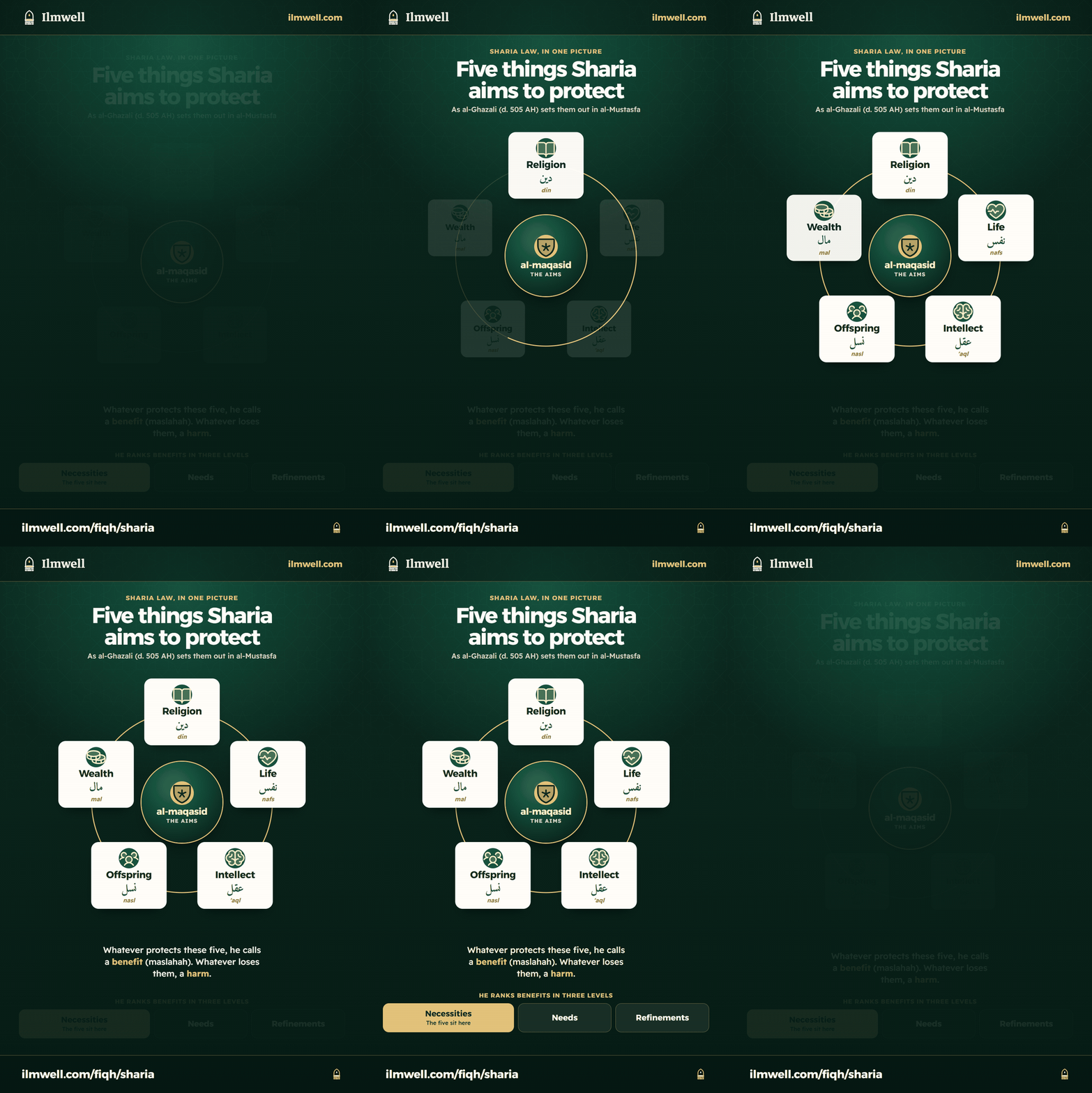
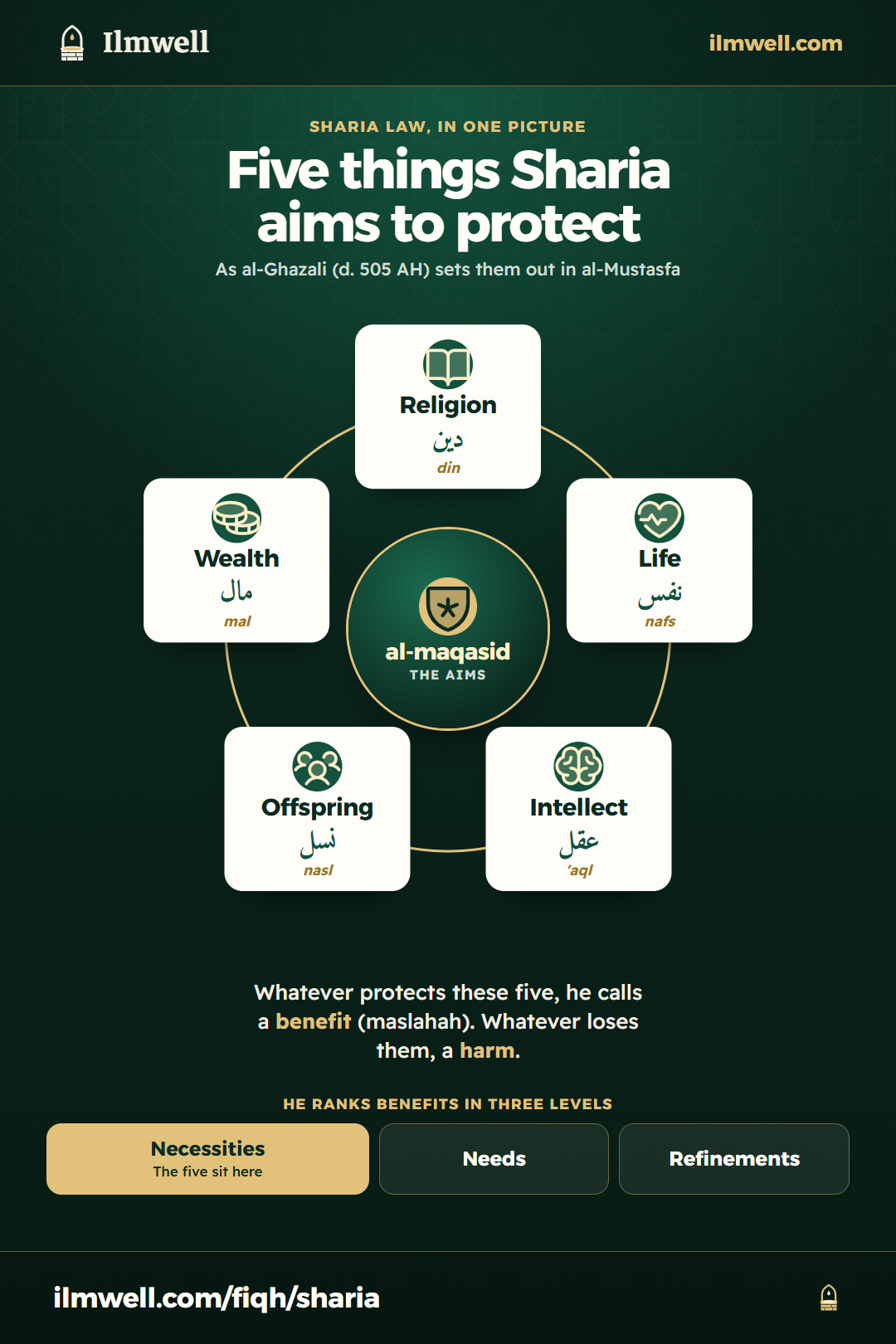
Al-Ghazali (d. 505 AH) writes in al-Mustasfa that the aim of the Sharia for people is five things: to preserve their religion, life, intellect, offspring and wealth. Whatever protects these five he calls a benefit (maslahah), and whatever loses them a harm 10.
- Religiondin
- Lifenafs
- Intellect'aql
- Offspringnasl
- Wealthmal
He ranks benefits in three levels, necessities, needs and refinements, and places the five among the necessities. He adds that no religion meant for people's good could fail to forbid losing them.
On the same page he gives an example of qiyas: every intoxicating drink or food is prohibited by analogy with wine, because wine was prohibited to preserve the intellect.
Is Sharia law the same as a country's legal system?
The 2018 review describes sharia as "written jurisprudence and law developed on the basis of a diversity of opinions among jurists in the classical period of Islam". It notes that Muslims use the word "in diverse ways", and that many aspects of sharia have been modified or modernised in most Muslim countries. In personal law, especially marriage and divorce, it adds, many Muslim societies still observe the rulings of classical jurisprudence 12.
Is there Sharia law in the UK?
Chaired by Professor Mona Siddiqui and published by the Home Office on 1 February 2018, the independent review looked at sharia councils in England and Wales; to the best of its knowledge there are none in Scotland. It defines them as voluntary local associations of scholars (estimates range from 30 to 85) who mainly advise on religious marriage and divorce. It states that they have no legal status and no legal jurisdiction, that they are not courts, and that where a council's decision conflicts with domestic law, domestic law prevails 12.
Although the councils claim no binding legal authority, the review adds, they "do in fact act in a decision-making capacity when dealing with Islamic divorce". It describes sharia itself as "a source of guidance for many Muslims".
After a news story, a colleague once asked me, quite kindly, what Sharia actually is. I realised I only had a vague answer. I wished I could have given him something clearer, and that is partly why I started looking into it properly.
Try it: five questions
Five quick questions. Pick an answer; each one explains itself.
1Besides the religious sense, what does shari'ah name in Ibn Faris's dictionary?
Answer: A watering place. The place where those who drink come down to the water; the religious sense is derived from it.
2Which verse uses the word shari'ah itself?
Answer: Al-Jathiyah 45:18. Al-Jathiyah 45:18, translated "a clear road of (Our) commandment".
3In al-Juwayni's definition, fiqh is knowledge of the rulings reached by what?
Answer: Ijtihad, scholarly striving. Knowledge of the rulings of the Sharia whose way is ijtihad (al-Waraqat).
4Which is not one of al-Ghazali's five aims?
Answer: Language. Language is not among his five aims (al-Mustasfa).
5A judge who strives and errs has how many rewards?
Answer: One. One reward; two if he strives and is right (Sahih al-Bukhari 7352). Source 2
Common mix-ups
- Sharia and fiqh are two words. In al-Juwayni's definition, fiqh is knowing the Sharia's rulings by ijtihad.
- A sharia council in England or Wales is not a court, in the words of the 2018 review.
Questions people ask
Is Sharia law the same in every Muslim country?
The UK government's 2018 independent review notes that many aspects of sharia have been modified or modernised in most Muslim countries, while many Muslim societies still follow classical rulings in marriage and divorce.
Sources
Every claim on this page comes from one of these. Gradings are reported with the scholar's name; we do not grade hadith ourselves.
- 1
Mu'awiya, in a sermon, said he heard the Prophet say that when Allah wants good for someone, He gives him understanding (yufaqqihhu) of the religion.
Sahih al-Bukhari 71 Book 3, Hadith 13
Authentic: in Sahih al-Bukhari
- 2
'Amr ibn al-'As heard the Prophet say that when a judge judges, strives to reach the right answer (ijtahada) and is right, he has two rewards, and when he judges, strives and errs, he has one reward.
Sahih al-Bukhari 7352 Book 96, Hadith 79
Authentic: in Sahih al-Bukhari
- 3
The root of shari'ah: the watering place where drinkers come down to water, and the religious words derived from it, with 5:48 and 45:18.
Ahmad ibn Faris ibn Zakariyya (d. 395 AH), Mu'jam Maqayis al-Lughah, ed. 'Abd al-Salam Muhammad Harun, 2nd edition, Mustafa al-Babi al-Halabi, Cairo, 1389 to 1392 AH / 1969 to 1972 (shamela.ws numbering follows the print), vol. 3, p. 262, entry 'shr'' Read on 21 October 2026. Record: scholarly-ibnfaris-sharia-word.
- 4
No one may call a thing lawful or unlawful except from knowledge: a report in the Book or the Sunnah, or ijma, or qiyas.
Muhammad ibn Idris al-Shafi'i (150 to 204 AH), al-Risalah, ed. Ahmad Muhammad Shakir, 1st edition, Mustafa al-Babi al-Halabi, Cairo, 1357 AH / 1938 (shamela.ws numbering follows the print), p. 39, paragraph 120 (Bab al-Bayan al-Khamis) Read on 21 October 2026. Record: scholarly-shafii-risala-four-sources.
- 5
Fiqh defined as knowledge of the rulings of the Sharia whose way is ijtihad, and ijtihad as exerting full effort to reach the goal.
'Abd al-Malik ibn 'Abdullah al-Juwayni, Imam al-Haramayn (d. 478 AH), al-Waraqat, ed. 'Abd al-Latif Muhammad al-'Abd (shamela.ws numbering follows the print), p. 7 (section 'Ma'na usul al-fiqh') and p. 31 (section 'al-Ijtihad') Read on 21 October 2026. Record: scholarly-juwayni-fiqh-definition.
- 6
The seven rulings and their definitions.
'Abd al-Malik ibn 'Abdullah al-Juwayni, Imam al-Haramayn (d. 478 AH), al-Waraqat, ed. 'Abd al-Latif Muhammad al-'Abd (shamela.ws numbering follows the print), p. 8 (section 'Anwa' al-hukm') Read on 21 October 2026. Record: scholarly-juwayni-seven-rulings.
- 7
The definitions of ijma and qiyas.
'Abd al-Malik ibn 'Abdullah al-Juwayni, Imam al-Haramayn (d. 478 AH), al-Waraqat, ed. 'Abd al-Latif Muhammad al-'Abd (shamela.ws numbering follows the print), p. 24 (section 'al-Ijma') and p. 26 (section 'al-Qiyas') Read on 21 October 2026. Record: scholarly-juwayni-ijma-qiyas.
- 8
The four imams named as "the four", and his book following the Maliki school while noting the others.
Abu al-Qasim Muhammad ibn Ahmad ibn Juzayy al-Kalbi al-Gharnati (d. 741 AH), al-Qawanin al-Fiqhiyyah (shamela.ws edition, numbering follows the print), p. 7 (muqaddimah) and p. 8 (Bayan istilah al-kitab) Read on 21 October 2026. Record: scholarly-ibnjuzayy-four-imams.
- 9
His arrangement of fiqh: creed, then worship and dealings in ten books each, then a closing book on conduct.
Abu al-Qasim Muhammad ibn Ahmad ibn Juzayy al-Kalbi al-Gharnati (d. 741 AH), al-Qawanin al-Fiqhiyyah (shamela.ws edition, numbering follows the print), pp. 8 to 9 (Bayan tartib al-kitab) and p. 269 (Kitab al-Jami') Read on 21 October 2026. Record: scholarly-ibnjuzayy-divisions.
- 10
The five aims of the Sharia, the three levels of benefit, and his example of qiyas on wine and other intoxicants.
Abu Hamid Muhammad ibn Muhammad al-Ghazali (d. 505 AH), al-Mustasfa, ed. Muhammad 'Abd al-Salam 'Abd al-Shafi, 1st edition, Dar al-Kutub al-'Ilmiyyah, Beirut, 1413 AH / 1993 (shamela.ws numbering follows the print), p. 174 (al-asl al-rabi': al-istislah) Read on 21 October 2026. Record: scholarly-ghazali-five-aims.
- 11
The thirteen offences that bring a punishment, opening his book on blood and hudud, and carrying out the hudud as a matter within the authority of the judge.
Abu al-Qasim Muhammad ibn Ahmad ibn Juzayy al-Kalbi al-Gharnati (d. 741 AH), al-Qawanin al-Fiqhiyyah (shamela.ws edition, numbering follows the print), p. 226 (al-Kitab al-sabi' fi al-dima' wa al-hudud) and p. 194 (al-Kitab al-khamis fi al-aqdiyah, chapter one, section two) Read on 21 October 2026. Record: scholarly-ibnjuzayy-hudud-book.
- 12
What sharia includes, how the word is used, and the legal status and role of sharia councils in England and Wales.
Home Office; review chaired by Professor Mona Siddiqui with a panel of experts, The independent review into the application of sharia law in England and Wales, Executive summary, p. 3 (repeated in the report body) Read on 21 October 2026. Record: reference-homeoffice-sharia-review.
- Q
Quran Arabic and English for Al-Jathiyah 45:18 (the word shari'ah shown from its Arabic); English phrases from Al-Maidah 5:48 and Ash-Shura 42:13. Al-Maidah 5:6 is referred to in our words.
Tanzil Project Uthmani text, CC BY 3.0. English: adapted from Marmaduke Pickthall's translation (1930), modernised and checked against modern translations.
Next
- Madhhabs and why scholars differGuide
- What is a fatwaGuide
- The five pillars of Islam explainedExplainer
- Start at AlifThe hub
- Halal and haramExplainer
For your own situation, ask a scholar you trust.
Join the email list
New guides by email, now and then. No spam, and you can leave at any time.
Ilmwell is free and kept going by readers. See how to support it.