The short answer
The five pillars of Islam are the Shahadah (the testimony of faith), Salah (prayer), Zakat (charity), fasting in Ramadan and Hajj (the pilgrimage to Makkah). The Prophet Muhammad, peace be upon him, said Islam is built on these five (Sahih al-Bukhari 8 and Sahih Muslim 16, graded sahih). Some wordings put Hajj before fasting in the list of 5 pillars.
What are the five pillars of Islam?
Five acts, named by the Prophet in a hadith narrated by Ibn 'Umar, may Allah be pleased with him. Each comes below with what it is in plain words, a verse of the Quran about it, and where to learn it in practice.
- 1
Shahadah: the testimony of faith
Bearing witness that there is no god but Allah and that Muhammad is the Messenger of Allah.
فَٱعْلَمْ أَنَّهُۥ لَآ إِلَـٰهَ إِلَّا ٱللَّهُ
So know (O Muhammad) that there is no God except Allah Muhammad 47:19 مُّحَمَّدٌ رَّسُولُ ٱللَّهِ
Muhammad is the messenger of Allah. Al-Fath 48:29 - Shahadah: meaning and contextMeaning and context
- 2
Salah: prayer
Establishing the prayer, with its recitation and movements. Al-Maidah 5:6 tells believers rising for prayer to "wash your faces, and your hands up to the elbows, and lightly rub your heads and (wash) your feet up to the ankles": the washing called wudu.
حَـٰفِظُوا۟ عَلَى ٱلصَّلَوَٰتِ وَٱلصَّلَوٰةِ ٱلْوُسْطَىٰ وَقُومُوا۟ لِلَّهِ قَـٰنِتِينَ
Be guardians of your prayers, and of the midmost prayer, and stand up with devotion to Allah. Al-Baqarah 2:238 - How to perform wuduPractical guide
- How to pray Salah: learn the sequenceGuide
- Al-Fatihah: understanding what you reciteQuran lesson
- 3
Zakat: charity from wealth
Giving a share of your wealth in charity. Who gives it, on what and how much are rulings with details of their own, so they sit in the zakat lesson.
إِنَّ ٱلَّذِينَ ءَامَنُوا۟ وَعَمِلُوا۟ ٱلصَّـٰلِحَـٰتِ وَأَقَامُوا۟ ٱلصَّلَوٰةَ وَءَاتَوُا۟ ٱلزَّكَوٰةَ لَهُمْ أَجْرُهُمْ عِندَ رَبِّهِمْ وَلَا خَوْفٌ عَلَيْهِمْ وَلَا هُمْ يَحْزَنُونَ
Indeed, those who believe and do good works and establish prayer and pay the poor-due, their reward is with their Lord and there shall no fear come upon them neither shall they grieve. Al-Baqarah 2:277In this verse, prayer translates as-salah, and the poor-due is zakat. - 4
Sawm: fasting in Ramadan
Fasting through Ramadan, the month in which the Quran was revealed (Al-Baqarah 2:185). Al-Baqarah 2:187 says to "eat and drink until the white thread becomes distinct to you from the black thread of the dawn. Then strictly observe the fast till nightfall".
يَـٰٓأَيُّهَا ٱلَّذِينَ ءَامَنُوا۟ كُتِبَ عَلَيْكُمُ ٱلصِّيَامُ كَمَا كُتِبَ عَلَى ٱلَّذِينَ مِن قَبْلِكُمْ لَعَلَّكُمْ تَتَّقُونَ
O you who believe! Fasting is prescribed for you, even as it was prescribed for those before you, that you may ward off (evil)... Al-Baqarah 2:183 - 5
Hajj: the pilgrimage
The pilgrimage to the House: the Kaaba in Makkah, which Al-Maidah 5:97 calls the Sacred House.
وَلِلَّهِ عَلَى ٱلنَّاسِ حِجُّ ٱلْبَيْتِ مَنِ ٱسْتَطَاعَ إِلَيْهِ سَبِيلًا
And pilgrimage to the House is a duty to Allah for mankind, for him who can find a way thither. Al Imran 3:97
2AuthenticSahih Muslim 16
What order do the five pillars come in?
The list above puts fasting before Hajj, as Sahih Muslim 16a and 16d and the hadith of Jibril (the angel Gabriel, peace be upon him) do. In Muslim 16a, after Ibn 'Umar narrated the five, a man said: "Hajj, and fasting in Ramadan." Ibn 'Umar answered: no, "fasting in Ramadan, and Hajj". That, he said, is how he heard it from the Messenger of Allah.
فَقَالَ رَجُلٌ الْحَجِّ وَصِيَامِ رَمَضَانَ قَالَ لاَ . صِيَامِ رَمَضَانَ وَالْحَجِّ . هَكَذَا سَمِعْتُهُ مِنْ رَسُولِ اللَّهِ
2AuthenticSahih Muslim 16
Other wordings, among them Sahih al-Bukhari 8, put Hajj before fasting. The Ilmwell team compared six wordings on sunnah.com on 21 October 2026:
| Wording | The five, in order |
|---|---|
| Sahih al-Bukhari 8 | Testimony, prayer, zakat, Hajj, fasting |
| Sahih Muslim 16a | Declaring Allah one, prayer, zakat, fasting, Hajj |
| Sahih Muslim 16b | Worshipping Allah, disbelieving in what is besides Him, prayer, zakat, Hajj, fasting |
| Sahih Muslim 16c | Testimony, prayer, zakat, Hajj, fasting |
| Sahih Muslim 16d | Testimony (no god but Allah), prayer, zakat, fasting, Hajj |
| Sahih Muslim 8 (Jibril) | Testimony, prayer, zakat, fasting, Hajj |
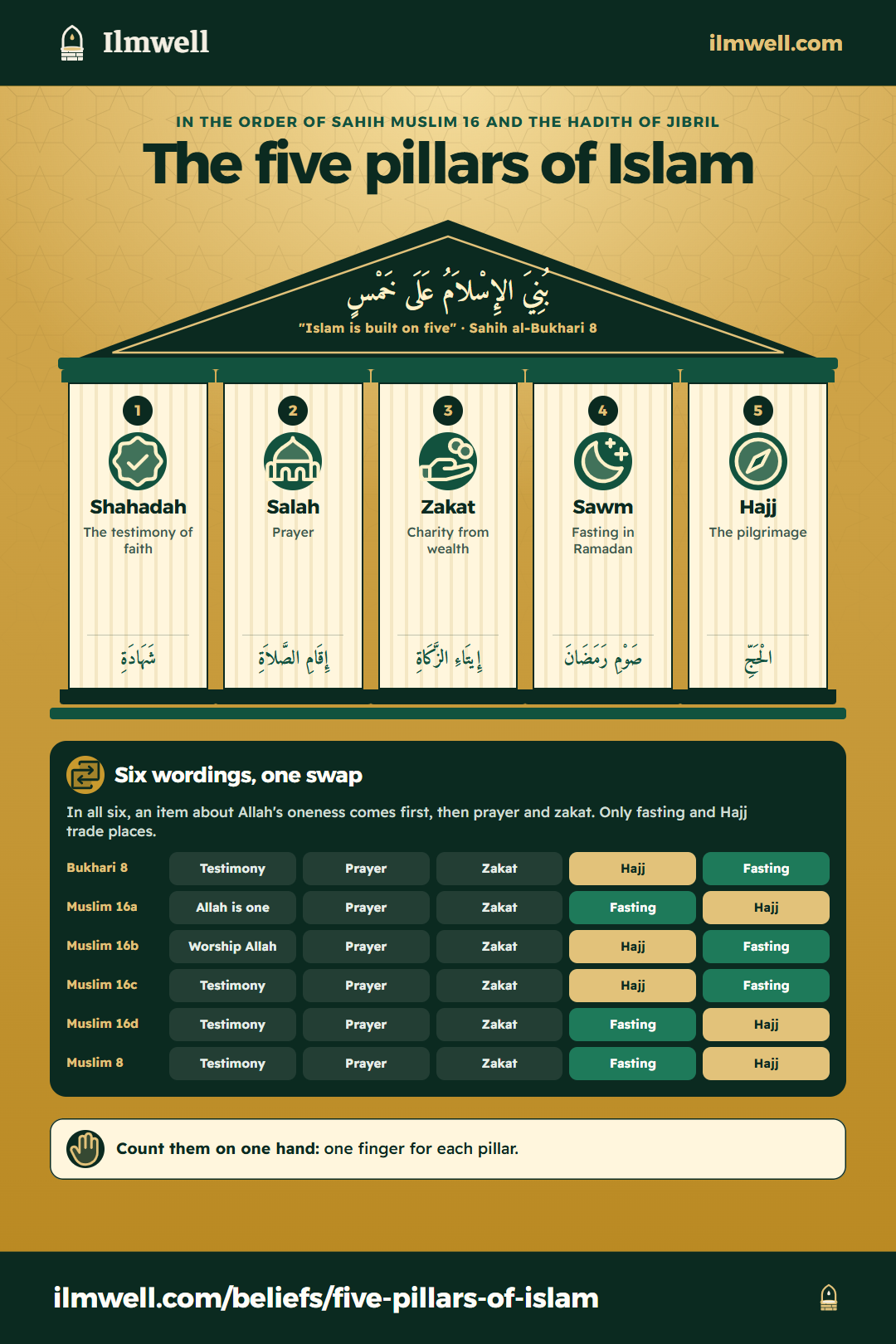
In all six, an item about Allah's oneness comes first; four word it as the testimony. Prayer and zakat follow. Only fasting and Hajj change places, and the narrations give no reason for either order.
The five pillars in one picture
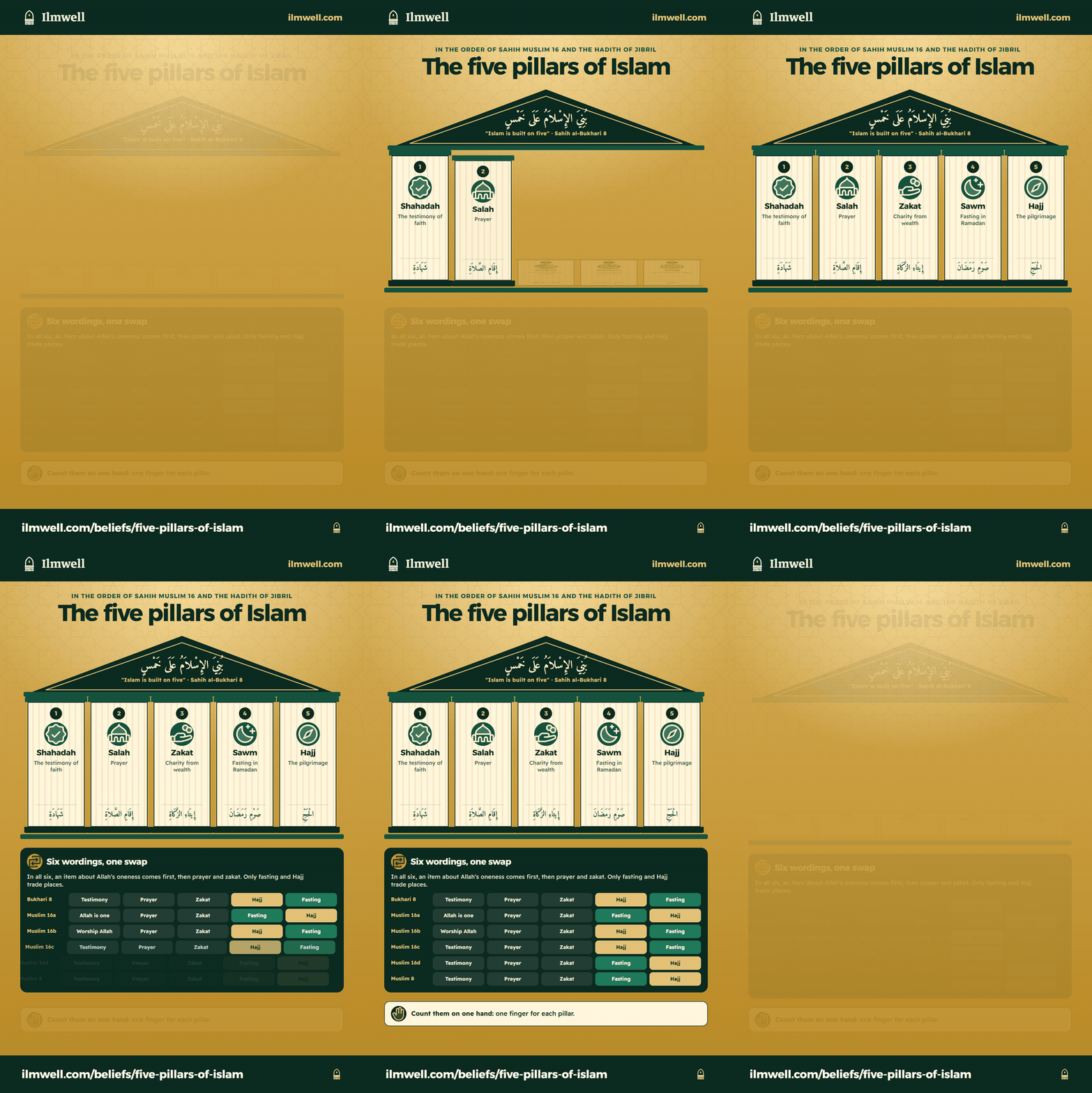
The five pillars of Islam. Islam is built on five (Sahih al-Bukhari 8). In the order of Sahih Muslim 16 and the hadith of Jibril: 1, Shahadah, the testimony of faith; 2, Salah, prayer; 3, Zakat, charity from wealth; 4, Sawm, fasting in Ramadan; 5, Hajj, the pilgrimage. Six wordings, one swap: in all six wordings checked (Bukhari 8, Muslim 16a to 16d, Muslim 8) an item about Allah's oneness comes first, then prayer and zakat; only fasting and Hajj trade places. Count them on one hand.
The five, and the one thing that changes between the wordings, in one picture.
Posting it on your own site? Link back to this guide; the code under "Use it on your own site" does it in one line.
What are the five pillars of Islam in Arabic?
The hadith opens with these words:
Sahih al-Bukhari 8
بُنِيَ الإِسْلاَمُ عَلَى خَمْسٍ
buniya l-islāmu ʿalā khams
Islam is built on five.
The hadith's Arabic has no word for pillars: it says Islam is built on five. Here is each pillar as Sahih al-Bukhari 8 words it.
| Pillar | Arabic | Say it | Meaning |
|---|---|---|---|
| Shahadah | شَهَادَةِ أَنْ لاَ إِلَهَ إِلاَّ اللَّهُ وَأَنَّ مُحَمَّدًا رَسُولُ اللَّهِ | shahādati an lā ilāha illā llāhu wa anna muḥammadan rasūlu llāh | Testifying that there is no god but Allah and that Muhammad is the Messenger of Allah |
| Salah | إِقَامِ الصَّلاَةِ | iqāmi ṣ-ṣalāh | Establishing the prayer |
| Zakat | إِيتَاءِ الزَّكَاةِ | ītā'i z-zakāh | Giving zakat |
| Sawm | صَوْمِ رَمَضَانَ | ṣawmi ramaḍān | Fasting in Ramadan |
| Hajj | الْحَجِّ | al-ḥajj | The pilgrimage |
Sahih Muslim 16a says siyam for fasting, from the same root as sawm.
Where do the five pillars come from? The hadith of Jibril
In the hadith of Jibril (Sahih Muslim 8, graded sahih), the Prophet answered "What is Islam?" with the five: the testimony, prayer, zakat, fasting in Ramadan and Hajj. For a fuller beginner's answer, see What is Islam?
'Umar ibn al-Khattab, may Allah be pleased with him, said that one day a man none of them knew came and sat down with the Prophet and said: "Muhammad, tell me about Islam."
The Prophet answered that Islam is to testify that there is no god but Allah and that Muhammad is the Messenger of Allah. It is to establish the prayer, give zakat, fast Ramadan, and make Hajj to the House if you are able to find a way to it. The man said: "You have spoken the truth." He went on to ask about iman (faith), ihsan (worshipping Allah as though you see Him) and the Hour (the Day of Judgement).
Then the man left, and 'Umar stayed a long while. The Prophet asked him whether he knew who the questioner was, and told him it was Jibril, who had come to teach them their religion.
الإِسْلاَمُ أَنْ تَشْهَدَ أَنْ لاَ إِلَهَ إِلاَّ اللَّهُ وَأَنَّ مُحَمَّدًا رَسُولُ اللَّهِ وَتُقِيمَ الصَّلاَةَ وَتُؤْتِيَ الزَّكَاةَ وَتَصُومَ رَمَضَانَ وَتَحُجَّ الْبَيْتَ إِنِ اسْتَطَعْتَ إِلَيْهِ سَبِيلاً
3AuthenticSahih Muslim 8
How do you explain the five pillars to kids?
Say a seven-year-old asks at dinner what the five pillars are. Count them on one hand, a finger for each, in order:
- Shahadah: saying, and believing, that there is no god but Allah and that Muhammad is His messenger.
- Salah: praying to Allah.
- Zakat: giving a share of your wealth in charity.
- Fasting: no food or drink from dawn until nightfall during Ramadan.
- Hajj: the journey to the Kaaba in Makkah.
In school RE I was the one expected to explain the five pillars to the class. I could list them but not explain them. That was a bit of a wake-up call, and it is partly why I started learning properly.
Try it: five questions
Five quick questions. Pick an answer; each one explains itself.
1In Sahih al-Bukhari 8 and the hadith of Jibril, which pillar comes first?
Answer: The testimony of faith. The testimony of faith opens the list in both, then prayer, then zakat. Source 1
2Which two pillars change places between wordings?
Answer: Fasting and Hajj. Fasting and Hajj. In Sahih Muslim 16a, Ibn 'Umar insisted on fasting, then Hajj. Source 2
3In the hadith of Jibril, the five pillars answer which question?
Answer: What is Islam?. Asked about Islam, the Prophet named the five (Sahih Muslim 8). Source 3
4Which pillar does Al Imran 3:97 tie to "him who can find a way thither"?
Answer: Hajj. Hajj, in Al Imran 3:97 and in the hadith of Jibril. Source 3
5Sawm is the Arabic name for which pillar?
Answer: Fasting. Sawm Ramadan, fasting in Ramadan, is the wording in Sahih al-Bukhari 8. Source 1
Common mix-ups
- The five pillars are the answer about Islam. Iman (faith) is a separate question in the hadith of Jibril, with its own answer: the six articles of faith, which have their own lesson.
- Pillars is the English name. The hadith's Arabic says Islam is "built on" five.
Questions people ask
Are the five pillars of Islam in the Quran?
Each one has a verse in the Quran, given in its card above. The grouping as five is the wording of the hadith of Ibn 'Umar in Sahih al-Bukhari 8 and Sahih Muslim 16, graded sahih.
Why are the five pillars important?
In Sahih al-Bukhari 8 (graded sahih), the Prophet said Islam is built on them, and in the hadith of Jibril they are his answer to the question of what Islam is (Sahih Muslim 8, graded sahih).
What is the first pillar of Islam?
It is the Shahadah: bearing witness that there is no god but Allah and that Muhammad is the Messenger of Allah. It opens the list in Sahih al-Bukhari 8 and in the hadith of Jibril, Sahih Muslim 8, both graded sahih.
Sources
Every claim on this page comes from one of these. Gradings are reported with the scholar's name; we do not grade hadith ourselves.
- 1
Ibn 'Umar reported the Prophet saying that Islam is built on five: testifying that there is no god but Allah and that Muhammad is the Messenger of Allah, establishing the prayer, giving zakat, Hajj and fasting in Ramadan.
Sahih al-Bukhari 8 Book 2, Hadith 1
Authentic: in Sahih al-Bukhari
- 2
In one wording of Sahih Muslim 16, Ibn 'Umar reported the Prophet naming the five with fasting in Ramadan before Hajj; a man said 'Hajj, and fasting in Ramadan', and Ibn 'Umar said no, fasting in Ramadan and Hajj, that is how he heard it from the Messenger of Allah.
Sahih Muslim 16 Book 1, Hadith 19
Authentic: in Sahih Muslim
- 3
In the hadith of Jibril, a man asked the Prophet about Islam, and he answered: to testify that there is no god but Allah and that Muhammad is the Messenger of Allah, to establish the prayer, give zakat, fast Ramadan and make Hajj to the House if you are able to find a way to it; asked about iman (faith), he answered: to believe in Allah, His angels, His books, His messengers, the Last Day, and the decree, its good and its bad.
Sahih Muslim 8 Book 1, Hadith 1
Authentic: in Sahih Muslim
- Q
Quran Arabic and English for Muhammad 47:19 and Al-Fath 48:29 (opening words), Al-Baqarah 2:238, 2:277 and 2:183, and Al Imran 3:97 (from 'and pilgrimage to the House'); English clauses from Al-Baqarah 2:187 and Al-Maidah 5:6. Al-Baqarah 2:185 and Al-Maidah 5:97 are referred to in our words.
Tanzil Project Uthmani text, CC BY 3.0. English: adapted from Marmaduke Pickthall's translation (1930), modernised and checked against modern translations.
Next
- Shahadah: meaning and contextMeaning and context
- The six articles of faith explainedGuide
- How to perform wudu: illustrated stepsPractical guide
- How to pray Salah: learn the sequenceGuide
- Start at AlifThe hub
For your own situation, ask a scholar you trust.
Join the email list
New guides by email, now and then. No spam, and you can leave at any time.
Ilmwell is free and kept going by readers. See how to support it.