The short answer
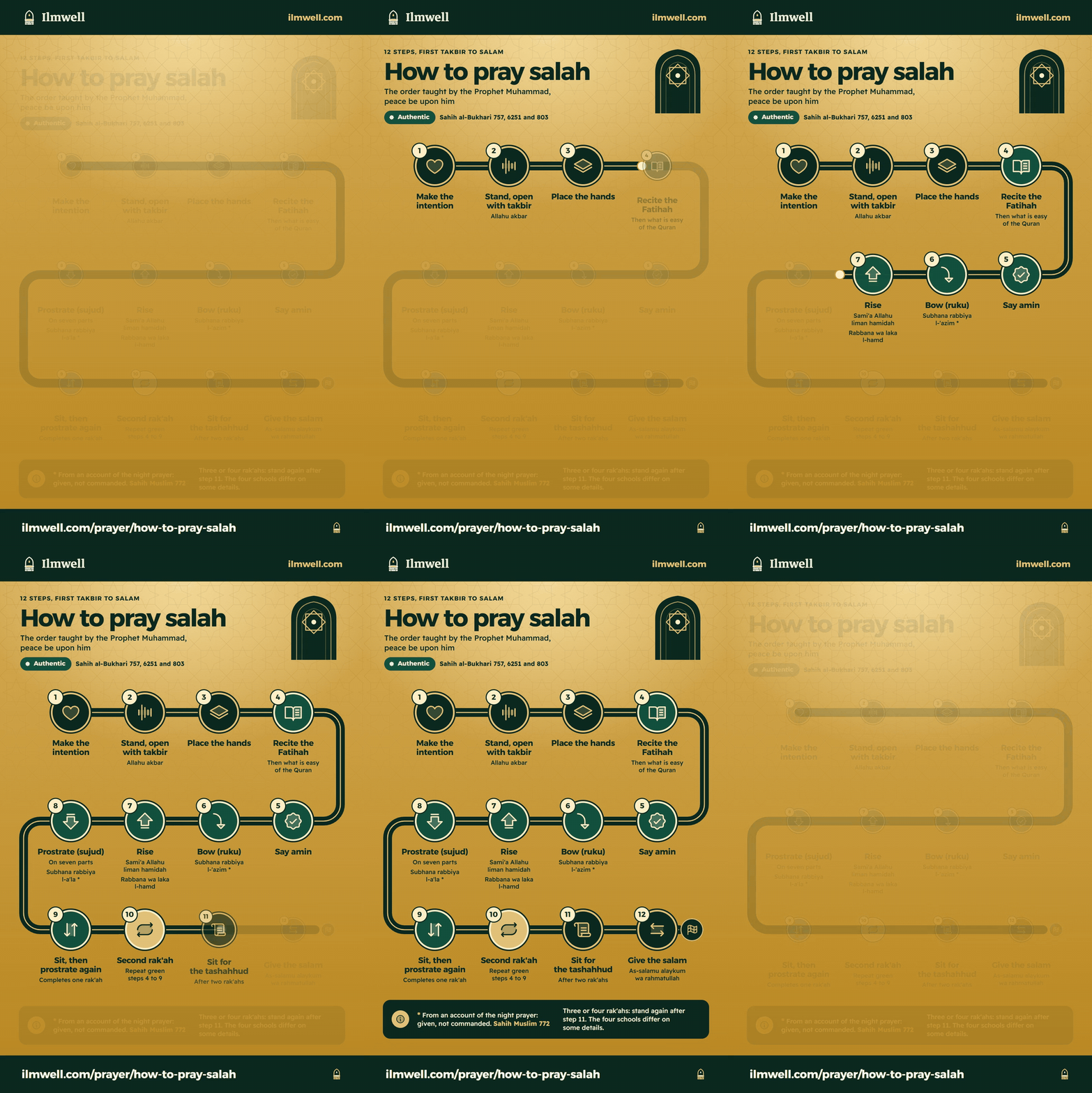
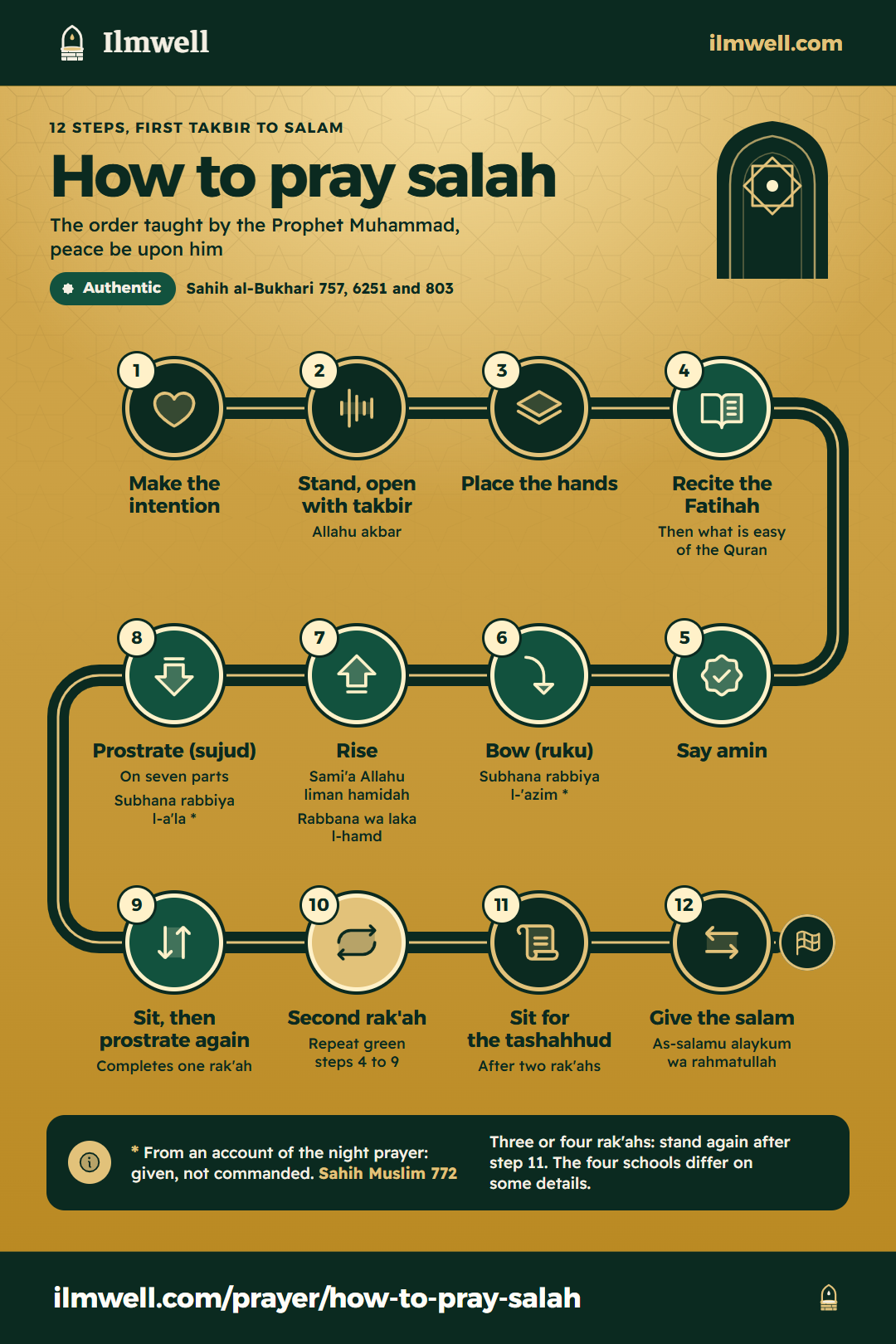
How to pray salah, or namaz: face the qibla (the direction of prayer), say takbir (Allahu akbar), recite from the Quran, bow, rise, prostrate, sit, prostrate again. The Prophet Muhammad, peace be upon him, taught this order to a man who had not prayed properly (Sahih al-Bukhari 757 and 6251, graded sahih). Tahajjud has its own guide.
What do you need before you pray?
Wudu, the qibla and the time. The Prophet's teaching to the man begins with wudu done well and facing the qibla, the direction Muslims face to pray.
2AuthenticSahih al-Bukhari 6251
Wudu is in how to perform wudu, and the Qibla finder gives the direction from where you are. The Quran says: "Prayer at fixed times has been enjoined on the believers." (An-Nisa 4:103, source 20). Your local mosque timetable gives the times.
Not covered here: clean clothing and place, the wording of the intention, the opening dua and the durood in the last sitting. The tashahhud and Dua qunoot have lessons, and Durood Ibrahim has its own lesson.
How do Muslims pray? The sequence, step by step
The Prophet told a group of young men who had stayed with him: "pray as you have seen me praying" (Sahih al-Bukhari 631).
3AuthenticSahih al-Bukhari 631
The man's lesson names an order, and in bowing, prostrating and sitting he was to stay until at ease (Sahih al-Bukhari 757). The takbirs below follow Abu Hurayrah, may Allah be pleased with him, who prayed saying takbir at each movement and said his prayer was the closest to the Prophet's (Sahih al-Bukhari 803). A rak'ah is one cycle of standing, bowing and two prostrations.
1AuthenticSahih al-Bukhari 757
4AuthenticSahih al-Bukhari 803
Make the intention
Al-Nawawi's Minhaj says the intention is in the heart and recommends speaking it before the takbir (source 16). The wording is not covered on this page.Stand and say the opening takbir
Say Allahu akbar (the takbir) on standing for the prayer, raising the hands level with the shoulders. The schools differ on how high the hands go and when they are raised again: see the table.اللَّهُ أَكْبَرُAllahu akbarAllah is greatest5AuthenticSahih al-Bukhari 735
Place the hands
People were ordered to put the right hand on the left forearm. The schools differ on where the hands go: see the table.6AuthenticSahih al-Bukhari 740
Recite the Fatihah, then what is easy of the Quran
The man was told to recite what is easy of the Quran. The hadith says there is no prayer for one who does not recite the Opening of the Book, Al-Fatihah, and the schools differ on how they hold this: see the table. Al-Fatihah and Bismillah have their own lessons.7AuthenticSahih al-Bukhari 756
Say amin
When the imam (the one leading the prayer) says "wa la d-dallin", the follower says amin. Aloud or in a low voice, and what the one praying alone does, differ: see the table.آمِينَAminthe word said after the Fatihah8AuthenticSahih al-Bukhari 782
Bow (ruku)
Say Allahu akbar as you go down, then bow with the hands set firmly on the knees. Subhana rabbiya l-'azim comes from a companion's account of the Prophet's long night prayer, which gives the words but does not command them. Some schools raise the hands here: see the table.سُبْحَانَ رَبِّيَ الْعَظِيمِSubhana rabbiya l-'azimGlory be to my Lord, the Mighty9AuthenticSahih Muslim 772
10AuthenticSahih al-Bukhari 828
Rise
Rise until standing straight, saying sami'a Allahu liman hamidah as you rise and rabbana wa laka l-hamd. This is the order in Abu Hurayrah's report, which he gave as the Prophet's practice. Who says which words differs by school: see the table.سَمِعَ اللَّهُ لِمَنْ حَمِدَهُSami'a Allahu liman hamidahAllah hears whoever praises Himرَبَّنَا وَلَكَ الْحَمْدُRabbana wa laka l-hamdOur Lord, to You is the praiseProstrate (sujud)
Say Allahu akbar as you go down and prostrate on seven parts, shown below. The hands are placed neither spread out nor clutched in, with the toes towards the qibla (Sahih al-Bukhari 828). These words are also from the night prayer in Sahih Muslim 772 (the long prayer of Hudhayfah, not a command for the obligatory prayer).سُبْحَانَ رَبِّيَ الأَعْلَىSubhana rabbiya l-a'laGlory be to my Lord, the Most High11AuthenticSahih al-Bukhari 812
Sit, then prostrate again
Lift the head with a takbir and sit, then say a takbir, prostrate a second time, and lift the head with a takbir. That completes one rak'ah. The second prostration is in Sahih al-Bukhari 6251, the takbirs in 803.Stand for the second rak'ah
Do steps 4 to 9 again: the man was told to do the same throughout the prayer, and the Fatihah is recited in each rak'ah (Sahih al-Bukhari 776, for Zuhr).Sit and say the tashahhud
A companion described the sitting after two rak'ahs as on the left foot with the right foot upright (Sahih al-Bukhari 828); the schools differ on the posture: see the table. The tashahhud is said in this sitting: its wording and the schools' differences are in the tashahhud lesson. In a prayer of three or four rak'ahs, stand with a takbir and continue, then sit again at the end.Give the salam
Turn the face to the right and then the left, giving the salam to each side. The words are as al-Hidayah words them (source 15); the Minhaj (p. 29) gives the same words (source 16).السلام عليكم ورحمة اللهAs-salamu alaykum wa rahmatullahPeace be upon you, and Allah's mercy12AuthenticSahih Muslim 582
Which seven parts touch the ground in prostration?
Ibn Abbas, may Allah be pleased with him, reported that the Prophet said: "I was ordered to prostrate on seven bones", and, in the same report, "we do not gather the clothes or the hair". The mat below is seen from above; the top is the qibla end.
- Forehead, with the tip of the nose
- Left hand
- Right hand
- Left knee
- Right knee
- Toes of the left foot
- Toes of the right foot
Where do the four schools differ on salah?
Each cell names the work it comes from. Iftirash is sitting on the left foot with the right foot upright; tawarruk, the other sitting, is described in each cell. On a phone, scroll sideways to see all four schools.
| Hanafi | Shafi'i | Maliki | Hanbali | |
|---|---|---|---|---|
| Raising the hands | At the opening takbir only, to the earlobes (al-Hidayah 1/48, 1/52) | At the opening takbir, in bowing and on rising, to the shoulders (Minhaj pp. 25, 27) | At the opening takbir only, to the shoulders (al-Sharh al-Kabir 1/247) | At the opening takbir and in bowing, to the ears or the shoulders; for rising Ibn Qudamah cites Ibn 'Umar's report, may Allah be pleased with him, and Ahmad's answer (al-Mughni 1/339 to 340, 1/358) |
| Where the hands go | Right on left, below the navel (al-Hidayah 1/49) | Under the chest, right holding left (Minhaj p. 30) | Letting them hang is recommended; holding is disliked in an obligatory prayer (al-Sharh al-Kabir 1/250) | Below the navel in al-Khiraqi's text; Ahmad is also reported with above it (al-Mughni 1/341) |
| Bismillah before the Fatihah | Said in a low voice, not aloud (al-Hidayah 1/49) | Part of the Fatihah (Minhaj p. 26) | Disliked in an obligatory prayer, permitted in a voluntary one (al-Sharh al-Kabir 1/251) | Recited, not aloud; reports differ on whether it is a verse of the Fatihah (al-Mughni 1/344 to 346) |
| The Fatihah | With a surah or three verses; the Fatihah is not fixed as a pillar, though the book calls both necessary (wajib) (al-Hidayah 1/50) | Fixed in every rak'ah except a latecomer's (Minhaj p. 26) | One of three spoken pillars, with the opening takbir and the salam (al-Dasuqi, al-Sharh al-Kabir 1/231) | Required in every rak'ah in the sound view; one report from Ahmad has it in only two (al-Mughni 1/350) |
| Amin | Imam and follower, in a low voice (al-Hidayah 1/50) | With the imam's amin, aloud in the more correct view (Minhaj p. 26) | Recommended: the follower at the imam's "wa la d-dallin", the imam only in quiet prayers, the one praying alone always; all in a low voice (al-Sharh al-Kabir 1/248) | Imam and follower, aloud where the recitation is aloud (al-Mughni 1/352 to 353) |
| Rabbana wa laka l-hamd | The follower says it; the imam says only sami'a; the one praying alone says both (al-Hidayah 1/50 to 51) | On standing straight, after sami'a on rising (Minhaj p. 27) | The follower and the one praying alone; the imam does not add it (al-Sharh al-Kabir 1/248) | Every worshipper in the well-known report; the follower does not say sami'a (al-Mughni 1/365 to 367) |
| Sitting | Both sittings are iftirash (al-Hidayah 1/52 to 53) | First iftirash; last tawarruk, the left foot out to the right and the hip on the floor (Minhaj p. 28) | Every sitting: the left hip and buttocks on the ground, the right foot upright over the left (al-Sharh al-Kabir 1/249) | The last sitting, in the second tashahhud: the right foot upright, the left under the right thigh, buttocks on the ground (al-Mughni 1/386) |
Sources 15 to 18 are the four works; each cell gives its volume and page. The schools read Sahih al-Bukhari 828 (the sittings) and 735 (the raised hands) and other reports differently.
How many rak'ahs are in the five daily prayers?
'Aisha, may Allah be pleased with her, reported that the prayer began as two rak'ahs, at home and while travelling; the travelling prayer stayed as it was and the resident's was increased.
13AuthenticSahih al-Bukhari 350
The counts below are as al-Shafi'i reports them in Kitab al-Umm: he writes that the community handed down each prayer's count (source 19, an online transcription). If you have ever lost count in the third rak'ah, this is the table to know. These are the fard (obligatory) rak'ahs only; sunnah rak'ahs are prayed separately.
| Prayer | Fard rak'ahs | Recitation, as he reports | Sittings (Bukhari 803, 828) |
|---|---|---|---|
| Fajr | 2 | Both aloud | At the end |
| Zuhr | 4 | None aloud | After the 2nd and the 4th |
| Asr | 4 | None aloud | After the 2nd and the 4th |
| Maghrib | 3 | First two aloud, third quiet | After the 2nd and the 3rd |
| Isha | 4 | First two aloud, last two quiet | After the 2nd and the 4th |
The sittings follow Sahih al-Bukhari 803 and 828: a sitting after two rak'ahs, then a stand with a takbir, and a sitting at the end. In Zuhr the Prophet recited the Fatihah with a surah in each of the first two rak'ahs, and the Fatihah in the last two.
14AuthenticSahih al-Bukhari 776
How do you pray Zuhr and Asr?
Each is four rak'ahs: steps 1 to 10 for the first two, the sitting in step 11, then a takbir and two more rak'ahs as in steps 3 to 9 but with the Fatihah alone, as in Zuhr (Sahih al-Bukhari 776), and the last sitting and salam. Maghrib, Isha and Fajr follow the table.
What about Tahajjud, Eid and the Friday prayer?
Tahajjud namaz has its steps in how to pray Tahajjud, and the dua said standing in some prayers is in Dua qunoot. The Friday prayer has a guide of its own: Jummah prayer.
Common mix-ups
- Not staying until at ease. The man was told to bow, prostrate and sit until at ease (Sahih al-Bukhari 757).
- Gathering the clothes or hair in prostration. The Prophet said "we do not gather" them (Sahih al-Bukhari 812).
- Reading a difference in the table as someone's mistake. For your own prayer, ask a scholar you trust.
I learnt to pray quite young by copying my dad at the end of the row, half a second behind him. I was into my teens before I realised nobody had ever explained why we stand, bow and prostrate in that order. Reading it step by step was oddly moving.
Try it: the order and the counts
Picture a younger cousin asking you to talk through the sequence. Four quick checks, each with its source.
1In the hadith of the man who did not pray properly, how long was he told to stay in bowing, prostrating and sitting?
Answer: Until at ease. The Prophet told him to bow, prostrate and sit until at ease. Source 1
2How many parts of the body touch the ground in prostration?
Answer: Seven. Forehead with the nose, two hands, two knees and the toes of both feet. Source 11
3Which words does Abu Hurayrah's report give for rising from bowing?
Answer: Sami'a Allahu liman hamidah, then rabbana wa laka l-hamd. Subhana rabbiya l-a'la is for prostration, and the salam ends the prayer. Who says which of the first two differs by school: see the table. Source 4
4How many rak'ahs is Maghrib?
Answer: Three. Three: two aloud and the third quiet, in al-Shafi'i's report of what the community handed down (source 19).
Sources
Every claim on this page comes from one of these. Gradings are reported with the scholar's name; we do not grade hadith ourselves.
- 1
Abu Hurayrah, may Allah be pleased with him, reported that a man prayed in the mosque, greeted the Prophet, and was told three times to go back and pray because he had not prayed; the man asked to be taught, and the Prophet told him: when you stand for prayer, say takbir, then recite what you know of the Quran, then bow until at ease, rise until standing straight, prostrate until at ease, sit until at ease, and do the same in all his prayers.
Sahih al-Bukhari 757 Book 10, Hadith 151
Authentic: in Sahih al-Bukhari
- 2
Abu Hurayrah, may Allah be pleased with him, reported that a man prayed in the mosque and was told more than once to go back and pray because he had not prayed; asked to be taught, the Prophet said: when you stand for prayer, perform wudu well, face the qibla, say takbir, recite what is easy of the Quran, bow until at ease, rise until standing straight, prostrate until at ease, sit until at ease, prostrate again until at ease, sit until at ease, and do the same throughout the prayer.
Sahih al-Bukhari 6251 Book 79, Hadith 25
Authentic: in Sahih al-Bukhari
- 3
Malik ibn al-Huwayrith, may Allah be pleased with him, reported that the Prophet, sending the young men who had stayed with him for twenty days back to their families, told them to teach their families and order them to do good, and added: pray as you have seen me praying, and when the time for prayer comes, one of you should call the adhan and the eldest of you should lead.
Sahih al-Bukhari 631 Book 10, Hadith 28
Authentic: in Sahih al-Bukhari
- 4
Two Followers (named in the notes) reported that Abu Hurayrah used to say takbir in every prayer, obligatory or voluntary: on standing, on bowing; then sami'a Allahu liman hamidah, then rabbana wa laka l-hamd before prostrating; then 'Allahu akbar' on going down to prostrate, and takbir on raising the head, on the second prostration, on raising the head again, and on standing from the sitting after two rak'ahs, doing the same in every rak'ah; and he said that his prayer was the closest in resemblance to the Prophet's, and that this was his prayer until he left the world.
Sahih al-Bukhari 803 Book 10, Hadith 198
Authentic: in Sahih al-Bukhari
- 5
Ibn 'Umar, may Allah be pleased with him, reported that the Prophet raised his hands to the level of his shoulders when opening the prayer, when saying takbir for bowing, and when raising his head from bowing (saying sami'a Allahu liman hamidah, rabbana wa laka l-hamd), and did not do so in prostration.
Sahih al-Bukhari 735 Book 10, Hadith 129
Authentic: in Sahih al-Bukhari
- 6
Sahl ibn Sa'd, may Allah be pleased with him, said that people were ordered to place the right hand on the left forearm in the prayer; Abu Hazim said he knew the order was from the Prophet.
Sahih al-Bukhari 740 Book 10, Hadith 134
Authentic: in Sahih al-Bukhari
- 7
The Prophet said there is no prayer for the one who does not recite the Opening of the Book (Fatihat al-Kitab).
Sahih al-Bukhari 756 Book 10, Hadith 150
Authentic: in Sahih al-Bukhari
- 8
When the imam says ghayri l-maghdubi alayhim wa la d-dallin, say Amin; whoever's Amin matches the angels' is forgiven.
Sahih al-Bukhari 782 Book 10, Hadith 177
Authentic: in Sahih al-Bukhari
- 9
Hudhayfah, may Allah be pleased with him, reported praying one night behind the Prophet, who recited al-Baqarah, al-Nisa' and Al 'Imran slowly, glorifying at verses of glory, asking at verses of asking and seeking protection at verses of protection, then bowed saying 'Glory be to my Mighty Lord' for about as long as he had stood, rose saying sami'a Allahu liman hamidah and stood about as long, then prostrated saying 'Glory be to my Lord, the Most High' for about as long.
Sahih Muslim 772 Book 6, Hadith 242
Authentic: in Sahih Muslim
- 10
Abu Humayd al-Sa'idi, may Allah be pleased with him, among companions discussing the Prophet's prayer, described it: hands level with the shoulders at the takbir; in bowing, the hands set firmly on the knees and the back bent level; on rising, standing until every vertebra returned to its place; in prostration, the hands placed neither spread out nor clutched in, with the toes of the feet facing the qibla; in the sitting after the two rak'ahs, sitting on the left foot with the right foot upright; in the last rak'ah, the left foot brought forward, the other upright, sitting on the seat.
Sahih al-Bukhari 828 Book 10, Hadith 222
Authentic: in Sahih al-Bukhari
- 11
Ibn 'Abbas, may Allah be pleased with him, reported that the Prophet said: 'I was ordered to prostrate on seven bones', the forehead (he pointed to his nose with his hand), the hands, the knees and the ends of the feet, 'and we do not gather (wa la nakfita) the clothes or the hair'.
Sahih al-Bukhari 812 Book 10, Hadith 207
Authentic: in Sahih al-Bukhari
- 12
'Amir ibn Sa'd reported from his father, Sa'd, may Allah be pleased with him, that he used to see the Prophet give the salam to his right and to his left.
Sahih Muslim 582 Book 5, Hadith 153
Authentic: in Sahih Muslim
- 13
'Aisha, may Allah be pleased with her, mother of the believers, said that when Allah made the prayer obligatory it was two rak'ahs in residence and while travelling; the prayer while travelling stayed as it was and the prayer of the resident was increased.
Sahih al-Bukhari 350 Book 8, Hadith 2
Authentic: in Sahih al-Bukhari
- 14
In Zuhr the Prophet recited Umm al-Kitab with another surah in the first two rakahs, and Umm al-Kitab in the last two.
Sahih al-Bukhari 776 Book 10, Hadith 171
Authentic: in Sahih al-Bukhari
- 15
Al-Marghinani's al-Hidayah (Hanafi): the hands are raised with the opening takbir to the earlobes (al-Shafi'i, he notes, raises them to the shoulders); the right hand is placed on the left below the navel; the basmala is recited in a low voice, with the ta'awwudh, and not aloud (al-Shafi'i recites it aloud in aloud prayers); the imam and the follower say amin after the Fatihah, in a low voice; the hands are raised only at the first takbir, not in bowing or on rising from it (against al-Shafi'i); the sitting after the second rak'ah is on the left foot with the right foot upright, and the last sitting is done as the first (against Malik's sitting on the hip); the prayer ends with the salam to the right and to the left. On the Fatihah: the Fatihah and a surah (or three verses) are recited, and the Fatihah is not fixed as a pillar for the Hanafis, who still call the Fatihah and the surah necessary (wajib). On rising from bowing: the imam says sami'a Allahu liman hamidah and not rabbana wa laka l-hamd (Abu Hanifa; his two companions have him say it to himself), the follower says rabbana laka l-hamd, and the one praying alone says both.
al-Marghinani, al-Hidayah 1/48 to 1/54 Record: scholarly-salah-hanafi. Read on shamela.ws.
- 16
Al-Nawawi's Minhaj al-Talibin (Shafi'i): the intention is in the heart, and saying it aloud before the takbir is recommended; the hands are raised to the level of the shoulders at the opening takbir, in bowing and on rising from bowing; the basmala is part of the Fatihah, which is recited in every rak'ah; amin after the Fatihah is sunnah, said with the imam's amin and aloud (in the more correct view); the first sitting is iftirash and the last is tawarruk; the longer salam is 'al-salamu alaykum wa rahmatullah' twice, right then left; the hands are placed under the chest, right holding left. After rising from bowing the worshipper says sami'a Allahu liman hamidah while rising and rabbana laka l-hamd on standing straight; the Fatihah is fixed (tata'ayyan) in every rak'ah except a latecomer's.
al-Nawawi, Minhaj al-Talibin, pp. 25 to 30 Record: scholarly-salah-shafii. Read on shamela.ws.
- 17
Al-Dardir's al-Sharh al-Kabir on Khalil's Mukhtasar, with al-Dasuqi's Hashiya (Maliki): the hands are raised to the shoulders with the opening takbir only, not in bowing, on rising from it, or on standing from two rak'ahs; amin is said by the one praying alone, by the imam in the quiet prayers (not in the aloud ones) and by the follower, who says it after the imam's 'wa la d-dallin' (even in an aloud prayer, if he hears it), and all say it in a low voice; letting the hands hang at the sides (sadl) is recommended for every worshipper, and holding one hand with the other in an obligatory prayer is disliked; the basmala (and the ta'awwudh) is permitted in a voluntary prayer and disliked in an obligatory one; every sitting is recommended with the left hip on the ground, the right foot upright over the left (tawarruk). The Fatihah is one of three spoken pillars (with the opening takbir and the salam). After sami'a Allahu liman hamidah, rabbana wa laka l-hamd is recommended for the follower and the one praying alone, and the imam does not add it. Amin is recommended (mandub), and the follower says it at the imam's 'wa la d-dallin'.
al-Dardir, al-Sharh al-Kabir 1/231, 1/247 to 251, with al-Dasuqi's Hashiya Record: scholarly-salah-maliki. Read on shamela.ws.
- 18
Ibn Qudamah's al-Mughni (Hanbali), explaining al-Khiraqi's Mukhtasar: the hands are raised to the roots of the ears or the level of the shoulders at the opening takbir and again in bowing and on rising from it; al-Khiraqi has the hands placed below the navel, and Ahmad is reported with that view and with placing them above the navel; the basmala is recited at the start of the Fatihah and of each surah but not aloud; reports from Ahmad differ on whether it is a verse of the Fatihah that must be recited; amin is a sunnah for the imam and the follower, said aloud where the recitation is aloud; and the last sitting, in the second tashahhud, is tawarruk. The Fatihah must be recited in every rak'ah in the sound view of the school, with a report from Ahmad that it is needed in only two. Raising the hands on rising from bowing is argued from Ibn 'Umar's report and Ahmad's answer. Rabbana wa laka l-hamd is said by every worshipper in the well-known report from Ahmad; the follower says it and does not say sami'a Allahu liman hamidah.
Ibn Qudamah, al-Mughni 1/339 to 353, 1/358, 1/365 to 367, 1/386 Record: scholarly-salah-hanbali. Read on shamela.ws.
- 19
Al-Shafi'i's Kitab al-Umm, Kitab al-Salah, 'Adad al-salawat al-khams: the general body of Muslims handed down the count of each prayer: Zuhr four rak'ahs with no aloud recitation, Asr four with no aloud recitation, Maghrib three (aloud in two, quiet in the third), Isha four (aloud in two, quiet in two) and Subh (Fajr) two, aloud in both.
al-Shafi'i, Kitab al-Umm, 'Adad al-salawat al-khams Record: scholarly-salah-counts-shafii. Read on ar.wikisource.org (an online transcription).
- 20
Al-Nisa 4:103 in part, in English.
Tanzil Project English: adapted from Marmaduke Pickthall's translation (1930), modernised and checked against modern translations.
Next
- The tashahhud: words and meaningWords lesson
- Dua qunoot: words, meaning and learning practiceDua lesson
- How to pray Tahajjud: a clear guidePractical guide
- How to perform wudu: illustrated stepsPractical guide
- Istikhara dua and how to pray istikharaPractical guide
- Al-Fatihah: Arabic, meaning and virtuesSurah lesson
- Bismillah: meaning and everyday usePhrase lesson
- Durood Ibrahim: Arabic and meaningWords lesson
- How to pray Fajr: steps and recitationsGuide
- How many rak'ahs in each prayerGuide
- Adhan and iqamah: wording and meaningWords lesson
- Dua after salah and a simple dhikr guideWords lesson
- Sunnah and nafl prayers: how they fit togetherGuide
- Jummah prayer: what it is and how it differsGuide
- How to pray WitrGuide
- The funeral prayer (Janazah)Guide
- What breaks wudu? A clear referenceGuide
- Prayer and PurificationThe hub
- The five daily prayersGuide
For your own situation, ask a scholar you trust.
Join the email list
New guides by email, now and then. No spam, and you can leave at any time.
Ilmwell is free and kept going by readers. See how to support it.