The short answer
Surah Muzammil, also written Al-Muzzammil, is chapter 73 of the Quran, with 20 verses that begin with an instruction to keep vigil at night. The Quran itself (73:1 to 20, meaning surah 73, verses 1 to 20) ends with a verse that asks for what is easy to recite and names people who are ill, travelling or fighting in Allah's cause.
Surah Al-Muzzammil in full: Arabic and English
Al-Muzzammil 73:1 to 20
يَـٰٓأَيُّهَا ٱلْمُزَّمِّلُ ١ قُمِ ٱلَّيْلَ إِلَّا قَلِيلًا ٢ نِّصْفَهُۥٓ أَوِ ٱنقُصْ مِنْهُ قَلِيلًا ٣ أَوْ زِدْ عَلَيْهِ وَرَتِّلِ ٱلْقُرْءَانَ تَرْتِيلًا ٤ إِنَّا سَنُلْقِى عَلَيْكَ قَوْلًا ثَقِيلًا ٥ إِنَّ نَاشِئَةَ ٱلَّيْلِ هِىَ أَشَدُّ وَطْـًٔا وَأَقْوَمُ قِيلًا ٦ إِنَّ لَكَ فِى ٱلنَّهَارِ سَبْحًا طَوِيلًا ٧ وَٱذْكُرِ ٱسْمَ رَبِّكَ وَتَبَتَّلْ إِلَيْهِ تَبْتِيلًا ٨ رَّبُّ ٱلْمَشْرِقِ وَٱلْمَغْرِبِ لَآ إِلَـٰهَ إِلَّا هُوَ فَٱتَّخِذْهُ وَكِيلًا ٩ وَٱصْبِرْ عَلَىٰ مَا يَقُولُونَ وَٱهْجُرْهُمْ هَجْرًا جَمِيلًا ١٠ وَذَرْنِى وَٱلْمُكَذِّبِينَ أُو۟لِى ٱلنَّعْمَةِ وَمَهِّلْهُمْ قَلِيلًا ١١ إِنَّ لَدَيْنَآ أَنكَالًا وَجَحِيمًا ١٢ وَطَعَامًا ذَا غُصَّةٍ وَعَذَابًا أَلِيمًا ١٣ يَوْمَ تَرْجُفُ ٱلْأَرْضُ وَٱلْجِبَالُ وَكَانَتِ ٱلْجِبَالُ كَثِيبًا مَّهِيلًا ١٤ إِنَّآ أَرْسَلْنَآ إِلَيْكُمْ رَسُولًا شَـٰهِدًا عَلَيْكُمْ كَمَآ أَرْسَلْنَآ إِلَىٰ فِرْعَوْنَ رَسُولًا ١٥ فَعَصَىٰ فِرْعَوْنُ ٱلرَّسُولَ فَأَخَذْنَـٰهُ أَخْذًا وَبِيلًا ١٦ فَكَيْفَ تَتَّقُونَ إِن كَفَرْتُمْ يَوْمًا يَجْعَلُ ٱلْوِلْدَٰنَ شِيبًا ١٧ ٱلسَّمَآءُ مُنفَطِرٌۢ بِهِۦ ۚ كَانَ وَعْدُهُۥ مَفْعُولًا ١٨ إِنَّ هَـٰذِهِۦ تَذْكِرَةٌ ۖ فَمَن شَآءَ ٱتَّخَذَ إِلَىٰ رَبِّهِۦ سَبِيلًا ١٩ ۞ إِنَّ رَبَّكَ يَعْلَمُ أَنَّكَ تَقُومُ أَدْنَىٰ مِن ثُلُثَىِ ٱلَّيْلِ وَنِصْفَهُۥ وَثُلُثَهُۥ وَطَآئِفَةٌ مِّنَ ٱلَّذِينَ مَعَكَ ۚ وَٱللَّهُ يُقَدِّرُ ٱلَّيْلَ وَٱلنَّهَارَ ۚ عَلِمَ أَن لَّن تُحْصُوهُ فَتَابَ عَلَيْكُمْ ۖ فَٱقْرَءُوا۟ مَا تَيَسَّرَ مِنَ ٱلْقُرْءَانِ ۚ عَلِمَ أَن سَيَكُونُ مِنكُم مَّرْضَىٰ ۙ وَءَاخَرُونَ يَضْرِبُونَ فِى ٱلْأَرْضِ يَبْتَغُونَ مِن فَضْلِ ٱللَّهِ ۙ وَءَاخَرُونَ يُقَـٰتِلُونَ فِى سَبِيلِ ٱللَّهِ ۖ فَٱقْرَءُوا۟ مَا تَيَسَّرَ مِنْهُ ۚ وَأَقِيمُوا۟ ٱلصَّلَوٰةَ وَءَاتُوا۟ ٱلزَّكَوٰةَ وَأَقْرِضُوا۟ ٱللَّهَ قَرْضًا حَسَنًا ۚ وَمَا تُقَدِّمُوا۟ لِأَنفُسِكُم مِّنْ خَيْرٍ تَجِدُوهُ عِندَ ٱللَّهِ هُوَ خَيْرًا وَأَعْظَمَ أَجْرًا ۚ وَٱسْتَغْفِرُوا۟ ٱللَّهَ ۖ إِنَّ ٱللَّهَ غَفُورٌ رَّحِيمٌۢ ٢٠
The Arabic above can be copied. Below, our own division into four passages, for reading and not marked in the text, gives each verse in Arabic and English.
Verses 1 to 9: the address and the night
What to follow: the address, standing at night, measured recitation and devotion (source 1).
- 1
يَـٰٓأَيُّهَا ٱلْمُزَّمِّلُ
O you wrapped up in your clothing!
- 2
قُمِ ٱلَّيْلَ إِلَّا قَلِيلًا
Keep vigil the night long, except a little.
- 3
نِّصْفَهُۥٓ أَوِ ٱنقُصْ مِنْهُ قَلِيلًا
A half thereof, or abate a little thereof.
- 4
أَوْ زِدْ عَلَيْهِ وَرَتِّلِ ٱلْقُرْءَانَ تَرْتِيلًا
Or add (a little) thereto - and chant the Quran in measure.
- 5
إِنَّا سَنُلْقِى عَلَيْكَ قَوْلًا ثَقِيلًا
For we shall charge you with a word of weight.
- 6
إِنَّ نَاشِئَةَ ٱلَّيْلِ هِىَ أَشَدُّ وَطْـًٔا وَأَقْوَمُ قِيلًا
Indeed, the vigil of the night is (a time) when impression is more keen and speech more certain.
- 7
إِنَّ لَكَ فِى ٱلنَّهَارِ سَبْحًا طَوِيلًا
Indeed, you have by day a chain of business.
- 8
وَٱذْكُرِ ٱسْمَ رَبِّكَ وَتَبَتَّلْ إِلَيْهِ تَبْتِيلًا
So remember the name of your Lord and devote yourself with a complete devotion.
- 9
رَّبُّ ٱلْمَشْرِقِ وَٱلْمَغْرِبِ لَآ إِلَـٰهَ إِلَّا هُوَ فَٱتَّخِذْهُ وَكِيلًا
Lord of the East and the West; there is no God except Him; so choose Him alone for your defender.
Verses 10 to 14: patience with what they say
What to follow: patience with opposition and a warning of judgement (source 2).
- 10
وَٱصْبِرْ عَلَىٰ مَا يَقُولُونَ وَٱهْجُرْهُمْ هَجْرًا جَمِيلًا
And bear with patience what they utter, and part from them with a fair leave-taking.
- 11
وَذَرْنِى وَٱلْمُكَذِّبِينَ أُو۟لِى ٱلنَّعْمَةِ وَمَهِّلْهُمْ قَلِيلًا
Leave Me to deal with the deniers, lords of ease and comfort (in this life); and give them respite awhile.
- 12
إِنَّ لَدَيْنَآ أَنكَالًا وَجَحِيمًا
Indeed, with Us are heavy fetters and a raging fire.
- 13
وَطَعَامًا ذَا غُصَّةٍ وَعَذَابًا أَلِيمًا
And food which chokes (the partaker), and a painful doom.
- 14
يَوْمَ تَرْجُفُ ٱلْأَرْضُ وَٱلْجِبَالُ وَكَانَتِ ٱلْجِبَالُ كَثِيبًا مَّهِيلًا
On the day when the earth and the hills rock, and the hills become a heap of running sand.
Verses 15 to 19: a messenger, Pharaoh and the Reminder
What to follow: Pharaoh's rejection of a messenger, and the reminder that follows (source 2).
- 15
إِنَّآ أَرْسَلْنَآ إِلَيْكُمْ رَسُولًا شَـٰهِدًا عَلَيْكُمْ كَمَآ أَرْسَلْنَآ إِلَىٰ فِرْعَوْنَ رَسُولًا
Indeed, We have sent to you a messenger as witness against you, even as We sent to Pharaoh a messenger.
- 16
فَعَصَىٰ فِرْعَوْنُ ٱلرَّسُولَ فَأَخَذْنَـٰهُ أَخْذًا وَبِيلًا
But Pharaoh rebelled against the messenger, whereupon We seized him with no gentle grip.
- 17
فَكَيْفَ تَتَّقُونَ إِن كَفَرْتُمْ يَوْمًا يَجْعَلُ ٱلْوِلْدَٰنَ شِيبًا
Then how, if you disbelieve, will you protect yourselves upon the day which will turn children grey.
- 18
ٱلسَّمَآءُ مُنفَطِرٌۢ بِهِۦ ۚ كَانَ وَعْدُهُۥ مَفْعُولًا
The very heaven being then rent apart. His promise is to be fulfilled.
- 19
إِنَّ هَـٰذِهِۦ تَذْكِرَةٌ ۖ فَمَن شَآءَ ٱتَّخَذَ إِلَىٰ رَبِّهِۦ سَبِيلًا
Indeed, this is a Reminder. Let him who will, then, choose a way to his Lord.
Verse 20: the closing verse
What to follow: what the verse says about recitation, the groups it names and what it tells everyone to do (source 3).
- 20
۞ إِنَّ رَبَّكَ يَعْلَمُ أَنَّكَ تَقُومُ أَدْنَىٰ مِن ثُلُثَىِ ٱلَّيْلِ وَنِصْفَهُۥ وَثُلُثَهُۥ وَطَآئِفَةٌ مِّنَ ٱلَّذِينَ مَعَكَ ۚ وَٱللَّهُ يُقَدِّرُ ٱلَّيْلَ وَٱلنَّهَارَ ۚ عَلِمَ أَن لَّن تُحْصُوهُ فَتَابَ عَلَيْكُمْ ۖ فَٱقْرَءُوا۟ مَا تَيَسَّرَ مِنَ ٱلْقُرْءَانِ ۚ عَلِمَ أَن سَيَكُونُ مِنكُم مَّرْضَىٰ ۙ وَءَاخَرُونَ يَضْرِبُونَ فِى ٱلْأَرْضِ يَبْتَغُونَ مِن فَضْلِ ٱللَّهِ ۙ وَءَاخَرُونَ يُقَـٰتِلُونَ فِى سَبِيلِ ٱللَّهِ ۖ فَٱقْرَءُوا۟ مَا تَيَسَّرَ مِنْهُ ۚ وَأَقِيمُوا۟ ٱلصَّلَوٰةَ وَءَاتُوا۟ ٱلزَّكَوٰةَ وَأَقْرِضُوا۟ ٱللَّهَ قَرْضًا حَسَنًا ۚ وَمَا تُقَدِّمُوا۟ لِأَنفُسِكُم مِّنْ خَيْرٍ تَجِدُوهُ عِندَ ٱللَّهِ هُوَ خَيْرًا وَأَعْظَمَ أَجْرًا ۚ وَٱسْتَغْفِرُوا۟ ٱللَّهَ ۖ إِنَّ ٱللَّهَ غَفُورٌ رَّحِيمٌۢ
Indeed, your Lord knows how you keep vigil sometimes nearly two-thirds of the night, or (sometimes) half or a third thereof, as do a party of those with you. Allah measures the night and the day. He knows that you count it not, and turns to you in mercy. Recite, then, of the Quran that which is easy for you. He knows that there are sick folk among you, while others travel in the land in search of Allah's bounty, and others (still) are fighting for the cause of Allah. So recite of it that which is easy (for you), and establish prayer and pay the poor-due, and (so) lend to Allah a goodly loan. Whatever good you send before you for your souls, you will find it with Allah, better and greater in the recompense. And seek forgiveness of Allah. Indeed, Allah is Forgiving, Merciful.
What is Surah Al-Muzzammil?
Al-Muzzammil is the 73rd surah of the Quran and has 20 verses (source 5). It falls in the 29th part (juz) of the Quran (source 8). The Tanzil metadata gives its English name as The Enshrouded One (source 6) and classes it as Meccan (from the Makkan period, before the move to Madinah) (source 7).
Ibn Kathir heads his commentary on the surah with the note that it is Makki (source 9). The page reports both labels as given. They are for the surah as a whole, and this page records no view on individual verses.
Muzammil, Muzzammil and Al-Muzzammil are spellings of the same chapter, so search by chapter 73 as well as by name.
| Item | Detail |
|---|---|
| Chapter | 73, source 4 |
| Verses | 20 (source 5) |
| Juz | 29 (source 8) |
| Classification | Makki in Ibn Kathir's heading (source 9); Meccan in the Tanzil metadata (source 7) |
| Name | Al-Muzzammil, The Enshrouded One in the Tanzil metadata (source 6) |
| Passage to notice | The move from the night instruction in 73:2 to 4 to the closing verse, 73:20 |
What does Al-Muzzammil mean?
The Tanzil metadata renders the name as The Enshrouded One (source 6), and the surah opens with the address "O you wrapped up in your clothing" (source 1).
Arabic reads right to left, so the first word is on the right.
- ٱلْمُزَّمِّلُAl-MuzzammilThe Enshrouded OneThe name of the surah in the Tanzil metadata, from the address in 73:1.
Ibn Kathir reads the opening as Allah addressing His Messenger, the Prophet Muhammad, peace be upon him, and calling him to rise for standing before his Lord (source 10).
The commentary reports different readings of the word. Ibn Kathir reports that Ibn Abbas, may Allah be pleased with him, al-Dahhak and al-Suddi take it as "the sleeper", and that Qatada takes it as the one wrapped up (source 10). The page gives no ruling on which reading is right.
What does measured recitation involve?
Verse 4 asks for the Quran to be chanted in measure (source 1). Ibn Kathir explains the instruction as reading unhurriedly, which helps understanding and reflection on the Quran (source 11).
As a learning exercise, choose a short passage and read its meaning before returning to the Arabic. A teacher can help with the sounds and the stopping points. This is a study suggestion, with no repetition count and no promised result. For a first look at reading with care, see Tajweed for beginners.
What does the final verse say about night prayer?
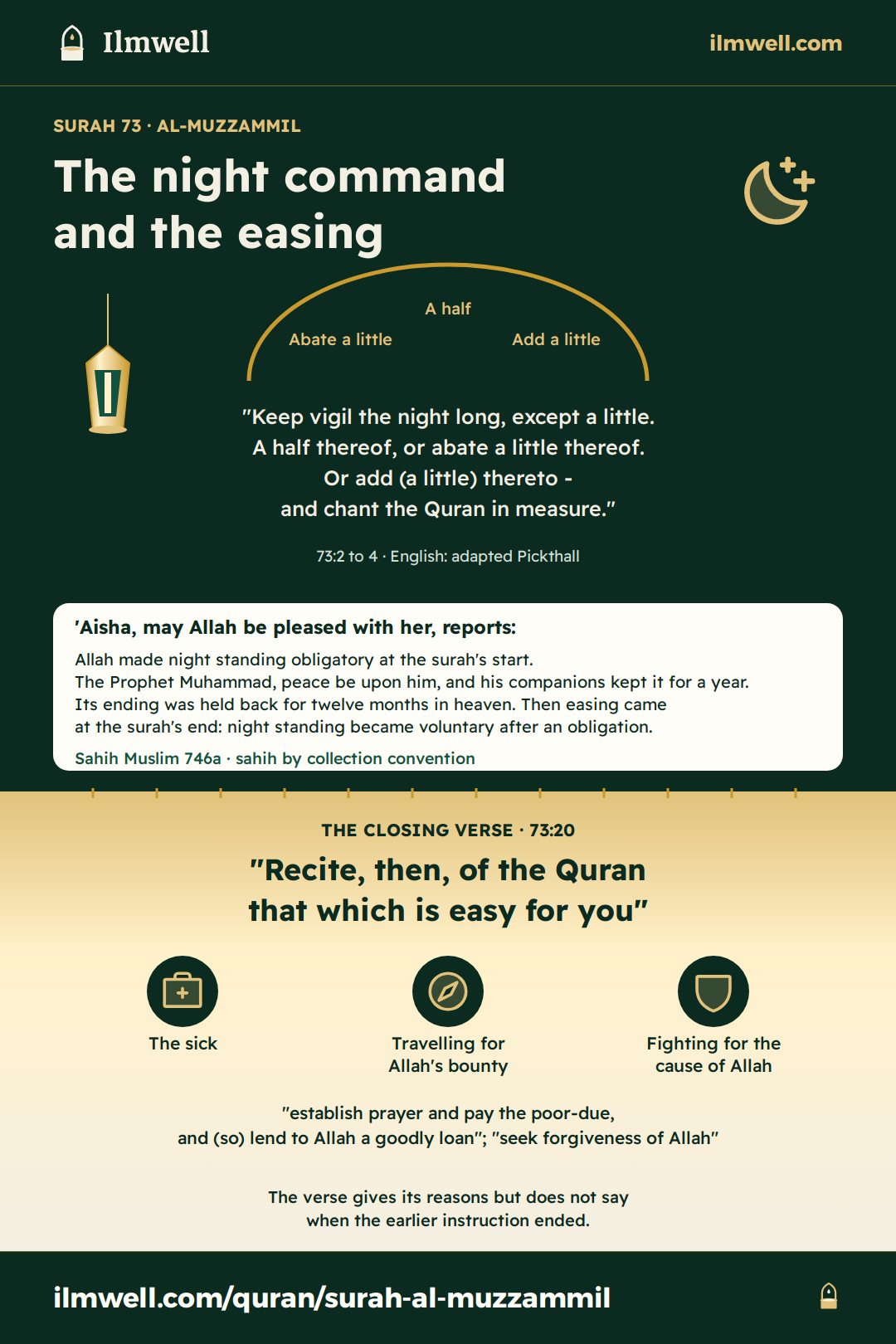
Verse 20 is the closing verse. It says Allah knows "you keep vigil sometimes nearly two-thirds of the night, or (sometimes) half or a third thereof, as do a party of those with you". It gives its own reasons: "He knows that you count it not". It adds "there are sick folk among you, while others travel in the land in search of Allah's bounty, and others (still) are fighting for the cause of Allah" (source 3).
It says "Recite, then, of the Quran that which is easy for you". It then addresses everyone: "establish prayer and pay the poor-due, and (so) lend to Allah a goodly loan", and ends with "seek forgiveness of Allah".
The verse gives its reasons but does not say when the earlier instruction ended. In Sahih Muslim 746a, 'Aisha, may Allah be pleased with her, says that Allah made night standing obligatory at the start of this surah. She reports that the Prophet and his companions kept it for a year, that its ending was held back for twelve months in heaven, that the easing then came at the end of the surah, and that night standing became voluntary after an obligation (source 12). Grade: sahih by collection convention. This is the grade Sahih Muslim carries as a collection, not a separate grader's verdict on this wording.
For a practical introduction to night prayer, see How to pray Tahajjud. Questions about your own night prayer belong with a scholar you trust.

What benefits of Surah Muzammil do these sources establish?
This page cites no reward for reciting the surah, no number of readings, and no promised outcome such as marriage, employment or wealth. Verse 20 does say of "Whatever good you send before you for your souls" that "you will find it with Allah, better and greater in the recompense" (source 3). That is the verse's statement about good sent ahead, not a reward stated for reciting the surah, and the page draws no ruling from it.
A claim about a reward needs its own graded report. If someone sends you a particular promise, keep its exact wording and ask for the report and its grading.
How can you study the surah?
One approach is to take the four passages above over separate sessions. After each, write a one-sentence summary and check it against the verses. Keep your own reflection apart from the translation.
Say you first learnt the opening verses as a child. You could begin this time with the final verse, then return to the opening and notice how the two relate. This is one illustrative exercise, not a prescribed recitation routine.
My Quran teacher stopped me mid-verse when I was about twelve and made me repeat one word five times until the vowel was right. I was embarrassed in front of the class. Now I am grateful, because I still say that word the way he taught me.
Try it: Surah Muzammil in three questions
Three quick questions on the surah. Each answer explains itself.
1Which chapter of the Quran is Al-Muzzammil?
Answer: Chapter 73. Chapter 73, with 20 verses. Chapter 29 is not this surah: juz 29 is the part of the Quran that contains it.
2Which verse names people who are ill, travelling or fighting?
Answer: 73:20. Verse 20. Verse 4 is about measured recitation, and verse 10 about patience.
3Who gives the account of the change in night prayer in Sahih Muslim 746a?
Answer: 'Aisha. 'Aisha, may Allah be pleased with her. It is her account, transmitted in the collection.
Questions people ask
Is Surah Muzzammil the same as Surah Al-Muzzammil?
Yes. Muzammil, Muzzammil and Al-Muzzammil are spellings of the 73rd surah, which has 20 verses.
Does reciting Surah Muzammil bring a reward?
This page cites no reward for reciting it. The benefits section sets out what verse 20 says about good sent ahead.
Is there a transliteration of Surah Al-Muzzammil on this page?
Not yet. This page gives the Arabic from the Tanzil text and the English meaning. A verse-by-verse transliteration needs an approved reader asset, which this page does not have.
Sources
Every claim on this page comes from one of these. Gradings are reported with the scholar's name; we do not grade hadith ourselves.
- 1
Surah Al-Muzzammil 73:1 to 9 addresses the one wrapped up and tells him to keep vigil through the night, except a little, and to chant the Quran in measure (73:4). It says a weighty word will be sent down, that the night is firmer for impression and speech, that the day holds business, and that he should remember the name of his Lord and devote himself to Him.
- 2
Surah Al-Muzzammil 73:10 to 19 tells the addressee to bear patiently what the opponents say and to part from them graciously, leaves the deniers to Allah, warns of fetters, a raging fire and a painful doom on the day the earth and mountains shake, recalls that a messenger was sent to Pharaoh who rebelled and was seized, and calls the Reminder a way to the Lord.
- 3
Surah Al-Muzzammil 73:20 says that Allah knows the addressee and a group with him keep vigil nearly two-thirds of the night, or half, or a third; that Allah measures night and day and knows they cannot count it; and that the reader should recite what is easy. It names people who are ill, travelling for Allah's bounty and fighting in His cause. Addressing everyone, it says to establish prayer, pay the poor-due, lend Allah a goodly loan and seek forgiveness, and says that whatever good is sent ahead will be found with Allah, better and greater in the recompense.
- 4
Surah Al-Muzzammil (73) has 20 verses. It opens with an address to the one wrapped up, tells him to keep vigil through the night except a little, and closes with verse 73:20, which asks for what is easy to recite and names people who are ill, travelling or fighting in Allah's cause.
- 5
Surah Al-Muzzammil, surah 73, has 20 verses.
- 6
The Tanzil metadata names Surah 73 Al-Muzzammil and translates the name as The Enshrouded One.
- 7
The Tanzil metadata classes Surah 73, Al-Muzzammil, as Meccan.
- 8
Surah 73 lies within the 29th part (juz) of the Quran, which begins at 67:1 and ends before 78:1 in the Tanzil juz table.
- 9
Ibn Kathir heads his commentary on Surah Al-Muzzammil with the note that it is Makki.
Ibn Kathir, Tafsir al-Qur'an al-'Azim (al-Salama edition), vol. 8, p. 249, the heading of the commentary Electronic copy: not checked against print. The reports he quotes are not graded here.
- 10
Ibn Kathir reads the opening of Surah Al-Muzzammil (73:1 to 4) as Allah addressing His Messenger, the Prophet Muhammad, peace be upon him, and calling him to rise for standing before his Lord, and he reports that Ibn Abbas, al-Dahhak and al-Suddi take al-Muzzammil as the sleeper and that Qatada takes it as the one wrapped up.
Ibn Kathir, Tafsir al-Qur'an al-'Azim (al-Salama edition), vol. 8, p. 249, on 73:1 to 4 Electronic copy: not checked against print. The reports he quotes are not graded here.
- 11
Ibn Kathir explains the command to recite the Quran in measured recitation in Surah Al-Muzzammil 73:4 as reading slowly, which helps understanding and reflection on the Quran.
Ibn Kathir, Tafsir al-Qur'an al-'Azim (al-Salama edition), vol. 8, p. 250, on 73:4 Electronic copy: not checked against print. The reports he quotes are not graded here.
- 12
'Aisha says that Allah made night standing obligatory at the start of this surah, that the Prophet and his companions kept it for a year, that its ending was held back for twelve months in heaven, and that the easing revealed at the end of the surah made night standing voluntary after an obligation. The suffix "a" in 746a is the sunnah.com locator that identifies this version of the report.
Sahih Muslim 746a Grade: sahih by collection convention (Sahih Muslim), not a grader's verdict. Electronic text read on Islamweb on 2 November 2026; not a print check.
- Q
Quran Arabic on this page is the Tanzil Uthmani text, and the English is the adapted Pickthall translation (1930).
Tanzil Project English: adapted from Marmaduke Pickthall's translation (1930), modernised and checked against modern translations.
Next
- How to pray TahajjudGuide
- SabrTopic page
- Al-MulkQuran lesson
- Tajweed for beginnersGuide
- How to understand the QuranQuran guide
- Quran and SurahsThe hub
For your own situation, ask a scholar you trust.
Join the email list
New guides by email, now and then. No spam, and you can leave at any time.
Ilmwell is free and kept going by readers. See how to support it.