The short answer
The Hijrah (also spelt hijra) is the emigration of the Prophet Muhammad, peace be upon him, from Makkah to Madinah, as told in Sahih al-Bukhari 3905, graded sahih. He and Abu Bakr, may Allah be pleased with him, hid three nights in a cave on Mount Thawr. Years were counted from his arrival (Sahih al-Bukhari 3934, graded sahih).
What does Hijrah mean?
Ibn Hajar, in Fath al-Bari, defines hijrah as leaving, and hijrah to a thing as moving to it from something else. He says it took two forms in Islam. The first was a move from a land of fear to a land of safety, as in the emigrations to Abyssinia and the start of the emigration from Makkah to Madinah 6.
With a capital H, the Hijrah means that emigration of the Prophet to Madinah. This page tells its history; it gives no ruling on moving country today.
Why did the Prophet leave Makkah?
'Aisha, may Allah be pleased with her, the Prophet's wife, tells it in Sahih al-Bukhari 3905 (graded sahih). When the Muslims of Makkah were put under trial, Abu Bakr set out towards Abyssinia before turning back, and others had emigrated there. The Prophet then told the Muslims he had been shown the land they would emigrate to, a place of palm trees between two lava tracts, and Muslims emigrated towards Madinah.
Then the Prophet was given permission to leave, and Abu Bakr went with him.
1AuthenticSahih al-Bukhari 3905
What happened on the Hijrah journey?
These four steps follow 'Aisha's account in Sahih al-Bukhari 3905, graded sahih, in its own order.
- Permission to leave. At midday the Prophet came to Abu Bakr's house and told him he had been given permission to leave. Abu Bakr asked to go with him, and he said yes.
- Food for the road. 'Aisha says: we made the two ready quickly and put food for them in a leather bag. Asma bint Abi Bakr, may Allah be pleased with her, cut a piece from her waistband to tie its mouth, and so was called Dhat al-Nitaq, she of the waistband.
- Three nights in the cave. The two reached a cave in Mount Thawr and stayed hidden there for three nights. 'Abdullah ibn Abi Bakr, may Allah be pleased with him, spent the nights with them and brought news of Quraysh after dark. 'Amir ibn Fuhayrah, may Allah be pleased with him, Abu Bakr's freed slave, grazed sheep near them so they had milk.
- The guide and the coast road. A guide they had hired brought their two camels to the cave after three nights. 'Amir and the guide went with them, and the guide took them by the coastal road.
1AuthenticSahih al-Bukhari 3905
Arrival in Madinah
The Muslims of Madinah went out every morning to wait for him. He stopped among the clan of Banu 'Amr ibn 'Awf on a Monday in Rabi' al-Awwal, according to 'Urwa ibn al-Zubayr, a successor (of the generation after the companions), in Sahih al-Bukhari 3906, graded sahih. The mosque "founded on piety" was founded there, and he prayed in it. Al-Mubarakpuri's al-Rahiq al-Makhtum names this stop Quba 9.
Anas ibn Malik, may Allah be pleased with him, says he stopped in the upper part of Madinah among Banu 'Amr ibn 'Awf. He then rode on, with Abu Bakr behind him on his camel and the leaders of Banu al-Najjar around him. He dismounted in the courtyard of Abu Ayyub, may Allah be pleased with him, and later ordered the mosque to be built (Sahih al-Bukhari 3932, graded sahih).
3AuthenticSahih al-Bukhari 3906
4AuthenticSahih al-Bukhari 3932
What happened in the cave?
Abu Bakr himself said that while he was in the cave he told the Prophet that if one of them looked beneath his feet, he would see them. The Prophet answered: "What do you think, Abu Bakr, of two whose third is Allah?" (Sahih al-Bukhari 3653, graded sahih).
2AuthenticSahih al-Bukhari 3653
The Quran speaks of the moment "when they two were in the cave, when he said to his comrade: Do not grieve. Indeed, Allah is with us." (At-Tawbah 9:40).
إِلَّا تَنصُرُوهُ فَقَدْ نَصَرَهُ ٱللَّهُ إِذْ أَخْرَجَهُ ٱلَّذِينَ كَفَرُوا۟ ثَانِىَ ٱثْنَيْنِ إِذْ هُمَا فِى ٱلْغَارِ إِذْ يَقُولُ لِصَـٰحِبِهِۦ لَا تَحْزَنْ إِنَّ ٱللَّهَ مَعَنَا ۖ فَأَنزَلَ ٱللَّهُ سَكِينَتَهُۥ عَلَيْهِ وَأَيَّدَهُۥ بِجُنُودٍ لَّمْ تَرَوْهَا وَجَعَلَ كَلِمَةَ ٱلَّذِينَ كَفَرُوا۟ ٱلسُّفْلَىٰ ۗ وَكَلِمَةُ ٱللَّهِ هِىَ ٱلْعُلْيَا ۗ وَٱللَّهُ عَزِيزٌ حَكِيمٌ
The verse does not name the cave; the name Mount Thawr comes from Sahih al-Bukhari 3905. Neither 3653 nor 3905 mentions a spider's web or a dove. This page has not checked the other narrations that tell of them, so it makes no claim about them either way.
Which places does the Hijrah pass through?
There is no route map here: the sources give place names, not a line on a map. These are the places, in the order the reports give them.
| Place | What happens there | Source |
|---|---|---|
| Makkah | Abu Bakr's house, where the Prophet brought the news of permission and the two were made ready | Sahih al-Bukhari 3905 |
| Mount Thawr | A cave in this mountain, where the two hid for three nights | Sahih al-Bukhari 3905 |
| The coastal road | The route the hired guide took after the cave | Sahih al-Bukhari 3905 |
| Banu 'Amr ibn 'Awf, in the upper part of Madinah | Where he first stopped; the mosque founded on piety was founded there | Sahih al-Bukhari 3906 and 3932 |
| Madinah | Where he dismounted in the courtyard of Abu Ayyub (3932); where his camel knelt, at the site of his mosque (3906) | Sahih al-Bukhari 3932 and 3906 |
Al-Mubarakpuri adds that the two took the road south of Makkah, towards Yemen, for about five miles to Mount Thawr, because Quraysh would watch the main road north 7.
When did the Hijrah happen?
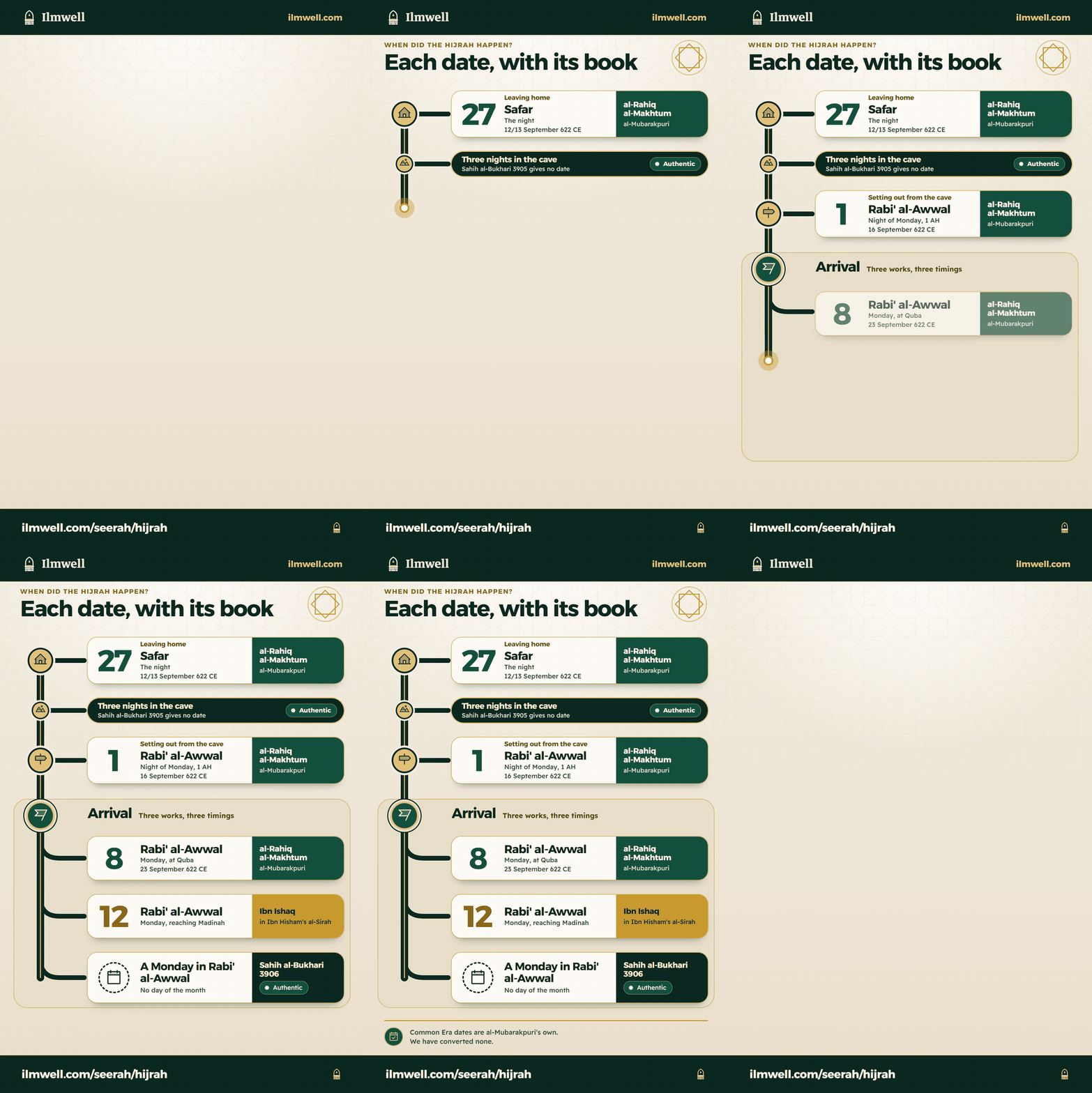
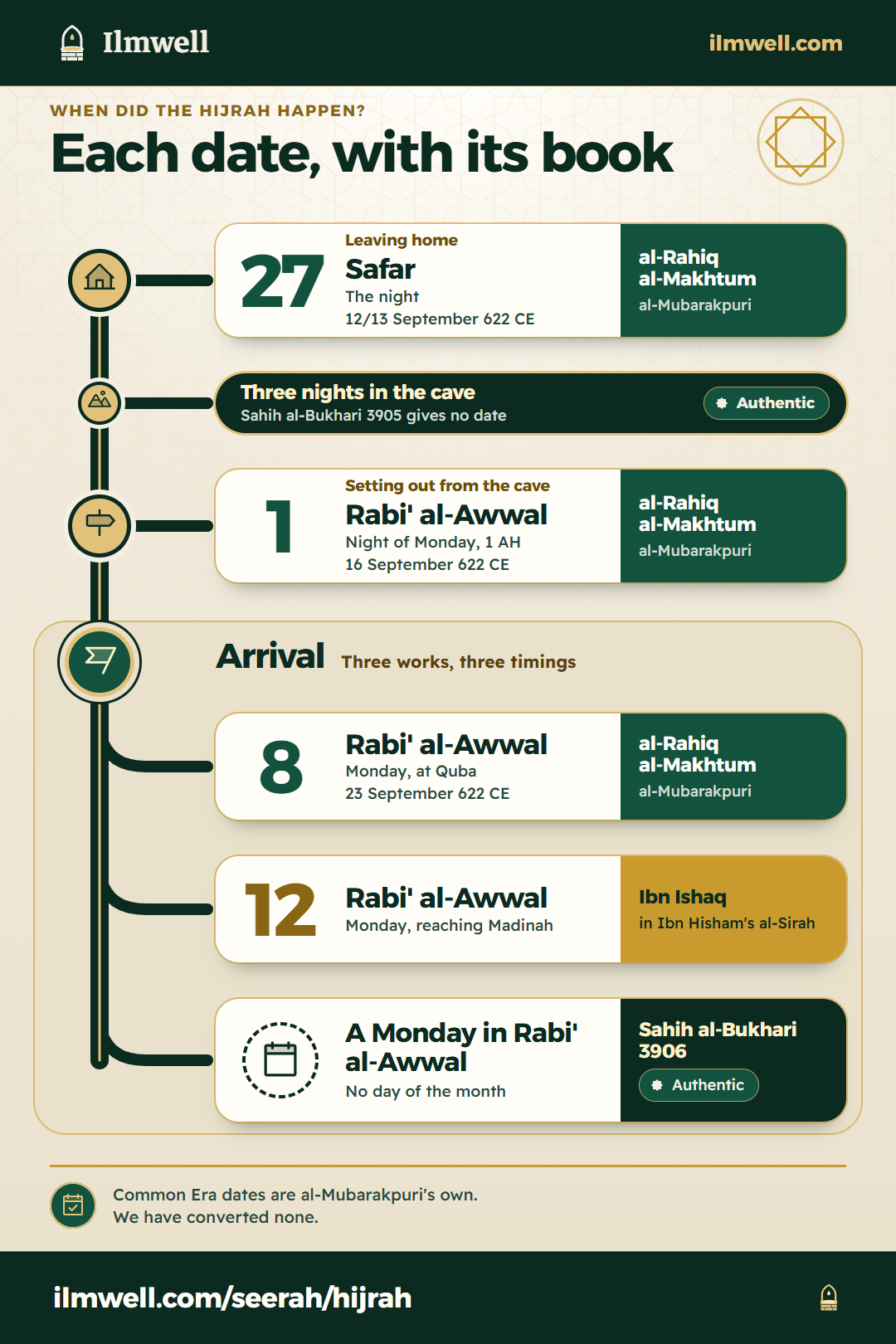
Sahih al-Bukhari 3905 gives no date for the departure; 'Urwa's report in 3906 gives only "a Monday in Rabi' al-Awwal" for the arrival. The days and years below come from two seerah works, each named. The Common Era dates are the ones al-Mubarakpuri gives; we have not converted any date ourselves.
| Stage | What the sources say |
|---|---|
| Leaving home | The night of 27 Safar, year 14 of the prophethood, which al-Mubarakpuri gives as 12/13 September 622 CE (al-Rahiq al-Makhtum) 7. |
| Setting out from the cave | The night of Monday, 1 Rabi' al-Awwal, 1 AH, given as 16 September 622 CE (al-Rahiq al-Makhtum) 8. Sahih al-Bukhari 3905: after three nights. |
| Arrival | Monday, 8 Rabi' al-Awwal, at Quba, "the first year of the Hijrah", given as 23 September 622 CE (al-Rahiq al-Makhtum) 9. Monday, 12 Rabi' al-Awwal, aged 53, thirteen years after his mission began (Ibn Ishaq, in Ibn Hisham's al-Sirah) 10. A Monday in Rabi' al-Awwal (Sahih al-Bukhari 3906). |
Al-Mubarakpuri cites Rahmatan lil-'Alamin for the departure and Quba dates, and notes that he counts the years of the prophethood from Muharram; counted from the month of the first revelation, the same Safar falls in year 13 7.
Why does the Islamic calendar start from the Hijrah?
They counted the years neither from the Prophet's mission nor from his death, only from his arrival in Madinah, said Sahl ibn Sa'd, may Allah be pleased with him (Sahih al-Bukhari 3934, graded sahih). That is a companion's report of what they did; it gives no reason.
5AuthenticSahih al-Bukhari 3934
The reason comes from reports gathered by Ibn Hajar in Fath al-Bari. He calls a report from al-Zuhri, that the Prophet himself ordered the dating, "mu'dal", a chain with links missing, and says the well-known view is that it began under 'Umar, may Allah be pleased with him 11.
Among the reasons given, Ibn Hajar cites the account of al-Sha'bi, a successor: Abu Musa, may Allah be pleased with him, wrote to 'Umar that his letters arrived undated. 'Umar gathered the people; some said to count from the mission, some from the Hijrah. 'Umar said the Hijrah separated truth from falsehood, so date by it, in the year seventeen. When some proposed Ramadan, he chose Muharram, the month people return from Hajj 11. Ibn Hajar gives no grade for this account in the passage.
Ibn Hajar's own explanation of Muharram: the pledge fell in Dhu al-Hijjah, so the resolve to emigrate began with the next new moon, Muharram 11.
Where do the sources differ?
| Question | What the sources say |
|---|---|
| Day of arrival | 8 Rabi' al-Awwal (al-Rahiq al-Makhtum) 9; 12 Rabi' al-Awwal (Ibn Ishaq) 10; a Monday in Rabi' al-Awwal, no day of the month ('Urwa, Sahih al-Bukhari 3906). |
| Nights with Banu 'Amr ibn 'Awf | Fourteen (Anas, Sahih al-Bukhari 3932). Ten-odd, that is more than ten ('Urwa, Sahih al-Bukhari 3906). |
| The mosque land | A date-drying yard of two orphan boys, who offered it as a gift ('Urwa, Sahih al-Bukhari 3906). A walled garden of Banu al-Najjar, who said they sought its price only from Allah (Anas, Sahih al-Bukhari 3932). |
I knew the Hijrah as a date on the calendar long before I knew the journey behind it. Reading the account in order, with the places named, made the new year feel like it meant something.
Try it: three questions
Pick an answer; each one explains itself.
1Which report names Mount Thawr as the place of the cave?
Answer: Sahih al-Bukhari 3905. 'Aisha's account names a cave in Mount Thawr. The verse speaks of the two in the cave without naming it. Source 1
2Does Sahih al-Bukhari 3653 mention a spider or a dove?
Answer: No. It gives Abu Bakr's words that if one of them looked beneath his feet he would see them, and the Prophet's answer about two whose third is Allah. Nothing more. Source 2
3In Sahih al-Bukhari 3934, from what were the years counted?
Answer: His arrival in Madinah. Sahl ibn Sa'd says they counted neither from his mission nor from his death, only from his arrival in Madinah. Source 5
Questions people ask
Did the Hijrah happen on the first day of Muharram?
None of the works cited on this page places it in Muharram. Al-Mubarakpuri's al-Rahiq al-Makhtum dates the departure from home to 27 Safar and the arrival of the Prophet Muhammad, peace be upon him, at Quba to 8 Rabi' al-Awwal; Ibn Ishaq gives 12 Rabi' al-Awwal for the arrival. Fath al-Bari, the commentary on Sahih al-Bukhari, cites an account from al-Sha'bi, given there without a grade, that 'Umar, may Allah be pleased with him, chose Muharram to start the year because people return from Hajj then.
Sources
Every claim on this page comes from one of these. Gradings are reported with the scholar's name; we do not grade hadith ourselves.
- 1
'Aisha's account of the emigration: after the Prophet was given permission to emigrate, he and Abu Bakr left and hid in a cave on Mount Thawr for three nights before setting out with a hired guide.
Sahih al-Bukhari 3905 Book 63, Hadith 130
Authentic: in Sahih al-Bukhari
- 2
Abu Bakr said that while he was in the cave he told the Prophet that if one of them looked beneath his feet he would see them, and the Prophet replied: what do you think, Abu Bakr, of two whose third is Allah?
Sahih al-Bukhari 3653 Book 62, Hadith 5
Authentic: in Sahih al-Bukhari
- 3
'Urwa ibn al-Zubayr reported that the Prophet reached Banu 'Amr ibn 'Awf on a Monday in Rabi' al-Awwal, stayed more than ten nights while the mosque founded on piety was founded, then rode on until his camel knelt at the site of his mosque in Madinah, which he then built.
Sahih al-Bukhari 3906 Book 63, Hadith 131
Authentic: in Sahih al-Bukhari
- 4
Anas said that when the Prophet came to Madinah he stopped in its upper part among Banu 'Amr ibn 'Awf for fourteen nights, then rode with Abu Bakr behind him to the courtyard of Abu Ayyub, and later had the mosque built on land of Banu al-Najjar.
Sahih al-Bukhari 3932 Book 63, Hadith 157
Authentic: in Sahih al-Bukhari
- 5
Sahl ibn Sa'd said the companions counted the years neither from the Prophet's mission nor from his death, but from his arrival in Madinah.
Sahih al-Bukhari 3934 Book 63, Hadith 159
Authentic: in Sahih al-Bukhari
- 6
The meaning of hijrah (leaving; moving from one place to another) and its first form in Islam, from a land of fear to a land of safety.
Ahmad ibn 'Ali ibn Hajar al-'Asqalani (d. 852 AH), Fath al-Bari bi-Sharh Sahih al-Bukhari, vol. 1, p. 16 (Kitab Bad' al-Wahy, on the word hijratuhu in the hadith of intentions) Read on 24 October 2026. Record: scholarly-ibnhajar-hijrah-meaning.
- 7
Leaving home on the night of 27 Safar, year 14 of the prophethood (12/13 September 622 CE as he gives it), and the road south to Mount Thawr.
Safi al-Rahman al-Mubarakpuri (d. 1427 AH), al-Rahiq al-Makhtum, p. 148 (section 'Min al-dar ila al-ghar'), footnote 3 citing Rahmatan lil-'Alamin 1/95 Read on 24 October 2026. Record: scholarly-mubarakpuri-hijrah-departure.
- 8
Setting out from the cave on the night of Monday, 1 Rabi' al-Awwal, 1 AH (16 September 622 CE as he gives it).
Safi al-Rahman al-Mubarakpuri (d. 1427 AH), al-Rahiq al-Makhtum, p. 151 (section 'Fi al-tariq ila al-Madinah') Read on 24 October 2026. Record: scholarly-mubarakpuri-hijrah-setting-out.
- 9
Arrival at Quba on Monday, 8 Rabi' al-Awwal, the first year of the Hijrah (23 September 622 CE as he gives it).
Safi al-Rahman al-Mubarakpuri (d. 1427 AH), al-Rahiq al-Makhtum, p. 154 (section 'al-Nuzul bi-Quba'), footnote 4 citing Rahmatan lil-'Alamin 1/102 Read on 24 October 2026. Record: scholarly-mubarakpuri-quba-arrival.
- 10
Ibn Ishaq's date for the arrival in Madinah: Monday, 12 Rabi' al-Awwal, aged 53.
'Abd al-Malik ibn Hisham (d. 213 AH), abridging Muhammad ibn Ishaq (d. 151 AH), al-Sirah al-Nabawiyyah (Sirat Ibn Hisham), vol. 1, p. 590 (section 'Tarikh al-Hijrah') Read on 21 October 2026. Record: scholarly-ibnhisham-hijrah.
- 11
Why the calendar counts from the Hijrah: al-Sha'bi's account of 'Umar's decision, as Ibn Hajar reports it, and the choice of Muharram.
Ahmad ibn 'Ali ibn Hajar al-'Asqalani (d. 852 AH), Fath al-Bari bi-Sharh Sahih al-Bukhari, vol. 7, p. 268 (Kitab Manaqib al-Ansar, Bab al-Tarikh min ayna arrakhu al-tarikh, on Sahih al-Bukhari 3934) Read on 24 October 2026. Record: scholarly-ibnhajar-calendar-hijrah.
- Q
Quran Arabic and English for At-Tawbah 9:40, and the English phrase quoted from it.
Tanzil Project Uthmani text, CC BY 3.0. English: adapted from Marmaduke Pickthall's translation (1930), modernised and checked against modern translations.
Next
Join the email list
New guides by email, now and then. No spam, and you can leave at any time.
Ilmwell is free and kept going by readers. See how to support it.