The short answer
The Prophet Muhammad, peace be upon him, is the messenger the Quran calls "the Seal of the Prophets" (Al-Ahzab 33:40). Born in Makkah in the Year of the Elephant (570 CE), he died in Madinah in 632 CE, aged 63 in the reports of 'Aisha, Anas and Ibn Abbas, may Allah be pleased with them (Sahih al-Bukhari 3536, graded sahih); others give 60 or 65.
His life at a glance: a timeline
A Hijri year counts from the Hijrah, his emigration to Madinah.
- Year of the Elephant (570 CE)Born in Makkah, on a Monday
- Ages 6 and 8His mother Aminah dies, then his grandfather
- Age 40The first revelation, in the cave of Hira
- The Makkan yearsHe calls Quraysh to Islam; some Muslims leave for Abyssinia
- Hijri year 1 (622 CE)The Hijrah: he emigrates to Madinah
- Hijri years 6 and 8Hudaybiyyah, then the conquest of Makkah
- Hijri year 10The Farewell Pilgrimage
- Hijri year 11 (632 CE)Dies in Madinah, on a Monday in Rabi' al-Awwal
Who was the Prophet Muhammad?
Muhammad ibn 'Abdullah (also spelt Mohammed) was of the Quraysh tribe, from its clan of Banu Hashim. He said Allah chose Quraysh from Kinanah, Banu Hashim from Quraysh, and him from Banu Hashim (Sahih Muslim 2276, graded sahih).
1AuthenticSahih Muslim 2276
مَّا كَانَ مُحَمَّدٌ أَبَآ أَحَدٍ مِّن رِّجَالِكُمْ وَلَـٰكِن رَّسُولَ ٱللَّهِ وَخَاتَمَ ٱلنَّبِيِّـۧنَ ۗ وَكَانَ ٱللَّهُ بِكُلِّ شَىْءٍ عَلِيمًا
Another verse addresses him: "We sent you not except as a mercy for the peoples." (Al-Anbiya 21:107).
When and where was Prophet Muhammad born?
He was born in Makkah in the Year of the Elephant, 570 CE in the Western calendar 32. The classical sources date it by the Year of the Elephant, not by a Western year, and they differ on the exact night (see the table below).
Asked about fasting on Mondays, he said it was the day he was born and the day he was sent, or revelation came to him (Sahih Muslim 1162, narrated by Abu Qatada, may Allah be pleased with him).
2AuthenticSahih Muslim 1162
Ibn Ishaq, in Ibn Hisham's al-Sirah al-Nabawiyyah, dates the birth to Monday, 12 Rabi' al-Awwal, in the Year of the Elephant (Surah Al-Fil, 105:1, speaks of "the owners of the Elephant") 23. Ibn Kathir's al-Bidayah wa al-Nihayah records other nights (see the table below) and al-Zubayr ibn Bakkar's report that he was born in Makkah 24.
His father, 'Abdullah ibn 'Abd al-Muttalib, died while his mother, Aminah bint Wahb, was pregnant, says Ibn Ishaq 23. Aminah died at al-Abwa' when he was six; his grandfather 'Abd al-Muttalib, with whom he then lived, died when he was eight 25.
How did the first revelation come?
Revelation came to him at forty, said Ibn Abbas, may Allah be pleased with him (Sahih al-Bukhari 3851, graded sahih). Al-Baqarah 2:185 names Ramadan as the month the Quran was revealed. 'Aisha, may Allah be pleased with her, tells how it began (Sahih al-Bukhari 3):
- It began with true dreams, each coming to pass as clearly as daybreak.
- He came to love solitude, worshipping for nights at a time in the cave of Hira, then returning to his wife Khadijah, may Allah be pleased with her, for provisions.
- The angel came to him in the cave and said: "Read." He answered: "I am not a reader." Three times the angel pressed him hard, then recited the opening of Surah Al-Alaq (Sahih al-Bukhari 3).
- He returned to Khadijah, his heart trembling, saying: "Cover me." She said Allah would never disgrace him.
ٱقْرَأْ بِٱسْمِ رَبِّكَ ٱلَّذِى خَلَقَ خَلَقَ ٱلْإِنسَـٰنَ مِنْ عَلَقٍ ٱقْرَأْ وَرَبُّكَ ٱلْأَكْرَمُ
3AuthenticSahih al-Bukhari 3
4AuthenticSahih al-Bukhari 3851
What happened in the Makkan years?
When the verse "And warn your tribe of near kindred" (Ash-Shu'ara 26:214) came down, he climbed the hill of as-Safa, called the clans of Quraysh together and warned them of a severe punishment (Sahih al-Bukhari 4770, graded sahih).
5AuthenticSahih al-Bukhari 4770
When the Muslims were put under trial, some emigrated to Abyssinia, 'Aisha said (Sahih al-Bukhari 3905, graded sahih).
Khadijah died three years before he left for Madinah, according to 'Urwa ibn al-Zubayr, a successor (of the generation after the companions), in Sahih al-Bukhari 3896 (graded sahih).
6AuthenticSahih al-Bukhari 3896
What was the Hijrah?
The Hijrah is his emigration from Makkah to Madinah, after some of his followers had gone ahead. It took place in 622 CE, the year the Islamic calendar counts from 32. In 'Aisha's account, he came at midday to her father, Abu Bakr, may Allah be pleased with him, to say he had permission to leave, and Abu Bakr went with him. The two hid in a cave in Mount Thawr for three nights, then set out with a hired guide (Sahih al-Bukhari 3905, graded sahih).
7AuthenticSahih al-Bukhari 3905
The Quran speaks of the two in the cave: "the second of two; when they two were in the cave" (At-Tawbah 9:40).
Muslims from Madinah met him on the lava plain outside it, and he stopped among the clan of Banu 'Amr ibn 'Awf on a Monday in Rabi' al-Awwal, according to 'Urwa ibn al-Zubayr in Sahih al-Bukhari 3906 (graded sahih). Ibn Ishaq gives the date as 12 Rabi' al-Awwal, his age as 53 26. The companions counted the Islamic years from this arrival, said Sahl ibn Sa'd, may Allah be pleased with him (Sahih al-Bukhari 3934, graded sahih).
8AuthenticSahih al-Bukhari 3934
What did he do in Madinah?
After more than ten nights with Banu 'Amr ibn 'Awf, where a mosque "founded on piety" was built, he rode on until his camel knelt in a date-drying yard owned by two orphan boys. He asked the two boys to name a price; they offered it as a gift. He then built a mosque there, carrying mud bricks himself: the narration calls it the Messenger's mosque in Madinah (Sahih al-Bukhari 3906, graded sahih).
9AuthenticSahih al-Bukhari 3906
Ten years in Madinah followed (Sahih al-Bukhari 3851). They included battles, and the Quran names one: "Allah had already given you the victory at Badr" (Al Imran 3:123). Ibn Hisham dates Hudaybiyyah, when he set out for 'umrah (the lesser pilgrimage), to the end of year six. He dates the conquest of Makkah to Ramadan of year eight 27.
What was the Farewell Pilgrimage?
It is his Hajj in the tenth year. Jabir ibn 'Abdullah, may Allah be pleased with him, said the Prophet went nine years without making Hajj, then announced it in the tenth, and great numbers came to Madinah to follow him (Sahih Muslim 1218, graded sahih). He set out with five nights of Dhu al-Qa'dah left, says Ibn Ishaq 27.
10AuthenticSahih Muslim 1218
'Umar ibn al-Khattab, may Allah be pleased with him, said the verse "This day have I perfected your religion for you..." (Al-Maidah 5:3) came down while the Prophet stood at 'Arafah, on a Friday (Sahih al-Bukhari 45, graded sahih).
11AuthenticSahih al-Bukhari 45
How did Prophet Muhammad die?
He died after an illness, in 'Aisha's house in Madinah, on a Monday, in 632 CE 32.
- When the illness grew heavy, he asked his wives' permission to be nursed in 'Aisha's house, and they agreed (Sahih al-Bukhari 4442, graded sahih).
- He died there on her day, resting against her chest. Wiping his face with water, he said "There is no god but Allah; death has its agonies", then raised his hand, saying "with the highest companion", until he passed away (Sahih al-Bukhari 4449, graded sahih).
- The day was a Monday, 'Aisha told her father (Sahih al-Bukhari 1387, graded sahih).
Where do the sources differ on dates and his age?
The narrations differ on his years in Makkah, and so on his age.
| Question | What the sources say |
|---|---|
| Night of his birth | 12 Rabi' al-Awwal (Ibn Ishaq) 23. Ibn Kathir also lists the 2nd, 8th and 10th, and a Ramadan date he calls very strange 24. |
| Year of his birth | The Year of the Elephant, the majority view in Ibn Kathir, who also reports Ibn Abza placing the Elephant ten years before the birth 24. |
| His father's death | Before his birth (Ibn Ishaq). The edition's editors note that most scholars place it in his infancy, at two months or more; another view gives twenty-eight months 23. |
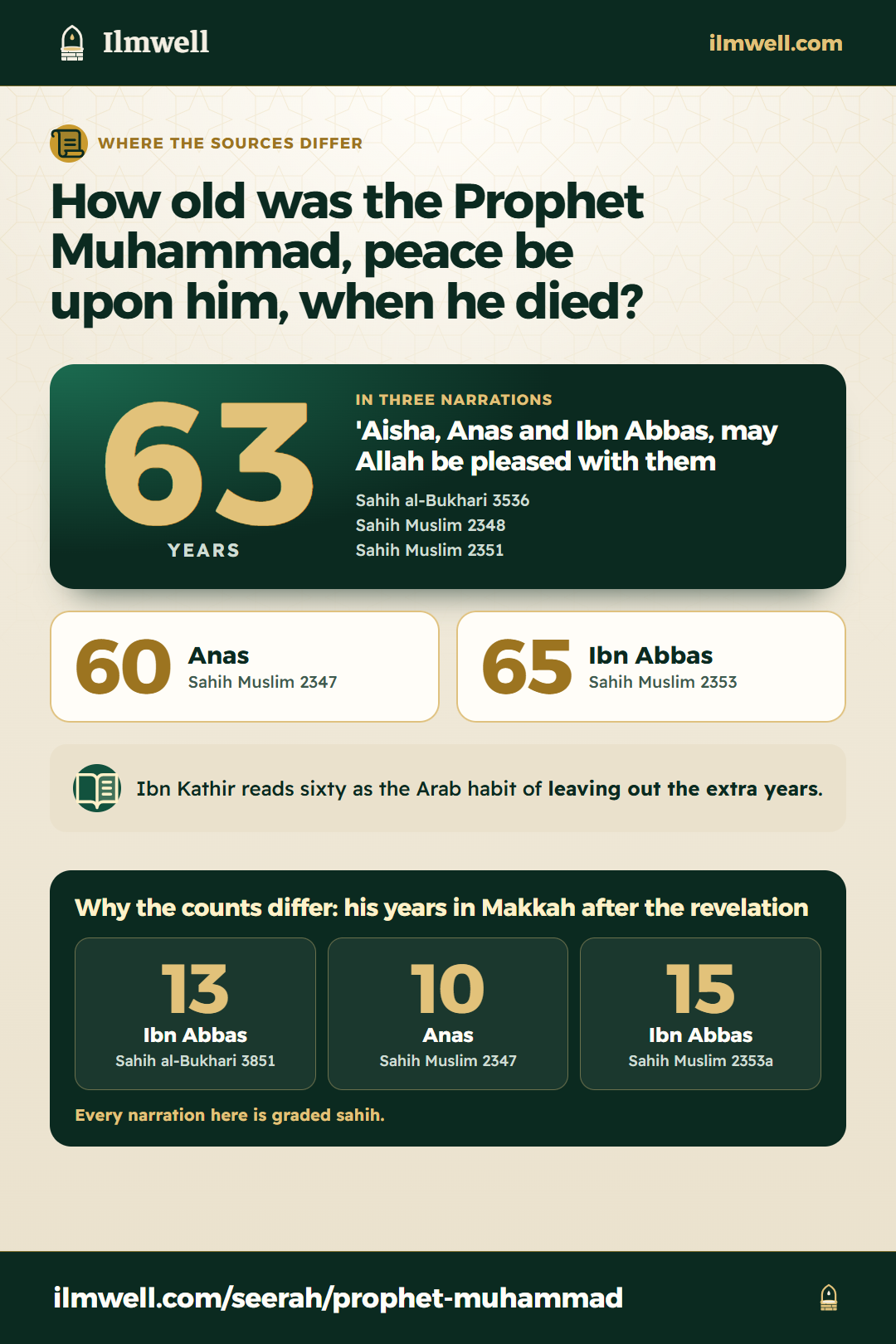
| Years in Makkah after the revelation | 13: Ibn Abbas (Sahih al-Bukhari 3851; Sahih Muslim 2351). 10: Anas ibn Malik, may Allah be pleased with him (Sahih Muslim 2347). 15: Ibn Abbas (Sahih Muslim 2353a). |
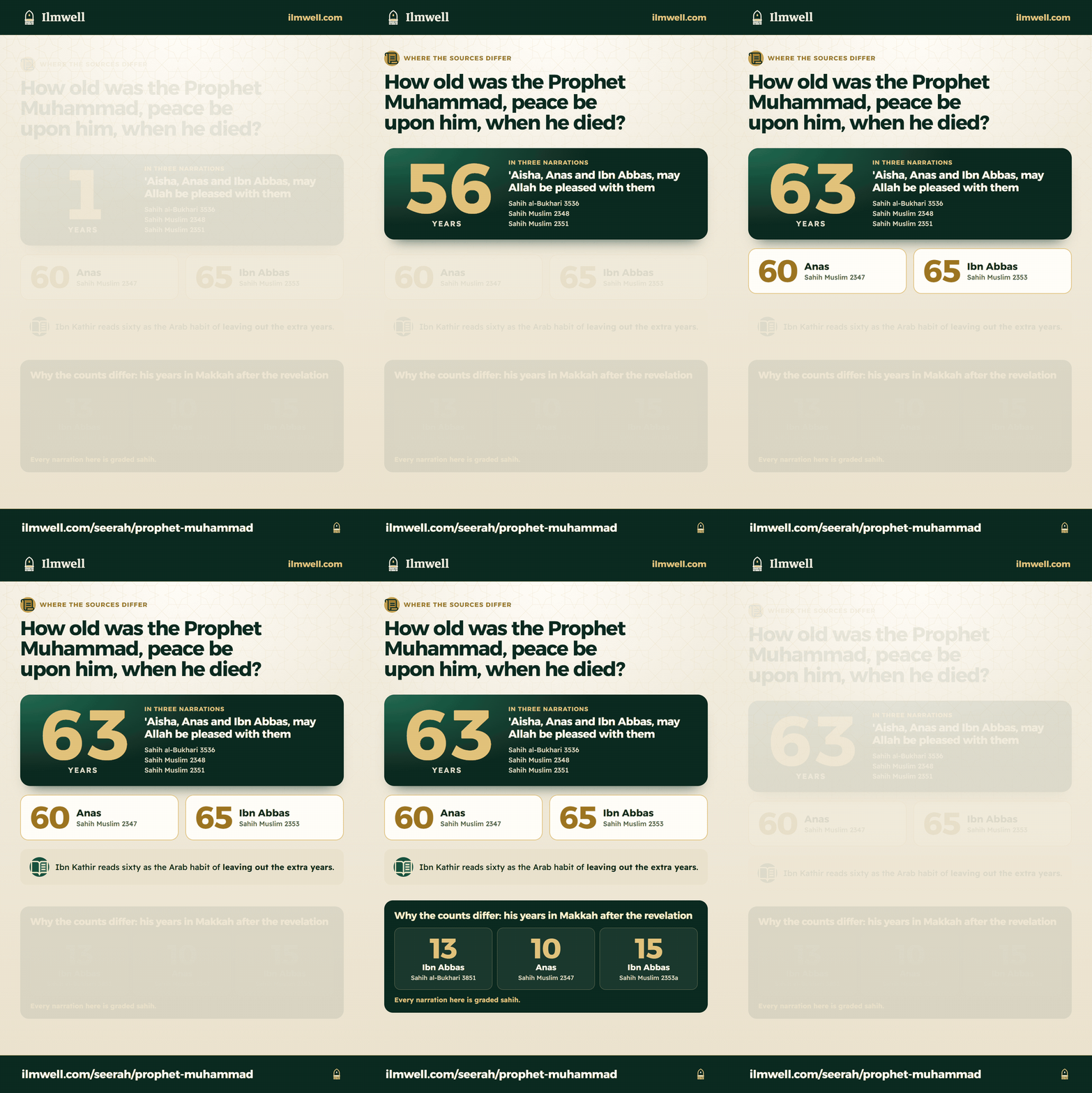
| Age at death | 63: 'Aisha (Sahih al-Bukhari 3536), Anas (Sahih Muslim 2348), Ibn Abbas (Sahih Muslim 2351). 60: Anas (Sahih Muslim 2347). 65: Ibn Abbas (Sahih Muslim 2353). Ibn Kathir reads sixty as the Arab habit of leaving out the extra years 28. |
| Date of death | 12 Rabi' al-Awwal (Ibn Ishaq, al-Waqidi), which Ibn Kathir calls the well-known view; 1 Rabi' al-Awwal (al-Layth); 2 Rabi' al-Awwal (Sa'd ibn Ibrahim al-Zuhri, Khalifah ibn Khayyat). All in year eleven 28. |
15AuthenticSahih al-Bukhari 3536
16AuthenticSahih Muslim 2348
17AuthenticSahih Muslim 2351
18AuthenticSahih Muslim 2347
19AuthenticSahih Muslim 2353
20AuthenticSahih Muslim 2353a
Where is Prophet Muhammad buried?
His grave is in Madinah, in the house of 'Aisha where he died: she said he died on her day "and was buried in my house" (Sahih al-Bukhari 1389, graded sahih). 'Umar, dying, asked her permission to be buried with his two companions, and she gave it (Sahih al-Bukhari 1392, graded sahih).
In Hijri year 88, Ibn Kathir records, 'Umar ibn 'Abd al-'Aziz, on the caliph al-Walid's order, brought 'Aisha's room into the Prophet's Mosque in Madinah, so that the grave came inside the mosque 29.
21AuthenticSahih al-Bukhari 1389
22AuthenticSahih al-Bukhari 1392
What is Prophet Muhammad's family tree?
His father's name was 'Abdullah and his mother's Aminah. Ibn Hisham's al-Sirah opens with his line, father to father, back to 'Adnan (ibn means "son of") 30.
- Muhammad
- 'Abdullah
- 'Abd al-Muttalib
- Hashim
- 'Abd Manaf
- Qusayy
- Kilab
- Murrah
- Ka'b
- Lu'ayy
- Ghalib
- Fihr
- Malik
- al-Nadr
- Kinanah
- Khuzaymah
- Mudrikah
- Ilyas
- Mudar
- Nizar
- Ma'add
- 'Adnan
Beyond 'Adnan, Ibn Hisham traces it to Isma'il, son of Ibrahim, peace be upon them.
Khadijah was the first woman he married, and he married no one else while she lived, says Ibn Hisham. All his children were hers except Ibrahim, whose mother was Mariyah, may Allah be pleased with her. His daughters Zaynab, Ruqayyah, Umm Kulthum and Fatimah, may Allah be pleased with them, all accepted Islam and emigrated with him 31.
| Child | Mother | What the source says |
|---|---|---|
| al-Qasim | Khadijah | Eldest son, says Ibn Hisham; died before Islam. The Prophet was called Abu al-Qasim after him. |
| al-Tayyib and al-Tahir | Khadijah | Died before Islam. The edition's editors note they are usually taken as titles of one son, 'Abdullah. |
| Ruqayyah | Khadijah | Eldest daughter, says Ibn Hisham. |
| Zaynab | Khadijah | Daughter. |
| Umm Kulthum | Khadijah | Daughter. |
| Fatimah | Khadijah | Daughter. |
| Ibrahim | Mariyah | Son. |
As Ibn Ishaq lists them, that is eight children; counting al-Tayyib and al-Tahir as one son, 'Abdullah, it is seven.
What I knew about the Prophet as a child was a handful of stories from assembly and a few from my parents. Reading his life properly as an adult, in order, felt like finding out that the person I had been introduced to had a whole story behind him.
Questions people ask
Is there a picture or photo of Prophet Muhammad?
Ilmwell shows no picture or photo of the Prophet Muhammad, peace be upon him, and does not describe his appearance, on this page or any other.
Where did Islam originate, and was he its founder?
The revelation began in the cave of Hira near Makkah when he was 40, as the timeline above records. The Quran calls him the Seal of the Prophets (Al-Ahzab 33:40), the last of a line that includes Ibrahim, Musa and Isa, peace be upon them, so Muslims do not call him the founder of Islam.
What do pbuh and SAW mean after his name?
Both are short forms of the blessing written after his name: pbuh for "peace be upon him", SAW for the Arabic sallallahu 'alayhi wa sallam, "Allah bless him and grant him peace".
Sources
Every claim on this page comes from one of these. Gradings are reported with the scholar's name; we do not grade hadith ourselves.
- 1
The Prophet said Allah chose Kinanah from the descendants of Isma'il, Quraysh from Kinanah, Banu Hashim from Quraysh, and him from Banu Hashim.
Sahih Muslim 2276 Book 43, Hadith 1
Authentic: in Sahih Muslim
- 2
Asked about fasting on Monday, the Prophet said it was the day he was born and the day he was sent, or revelation came down to him.
Sahih Muslim 1162 Book 13, Hadith 253
Authentic: in Sahih Muslim
- 3
'Aisha described how revelation began: true dreams, then worship alone in the cave of Hira, where the angel came, told him to read three times, and gave him the opening verses of Surah Al-Alaq; he returned to Khadijah, may Allah be pleased with her, who took him to Waraqa ibn Nawfal.
Sahih al-Bukhari 3 Book 1, Hadith 3
Authentic: in Sahih al-Bukhari
- 4
Ibn Abbas said revelation came to the Prophet when he was forty; he stayed thirteen years, was then commanded to emigrate, emigrated to Madinah, stayed there ten years and then died.
Sahih al-Bukhari 3851 Book 63, Hadith 76
Authentic: in Sahih al-Bukhari
- 5
Ibn Abbas said that when Ash-Shu'ara 26:214, on warning his nearest kindred, was revealed, the Prophet climbed as-Safa, called the clans of Quraysh together and warned them of a severe punishment.
Sahih al-Bukhari 4770 Book 65, Hadith 292
Authentic: in Sahih al-Bukhari
- 6
'Urwa ibn al-Zubayr said Khadijah died three years before the Prophet left for Madinah.
Sahih al-Bukhari 3896 Book 63, Hadith 121
Authentic: in Sahih al-Bukhari
- 7
'Aisha's account of the emigration: after the Prophet was given permission to emigrate, he and Abu Bakr left and hid in a cave on Mount Thawr for three nights before setting out with a hired guide.
Sahih al-Bukhari 3905 Book 63, Hadith 130
Authentic: in Sahih al-Bukhari
- 8
Sahl ibn Sa'd said the companions counted the years neither from the Prophet's mission nor from his death, but from his arrival in Madinah.
Sahih al-Bukhari 3934 Book 63, Hadith 159
Authentic: in Sahih al-Bukhari
- 9
'Urwa ibn al-Zubayr reported that the Prophet reached Banu 'Amr ibn 'Awf on a Monday in Rabi' al-Awwal, stayed more than ten nights while the mosque founded on piety was founded, then rode on until his camel knelt at the site of his mosque in Madinah, which he then built.
Sahih al-Bukhari 3906 Book 63, Hadith 131
Authentic: in Sahih al-Bukhari
- 10
Jabir ibn 'Abdullah said the Prophet stayed nine years without making Hajj, then announced in the tenth year that he would make Hajj, and a great many people came to Madinah to follow him.
Sahih Muslim 1218 Book 15, Hadith 159
Authentic: in Sahih Muslim
- 11
'Umar ibn al-Khattab said the verse of Al-Maidah 5:3 on the perfecting of the religion was revealed to the Prophet while he stood at 'Arafah, on a Friday.
Sahih al-Bukhari 45 Book 2, Hadith 38
Authentic: in Sahih al-Bukhari
- 12
'Aisha said that when the Prophet's illness grew heavy he asked his wives' permission to be nursed in her house, and they gave it.
Sahih al-Bukhari 4442 Book 64, Hadith 463
Authentic: in Sahih al-Bukhari
- 13
'Aisha said the Prophet died in her house, on her day, resting against her chest; wiping his face with water he said 'There is no god but Allah; death has its agonies', then raised his hand saying 'with the highest companion' until he died.
Sahih al-Bukhari 4449 Book 64, Hadith 469
Authentic: in Sahih al-Bukhari
- 14
'Aisha told Abu Bakr that the Prophet died on a Monday.
Sahih al-Bukhari 1387 Book 23, Hadith 139
Authentic: in Sahih al-Bukhari
- 15
'Aisha said the Prophet died aged sixty-three.
Sahih al-Bukhari 3536 Book 61, Hadith 45
Authentic: in Sahih al-Bukhari
- 16
Anas ibn Malik said the Prophet died aged sixty-three, as did Abu Bakr and 'Umar.
Sahih Muslim 2348 Book 43, Hadith 149
Authentic: in Sahih Muslim
- 17
Ibn Abbas said the Prophet stayed in Makkah thirteen years and died aged sixty-three.
Sahih Muslim 2351 Book 43, Hadith 154
Authentic: in Sahih Muslim
- 18
Anas ibn Malik said Allah sent the Prophet at the head of forty years; he stayed ten years in Makkah and ten in Madinah, and Allah took him at the head of sixty years.
Sahih Muslim 2347 Book 43, Hadith 147
Authentic: in Sahih Muslim
- 19
Ibn Abbas said the Prophet died aged sixty-five.
Sahih Muslim 2353 Book 43, Hadith 160
Authentic: in Sahih Muslim
- 20
Ibn Abbas counted the Prophet's life as forty years before he was sent, fifteen in Makkah 'in safety and in fear', and ten after his emigration to Madinah.
Sahih Muslim 2353a Book 43, Hadith 158
Authentic: in Sahih Muslim
- 21
'Aisha said the Prophet died on her day, between her chest and throat, and was buried in her house.
Sahih al-Bukhari 1389 Book 23, Hadith 141
Authentic: in Sahih al-Bukhari
- 22
When he was dying, 'Umar ibn al-Khattab asked 'Aisha's permission to be buried with his two companions, and she gave it.
Sahih al-Bukhari 1392 Book 23, Hadith 146
Authentic: in Sahih al-Bukhari
- 23
Ibn Ishaq's date of birth, the Year of the Elephant, and his father's death before his birth, with the editors' note on that death.
'Abd al-Malik ibn Hisham (d. 213 AH), abridging Muhammad ibn Ishaq (d. 151 AH), al-Sirah al-Nabawiyyah (Sirat Ibn Hisham), ed. Mustafa al-Saqqa, Ibrahim al-Abyari and 'Abd al-Hafiz Shalabi, 2nd edition, Mustafa al-Babi al-Halabi, Cairo, 1375 AH / 1955 (2 vols; shamela.ws numbering follows the print), vol. 1, p. 158 (birth date; death of 'Abdullah) and p. 159 (Qays ibn Makhramah's report) Read on 21 October 2026. Record: scholarly-ibnhisham-birth.
- 24
Ibn Kathir's list of the reported dates of his birth, the year, and al-Zubayr ibn Bakkar's report of the house in Makkah.
Isma'il ibn Kathir (d. 774 AH), al-Bidayah wa al-Nihayah, ed. 'Ali Shiri, 1st edition, Dar Ihya' al-Turath al-'Arabi, Beirut, 1408 AH / 1988 (shamela.ws numbering follows the print), vol. 2, pp. 319 to 321 (Bab mawlid Rasul Allah) Read on 21 October 2026. Record: scholarly-ibnkathir-birth-date.
- 25
The deaths of his mother Aminah (when he was six) and his grandfather (when he was eight).
'Abd al-Malik ibn Hisham (d. 213 AH), abridging Muhammad ibn Ishaq (d. 151 AH), al-Sirah al-Nabawiyyah (Sirat Ibn Hisham), ed. Mustafa al-Saqqa, Ibrahim al-Abyari and 'Abd al-Hafiz Shalabi, 2nd edition, Mustafa al-Babi al-Halabi, Cairo, 1375 AH / 1955 (2 vols; shamela.ws numbering follows the print), vol. 1, p. 168 (death of Aminah) and p. 169 (death of 'Abd al-Muttalib) Read on 21 October 2026. Record: scholarly-ibnhisham-childhood.
- 26
Ibn Ishaq's date for the arrival in Madinah: Monday, 12 Rabi' al-Awwal, aged 53.
'Abd al-Malik ibn Hisham (d. 213 AH), abridging Muhammad ibn Ishaq (d. 151 AH), al-Sirah al-Nabawiyyah (Sirat Ibn Hisham), ed. Mustafa al-Saqqa, Ibrahim al-Abyari and 'Abd al-Hafiz Shalabi, 2nd edition, Mustafa al-Babi al-Halabi, Cairo, 1375 AH / 1955 (2 vols; shamela.ws numbering follows the print), vol. 1, p. 590 (section 'Tarikh al-Hijrah') Read on 21 October 2026. Record: scholarly-ibnhisham-hijrah.
- 27
Hudaybiyyah (end of year six), the conquest of Makkah (Ramadan, year eight) and the departure for the Farewell Pilgrimage.
'Abd al-Malik ibn Hisham (d. 213 AH), abridging Muhammad ibn Ishaq (d. 151 AH), al-Sirah al-Nabawiyyah (Sirat Ibn Hisham), ed. Mustafa al-Saqqa, Ibrahim al-Abyari and 'Abd al-Hafiz Shalabi, 2nd edition, Mustafa al-Babi al-Halabi, Cairo, 1375 AH / 1955 (2 vols; shamela.ws numbering follows the print), vol. 2, p. 308 (Hudaybiyyah), p. 389 (conquest of Makkah), p. 601 (Farewell Pilgrimage) Read on 21 October 2026. Record: scholarly-ibnhisham-madinah-dates.
- 28
The reported dates of his death in Rabi' al-Awwal, year eleven, and Ibn Kathir's note on sixty and sixty-three.
Isma'il ibn Kathir (d. 774 AH), al-Bidayah wa al-Nihayah, ed. 'Ali Shiri, 1st edition, Dar Ihya' al-Turath al-'Arabi, Beirut, 1408 AH / 1988 (shamela.ws numbering follows the print), vol. 5, pp. 276 to 278 (fi dhikr al-waqt alladhi tuwuffiya fihi) Read on 21 October 2026. Record: scholarly-ibnkathir-death-date.
- 29
'Aisha's room, with the grave, brought into the Prophet's Mosque in 88 AH on the caliph al-Walid's order.
Isma'il ibn Kathir (d. 774 AH), al-Bidayah wa al-Nihayah, ed. 'Ali Shiri, 1st edition, Dar Ihya' al-Turath al-'Arabi, Beirut, 1408 AH / 1988 (shamela.ws numbering follows the print), vol. 9, p. 89 (events of the year 88) Read on 21 October 2026. Record: scholarly-ibnkathir-grave-mosque.
- 30
His lineage from Muhammad to 'Adnan, continuing to Isma'il son of Ibrahim.
'Abd al-Malik ibn Hisham (d. 213 AH), abridging Muhammad ibn Ishaq (d. 151 AH), al-Sirah al-Nabawiyyah (Sirat Ibn Hisham), ed. Mustafa al-Saqqa, Ibrahim al-Abyari and 'Abd al-Hafiz Shalabi, 2nd edition, Mustafa al-Babi al-Halabi, Cairo, 1375 AH / 1955 (2 vols; shamela.ws numbering follows the print), vol. 1, pp. 1 to 2 Read on 21 October 2026. Record: scholarly-ibnhisham-lineage.
- 31
His children by Khadijah and Ibrahim by Mariyah, and Khadijah as his first wife.
'Abd al-Malik ibn Hisham (d. 213 AH), abridging Muhammad ibn Ishaq (d. 151 AH), al-Sirah al-Nabawiyyah (Sirat Ibn Hisham), ed. Mustafa al-Saqqa, Ibrahim al-Abyari and 'Abd al-Hafiz Shalabi, 2nd edition, Mustafa al-Babi al-Halabi, Cairo, 1375 AH / 1955 (2 vols; shamela.ws numbering follows the print), vol. 1, pp. 190 to 191 Read on 21 October 2026. Record: scholarly-ibnhisham-children.
- 32
BBC (British Broadcasting Corporation), BBC Religions, "Islam: Prophet Muhammad (570-632)", Page last updated 2011-07-08 (archived religion guide, still online) Read on 21 October 2026. Record: reference-bbc-prophet-dates.
- Q
Quran Arabic and English for Al-Ahzab 33:40 and Al-Alaq 96:1 to 3; English phrases from Al-Anbiya 21:107, Ash-Shu'ara 26:214, At-Tawbah 9:40, Al Imran 3:123, Al-Maidah 5:3 and Al-Fil 105:1. Al-Baqarah 2:185 is referred to in our words.
Tanzil Project Uthmani text, CC BY 3.0. English: adapted from Marmaduke Pickthall's translation (1930), modernised and checked against modern translations.
Next
Join the email list
New guides by email, now and then. No spam, and you can leave at any time.
Ilmwell is free and kept going by readers. See how to support it.