The short answer
Allahu akbar, often translated "Allah is the greatest", is the takbir: the words Muslims say to begin the prayer and at most movements. The Prophet Muhammad, peace be upon him, told a man to say takbir on standing for prayer, and said it himself, again on bowing and prostrating (Sahih al-Bukhari 793 and 789, graded sahih).
How is Allahu akbar written in Arabic?
Sahih al-Bukhari 803
اللَّهُ أَكْبَرُ
Allahu akbar
Allah is greater, or the greatest
Two Followers (the generation after the companions) report that Abu Hurayrah, may Allah be pleased with him, said these words going down to prostrate in his own prayer. Saying them is takbir 9. To copy and paste the Arabic, use the button: it saves a fight with your phone's autocorrect.
3AuthenticSahih al-Bukhari 803
What does Allahu akbar mean?
It is two words: Allah, and akbar, from the root k-b-r, which also gives kabir, great 9. The sunnah.com English for the adhan (the call to prayer) in Sahih Muslim 385, graded sahih, reads "Allah is the Greatest".
Does it mean "Allah is the greatest" or "Allah is greater"?
In Lisan al-Arab, Ibn Manzur gives several readings. Some make akbar mean kabir, great. Sibawayh reads an omitted "than everything", as in "you are better", meaning than others. Al-Tahdhib, which he quotes, gives akbar for kabir or an implied "greatest of the great". Ibn Manzur gives the rule that a form like akbar takes "al-" or a following noun. 9
The same root gives the name al-Kabir:
عَـٰلِمُ ٱلْغَيْبِ وَٱلشَّهَـٰدَةِ ٱلْكَبِيرُ ٱلْمُتَعَالِ
How do you pronounce Allahu akbar?
Say it as two words: Allahu, then akbar. Lisan al-Arab says the r of akbar has no vowel when you stop on it, in the adhan and the prayer, and takes a damma (the u vowel) when it is joined to the next word 9. In al-Mughni, in a note on saying the takbir clearly that sits within his discussion of the opening takbir, Ibn Qudamah says lengthening the first letter (Aallahu) turns it into a question. 13
A recorded pronunciation by a fluent reciter is coming. We do not use a synthetic voice for Arabic.
When do Muslims say Allahu akbar?
It is an everyday part of Muslim worship. Some uses the sources describe; its use in any particular event is not covered here.
In the prayer and the adhan
To begin the prayer
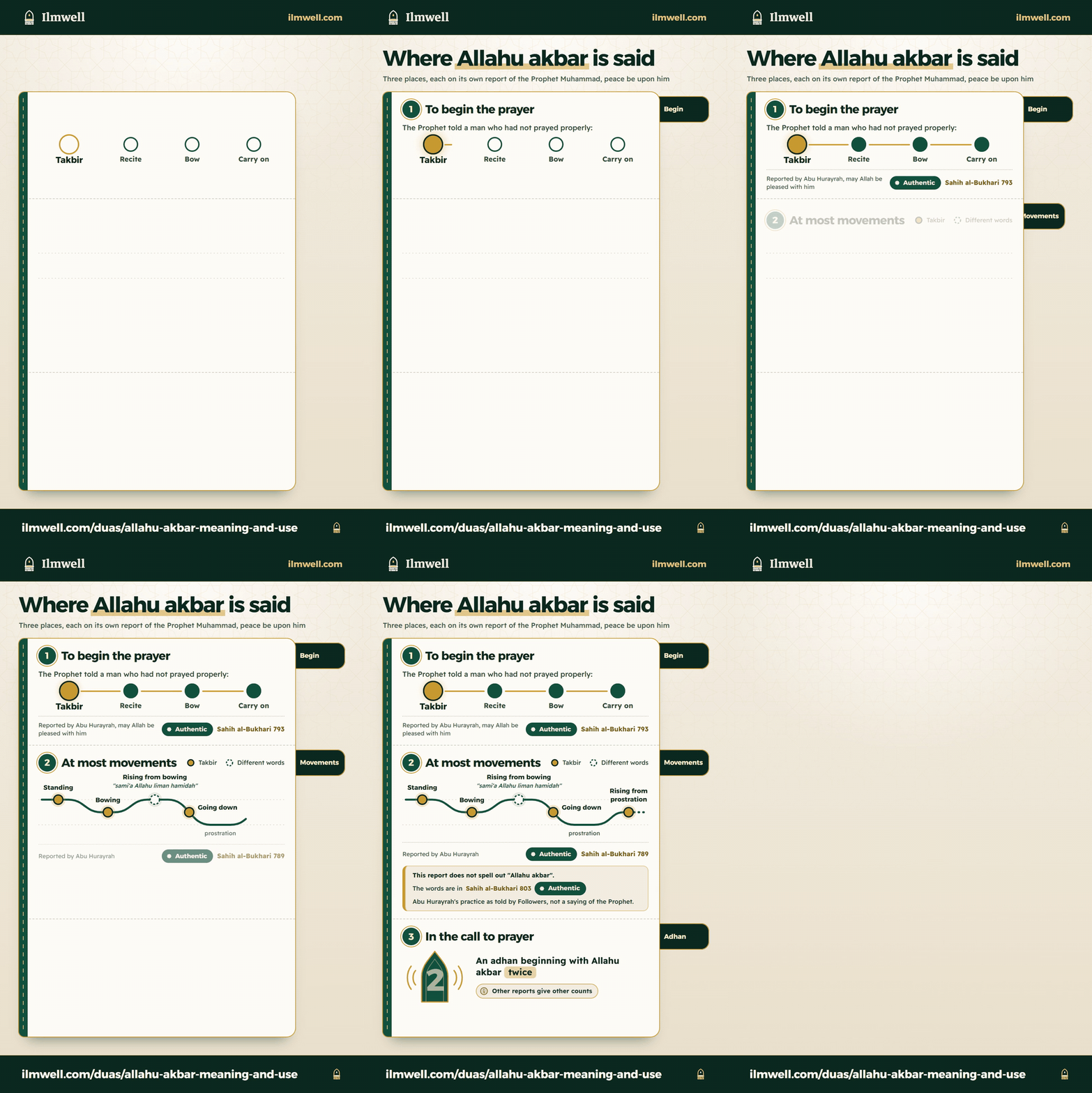
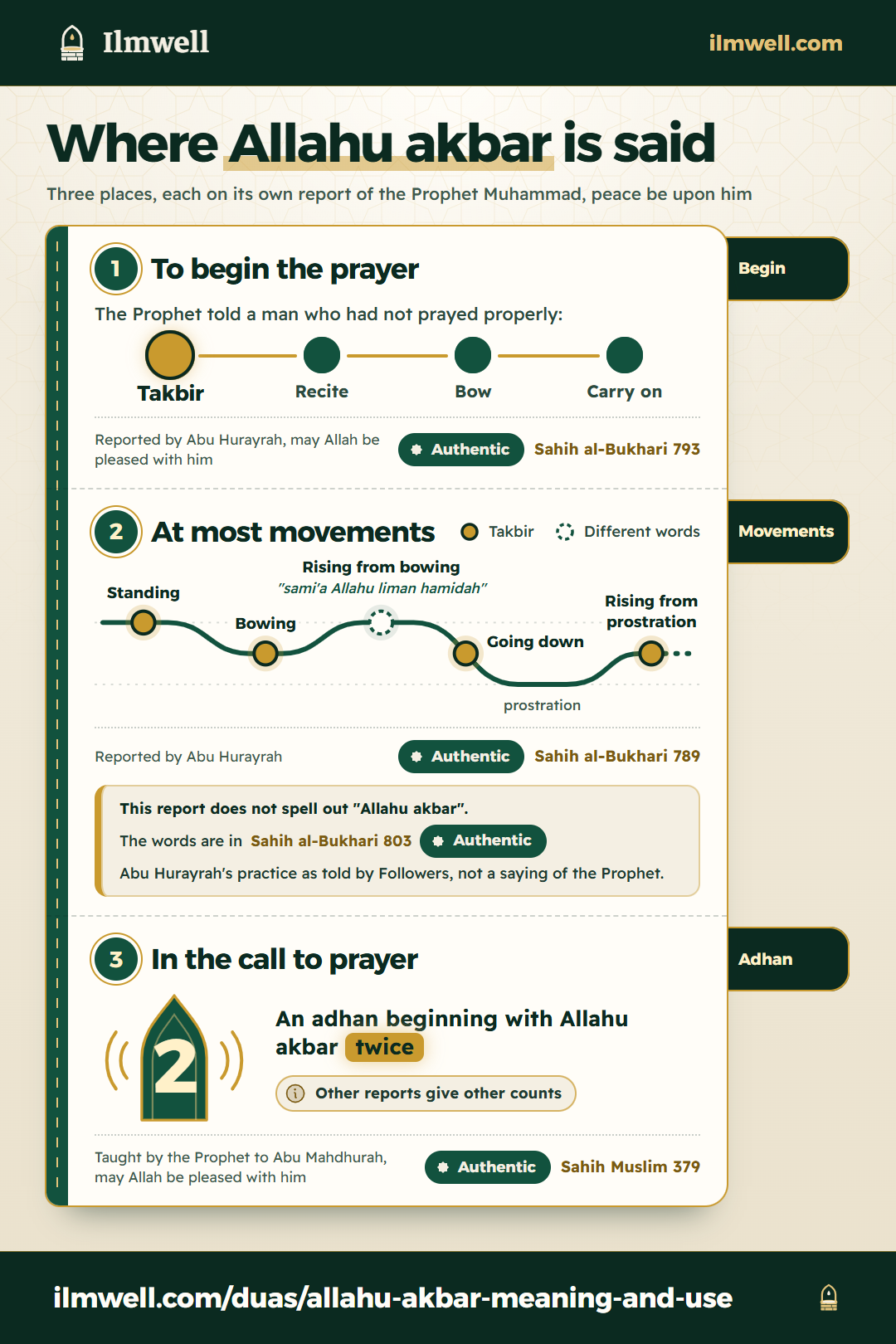
Abu Hurayrah reported that the Prophet told a man who had not prayed properly: when you stand for the prayer, say takbir, then recite, then bow, and carry on through the prayer.
1AuthenticSahih al-Bukhari 793
At most movements
Abu Hurayrah said the Prophet used to say takbir on standing, bowing, going down and rising from prostration, but "sami'a Allahu liman hamidah" on rising from bowing. The report does not spell out "Allahu akbar".
2AuthenticSahih al-Bukhari 789
The words are in Sahih al-Bukhari 803 (above), a Follower-reported practice of Abu Hurayrah, not a saying of the Prophet. The salah guide has the whole sequence.
In the call to prayer
Abu Mahdhurah, may Allah be pleased with him, reported that the Prophet taught him an adhan beginning with Allahu akbar twice; other reports give other counts (see the adhan lesson).
6AuthenticSahih Muslim 379
'Umar ibn al-Khattab, may Allah be pleased with him, reported the Prophet saying a listener repeats the muadhdhin's (caller's) Allahu akbar.
5AuthenticSahih Muslim 385
Afterwards and at other times
After the prayer
Two separate reports in Sahih Muslim give a count. Ka'b ibn 'Ujrah, may Allah be pleased with him, reported the Prophet saying that words after every prescribed prayer leave their sayer not disappointed: glorifying (Subhanallah) 33 times, praising (Alhamdulillah) 33 and magnifying (Allahu akbar) 34 (Sahih Muslim 596).
4AuthenticSahih Muslim 596
Abu Hurayrah has the Prophet saying: whoever glorifies Allah, praises Him and magnifies Him 33 times each after every prayer, and completes the hundred with "la ilaha illallahu wahdahu la sharika lah" and the rest, has his sins forgiven. The report adds that this holds even if they are like the foam of the sea (Sahih Muslim 597). That belongs to the whole set, not the takbir alone.
7AuthenticSahih Muslim 597
See also the tasbih counter, Subhanallah and Alhamdulillah.
At bedtime
'Ali, may Allah be pleased with him, reported that Fatimah, may Allah be pleased with her, had gone to ask the Prophet for a servant. He came to them in bed and told them to magnify Allah 34 times, praise Him 33 and glorify Him 33, better than what they had asked for (Sahih al-Bukhari 3113). See dua before sleeping.
8AuthenticSahih al-Bukhari 3113
How do the four schools treat the opening takbir?
Each cell names its book. Every passage here is about the opening takbir (takbirat al-ihram), the one that begins the prayer. The last column says which takbir each passage addresses, and none of the four supports a claim about the takbirs at movements or after the prayer. A rukn is a pillar, a shart a condition and fara'id (singular fard) things required. On a phone, scroll sideways.
| Its status | Its words | Which takbir it addresses | |
|---|---|---|---|
| Hanafi | Listed among six fara'id, citing Al-Muddaththir 74:3, "Your Lord magnify" (al-Hidayah 1/47), but called a condition (shart) (1/48) 10 | Abu Hanifa and Muhammad (al-Shaybani): another name of Allah or a phrase such as Allahu ajall, al-Rahman akbar or la ilaha illa Allah will do. Abu Yusuf: for one who can say it, only Allahu akbar, Allahu al-akbar or Allahu al-kabir (1/48) 10 | The opening takbir only (al-tahrima, the takbir of opening). It does not address the takbirs at movements or after the prayer. |
| Shafi'i | Second of thirteen pillars (Minhaj, p. 25) 11 | Allahu akbar for one able; Allahu al-akbar does no harm; akbar Allah is not accepted in the sound view (p. 25) 11 | The opening takbir only (takbirat al-ihram). It does not address the takbirs at movements or after the prayer. |
| Maliki | First of fifteen fara'id, which al-Dardir glosses as the prayer's pillars and parts (al-Sharh al-Kabir 1/231) 12 | Only Allahu akbar, in Arabic; al-Dasuqi adds that Allahu ajall, a'zam, al-kabir and al-akbar do not do (1/232 to 1/233) 12 | The opening takbir only (takbirat al-ihram). It does not address the takbirs at movements or after the prayer. |
| Hanbali | A pillar: no prayer without it, left out deliberately or by forgetting (al-Mughni 1/334) 13 | The prayer is entered only by saying Allahu akbar (1/333) 13 | The opening takbir only. The passage mentions a takbir at bowing once, as a view others held for someone who forgot the opening takbir; that is not a statement about the takbirs at movements. |
The first takbir I remember was at Eid in a packed school sports hall, standing next to my dad. I was too short to see the imam, so I listened for his voice and copied everyone around me. When the whole hall said it together, I felt it in my chest.
Try it: what would you say?
1What did the Prophet tell the man who had not prayed properly to say on standing for the prayer?
Answer: Takbir. He told him: when you stand for the prayer, say takbir. Source 1
2How many times does Sahih Muslim 596 give for magnifying Allah after the prayer?
Answer: 34. It gives 33 for glorifying and for praising, and 34 for magnifying. Sahih Muslim 597 is a separate report: 33 for each and a closing line. Source 4
3In al-Mughni, what does lengthening the first letter, Aallahu, turn the words into?
Answer: A question. Ibn Qudamah says it becomes a question (source 13).
Questions people ask
How is Allahu akbar different from Subhanallah and Alhamdulillah?
Subhanallah glorifies Allah, Alhamdulillah praises Him and Allahu akbar magnifies Him. Sahih Muslim 596, graded sahih, counts the three together after the prayer.
Sources
Every claim on this page comes from one of these. Gradings are reported with the scholar's name; we do not grade hadith ourselves.
- 1
The Prophet taught a man the stages of prayer: takbir, recitation, bowing, rising, prostration, sitting, prostration, and calm in each.
Sahih al-Bukhari 793 Book 10, Hadith 188
Authentic: in Sahih al-Bukhari
- 2
Abu Hurayrah reported that when the Prophet stood for prayer he used to say takbir as he stood, then as he bowed; then sami'a Allahu liman hamidah on lifting his back from bowing and rabbana laka l-hamd standing; then takbir on going down, on raising his head, on prostrating and on raising his head again; and he did the same through the whole prayer, and said takbir on standing from the two rak'ahs after sitting.
Authentic: in Sahih al-Bukhari (Al-Bukhari); sahih (Al-Albani); the chain is sahih on the conditions of the two shaykhs (Shu'ayb al-Arna'ut); included in his Sahih (Ibn Khuzaymah)
- 3
Two Followers (named in the notes) reported that Abu Hurayrah used to say takbir in every prayer, obligatory or voluntary: on standing, on bowing; then sami'a Allahu liman hamidah, then rabbana wa laka l-hamd before prostrating; then 'Allahu akbar' on going down to prostrate, and takbir on raising the head, on the second prostration, on raising the head again, and on standing from the sitting after two rak'ahs, doing the same in every rak'ah; and he said that his prayer was the closest in resemblance to the Prophet's, and that this was his prayer until he left the world.
Sahih al-Bukhari 803 Book 10, Hadith 198
Authentic: in Sahih al-Bukhari
- 4
Ka'b ibn 'Ujrah reported the Prophet saying that there are remembrances after every prescribed prayer whose sayer will not be disappointed: glorifying Allah 33 times, praising Him 33 times and declaring His greatness 34 times.
Authentic: in Sahih Muslim
- 5
'Umar ibn al-Khattab's report: the listener repeats the caller's words, except that at hayya 'ala as-salah and at hayya 'ala al-falah he says la hawla wa la quwwata illa billah.
Sahih Muslim 385 Book 4, Hadith 14
Authentic: in Sahih Muslim
- 6
Abu Mahdhurah's (may Allah be pleased with him) Adhan as Sahih Muslim gives it: two opening takbirs, the testimonies twice and then repeated twice, hayya 'ala as-salah and hayya 'ala al-falah twice each, with Ishaq's added ending.
Sahih Muslim 379 Book 4, Hadith 6
Authentic: in Sahih Muslim
- 7
Abu Hurayrah reported the Prophet saying that whoever glorifies Allah (sabbaha) 33 times after every prayer, praises Him 33 times and declares His greatness 33 times, ninety-nine in all, and completes the hundred with 'la ilaha illallahu wahdahu la sharika lah, lahul-mulku wa lahul-hamdu wa huwa 'ala kulli shay'in qadir', has his sins forgiven even if they are like the foam of the sea.
Sahih Muslim 597 Book 5, Hadith 188
Authentic: in Sahih Muslim
- 8
Ali reported that the Prophet told him and Fatimah, when they go to bed, to say Allahu akbar 34 times, Alhamdulillah 33 times and Subhanallah 33 times, and that this is better for them than the servant they had asked for.
Authentic: in Sahih al-Bukhari
- 9
Ibn Manzur, in Lisan al-Arab under the root k-b-r, reports how the phrase Allahu akbar is read: some make akbar mean kabir (great); Sibawayh reads an omitted 'than everything' (akbar min kulli shay'), as one says 'you are better' meaning than others; al-Azhari's Tahdhib gives two readings for the worshipper's and the muadhdhin's words, akbar standing in place of kabir, or an implied 'greatest of the great'; and a further reading is 'greater than that the reality of His greatness be known'. He also says takbir is ta'zim (magnifying), that the form af'al takes 'al-' or an annexation, and that the r of akbar in the adhan and the prayer is without a vowel when stopped on, taking a damma when joined to a following word.
Ibn Manzur, Lisan al-Arab, vol. 5, pp. 125 and 127, root k-b-r Record: scholarly-lisan-kbr-allahu-akbar. Read on shamela.ws on 27 October 2026 (an electronic text; the print edition was not checked).
- 10
Al-Marghinani's al-Hidayah (Hanafi) lists the opening takbir (al-tahrima) first among the six fara'id of the prayer, citing Al-Muddaththir 74:3 and saying the meaning is the takbir of opening; then calls it a condition (shart) among the Hanafis, against al-Shafi'i; and on its wording, reports that Abu Hanifa and Muhammad accept, in its place, Allahu ajall or a'zam, al-Rahman akbar, la ilaha illa Allah or another of the names of Allah, while Abu Yusuf, for one who can say the takbir, accepts only Allahu akbar, Allahu al-akbar or Allahu al-kabir.
al-Marghinani, al-Hidayah 1/47 to 1/48 Record: scholarly-takbir-hanafi-hidayah. Read on shamela.ws on 27 October 2026.
- 11
Al-Nawawi's Minhaj al-Talibin (Shafi'i) counts the opening takbir (takbirat al-ihram) as the second of the thirteen pillars (arkan) of the prayer; for one able to say it, the words are fixed as Allahu akbar; an addition that does not stop it counting as the takbir does no harm, such as Allahu al-akbar, and likewise Allahu al-jalil akbar in the sounder view, but not akbar Allah in the sound view; one unable to say it may translate it, and must learn it if able.
al-Nawawi, Minhaj al-Talibin, p. 25 Record: scholarly-takbir-shafii-minhaj. Read on shamela.ws on 27 October 2026.
- 12
Al-Dardir's al-Sharh al-Kabir on Khalil's Mukhtasar (Maliki), with al-Dasuqi's Hashiya, lists the opening takbir first of the fifteen fara'id of the prayer; only Allahu akbar is enough, with the name of Allah first and a natural lengthening, in Arabic; and al-Dasuqi adds that no other word of magnification, such as Allahu ajall or a'zam, al-kabir or al-akbar, will do in the opening takbir.
al-Dardir, al-Sharh al-Kabir 1/231 to 1/232, with al-Dasuqi's Hashiya 1/232 to 1/233 Record: scholarly-takbir-maliki-sharh-kabir. Read on shamela.ws on 27 October 2026.
- 13
Ibn Qudamah's al-Mughni (Hanbali), explaining al-Khiraqi's Mukhtasar, says the prayer is not entered except by saying Allahu akbar according to Ahmad's school and Malik, and that the takbir is a pillar (rukn) of the prayer, which is not entered without it, whether it is left out deliberately or by forgetting. In a later section (643) he says the worshipper makes the takbir clear and does not lengthen where there is no lengthening: if the first hamza is lengthened (Aallahu) it becomes a question, and if akbar is lengthened with an added alif it becomes the plural of kabar, a drum, and the meaning changes.
Ibn Qudamah, al-Mughni 1/333 to 1/335 Record: scholarly-takbir-hanbali-mughni. Read on shamela.ws on 27 October 2026.
- 14
Quran Arabic and English for Al-Ra'd 13:9, and the English of Al-Muddaththir 74:3.
Tanzil Project Uthmani text, CC BY 3.0. English: adapted from Marmaduke Pickthall's translation (1930), modernised and checked against modern translations. The short English lines from sunnah.com are credited to sunnah.com.
Next
- Subhanallah: meaning and everyday contextsPhrase lesson
- Alhamdulillah: meaning, pronunciation and everyday usePhrase lesson
- How to pray Salah: learn the sequencePractical guide
- Adhan and IqamahPrayer lesson
- Dua after SalahPrayer lesson
- Tasbih counterTool
- Duas, Remembrance and PhrasesThe hub
For your own situation, ask a scholar you trust.
Join the email list
New guides by email, now and then. No spam, and you can leave at any time.
Ilmwell is free and kept going by readers. See how to support it.