The short answer
In Islam, the dua before sleeping that Sahih al-Bukhari 6324 (graded sahih) gives is Bismika Allahumma amutu wa ahya, meaning "With Your name, O Allah, I die and I live". The same report gives a separate dua for waking. The Prophet Muhammad, peace be upon him, taught or practised other bedtime recitations too.
What dua do you say before sleeping?
Hudhayfah, may Allah be pleased with him, reported that whenever the Prophet intended to go to bed he said these words. A hadith is a report about the Prophet, and this one is in Sahih al-Bukhari 6324.
Sahih al-Bukhari 6324
بِاسْمِكَ اللَّهُمَّ أَمُوتُ وَأَحْيَا
Bismika llāhumma amūtu wa aḥyā.
With Your name, O Allah, I die and I live.
1AuthenticSahih al-Bukhari 6324
This is one recorded sleeping dua. Another narration, Sahih al-Bukhari 6312, gives it without "Allahumma": Bismika amutu wa ahya. Learn whichever wording you have heard; a shorter one does not need to be padded out to match the other.
2AuthenticSahih al-Bukhari 6312
Transliteration helps you recognise the words, but English letters cannot show every Arabic sound. Learn the Arabic with a teacher or a reliable human recitation if you can.
What do the words of the sleeping dua mean?
It is four Arabic words, so it is quick to learn. Say it is late, the phone is still lit beside the pillow and nothing comes to mind: four short words are easier to keep than a long script.
Arabic reads right to left, so the first word is on the right.
- بِاسْمِكَbismikawith Your name
- اللَّهُمَّAllāhummaO Allah
- أَمُوتُamūtuI die
- وَأَحْيَاwa aḥyāand I live
Why does a bedtime dua mention death?
The wording can feel surprising at first. The Dorar hadith commentary on this report says sleep is called a death because reason and movement go with it, and that the waking dua, "to Him is the resurrection", points from waking after sleep to resurrection after death (source 7). That explanation belongs to the commentary, not the hadith. The dua itself contains no promise about how quickly you will fall asleep.
What is the dua after sleeping?
On waking, the same report gives a different dua, which opens with praise to Allah.
Sahih al-Bukhari 6324
الْحَمْدُ لِلَّهِ الَّذِي أَحْيَانَا بَعْدَ مَا أَمَاتَنَا، وَإِلَيْهِ النُّشُورُ
Al-ḥamdu lillāhi lladhī aḥyānā baʿda mā amātanā, wa ilayhi n-nushūr.
All praise is for Allah, who gave us life after causing us to die, and to Him is the resurrection.
The two duas are paired in the narration but are not interchangeable: the first begins "Bismika" and the waking dua begins "Alhamdu lillah". "Caused us to die" refers to sleep, as the pairing with the bedtime words shows.
What else is reported at bedtime?
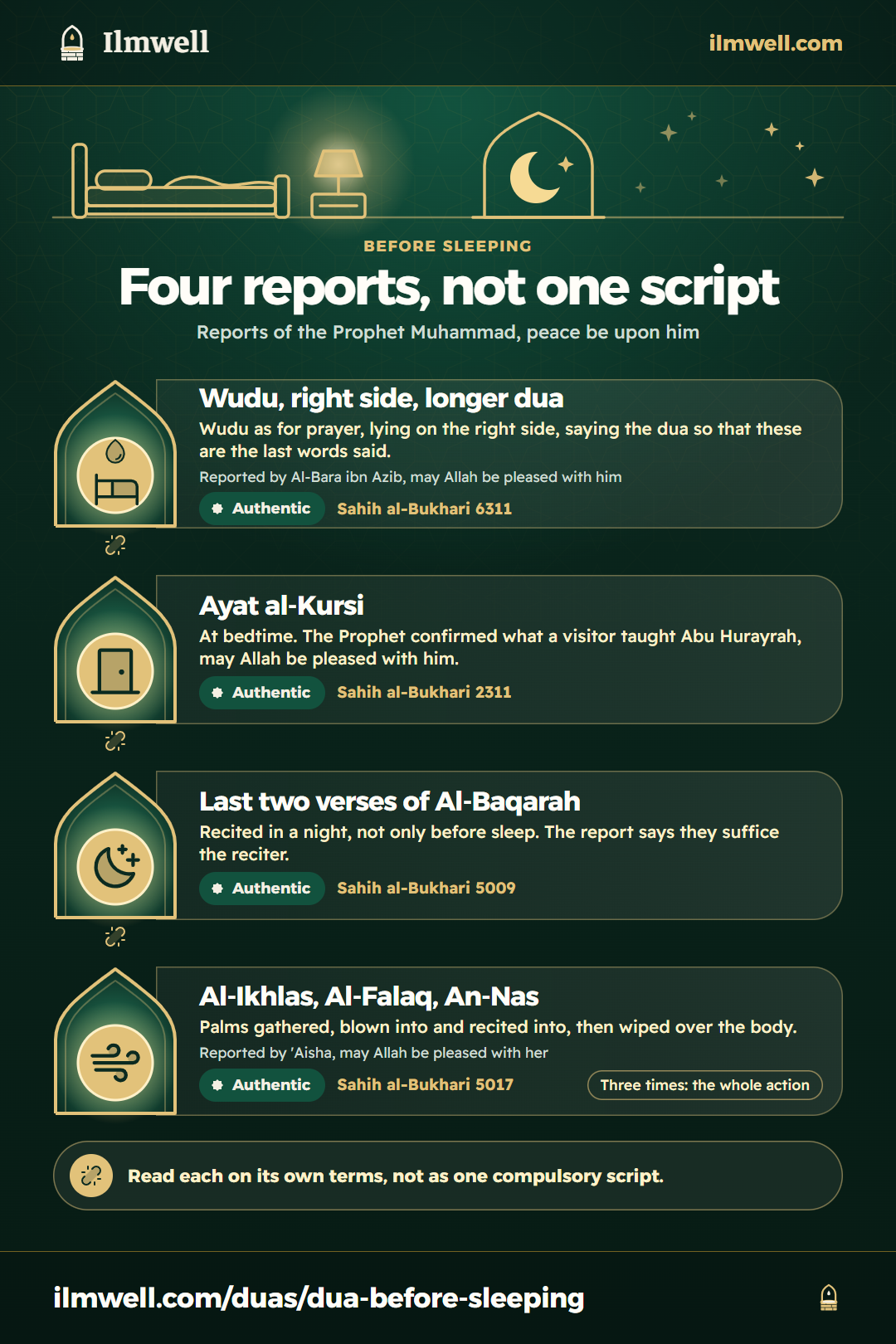
Separate reports describe washing for prayer, lying on the right side and particular recitations. Read each on its own terms, rather than combining them into one compulsory script.
| Practice or recitation | What the report describes | Source |
|---|---|---|
| Wudu and the right side | Making wudu (the washing before prayer) as for prayer, lying on the right side and saying a longer dua, so that these are the last words said | Bukhari 6311, sahih |
| Ayat al-Kursi (Al-Baqarah 2:255) | Recited at bedtime, in a report where the Prophet confirmed what a visitor taught Abu Hurayrah, may Allah be pleased with him | Bukhari 2311, sahih |
| The last two verses of Al-Baqarah | Recited in a night; the report says they suffice the reciter | Bukhari 5009, sahih |
| Al-Ikhlas, Al-Falaq and An-Nas | Gathering the palms, blowing into them and reciting into them, then wiping over the body; the report says he did that three times (Bukhari 5017) | Bukhari 5017, sahih |
The longer dua of al-Bara
Al-Bara ibn Azib, may Allah be pleased with him, reported the Prophet telling him to make wudu as for prayer, lie on his right side and say the words below. The Prophet added that if he died, he would die on the fitrah (the Arabic word in the report, which it does not define), and to make these the last words he said. Al-Bara repeated it back with "wa birasulika" (and Your messenger) and the Prophet told him to say "wa binabiyyika" (and Your Prophet).
Sahih al-Bukhari 6311
اللَّهُمَّ أَسْلَمْتُ وَجْهِي إِلَيْكَ، وَفَوَّضْتُ أَمْرِي إِلَيْكَ، وَأَلْجَأْتُ ظَهْرِي إِلَيْكَ، رَغْبَةً وَرَهْبَةً إِلَيْكَ، لاَ مَلْجَأَ وَلاَ مَنْجَا مِنْكَ إِلاَّ إِلَيْكَ، آمَنْتُ بِكِتَابِكَ الَّذِي أَنْزَلْتَ، وَبِنَبِيِّكَ الَّذِي أَرْسَلْتَ
Allāhumma aslamtu wajhī ilayk, wa fawwaḍtu amrī ilayk, wa alja'tu ẓahrī ilayk, raghbatan wa rahbatan ilayk. Lā malja'a wa lā manjā minka illā ilayk. Āmantu bikitābika lladhī anzalt, wa binabiyyika lladhī arsalt.
O Allah, I submit my face to You, I entrust my affair to You, and I lean my back on You, in hope and in fear of You. There is no refuge and no escape from You except to You. I believe in Your Book which You sent down, and in Your Prophet whom You sent.
3AuthenticSahih al-Bukhari 6311
Notice the timing of the Al-Baqarah report: it says in a night, not only at the moment before sleep, and it does not spell out a single meaning for "suffice".
4AuthenticSahih al-Bukhari 2311
5AuthenticSahih al-Bukhari 5009
The report about the three surahs comes from 'Aisha, may Allah be pleased with her. It describes wiping the head, face and the front of the body, then as much of the body as the hands could reach. The count of three belongs to that whole action, not to each surah and not to every bedtime dua.
6AuthenticSahih al-Bukhari 5017
If you are learning several of these, give each its own place on a small reminder card. It is easier to remember which words belong together when they are not printed as one long paragraph.

Is there a dua to sleep instantly?
The bedtime reports on this page do not promise instant sleep. Their wording teaches remembrance and supplication, not a deadline for falling asleep. Saying the sleeping dua and still lying awake does not contradict anything these narrations say.
Claims such as "works in one minute" or "repeat this exact number to fall asleep" are not supported by the reports used here. If sleep is a lasting problem, a GP is the right person to ask.
My mum had a rule that the lights stayed on until I had said my dua. I resented it at the time. These days it is the one part of my evening routine I never skip, and I would feel odd going to bed without it.
Try it: what would you say?
Pick an answer; each one explains itself.
1You are getting into bed. Which short dua is the one in Sahih al-Bukhari 6324?
Answer: Bismika Allahumma amutu wa ahya. It is the bedtime wording. The second option is the waking dua in the same report. Source 1
2You have just woken up. Which opening do you use?
Answer: Alhamdu lillahil-ladhi ahyana, the waking dua. The same report gives the waking dua, which opens with praise to Allah. Source 1
3Does the report about the last two verses of Al-Baqarah say only "before sleeping"?
Answer: No, it says in a night. Sahih al-Bukhari 5009 says "in a night" and does not name the moment before sleep. Source 5
Questions people ask
What is the sleeping dua in English?
The sleeping dua, or dua before sleep, in Sahih al-Bukhari 6324 (graded sahih) is "With Your name, O Allah, I die and I live." The same report gives the waking dua: "All praise is for Allah, who gave us life after causing us to die, and to Him is the resurrection."
What is the dua for waking up from sleep?
In Sahih al-Bukhari 6324 (graded sahih), on waking the Prophet, peace be upon him, said: "Alhamdu lillahil-ladhi ahyana ba'da ma amatana, wa ilayhin-nushur." The bedtime dua and the waking dua are a pair in the report but are not interchangeable.
Is there a dua for peaceful sleep?
The reports on this page ask for no particular quality of sleep and give no wording for peaceful sleep. They teach remembrance at bedtime. If you cannot sleep, speak to your GP.
Sources
Every claim on this page comes from one of these. Gradings are reported with the scholar's name; we do not grade hadith ourselves.
- 1
Hudhayfah, may Allah be pleased with him, reported that whenever the Prophet intended to go to bed he would say: with Your name, O Allah, I die and I live; and on waking he would say: all praise is for Allah who gave us life after causing us to die, and to Him is the resurrection.
Sahih al-Bukhari 6324 Book 80, Hadith 21
Authentic: in Sahih al-Bukhari
- 2
On waking, the Prophet would say: al-hamdu lillahi alladhi ahyana ba'da ma amatana wa ilayhi al-nushur (praise is for Allah who gave us life after causing us to die, and to Him is the resurrection).
Sahih al-Bukhari 6312 Book 80, Hadith 9
Authentic: in Sahih al-Bukhari
- 3
Al-Bara' ibn 'Azib, may Allah be pleased with him, reported that the Prophet said: when you come to your bed, make wudu as for prayer, lie on your right side and say a longer supplication (ending Amantu bikitabik alladhi anzalta wa binabiyyika alladhi arsalta); if you die, you die on the fitrah (fa-in mutta mutta 'ala al-fitrah); and make these the last words you say. Al-Bara' repeated it back with 'wa birasulika' and the Prophet told him to say 'wa binabiyyika'.
Sahih al-Bukhari 6311 Book 80, Hadith 8
Authentic: in Sahih al-Bukhari
- 4
A thief whom Abu Hurayrah caught three nights running taught him to recite Ayat al-Kursi at bedtime, so that a guardian from Allah stays with him and no devil comes near until morning. The Prophet said the thief had told the truth though he was a liar, and that he was a devil.
Sahih al-Bukhari 2311 Book 40, Hadith 11
Authentic: sahih on the conditions of al-Bukhari (Ibn Hajar al-'Asqalani); sahih, well known (Ibn al-Mulaqqin); Sahih (Al-Albani). Remarks: mu'allaq: recorded with the start of its chain left out (Al-Bukhari)
- 5
The Prophet said that whoever recites the two verses at the end of Surat al-Baqarah in a night, they will suffice him.
Sahih al-Bukhari 5009 Book 66, Hadith 31
Authentic: in Sahih al-Bukhari
- 6
'Aisha narrated that every night at bedtime the Prophet gathered his palms, blew into them and recited into them Al-Ikhlas, Al-Falaq and An-Nas, then wiped what he could of his body with them, doing that three times.
Sahih al-Bukhari 5017 Book 66, Hadith 39
Authentic: in Sahih al-Bukhari
- 7
The Dorar hadith commentary on Sahih al-Bukhari 6324 explains why sleep is called a death in the bedtime dua, and the waking dua as praise for the return of the soul and a reminder of the resurrection.
Dorar (al-Durar al-Saniyya) hadith commentary on Sahih al-Bukhari 6324 Record: scholarly-dorar-sharh-bukhari-6324-sleep-death. The commentary text is not signed on the page.
Next
For your own situation, ask a scholar you trust.
Join the email list
New guides by email, now and then. No spam, and you can leave at any time.
Ilmwell is free and kept going by readers. See how to support it.