The short answer
Allahumma barik means "O Allah, bless": the Prophet Muhammad, peace be upon him, said "Allahumma barik lahum" for a host who fed him (Sahih Muslim 2042). It asks Allah to put blessing (barakah) in someone or something. Muslims often say Allahumma barik lahu (for him) or laha (for her) when they admire something.
How is Allahumma barik written in Arabic?
Sahih Muslim 2042
اللَّهُمَّ بَارِكْ
allāhumma bārik
O Allah, bless
1AuthenticSahih Muslim 2042
To copy and paste the Arabic, use the button under it.
What does Allahumma barik mean?
A short dua, followed in the hadith by who or what is to be blessed.
Arabic reads right to left, so the first word is on the right.
- اللَّهُمَّallāhummaO AllahThe form of "Allah" used when calling on Him in dua.
- بَارِكْbārikblessA request: put barakah, blessing, in it. Barakah and Tabarakallah share the same root.
- لَهُمْlahumfor themThe ending changes with who you mean: lahu, laha, lahum.
How do you pronounce Allahumma barik?
allāhummabārik
- Lean on the doubled l and the doubled m: al-lā-hum-ma.
- bā is long, as in "father"; rik is short and ends crisply on the k.
Listen and repeat. A recorded pronunciation by a fluent reciter is coming. We do not use a synthetic voice for Arabic.
Is it Allahumma barik lahu or laha?
Lahu for a man or boy, laha for a woman or girl. Allahumma barik lahu means "O Allah, bless him", and Allahumma barik laha means "O Allah, bless her".
| For | Say | Ending used in |
|---|---|---|
| A man or boy | Allahumma barik lahu | Sahih al-Bukhari 6334 |
| A woman or girl | Allahumma barik laha | Same grammar (no narration) |
| A group, or a family | Allahumma barik lahum | Sahih Muslim 2042 |
| You (to a man) | Allahumma barik laka | Sunan Abi Dawud 2130 (with barakallahu) |
| You (to a woman) | Allahumma barik laki | Same grammar (no narration) |
| Us | Allahumma barik lana | Sahih Muslim 1373 |
To bless a thing for someone, add fihi, "in it": barik lana fihi, "bless it for us", is the food dua below. The blessing on the Prophet that he taught uses barik ʿala Muhammad, "bless Muhammad".
7AuthenticSahih al-Bukhari 3370
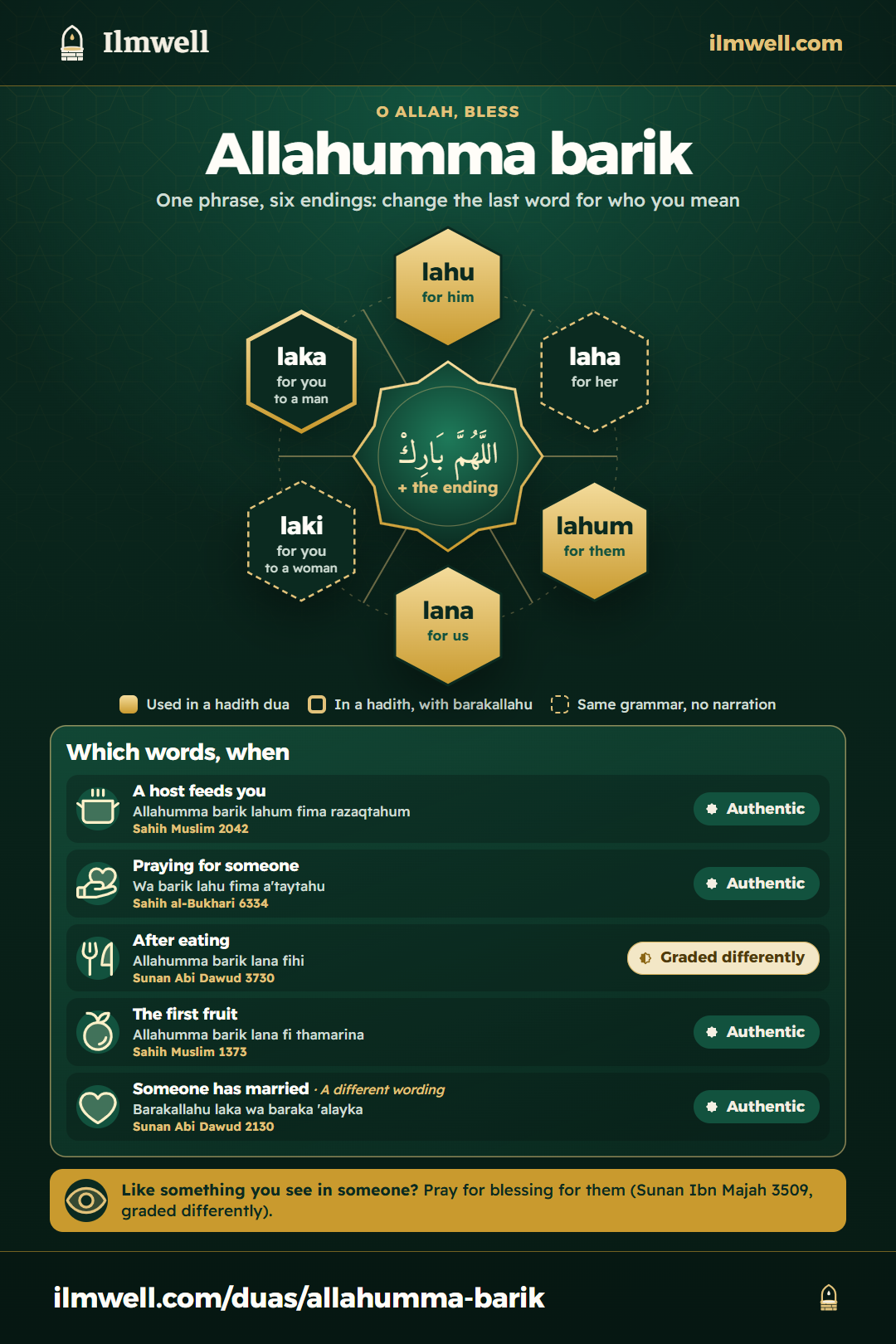
Allahumma barik in one picture
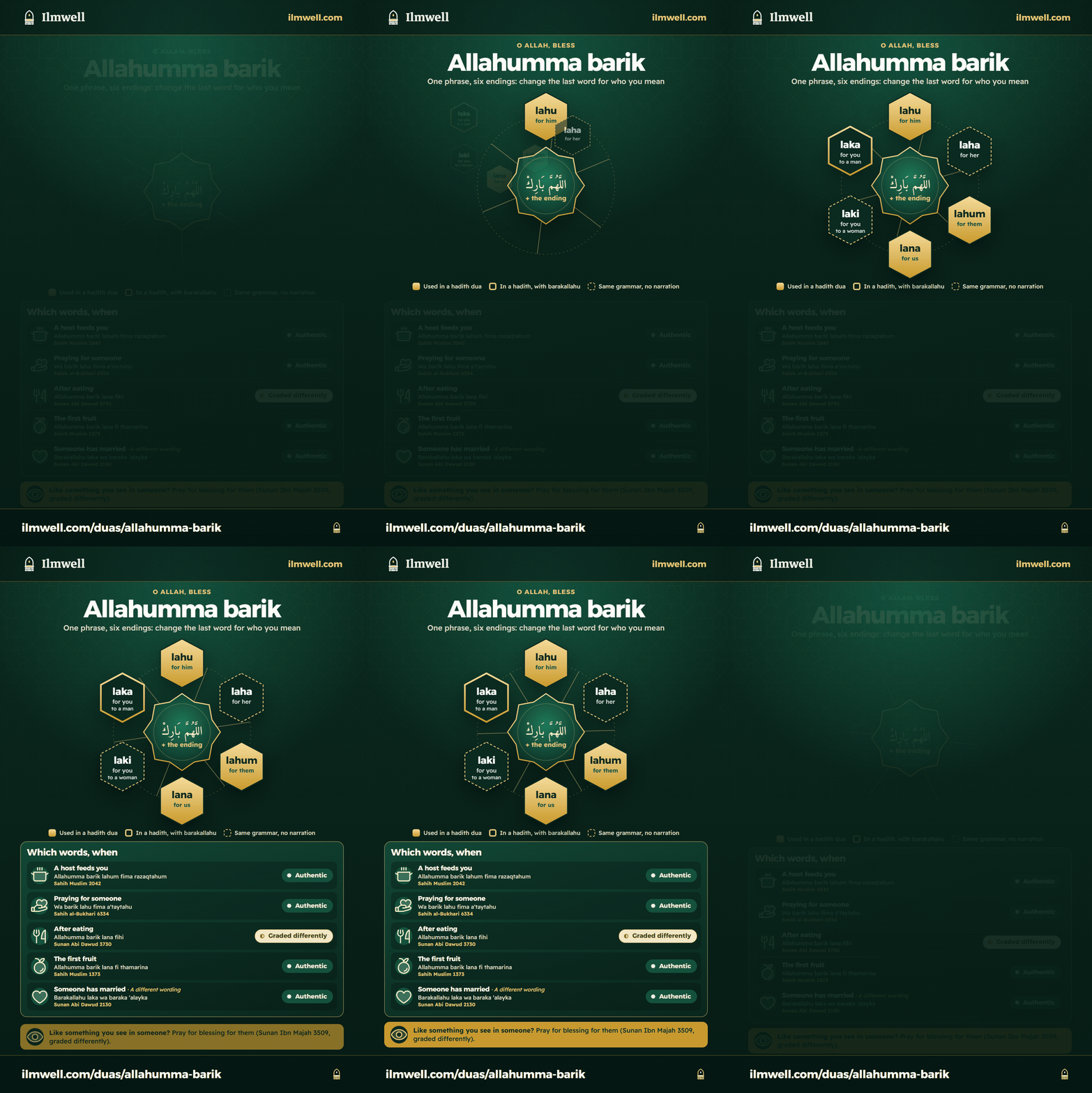
Allahumma barik infographic: O Allah, bless. One phrase, six endings: lahu for him, laha for her, lahum for them, laka for you (to a man), laki for you (to a woman), lana for us. Lahu, lahum and lana are used in hadith duas; laka is used in a hadith with barakallahu; laha and laki follow the same grammar with no narration. Which words, when: a host feeds you, Allahumma barik lahum fima razaqtahum (Sahih Muslim 2042, authentic); praying for someone, wa barik lahu fima a'taytahu (Sahih al-Bukhari 6334, authentic); after eating, Allahumma barik lana fihi (Sunan Abi Dawud 3730, graded differently); the first fruit, Allahumma barik lana fi thamarina (Sahih Muslim 1373, authentic); someone has married, a different wording, barakallahu laka wa baraka 'alayka (Sunan Abi Dawud 2130, authentic). Like something you see in someone? Pray for blessing for them (Sunan Ibn Majah 3509, graded differently).
Every ending and every moment above, in one picture. Save it, print it, or share it.
Posting it on your own site? Link back to this guide; the code under "Use it on your own site" does it in one line.
When do Muslims say Allahumma barik?
Each moment in the hadith has its own wording, and each is a separate dua.
A host feeds you
اللَّهُمَّ بَارِكْ لَهُمْ فِي مَا رَزَقْتَهُمْ وَاغْفِرْ لَهُمْ وَارْحَمْهُمْ
Allahumma barik lahum fima razaqtahum, waghfir lahum warhamhum
O Allah, bless them in what You have provided them, and forgive them and have mercy on them.
'Abdullah ibn Busr, may Allah be pleased with him, tells how the Prophet was a guest of his father. After the Prophet had eaten and drunk, the father asked him to pray for them.
1AuthenticSahih Muslim 2042
Praying for a person
اللَّهُمَّ أَكْثِرْ مَالَهُ وَوَلَدَهُ، وَبَارِكْ لَهُ فِيمَا أَعْطَيْتَهُ
Allahumma akthir malahu wa waladahu, wa barik lahu fima a'taytahu
O Allah, increase his wealth and his children, and bless him in what You have given him.
The Prophet's dua for Anas, may Allah be pleased with him, after Umm Sulaim, may Allah be pleased with her, told him Anas was his servant.
3AuthenticSahih al-Bukhari 6334
After eating
اللَّهُمَّ بَارِكْ لَنَا فِيهِ وَأَطْعِمْنَا خَيْرًا مِنْهُ
Allahumma barik lana fihi wa at'imna khayran minhu
O Allah, bless it for us and feed us with better than it.
After drinking milk
اللَّهُمَّ بَارِكْ لَنَا فِيهِ وَزِدْنَا مِنْهُ
Allahumma barik lana fihi wa zidna minhu
O Allah, bless it for us and give us more of it.
Both of these come from one narration, graded differently.
The first fruit
اللَّهُمَّ بَارِكْ لَنَا فِي ثَمَرِنَا وَبَارِكْ لَنَا فِي مَدِينَتِنَا وَبَارِكْ لَنَا فِي صَاعِنَا وَبَارِكْ لَنَا فِي مُدِّنَا
Allahumma barik lana fi thamarina, wa barik lana fi madinatina, wa barik lana fi sa'ina, wa barik lana fi muddina
O Allah, bless us in our fruit, bless us in our city, bless us in our sa' and bless us in our mudd.
Said on taking the first fruit people brought him. A sa' and a mudd are measures of volume.
5AuthenticSahih Muslim 1373
Congratulating someone who has married
بَارَكَ اللَّهُ لَكَ وَبَارَكَ عَلَيْكَ وَجَمَعَ بَيْنَكُمَا فِي خَيْرٍ
Barakallahu laka wa baraka 'alayka wa jama'a baynakuma fi khayr
May Allah bless you, send blessing upon you, and bring the two of you together in good.
A different wording: barakallahu, "may Allah bless", with no Allahumma. Also in Jami' at-Tirmidhi 1091.
6AuthenticSunan Abi Dawud 2130
What does the hadith say about admiring something?
A hadith graded differently tells the admirer to pray for blessing. 'Amir ibn Rabi'ah, may Allah be pleased with him, said of Sahl ibn Hunayf, may Allah be pleased with him, that he had never seen skin like his, and Sahl collapsed. The Prophet said that when one of you sees something he likes in his brother, he should pray for blessing for him.
2Graded differently Sunan Ibn Majah 3509
The narration gives no fixed words. The full story and the evil eye question are in the Mashallah lesson.
What is the difference between Mashallah and Allahumma barik?
Mashallah is a statement; Allahumma barik is a request. Mashallah credits the good you see to Allah's will, and Allahumma barik asks Allah to bless it.
| Mashallah | Allahumma barik | |
|---|---|---|
| Means | What Allah wills | O Allah, bless |
| Kind of words | A statement about Allah's will | A dua asking for blessing |
| Comes from | The Quran, Al-Kahf 18:39 | The Prophet's duas, such as Sahih Muslim 2042 |
| Example | "Mashallah, what a lovely garden." | "Allahumma barik laha, she is beautiful." |
Many people say both together: "Mashallah, Allahumma barik." The verse behind the first is in the Mashallah lesson.
I was about twelve before I heard anyone say Allahumma barik instead of Mashallah. At a cousin's wedding an uncle said it quietly over the baby, and I asked my mum why. That was the first time I thought about which words we choose.
Try it: what would you say?
Two everyday scenes. Pick an answer; each one explains itself.
1Your friend shows you a photo of her new baby girl. Which words pray for blessing for her?
Answer: Allahumma barik laha. Laha is "for her"; lahu is "for him". A hadith graded differently tells an admirer to pray for blessing. Source 2
2Your aunt has just fed the whole family, with enough left over to feed them all again. Which dua did the Prophet make for a host?
Answer: Allahumma barik lahum fima razaqtahum. He said it when a host who had fed him asked him to pray for them. Source 1
Is "Allahumma barik lana fi Rajab" authentic?
It is graded weak. A report from Anas says that when Rajab began, the Prophet would say: O Allah, bless us in Rajab and Sha'ban (the two months before Ramadan), and bring us to Ramadan. Its graders call it weak.
اللَّهُمَّ بَارِكْ لَنَا فِي رَجَبٍ وَشَعْبَانَ وَبَلِّغْنَا رَمَضَانَ
For "Allahumma barik lana" in a narration graded authentic, see the first-fruit dua in the section on when Muslims say it.
How do you reply to Allahumma barik?
The report below is about barakallahu fikum, not Allahumma barik. The principle 'Aisha, may Allah be pleased with her, shows in it is returning the like of what was said. A sheep was given to the Prophet, and he said to share it out. When the servant came back, 'Aisha would ask what they had said. When they had said بارَكَ اللهُ فيكم, barakallahu fikum (may Allah bless you), she answered وفيهم باركَ اللهُ, wa fihim barakallah (and may Allah bless them). We return the like of what they said, she explained, and our reward stays with us.
9AuthenticAl-Kalim al-Tayyib 239
The report has one grading, which accepts its chain. Said to one person, the same reply becomes wa fik barakallah by the same grammar: and may Allah bless you.
Common mix-ups
- Barik (bless) is the request. Baraka, as in barakallah, is the past tense, used in dua to mean "may He bless". "Allahumma barak" mixes the two.
Questions people ask
What does Tabarakallah mean?
Tabarakallah means "blessed is Allah". It is praise, not a request. The words appear in the Quran in Al-A'raf 7:54; the Mashallah lesson covers them.
How do you spell Allahumma barik?
Allahumma barik is the most common English spelling. Allahuma barik, Allah humma barik, Allah huma barik, Allahumabarik and Alhumma barik are other ways of writing the same two Arabic words.
Sources
Every claim on this page comes from one of these. Gradings are reported with the scholar's name; we do not grade hadith ourselves.
- 1
When 'Abdullah ibn Busr's father hosted the Prophet and asked him to supplicate for them, the Prophet said: O Allah, bless them in what You have provided them, and forgive them and have mercy on them.
Sahih Muslim 2042 Book 36, Hadith 202
Authentic: in Sahih Muslim (Muslim); Sahih (Al-Albani); its chain is sahih to Muslim's standard (Shu'ayb al-Arna'ut)
- 2
When Sahl ibn Hunayf collapsed after 'Amir ibn Rabi'ah admired him, the Prophet said that whoever sees something he likes in his brother should pray for blessing for him.
Sunan Ibn Majah 3509 Book 31, Hadith 74
Graded differently. Here is who graded it which way:
- SoundDarussalam, Al-Albani, Al-Nawawi, Shu'ayb al-Arna'ut, Al-Suyuti
- WeakAl-Munawi, Al-San'ani
See each grading in full, with its wording and where it was given
Scholars disagree about this hadith. Here is how each graded it, so you can follow the scholar you trust.
- Sahih: Darussalam (as shown on sunnah.com)
- صحيح (Sahih): Al-Albani, Sahih Ibn Majah 2844 (as listed on dorar.net)
- صحيح (Sahih, for the wording: let him pray for blessing for him): Al-Albani, Sahih al-Jami' 4020 (as listed on dorar.net)
- إسناده صحيح (its chain is sahih): Al-Nawawi, al-Majmu' 9/68 (as listed on dorar.net)
- صحيح رجاله ثقات رجال الشيخين (sahih; its narrators are trustworthy narrators used by al-Bukhari and Muslim): Shu'ayb al-Arna'ut, takhrij Mushkil al-Athar 2894 (as listed on dorar.net)
- صحيح (Sahih, for the wording: let him pray for blessing for him): Al-Suyuti, al-Jami' al-Saghir 5448 (as listed on dorar.net)
- مرسل (mursal: Abu Umama reports it without saying whom he heard it from; said of the short wording in al-Jami' al-Saghir): Al-Munawi, Fayd al-Qadir 4/324 (as listed on dorar.net)
- مرسل (mursal; said of the same short wording): Al-San'ani, al-Tanwir Sharh al-Jami' al-Saghir 7/257 (as listed on dorar.net)
- 3
Umm Sulaim told the Prophet that Anas was his servant, and the Prophet said: O Allah, increase his wealth and children, and bless him in what You have given him.
Sahih al-Bukhari 6334 Book 80, Hadith 31
Authentic: in Sahih al-Bukhari
- 4
The Prophet taught a dua for after eating, O Allah, bless it for us and feed us better than it, and one for after milk: O Allah, bless it for us and give us more of it.
Sunan Abi Dawud 3730 Book 27, Hadith 62
Graded differently. Here is who graded it which way:
- SoundAl-Albani, Al-Tirmidhi, Shu'ayb al-Arna'ut, Ibn Hajar al-'Asqalani, Ibn al-Qayyim
- Weak chain, strengthenedShu'ayb al-Arna'ut
- WeakDarussalam, Shu'ayb al-Arna'ut, Ibn Baz, Al-Mundhiri
See each grading in full, with its wording and where it was given
Scholars disagree about this hadith. Here is how each graded it, so you can follow the scholar you trust.
- Hasan: Al-Albani (as shown on sunnah.com for Abu Dawud 3730)
- حسن (hasan): Al-Tirmidhi, in the Arabic text after Jami' at-Tirmidhi 3455 (as shown on sunnah.com)
- Da'if: Darussalam, on Jami' at-Tirmidhi 3455 (as shown on sunnah.com)
- حسن (hasan): Al-Albani, Sahih al-Jami' 6045 and Sahih al-Tirmidhi 3455 (as listed on dorar.net)
- حسن (hasan): Shu'ayb al-Arna'ut, takhrij Sunan Abi Dawud 3730 (as listed on dorar.net)
- حسن لشواهده (hasan through its supporting narrations): Shu'ayb al-Arna'ut, takhrij Zad al-Ma'ad 4/217 (as listed on dorar.net)
- [فيه] علي بن زيد بن جدعان، وهو ضعيف (it contains 'Ali ibn Zayd ibn Jud'an, who is weak): Shu'ayb al-Arna'ut, takhrij Zad al-Ma'ad 2/366 (as listed on dorar.net)
- حسن (hasan): Ibn Hajar al-'Asqalani, Hidayat al-Ruwat 4/183 (as listed on dorar.net)
- حسن (hasan): Ibn al-Qayyim, Zad al-Ma'ad 2/366 (as listed on dorar.net)
- إسناده ضعيف (its chain is weak): Ibn Baz, al-Tuhfa al-Karima 114 (as listed on dorar.net)
- [فيه] عمر بن حرملة ... وعلي بن زيد بن جدعان، وقد ضعفه جماعة من الأئمة ('Umar ibn Harmala is little known; 'Ali ibn Zayd ibn Jud'an was declared weak by a group of imams): Al-Mundhiri, Mukhtasar Sunan Abi Dawud 2/558 (as listed on dorar.net)
- 5
On receiving the first fruit people brought him, the Prophet said: O Allah, bless us in our fruit, our city, our sa' and our mudd.
Sahih Muslim 1373 Book 15, Hadith 538
Authentic: in Sahih Muslim (Muslim); its chain is sahih to Muslim's standard (Shu'ayb al-Arna'ut)
- 6
When the Prophet congratulated someone who had married, he said: barakallahu laka wa baraka 'alayka wa jama'a baynakuma fi khayr (may Allah bless you, send blessing upon you, and bring you both together in good).
Sunan Abi Dawud 2130 Book 12, Hadith 85
Authentic: Sahih (Al-Albani); hasan sahih (Al-Tirmidhi); Sahih (Darussalam); its chain is strong (Shu'ayb al-Arna'ut); sahih to Muslim's standard (Al-Hakim); its chain is sahih (Al-Nawawi); hasan sahih (Al-Albani); hasan (Muqbil al-Wadi'i). Remarks: stronger than the hadith of Mu'adh on the topic (Ibn Hajar al-'Asqalani); silent about it; he said what he is silent about is fit to use (Abu Dawud)
- 7
Asked how to send blessings (salat) on him and his household, the Prophet taught a wording that includes: Allahumma barik 'ala Muhammad wa 'ala ali Muhammad, kama barakta 'ala Ibrahim wa 'ala ali Ibrahim, innaka hamidun majid.
Sahih al-Bukhari 3370 Book 60, Hadith 44
Authentic: in Sahih al-Bukhari
- 8
A report from Anas says that when Rajab began, the Prophet would say: O Allah, bless us in Rajab and Sha'ban, and bring us to Ramadan.
Mishkat al-Masabih 1369 Book 4, Hadith 774
Weak: da'if (Al-Albani); weak (Al-Albani); its chain has weakness (Al-Nawawi); its chain has weakness (Ibn Rajab); its chain is weak (Shu'ayb al-Arna'ut); its chain is weak (Ahmad Shakir); weak (Ibn Baz); it has been criticised (Ibn 'Uthaymin); not strong (Al-Bayhaqi); it contains Za'ida ibn Abi al-Ruqad and Ziyad al-Numayri, both weak (Al-Dhahabi). Remarks: it contains Za'ida ibn Abi al-Ruqad, who has been criticised and also declared reliable (Al-Haythami); narrated only through this chain; Za'ida ibn Abi al-Ruqad alone reports it (Al-Tabarani)
- 9
A report about 'Aisha says that when people said 'barakallahu fikum' (may Allah bless you), she answered 'wa fihim barakallah' (and may Allah bless them).
Al-Kalim al-Tayyib 239 Ibn Taymiyya, al-Kalim al-Tayyib, with al-Albani's takhrij, no. 239, as dorar.net cites it
Authentic: its chain is good (Al-Albani)
- Q
Al-Kahf 18:39 (Mashallah) and Al-A'raf 7:54 (Tabarakallah), referred to here and quoted in full on the Mashallah lesson.
Tanzil Project Uthmani text, CC BY 3.0.
Next
- Mashallah: meaning and when to say itPhrase lesson
- Inshallah: meaning, spelling and usagePhrase lesson
- Alhamdulillah: meaning, pronunciation and everyday usePhrase lesson
- Assalamu alaikum and walaikum assalam: meaning and replyPhrase lesson
- Duas, Remembrance and PhrasesThe hub
For your own situation, ask a scholar you trust.
Join the email list
New guides by email, now and then. No spam, and you can leave at any time.
Ilmwell is free and kept going by readers. See how to support it.