The short answer
Walaikum assalam means "and upon you be peace". It is the reply to Assalamu alaikum, "peace be upon you", the greeting Muslims give each other. The Quran tells believers to return a greeting with a better one or the same (An-Nisa 4:86). A narration in Sunan Abi Dawud 5195, graded differently, speaks of the longer greeting with wa rahmatullahi wa barakatuh: and Allah's mercy and His blessings.
How is Assalamu alaikum written in Arabic?
Sahih al-Bukhari 6227
السَّلاَمُ عَلَيْكُمْ
as-salāmu ʿalaykum
Peace be upon you
1AuthenticSahih al-Bukhari 6227
Two words: as-salāmu, the peace, and ʿalaykum, upon you. Spelling note: assalamualaikum, assalam o alaikum, as salaam alaikum, salaam alaikum, salamalaykum and asalamualaikum are the same words in English letters. If the family group chat manages four of them before breakfast, nobody has got it wrong. The spelling does not change what you mean when you say salaam alaikum: peace be upon you. To copy and paste the Arabic text, use the button under it.
Assalamu alaikum wa rahmatullahi wa barakatuh
The full greeting adds Allah's mercy and His blessings, in the words of a narration graded differently (told below).
السَّلاَمُ عَلَيْكُمْ وَرَحْمَةُ اللَّهِ وَبَرَكَاتُهُ
as-salāmu ʿalaykum wa raḥmatu llāhi wa barakātuh
Peace be upon you, and the mercy of Allah and His blessings
How do you reply to Assalamu alaikum?
The response to salam alaikum is walaikum assalam: and upon you be peace. The words swap round and the reply opens with wa, "and". When the Prophet Muhammad, peace be upon him, asked permission to enter the house of Sa'd ibn 'Ubada, may Allah be pleased with him, with "as-salamu alaykum wa rahmatullah", Sa'd answered with these words:
4AuthenticSahih al-Bukhari 6251
Mishkat al-Masabih 4249
وَعَلَيْكُمُ السَّلَامُ وَرَحْمَةُ اللَّهِ
wa ʿalaykumu s-salāmu wa raḥmatu llāh
And upon you be peace, and the mercy of Allah
3AuthenticMishkat al-Masabih 4249
Walaikum assalam is its first two words. A reply can also add wa barakatuh, as Aisha, may Allah be pleased with her, did in Sahih al-Bukhari 3217. Spelling note: walaikum salam, wa alaikum assalam and waalaikumsalam warahmatullahi wabarakatuh are the same words in English letters.
What does salam alaikum mean?
Salam alaikum means "peace be upon you". The Quran itself uses this form, سَلَـٰمٌ عَلَيْكُمْ (salamun alaykum, "peace be to you"), in Al-An'am 6:54 and Az-Zumar 39:73.
Arabic reads right to left, so the first word is on the right.
- السَّلاَمُas-salāmuthe peace"Al" (the) becomes "as" before the s.
- عَلَيْكُمْʿalaykumupon you"ʿAlā" (upon) with "kum" (you).
- وَرَحْمَةُwa raḥmatuand the mercy
- اللَّهِllāhiof Allah
- وَبَرَكَاتُهُwa barakātuhand His blessings
How do you pronounce Assalamu alaikum?
assalāmuʿalaykum
waʿalaykumussalām
- as-salām has a doubled s: as-salam, not al-salam.
- lā is long. Hold the a, as in "father".
- ʿa starts with the letter ʿayn, a tight sound from the throat. A clean "a" is a fine start.
Listen and repeat. A looped recording by a fluent speaker is coming. We do not use a synthetic voice for Arabic.
Why add wa rahmatullahi wa barakatuh?
وَإِذَا حُيِّيتُم بِتَحِيَّةٍ فَحَيُّوا۟ بِأَحْسَنَ مِنْهَآ أَوْ رُدُّوهَآ ۗ إِنَّ ٱللَّهَ كَانَ عَلَىٰ كُلِّ شَىْءٍ حَسِيبًا
A man came to the Prophet and said "as-salamu alaykum". The Prophet returned it, the man sat down, and the Prophet said "ten". A second man added "wa rahmatullah"; the Prophet said "twenty". A third added "wa barakatuh", and the Prophet said "thirty". The narration does not say what is counted.
2Graded differently Sunan Abi Dawud 5195also in Jami' at-Tirmidhi 2689
When Allah created Adam, peace be upon him, He told him to greet a group of angels sitting there and listen to their reply, for that would be the greeting of Adam and his descendants. Adam said "as-salamu alaykum"; the angels replied, adding "wa rahmatullah":
السَّلاَمُ عَلَيْكَ وَرَحْمَةُ اللَّهِ
1AuthenticSahih al-Bukhari 6227
The Prophet said you will not believe until you love one another, and pointed to what brings that love: spread the salam among yourselves.
5AuthenticSahih Muslim 54
Who should say salam first?
Say you walk into a busy family dinner. You greet first: you are the one walking in, and the people at the table are sitting.
Walking up to people who are sitting
You greet first, as a rider greets someone on foot.
6AuthenticSahih al-Bukhari 6232
Younger meets older
The younger person greets first.
7AuthenticSahih al-Bukhari 6231
A few people meet a bigger group
The smaller group greets first.
6AuthenticSahih al-Bukhari 6232
Entering houses
"When you enter houses, salute one another with a greeting from Allah, blessed and sweet."
An-Nur 24:61
Meeting someone you do not know
Greet them too.
Asked which part of Islam is best, the Prophet named feeding people and greeting those you know and do not know.
8AuthenticSahih al-Bukhari 6236
A group passes people who are sitting
One of the group can greet for all, and one of those sitting can reply for all.
Someone passes on salam from another person
Return it to the sender: and upon him be peace.
وَعَلَيْهِ السَّلاَمُ وَرَحْمَةُ اللَّهِ وَبَرَكَاتُهُ
Wa alayhi as-salam wa rahmatullahi wa barakatuh
Aisha, may Allah be pleased with her, said this when told the angel Jibril was sending her salam.
10AuthenticSahih al-Bukhari 3217
Show An-Nur 24:61 in Arabic
فَإِذَا دَخَلْتُم بُيُوتًا فَسَلِّمُوا۟ عَلَىٰٓ أَنفُسِكُمْ تَحِيَّةً مِّنْ عِندِ ٱللَّهِ مُبَـٰرَكَةً طَيِّبَةً
When you enter houses, salute one another with a greeting from Allah, blessed and sweet.
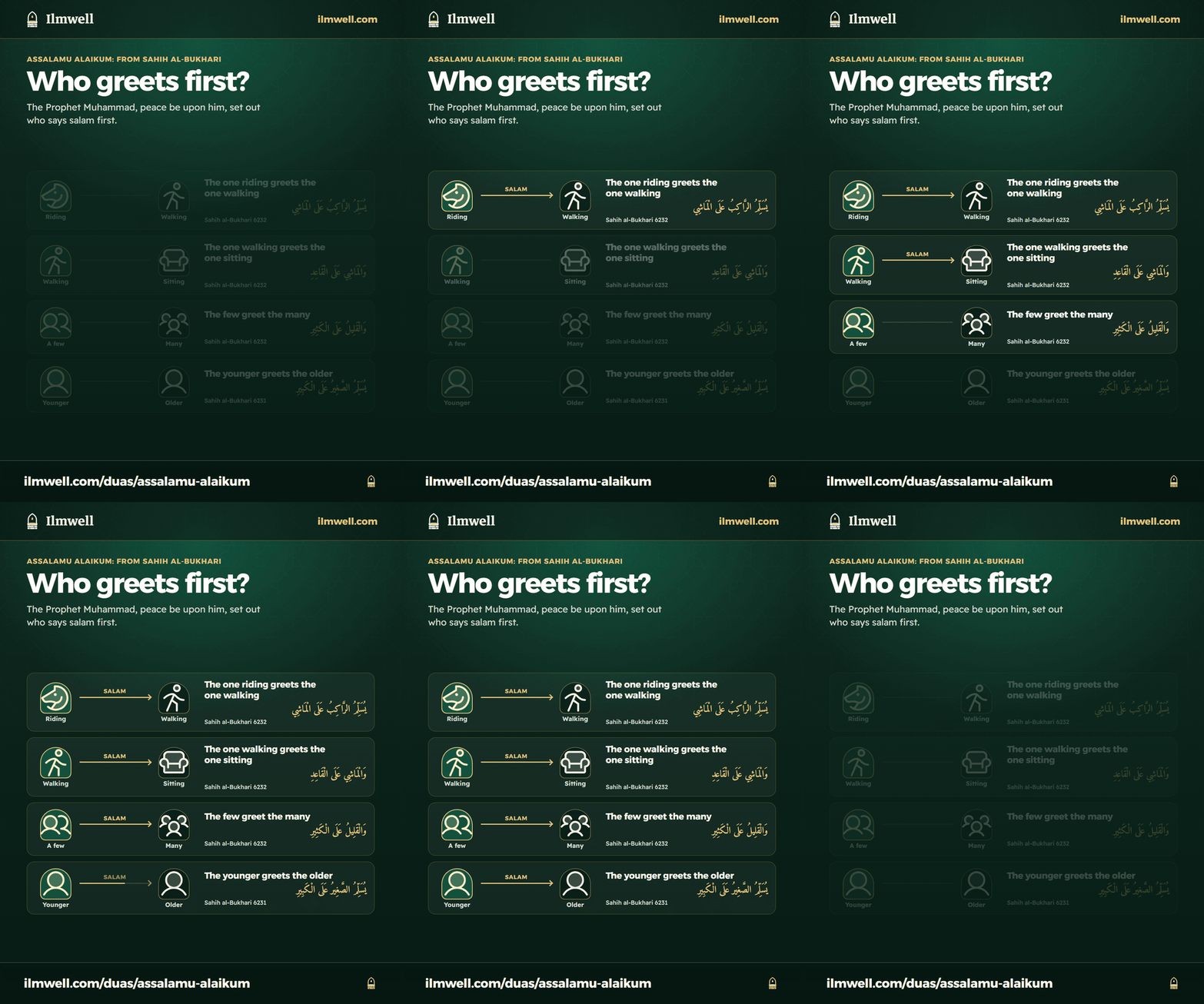
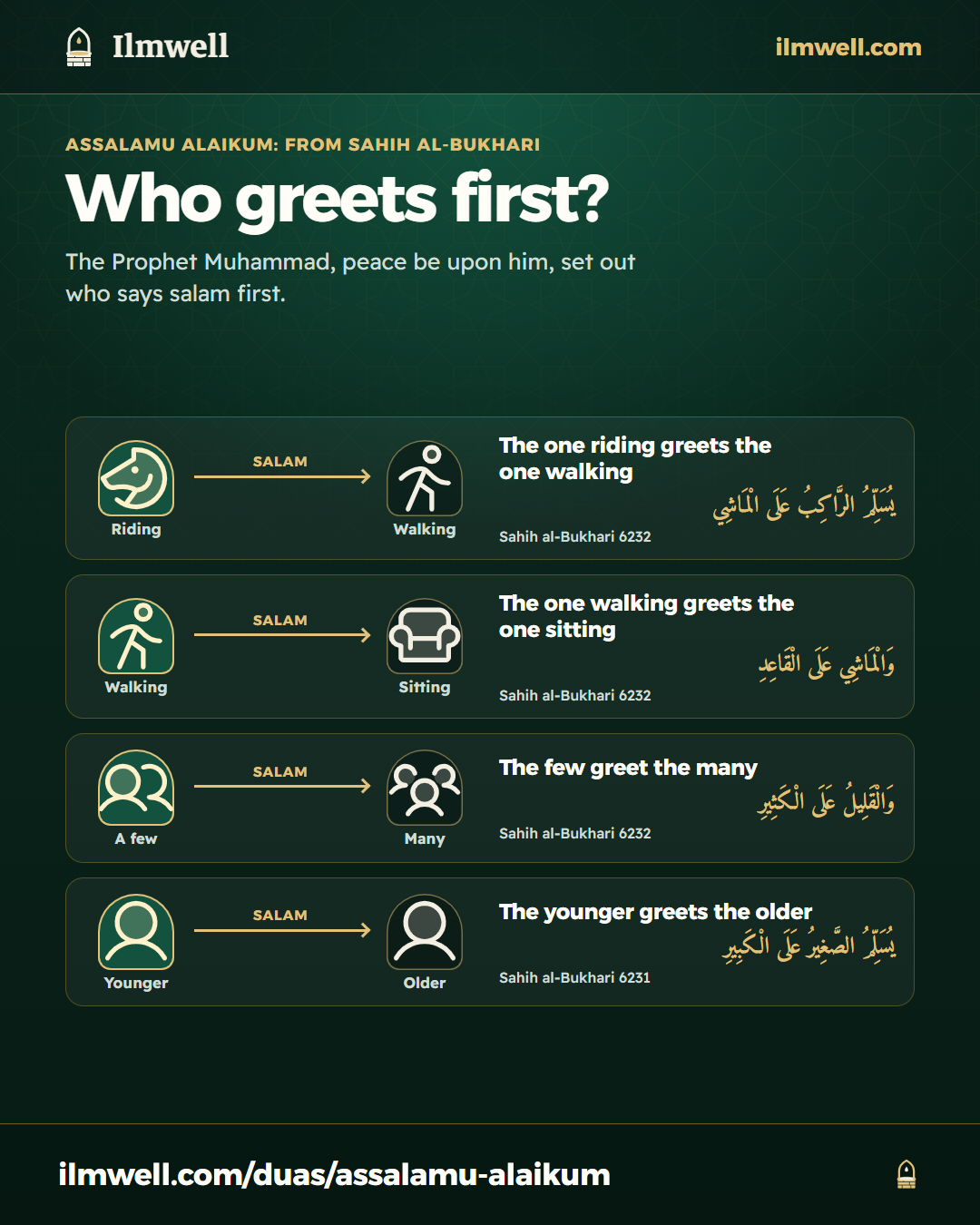
Who greets first, in one picture
Who greets first? From Sahih al-Bukhari. The one riding greets the one walking (6232). The one walking greets the one sitting (6232). The few greet the many (6232). The younger greets the older (6231). Each rule is shown with its Arabic from the hadith.
The four rules from the hadith above, with their Arabic. Save it for the family group chat.
Posting it on your own site? Link back to this guide; the code under "Use it on your own site" does it in one line.
Growing up, I only gave salam to people I knew. The first time a stranger said it to me at a bus stop, I froze for a second before answering. I have tried to be the first to say it ever since.
Try it: who greets, and what do you say?
Four everyday moments. Pick an answer; each one explains itself.
1Someone says "Assalamu alaikum" to you. What do you say?
Answer: Walaikum assalam. "Walaikum assalam" returns the greeting: and upon you be peace. Source 3
2You walk into the kitchen and your gran is sitting with her tea. Who says salam first?
Answer: You. Both rules point to you: the one passing greets the one sitting, and the younger greets the older. Source 7
3A friend greets you with "Assalamu alaikum wa rahmatullah". Which reply adds to it?
Answer: Walaikum assalam wa rahmatullahi wa barakatuh. An-Nisa 4:86 describes returning a greeting with a better one; the angels added to Adam's greeting too. Source 1
4Your mum says, "Your uncle sends you his salam." What can you say?
Answer: Wa alayhi as-salam. "And upon him be peace": how Aisha answered a passed-on salam. Source 10
Can non-Muslims say Assalamu alaikum?
None of these narrations says whether a non-Muslim may say it. They do give a reply: the Prophet said that if the People of the Book (Jews and Christians) greet you, reply wa alaykum, "and upon you".
11AuthenticSahih al-Bukhari 6258
In another narration the Prophet said that when the Jews greet you, one of them says as-samu alayka, "death be upon you"; so reply wa alayka.
12AuthenticSahih al-Bukhari 6257
How to answer a non-Muslim friend's salam today is a question for a scholar you trust.
A common mix-up
"Alayka salam" as a hello. A man once greeted the Prophet with عَلَيْكَ السَّلاَمُ (alayka as-salam), the words reversed, and the Prophet told him not to, calling it the greeting of the dead. The reply wa alaykum as-salam opens with "wa" and answers a greeting.
13AuthenticSunan Abi Dawud 5209
Questions people ask
What is the reply to Assalamu alaikum?
Walaikum assalam (wa alaykum as-salam), "and upon you be peace", or a fuller form such as wa alaykum as-salam wa rahmatullah, the reply Sa'd ibn 'Ubada gave the Prophet, peace be upon him, in Mishkat al-Masabih 4249, graded authentic.
How do you spell walaikum assalam?
Spellings in English letters include walaikum assalam, wa alaikum assalam, walaikum salam, waalaikumsalam and wa alaykum as-salam.
Is it wa alayka or wa alaykum?
Both appear in the sources. The Prophet answered one man with wa alayka as-salam in Sahih al-Bukhari 6251, graded authentic, and Sa'd ibn 'Ubada answered the Prophet with wa alaykum as-salam wa rahmatullah in Mishkat al-Masabih 4249, graded authentic.
Sources
Every claim on this page comes from one of these. Gradings are reported with the scholar's name; we do not grade hadith ourselves.
- 1
Allah told the newly created Adam to greet a group of angels sitting there and listen to their reply, as his and his descendants' greeting; Adam said as-salamu alaykum and they replied as-salamu alayka wa rahmatullah.
Sahih al-Bukhari 6227 Book 79, Hadith 1
Authentic: in Sahih al-Bukhari
- 2
A man greeted the Prophet with as-salamu alaykum and the Prophet said ten; a second said as-salamu alaykum wa rahmatullah and he said twenty; a third added wa barakatuh and he said thirty.
Sunan Abi Dawud 5195 Book 43, Hadith 423
Graded differently. Here is who graded it which way:
- SoundAl-Albani, Shu'ayb al-Arna'ut, Al-Mundhiri, Ibn Muflih, Ibn Hajar al-Asqalani, Al-Tirmidhi, Darussalam
- WeakIbn al-Jawzi
- Other remarksAl-Dhahabi, Abu Dawud
See each grading in full, with its wording and where it was given
Scholars disagree about this hadith. Here is how each graded it, so you can follow the scholar you trust.
- Sahih: Al-Albani (as shown on sunnah.com)
- صحيح (Sahih): Al-Albani, Sahih Abi Dawud 5195 (as listed on dorar.net)
- إسناده قوي (its chain is strong): Shu'ayb al-Arna'ut, takhrij of Sunan Abi Dawud 5195 (as listed on dorar.net)
- إسناده قوي على شرط مسلم (its chain is strong, meeting Muslim's conditions): Shu'ayb al-Arna'ut, takhrij of Musnad Ahmad 19948 (as listed on dorar.net)
- [إسناده صحيح أو حسن أو ما قاربهما] (its chain is sahih or hasan or close to them): Al-Mundhiri, al-Targhib wa al-Tarhib 3/370 (as listed on dorar.net)
- إسناده جيد (its chain is good): Ibn Muflih, al-Adab al-Shar'iyya 1/359 (as listed on dorar.net)
- حسن غريب (hasan gharib): Ibn Hajar al-Asqalani, as cited in al-Futuhat al-Rabbaniyya 5/289 (as listed on dorar.net)
- حسن صحيح غريب (hasan sahih gharib): Al-Tirmidhi, Jami' at-Tirmidhi 2689, in the Arabic text after the hadith (as shown on sunnah.com)
- Hasan: Darussalam, for Jami' at-Tirmidhi 2689 (as shown on sunnah.com)
- لا يصح (it is not sound): Ibn al-Jawzi, al-'Ilal al-Mutanahiya 2/718 (as listed on dorar.net)
- رواته ثقات (its narrators are trustworthy): Al-Dhahabi, Talkhis al-'Ilal al-Mutanahiya 252 (as listed on dorar.net)
- سكت عنه (he remained silent on it; in his letter to the people of Makkah he said whatever he is silent on is suitable): Abu Dawud, in his Sunan, on this hadith (as listed on dorar.net)
- 3
The Prophet asked permission to enter Sa'd ibn 'Ubada's house saying as-salamu alaykum wa rahmatullah, and Sa'd replied wa alaykum as-salam wa rahmatullah without letting him hear, three times.
Mishkat al-Masabih 4249 Book 21, Hadith 86
Authentic: its chain is sahih (Shu'ayb al-Arna'ut); its chain is sahih by the conditions of al-Bukhari and Muslim (Shu'ayb al-Arna'ut); its chain is sahih (Al-Albani); hasan, as he said in his introduction (Ibn Hajar al-Asqalani); good and strong (Ibn Kathir). Remarks: its narrators are those of the Sahih (Al-Haythami)
- 4
A man prayed in the mosque, came and greeted the Prophet, and the Prophet returned his greeting with wa alayka as-salam before telling him to go back and pray.
Sahih al-Bukhari 6251 Book 79, Hadith 25
Authentic: in Sahih al-Bukhari
- 5
The Prophet said people will not believe until they love one another, and directed them to spread the salam among themselves as the thing that brings this love.
Sahih Muslim 54 Book 1, Hadith 101
Authentic: in Sahih Muslim
- 6
The Prophet said the one riding greets the one walking, the one walking greets the one sitting, and the smaller number greets the larger.
Sahih al-Bukhari 6232 Book 79, Hadith 6
Authentic: in Sahih al-Bukhari
- 7
The Prophet said the young greets the old, the one passing greets the one sitting, and the smaller number greets the larger.
Sahih al-Bukhari 6231 Book 79, Hadith 5
Authentic: in Sahih al-Bukhari
- 8
Asked which part of Islam is best, the Prophet said to feed people and to greet those you know and those you do not know.
Sahih al-Bukhari 6236 Book 79, Hadith 10
Authentic: in Sahih al-Bukhari
- 9
It is enough for a group passing by that one of them greets, and enough for those sitting that one of them replies.
Sunan Abi Dawud 5210 Book 43, Hadith 438
Graded differently. Here is who graded it which way:
- SoundAl-Albani, Ibn 'Abd al-Barr, 'Abd al-Haqq al-Ishbili
- WeakIbn Baz, Ibn al-Mulaqqin, Ibn al-Qayyim, Ibn Muflih
- Other remarksAbu Dawud
See each grading in full, with its wording and where it was given
Scholars disagree about this hadith. Here is how each graded it, so you can follow the scholar you trust.
- Sahih: Al-Albani (as shown on sunnah.com)
- صحيح (Sahih): Al-Albani, Sahih al-Jami' 8023 (as listed on dorar.net)
- حسن (Hasan): Ibn 'Abd al-Barr, as cited in Nayl al-Maram 348 (as listed on dorar.net)
- [أشار في المقدمة أنه صحيح الإسناد] (he indicated in his introduction that its chain is sahih): 'Abd al-Haqq al-Ishbili, al-Ahkam al-Shar'iyya al-Sughra 822 (as listed on dorar.net)
- في إسناده سعيد بن خالد الخزاعي وهو ضعيف (its chain has Sa'id ibn Khalid al-Khuza'i, who is weak): Ibn Baz, Hashiyat Bulugh al-Maram 773 (as listed on dorar.net)
- في سنده سعيد بن خالد الخزاعي ضعفوه (its chain has Sa'id ibn Khalid al-Khuza'i, whom they declared weak): Ibn al-Mulaqqin, Tuhfat al-Muhtaj 2/500 (as listed on dorar.net)
- قال أبو زرعة الرازي مدني ضعيف (Abu Zur'a al-Razi said of Sa'id ibn Khalid: a Madinan, weak): Ibn al-Qayyim, Zad al-Ma'ad 2/390 (as listed on dorar.net)
- [فيه] سعيد بن خالد الخزاعي ضعفه أبو زرعة (it has Sa'id ibn Khalid al-Khuza'i, declared weak by Abu Zur'a): Ibn Muflih, al-Adab al-Shar'iyya 1/356 (as listed on dorar.net)
- سكت عنه (he remained silent on it; in his letter to the people of Makkah he said whatever he is silent on is suitable): Abu Dawud, in his Sunan, on this hadith (as listed on dorar.net)
- 10
The Prophet told Aisha that Jibril was sending her salam, and she replied wa alayhi as-salam wa rahmatullahi wa barakatuh.
Sahih al-Bukhari 3217 Book 59, Hadith 28
Authentic: in Sahih al-Bukhari
- 11
The Prophet said that if the People of the Book greet you, reply wa alaykum (and upon you).
Sahih al-Bukhari 6258 Book 79, Hadith 32
Authentic: in Sahih al-Bukhari
- 12
The Prophet said that when the Jews greeted them, one of them would say as-samu alayka (death be upon you), so the reply was wa alayka (and upon you).
Sahih al-Bukhari 6257 Book 79, Hadith 31
Authentic: in Sahih al-Bukhari
- 13
Abu Jurayy greeted the Prophet with alayka as-salam, and the Prophet told him not to say alayka as-salam because that is the greeting of the dead.
Sunan Abi Dawud 5209 Book 43, Hadith 437
Authentic: Sahih (Al-Albani); Sahih (Shu'ayb al-Arna'ut); its chain is sahih (Al-Nawawi); Sahih (Ibn al-Qayyim); Sahih (Ibn Daqiq al-'Id); Sahih (Ibn Hajar al-Asqalani); its chain is good (Ibn Muflih). Remarks: he remained silent on it; in his letter to the people of Makkah he said whatever he is silent on is suitable (Abu Dawud)
- Q
Quran Arabic and English for An-Nisa 4:86 (returning a greeting), An-Nur 24:61 (greeting on entering houses), and Al-An'am 6:54 and Az-Zumar 39:73 (salamun alaykum).
Tanzil Project Uthmani text, CC BY 3.0. English: adapted from Marmaduke Pickthall's translation (1930), modernised and checked against modern translations.
Next
- Alhamdulillah: meaning, pronunciation and everyday usePhrase lesson
- Mashallah: meaning and when to say itPhrase lesson
- Jazakallah khair: meaning and how to replyGuide
- Inshallah: meaning, spelling and usagePhrase lesson
- Start at Alif: Islam basicsThe beginner path
For your own situation, ask a scholar you trust.
Join the email list
New guides by email, now and then. No spam, and you can leave at any time.
Ilmwell is free and kept going by readers. See how to support it.