The short answer
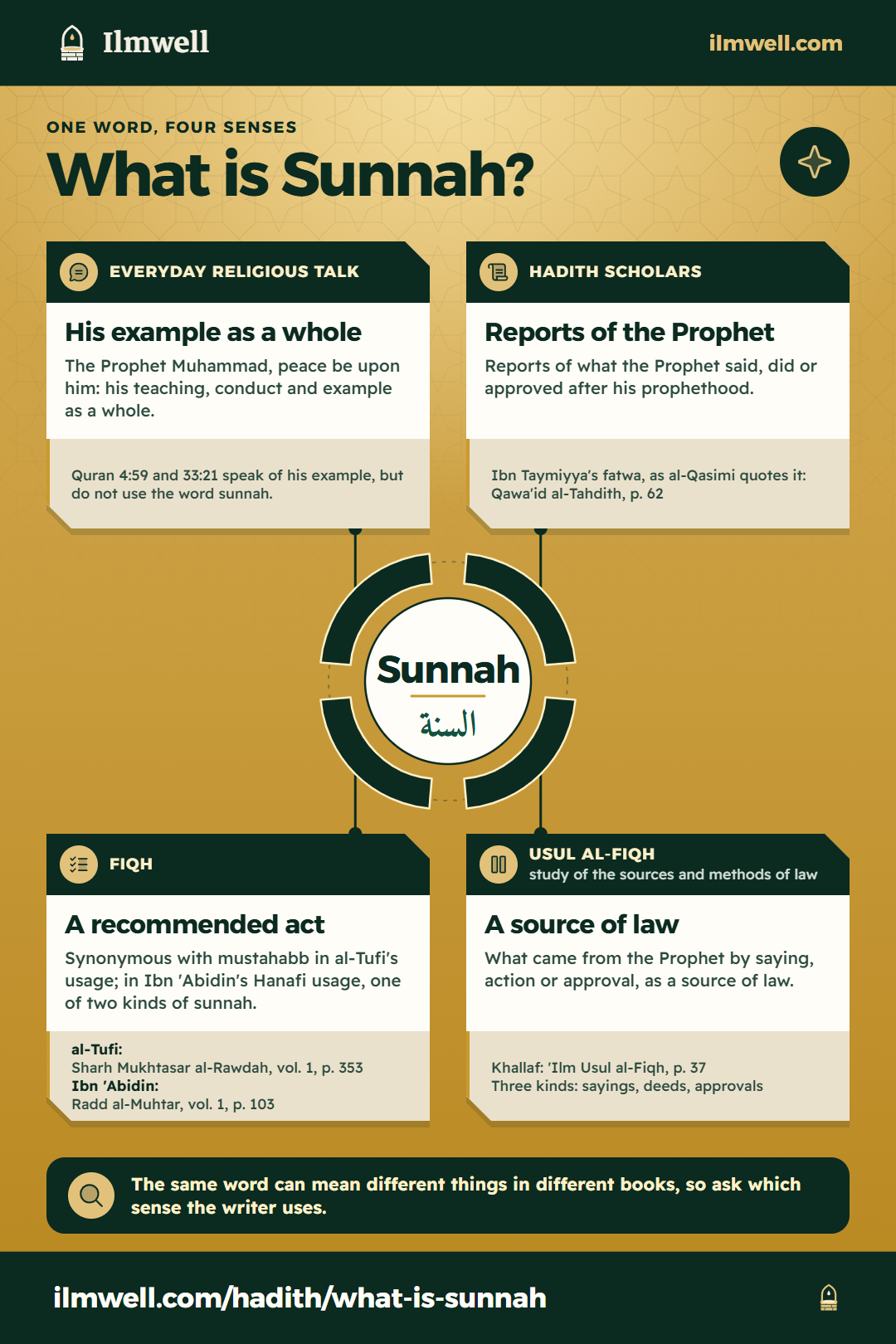
What is Sunnah? In everyday Islamic speech, Sunnah means the example and guidance of the Prophet Muhammad, peace be upon him. Scholars give the word more specific meanings in hadith, fiqh (Islamic law) and usul al-fiqh (principles of jurisprudence). Abd al-Wahhab Khallaf's usul textbook defines it as what came from him by saying, action or approval 7.
What does Sunnah mean in Islam?
The Quran tells believers to obey Allah and the Messenger, and describes the Messenger as a good example. 2 3
يَـٰٓأَيُّهَا ٱلَّذِينَ ءَامَنُوٓا۟ أَطِيعُوا۟ ٱللَّهَ وَأَطِيعُوا۟ ٱلرَّسُولَ وَأُو۟لِى ٱلْأَمْرِ مِنكُمْ ۖ فَإِن تَنَـٰزَعْتُمْ فِى شَىْءٍ فَرُدُّوهُ إِلَى ٱللَّهِ وَٱلرَّسُولِ إِن كُنتُمْ تُؤْمِنُونَ بِٱللَّهِ وَٱلْيَوْمِ ٱلْـَٔاخِرِ ۚ ذَٰلِكَ خَيْرٌ وَأَحْسَنُ تَأْوِيلًا
لَّقَدْ كَانَ لَكُمْ فِى رَسُولِ ٱللَّهِ أُسْوَةٌ حَسَنَةٌ لِّمَن كَانَ يَرْجُوا۟ ٱللَّهَ وَٱلْيَوْمَ ٱلْـَٔاخِرَ وَذَكَرَ ٱللَّهَ كَثِيرًا
These verses speak of obeying the Messenger and of his example. They do not use the word sunnah, and they do not supply the later technical categories. In ordinary religious talk, Sunnah can mean his teaching, conduct and example as a whole.
Is Sunnah the same as hadith?
A hadith is a transmitted report, and Sunnah is the example being studied. Reports are the main evidence for it, but each report's wording, authenticity, context and legal significance still need examining. See what is a hadith? and sahih, hasan and da'if.
Sahih al-Bukhari 631 is an example. Malik ibn al-Huwayrith, may Allah be pleased with him, reported that the Prophet Muhammad, peace be upon him, told young men who had stayed with him for twenty days to return to their families, teach them, and pray as they had seen him pray.
1AuthenticSahih al-Bukhari 631
The instruction was given to those men as they left. The report describes no act of the prayer, so it cannot settle the ruling of any of them.
What does Sunnah mean to hadith scholars?
In hadith scholarship the word sunnah overlaps with hadith. Ibn Taymiyya, in a fatwa quoted by al-Qasimi in his Qawa'id al-Tahdith, says that unqualified use of the Prophetic hadith covers what was reported from him after his prophethood: his words, deeds and approvals. He adds that his sunnah is established through these three ways. 4
al-Qasimi, Qawa'id al-Tahdith, p. 62, quoting Ibn Taymiyya
فإن سنته ثبتت من هذه الوجوه الثلاثة
We read this as al-Qasimi gives it. The fatwa itself was not located as a separate text.
What does Sunnah mean in fiqh?
In fiqh the word can name a recommended act. Al-Tufi, in his commentary on his abridgement of al-Rawdah, says that nadb (recommendation) is a synonym of sunnah and mustahabb. He explains that the three are equal in definition and reality and differ only in their words. 5
al-Tufi, Sharh Mukhtasar al-Rawdah, vol. 1, p. 353
وهو مرادف السنة والمستحب
Ibn 'Abidin, a Hanafi jurist, draws finer lines. In the chapter on the sunan of wudu (ablution), he divides sunnah into sunnat al-huda, whose omission brings disapproval, and sunan al-zawa'id, whose omission does not. He also says that, as to ruling, nafl and sunan al-zawa'id do not differ. 6
Ibn 'Abidin, Radd al-Muhtar, vol. 1, p. 103
والسنة نوعان : سنة الهدي ، وتركها يوجب إساءة وكراهية كالجماعة والأذان والإقامة ونحوها . وسنة الزوائد
These are the terms of particular books, not rulings on any act.
What does Sunnah mean in usul al-fiqh?
In usul al-fiqh, the study of the sources and methods of law, Sunnah is what came from the Prophet by saying, action or approval. Khallaf gives three kinds: sayings, deeds and approvals. 7
Khallaf, 'Ilm Usul al-Fiqh, p. 37
ما صدر عن رسول الله -صلى الله عليه وسلم- من قول، أو فعل، أو تقرير
What are the senses of Sunnah at a glance?
| Field | What Sunnah refers to | Source |
|---|---|---|
| Hadith scholars | Reports of what the Prophet said, did or approved after his prophethood | 4 |
| Fiqh | A recommended act, synonymous with mustahabb in al-Tufi's usage; in Ibn 'Abidin's Hanafi usage, one of two kinds of sunnah | 5 6 |
| Usul al-fiqh | What came from the Prophet by saying, action or approval, as a source of law | 7 |
The same word can mean different things in different books, so ask which sense the writer uses.
Why does a prayer chart call something 'sunnah'?
A prayer chart may use sunnah as a legal label for an additional prayer, in the fiqh sense above, and fard for the compulsory prayers. Before following a chart, check whether it names its school or its source.
What does it mean when people say 'follow the Sunnah'?
It may mean following the Prophet's religious guidance in general, or a particular act that the speaker believes is established from him. Ask which source, what it reported, and how it was understood.
Knowing that a report exists does not by itself settle the status of the act it describes. That takes evidence and scholarly interpretation.
An authentic report is a starting point. Authenticity and legal interpretation are separate questions, and the hadith grading guide explains the grades.
How can I check a claim about the Sunnah?
- Find the report and its wording, rather than relying on an unattributed graphic.
- Check the collection and the grading, then read the surrounding context.
- For a ruling, ask how qualified scholars applied the evidence, and whether recognised schools differ.
In Sahih al-Bukhari 631 the instruction came after twenty days' stay and was given as the men left. That context matters more than a clipped sentence presented as a complete manual. 1
The first time I heard a habit called sunnah was at my uncle's house, when he saw me eating with my left hand and told me, kindly, that using the right was sunnah. I swapped hands straight away, and I have noticed what people call sunnah ever since.
Try it: which sense is meant?
Pick an answer; each one explains itself.
1In a sentence about the Prophet's example, can sunnah mean what he reported, as a whole?
Answer: Yes. In hadith scholarship and usul al-fiqh the word covers his reported words, deeds and approvals. The narrower fiqh use, for a recommended act, is a separate meaning.
2On a prayer timetable, can sunnah be a legal label?
Answer: It may be, in the fiqh sense. A timetable may use the fiqh sense of a recommended prayer. Check which school or source it follows before taking the label as a ruling.
3Which report would you check before sharing a ruling that uses the word sunnah?
Answer: The report itself, its grading and its context. A label on its own is not evidence. Check the report, how it was graded and what surrounds it.
Questions people ask
Is the Sunnah only optional acts?
No. In fiqh the word can name a recommended act, which is one narrower sense. In hadith scholarship and usul al-fiqh it names what was reported from the Prophet Muhammad, peace be upon him, by saying, action or approval, whatever the ruling on that act.
Can I call a popular practice sunnah because many people do it?
Popularity alone does not show that a practice comes from the Prophet. Find the report, its grading and its context before using the word.
Does every hadith describe a sunnah to copy?
No. A hadith is a report to evaluate and understand. Its wording and context show what it asks, and some reports describe a particular situation rather than a general instruction.
Sources
Every claim on this page comes from one of these. Gradings are reported with the scholar's name; we do not grade hadith ourselves.
- 1
Malik ibn al-Huwayrith, may Allah be pleased with him, reported that the Prophet, sending the young men who had stayed with him for twenty days back to their families, told them to teach their families and order them to do good, and added: pray as you have seen me praying, and when the time for prayer comes, one of you should call the adhan and the eldest of you should lead.
Sahih al-Bukhari 631 Book 10, Hadith 28
Authentic: in Sahih al-Bukhari
- 2
An-Nisa 4:59 tells believers to obey Allah and obey the Messenger, and to refer a disputed matter back to Allah and the Messenger if they believe in Allah and the Last Day.
Quran 4:59 Tanzil and adapted Pickthall text.
- 3
Al-Ahzab 33:21 describes the Messenger of Allah as an excellent example for whoever hopes for Allah and the Last Day and remembers Allah often.
Quran 33:21 Tanzil and adapted Pickthall text.
- 4
In hadith terminology, unqualified use of 'the Prophetic hadith' covers what was reported from the Prophet after his prophethood: his words, his deeds and his approvals. Al-Qasimi gives this as Ibn Taymiyya's words in a fatwa, adding that the Prophet's sunnah is established through these three ways.
al-Qasimi, Qawa'id al-Tahdith, p. 62, quoting Ibn Taymiyya Read on shamela.ws.
- 5
Al-Tufi, in his commentary on his abridgement of the Rawdah, in the chapter on the recommended act (nadb), states that nadb is a synonym of sunnah and mustahabb, and explains that the three are equal in definition and reality and differ only in their words.
al-Tufi, Sharh Mukhtasar al-Rawdah, vol. 1, p. 353 Read on islamweb.net.
- 6
Ibn Abidin, in the chapter on the sunan of wudu (Radd al-Muhtar, Book of Purification), divides sunnah into two kinds: sunnat al-huda, whose omission brings disapproval, and sunan al-zawa'id, whose omission does not. He places nafl, including the mandub, below the zawa'id according to one view he reports, and in his own words says there is no difference in ruling between nafl and sunan al-zawa'id.
Ibn 'Abidin, Radd al-Muhtar, vol. 1, p. 103 Read on islamweb.net.
- 7
Abd al-Wahhab Khallaf, in his usul al-fiqh textbook, defines sunnah in the legal technical sense as what came from the Messenger of Allah, peace be upon him, by way of saying, action or approval, and divides it into verbal, practical and approval sunnahs.
Khallaf, 'Ilm Usul al-Fiqh, p. 37 Read on shamela.ws.
Next
- What is a hadith?Explainer
- Sahih hadith, hasan and daif: what grading meansExplainer
- Sunnah and Nafl prayersGuide
- How to pray SalahGuide
- How we sourceAbout
For your own situation, ask a scholar you trust.
Join the email list
New guides by email, now and then. No spam, and you can leave at any time.
Ilmwell is free and kept going by readers. See how to support it.