The short answer
What is hadith? A hadith is a transmitted report about the Prophet Muhammad, peace be upon him: his words, actions, appearance or approvals. Hadith scholars assess how each report was transmitted. Ibn al-Salah's Muqaddimah sets out the grades sahih (authentic), hasan (good) and da'if (weak).
What does hadith mean in Islam?
Sunnah.com describes hadith as the transmitted narrations concerning the speech, actions, appearance and approvals of the Prophet 8. A hadith is a report, not simply a quotation on an image. It may record something he said or did, or something done in his presence that he approved. The plural is ahadith.
An account of an action can be a hadith even when it holds no direct speech from him. The important questions are what the report attributes to him and how that attribution has been transmitted. Ibn al-Salah defines the marfu as what is attributed to the Messenger of Allah specifically, and says it can be connected or interrupted 6.
Calling something a hadith does not by itself show that the report is authentic. Whether its chain connects and whether it meets the conditions for acceptance are separate questions.
What are the chain and the text of a hadith?
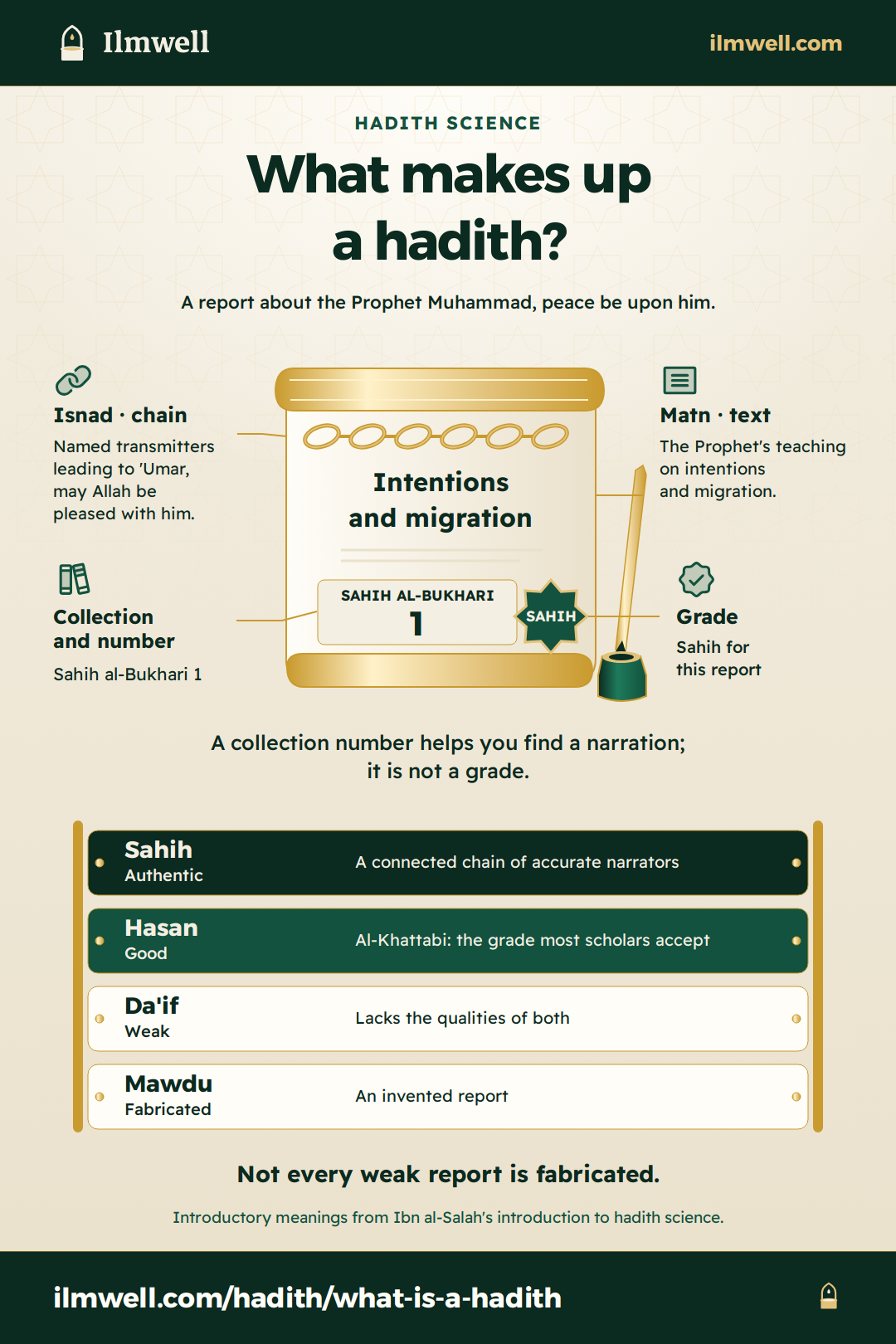
The isnad is the chain of people through whom a report is transmitted. The matn is the report's text. A reference lets you find both, rather than relying on an isolated English sentence.
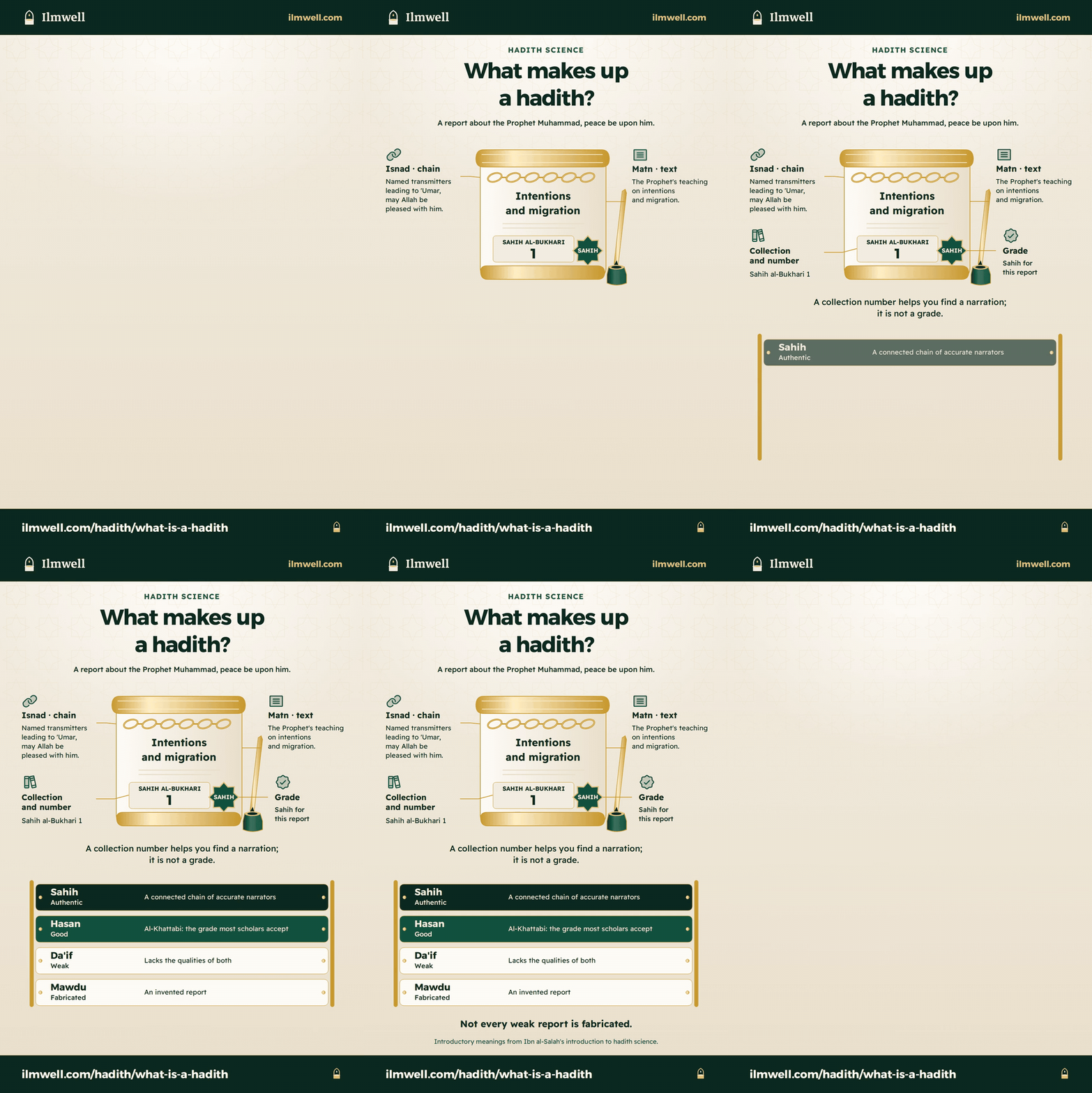
Sahih al-Bukhari 1 is a useful example. Its chain leads through named transmitters to 'Umar ibn al-Khattab, may Allah be pleased with him. Its text concerns intentions and the purpose of a person's migration.
1AuthenticSahih al-Bukhari 1
| Part | Question it answers | In the example |
|---|---|---|
| Isnad, the chain | Through whom was this transmitted? | A sequence of named narrators leading to 'Umar |
| Matn, the text | What is being reported? | The Prophet's teaching about intentions and migration |
| Collection and number | Where can I check it? | Sahih al-Bukhari 1 |
| Grade | How has its reliability been assessed? | Sahih for this report |
These parts serve different purposes. A collection number helps you find a narration; it is not a grade.
How do scholars assess a hadith?
They examine the transmission and the report, rather than asking whether a sentence sounds inspiring. Ibn al-Salah defines the sahih hadith as one with a connected chain, passed from a just and accurate narrator to a just and accurate narrator, that is neither irregular nor carrying a hidden defect 3. A connected chain means the narrators actually received the report through the stated links. The assessment compares other transmissions too; it is not a count of the names before the text.
That is why "someone shared it with a reference" is only a starting point. You still need the wording, the relevant transmission and its assessment.
What do sahih, hasan and weak mean?
They are assessments of reliability. The table gives introductory meanings from Ibn al-Salah's chapters, not a method for grading a narration yourself.
| Term | Plain meaning | What to remember |
|---|---|---|
| Sahih | Authentic | Meets the conditions of a connected chain and accurate narrators 3 |
| Hasan | Good | Al-Khattabi, as Ibn al-Salah quotes him, calls it the grade most scholars accept; Ibn al-Salah calls earlier explanations unclear and sets out two kinds 4 |
| Da'if | Weak | Lacks the qualities of both sahih and hasan 5 |
| Mawdu | Fabricated | The invented report, a worse category than other weak reports 7 |
Fabricated is the worst kind of weak report, and not every weak report is fabricated. Ibn al-Salah separates the fabricated report from other weak reports, whose truth is possible 7. A weakness may mean that authenticity has not been established; it does not by itself mean deliberate invention.
Assessments can also differ. Ibn al-Salah says scholars may differ on a particular report, because they differ on whether it has the required qualities 3. When that happens, look for the named scholar, the work cited and the exact wording or chain being assessed. A judgement on one version should not silently become a badge for every similar sentence.
Is every report in a hadith collection authentic?
The title of a collection does not replace checking the report. Ibn al-Salah says the connected reports in Sahih al-Bukhari and Sahih Muslim are sound, while some suspended reports, where the start of the chain is omitted, need a closer look 3. Other well-known collections include Sunan Abi Dawud, Jami' at-Tirmidhi, Sunan an-Nasa'i and Sunan Ibn Majah. Sunnah.com notes that collections have differing criteria for inclusion and that not all hadith in all collections are necessarily authentic 8.
Sunnah.com also says its English and Arabic numbering differ, because the translator sometimes split or combined reports 8. When a number seems not to match, compare the Arabic opening, the narrator, the book and the chapter before deciding you have found a different report.
How is a hadith different from the Quran?
The Quran is Islam's revealed scripture, and a hadith is a transmitted report. They are cited differently: a Quran reference gives a surah and verse, while a hadith reference gives a collection and a narration. Hadith grades assess transmitted reports; they are not labels for Quran verses. The Dorar creed encyclopedia quotes al-Suyuti's definition of the Quran as the revealed word given to Muhammad, peace be upon him, whose inimitability is the point, which leaves out the sacred hadith 9.
A hadith qudsi is a hadith in which the Prophet relates words from Allah. In Sahih Muslim 2577a, Abu Dharr, may Allah be pleased with him, reports the Prophet relating that Allah said He has forbidden oppression for Himself and made it forbidden among people. It remains a hadith, with a narration reference, and is not a verse of the Quran.
2AuthenticSahih Muslim 2577a
How should you check a hadith shared online?
Say a post in a group chat opens with "The Prophet said" and nothing else. Open the cited narration and compare what was shared with what it says. Then check its grade, and whether the claimed lesson follows from the text.
| Check | A useful question |
|---|---|
| Wording | Is this a quotation, a translation or a loose summary? |
| Attribution | Are these the Prophet's words, a companion's words or later commentary? |
| Reference | Can I find the collection and narration? |
| Assessment | Who assessed this version, and what grade did they give? |
| Claimed benefit | Does the narration mention that reward, timing or number? |
Finding an authentic report is also different from deriving a personal religious ruling. If a post is being used to settle a disputed practice, a qualified scholar can explain its context and the other evidence involved. A short translation rarely shows that whole discussion.
Growing up, "it's a hadith" ended a conversation. Nobody asked where it came from or how strong it was. The first time someone asked me for the source, I had none. That was uncomfortable, and useful.
Try it: reading a reference
Pick an answer; each one explains itself.
1Is the isnad the report's message?
Answer: No, it is the chain of transmission. The message is in the matn. You can see both in Sahih al-Bukhari 1. Source 1
2Does da'if automatically mean fabricated?
Answer: No. Ibn al-Salah treats a fabricated report as a separate, worse category than other weak reports.
3Is Sahih Muslim 2577a a Quran verse?
Answer: No, it is a hadith in which the Prophet relates words from Allah. It is a hadith with a narration reference, even though the words reported are Allah's. Source 2
Questions people ask
What does hadith mean in Islam?
A hadith is a transmitted report about the Prophet Muhammad, peace be upon him: his words, actions, appearance or approvals. Calling something a hadith does not by itself say it is authentic.
What is the difference between sahih, hasan and daif?
They are assessments of reliability in classical hadith scholarship. Sahih means authentic, hasan means good and da'if means weak: a report lacking the qualities of both sahih and hasan.
Is a hadith qudsi part of the Quran?
No. A hadith qudsi is a hadith in which the Prophet, peace be upon him, relates words from Allah. The Quran is defined separately, and Sahih Muslim 2577a is an example of a hadith qudsi.
Sources
Every claim on this page comes from one of these. Gradings are reported with the scholar's name; we do not grade hadith ourselves.
- 1
'Umar ibn al-Khattab heard the Prophet say that deeds are by intentions and each person has what he intended.
Sahih al-Bukhari 1 Book 1, Hadith 1
Authentic: in Sahih al-Bukhari
- 2
Abu Dharr, may Allah be pleased with him, reported that the Prophet related that Allah said: O My servants, I have forbidden oppression for Myself and made it forbidden among you, so do not oppress one another (a hadith qudsi).
Sahih Muslim 2577a Book 45, Hadith 70
Authentic: in Sahih Muslim
- 3
Ibn al-Salah divides the hadith into sahih, hasan and da'if, defines the sahih as a connected chain of just and accurate narrators with no irregularity and no hidden defect, says scholars may differ on a particular report, and says the connected reports in the two Sahih books are sound while some suspended (mu'allaq) reports there need a closer look.
Ibn al-Salah, Muqaddimah, type 1: al-sahih Record: scholarly-ibn-salah-type-1-sahih. Read as the Arabic Wikisource transcription of the Muqaddimah.
- 4
Ibn al-Salah gives, as reported from al-Khattabi, the hasan as the report whose source is known and whose narrators are well known, and from al-Tirmidhi that its chain has no one accused of lying, it is not irregular and it comes by more than one route; he finds these statements unclear and sets out two kinds of hasan himself.
Ibn al-Salah, Muqaddimah, type 2: al-hasan Record: scholarly-ibn-salah-type-2-hasan. Read as the Arabic Wikisource transcription of the Muqaddimah.
- 5
Ibn al-Salah says every hadith that does not gather the qualities of the sahih or the hasan is da'if (weak).
Ibn al-Salah, Muqaddimah, type 3: al-da'if Record: scholarly-ibn-salah-type-3-daif. Read as the Arabic Wikisource transcription of the Muqaddimah.
- 6
Ibn al-Salah defines the marfu as what is attributed specifically to the Messenger of Allah, and says it can be connected or interrupted.
Ibn al-Salah, Muqaddimah, type 6: al-marfu Record: scholarly-ibn-salah-type-6-marfu. Read as the Arabic Wikisource transcription of the Muqaddimah.
- 7
Ibn al-Salah defines the mawdu (fabricated) hadith as the invented and made-up report, the worst of the weak reports, and distinguishes it from other weak reports whose truth is possible.
Ibn al-Salah, Muqaddimah, type 21: al-mawdu Record: scholarly-ibn-salah-type-21-mawdu. Read as the Arabic Wikisource transcription of the Muqaddimah.
- 8
Sunnah.com's About page says hadith are the transmitted narrations concerning the speech, actions, appearance and approvals of the Prophet, that the collections have differing criteria for inclusion, and that not all hadith in all collections are necessarily authentic, and (section 6) that the numbering of the English and Arabic texts differs because the translator sometimes split or combined reports.
Sunnah.com, About, sections 2 and 6 Record: scholarly-sunnahcom-about-hadith.
- 9
The Dorar creed encyclopedia defines the Quran and, quoting al-Suyuti, excludes the sacred hadith (al-hadith al-qudsi, 'al-ahadith al-rabbaniyyah al-qudsiyyah') because the Quran is the revealed word whose inimitability is the point, giving the hadith 'I am as My servant thinks of Me' (Bukhari 7405, Muslim 2675) as an example.
Dorar, al-Mawsu'ah al-'Aqadiyyah, the definition of the Quran, quoting al-Suyuti Record: scholarly-dorar-definition-quran-qudsi.
Next
For your own situation, ask a scholar you trust.
Join the email list
New guides by email, now and then. No spam, and you can leave at any time.
Ilmwell is free and kept going by readers. See how to support it.