The short answer
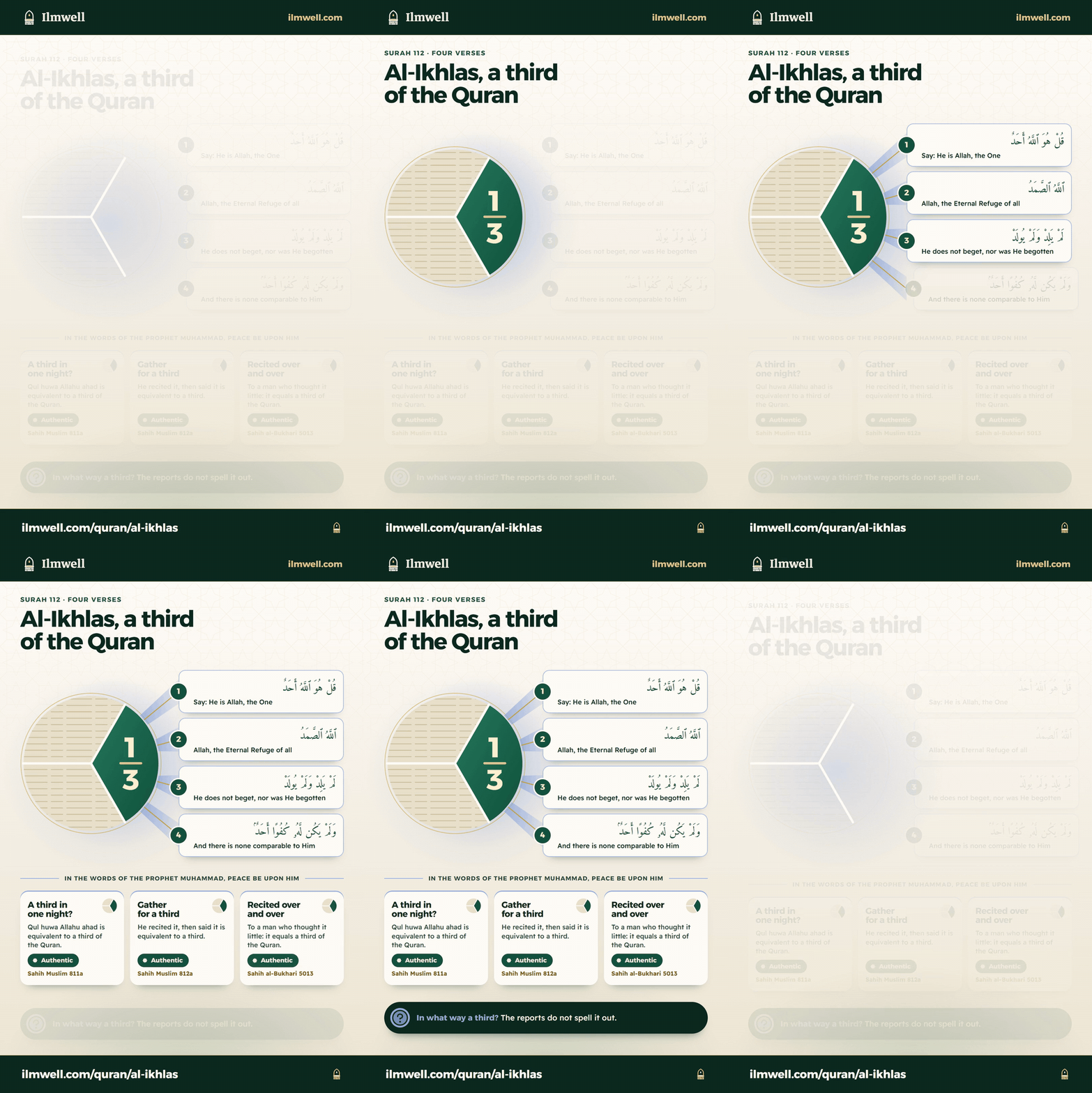
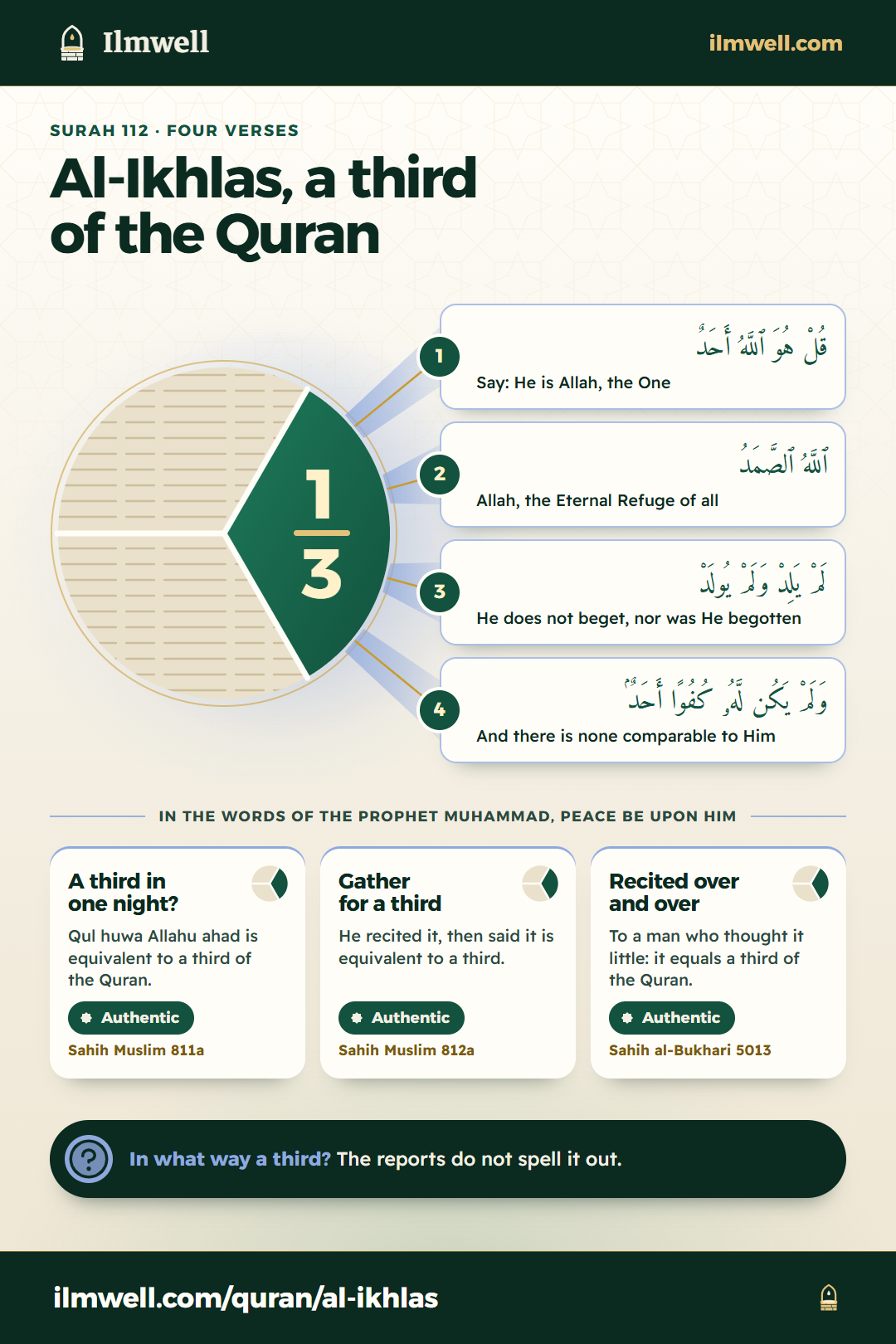
Surah Ikhlas in English begins "Say: He is Allah, the One!" (Al-Ikhlas 112:1, meaning surah 112, verse 1). It is the 112th surah, four verses saying Allah is One, the Eternal Refuge of all, who does not beget and was not begotten. The Prophet Muhammad, peace be upon him, said it equals a third of the Quran (Sahih Muslim 811a, graded sahih).
What is Surah Ikhlas in English, Arabic and transliteration?
Al-Ikhlas 112:1 to 4
قُلْ هُوَ ٱللَّهُ أَحَدٌ ٱللَّهُ ٱلصَّمَدُ لَمْ يَلِدْ وَلَمْ يُولَدْ وَلَمْ يَكُن لَّهُۥ كُفُوًا أَحَدٌۢ
Qul huwa llāhu aḥad. Allāhu ṣ-ṣamad. Lam yalid wa lam yūlad. Wa lam yakul-lahū kufuwan aḥad.
Say: He is Allah, the One! Allah, the Eternal Refuge of all! He does not beget, nor was He begotten. And there is none comparable to Him.
Al-Ikhlas is surah 112, with four verses. To copy and paste the Arabic text, use the button under the scroll. Like most surahs it is printed under Bismillah, which is not counted among its four verses.
What does Surah Ikhlas mean, verse by verse?
Here is the Surah Ikhlas transliteration, one verse at a time, with what each line says.
- 1
قُلْ هُوَ ٱللَّهُ أَحَدٌ
Qul huwallāhu aḥad
Say: He is Allah, the One!
The surah opens with the command qul, "say", as Al-Falaq and An-Nas do. Huwa is "He" and ahad is "One".
- 2
ٱللَّهُ ٱلصَّمَدُ
Allāhuṣ-ṣamad
Allah, the Eternal Refuge of all!
As-samad is given in this translation as "the Eternal Refuge of all". The verse names Allah again, in full, before describing Him.
- 3
لَمْ يَلِدْ وَلَمْ يُولَدْ
Lam yalid wa lam yūlad
He does not beget, nor was He begotten.
Two denials in one verse: He does not beget, and He was not begotten.
- 4
وَلَمْ يَكُن لَّهُۥ كُفُوًا أَحَدٌۢ
Wa lam yakul-lahū kufuwan aḥad
And there is none comparable to Him.
The last verse: "none comparable to Him". It ends on ahad, the word the first verse ends on.
The first verse is four words:
Arabic reads right to left, so the first word is on the right.
- قُلْqulsayAn instruction: say these words.
- هُوَhuwaHeThe one the surah is about.
- ٱللَّهُAllāhuAllahThe name of God in Arabic.
- أَحَدٌaḥadOneAlso the last word of verse 4.
What are the tawhid themes of Surah Ikhlas?
Tawhid is the oneness of Allah. The surah makes four statements about it, one in each verse, and the table keeps to the words of the translation.
| Verse | What it states |
|---|---|
| 1 | He is Allah, the One |
| 2 | Allah is the Eternal Refuge of all |
| 3 | He does not beget, nor was He begotten |
| 4 | There is none comparable to Him |
How the classical commentators explain each statement belongs to tafsir (Quran commentary). A page setting out the commentaries, each view with its named work, is coming.
Al-Ikhlas was the first surah I could recite from start to finish, because my mum made me practise it at the kitchen table. I knew it was short. I did not know how much was in it until I read what each verse says.
Try it: Surah Ikhlas in four questions
Four quick questions on the surah and its reports. Each answer explains itself.
1Which verse of Al-Ikhlas says that Allah does not beget and was not begotten?
Answer: Verse 3. Verse 3: lam yalid wa lam yulad, "He does not beget, nor was He begotten".
2How many verses does Surah Al-Ikhlas have?
Answer: Four. Four. It is surah 112, one of the shortest in the Quran.
3What did the Prophet say Al-Ikhlas is equivalent to?
Answer: A third of the Quran. Sahih Muslim 811a, graded sahih, reports it. A report that gives other fractions to other surahs is graded differently. Source 1
4What was the commander in the report told Allah feels towards him?
Answer: That Allah loves him. Sahih al-Bukhari 7375: he finished his prayer recitation with Al-Ikhlas, and the Prophet said to tell him that Allah loves him. Source 4
What are the benefits of Surah Ikhlas?
Each report below is retold from its source with its grade. One, kept apart at the end, is graded differently. The first two groups give no count of recitations and no worldly reward.
A third of the Quran
Abu Darda, may Allah be pleased with him, reported that the Prophet asked whether any of them was unable to recite a third of the Quran in a night. They asked how that could be done, and he said that Qul huwa Allahu ahad is equivalent to a third of the Quran.
1AuthenticSahih Muslim 811a
Abu Hurayrah, may Allah be pleased with him, reported that the Prophet told the people to gather, as he would recite a third of the Quran to them. He came out and recited Qul huwa Allahu ahad, then went in. He came out again and said he had told them he would recite a third of the Quran, and that this surah is equivalent to a third.
2AuthenticSahih Muslim 812a
Abu Said al-Khudri, may Allah be pleased with him, reported that a man heard another man reciting Qul huwa Allahu ahad over and over. The man mentioned it to the Prophet next morning as if he thought it little. The Prophet said, by Him in whose hand is his life, that this surah equals a third of the Quran.
3AuthenticSahih al-Bukhari 5013
These reports say "equivalent to a third". They do not spell out in what way, and we cite no scholar on that here.
The man Allah loves
'Aisha, may Allah be pleased with her, reported that the Prophet sent a man to command a unit. He led his companions in prayer and finished his recitation with Qul huwa Allahu ahad. When they returned they told the Prophet, who asked them to find out why. The man said it mentions the qualities of the Merciful and he loved to recite it. The Prophet said to tell him that Allah loves him.
4AuthenticSahih al-Bukhari 7375
The report is about this one man and his reason. It does not say the same is true of anyone else who recites it.
In the daily routine
Three reports put Al-Ikhlas alongside other surahs. They are told in full on the pages linked below, so only the summary and the source are shown here. At dawn, Abu Hurayrah reported that the Prophet recited Al-Kafirun and Al-Ikhlas in the two rak'ahs (units of prayer) before the Fajr prayer (Sahih Muslim 726). At bedtime, 'Aisha reported that he recited it with Al-Falaq and An-Nas into his palms (Sahih al-Bukhari 5017). Morning and evening, three times, is in Sunan Abi Dawud 5082. See the four Quls and Surah Falaq and Surah Nas.
5AuthenticSahih Muslim 726
6AuthenticSahih al-Bukhari 5017
7AuthenticSunan Abi Dawud 5082
A report graded differently has Ibn Abbas, may Allah be pleased with him, giving fractions to three surahs: Al-Ikhlas a third, with Al-Zalzalah half and Al-Kafirun a fourth. The gradings are set out on the four Quls.
How do you recite Surah Ikhlas?
It is short enough to learn in a sitting. Read along with the transliteration above, a verse at a time, and slow down for these sounds:
- ḥ in aḥad: a breathy h from the throat, not the h of "hat".
- ṣ in aṣ-ṣamad: a heavy s, with the tongue pulled back.
- The doubled d and the long ū in yūlad are held a little longer.
Listen and repeat. A recording by a fluent human reciter is coming. We do not use a synthetic voice for the Quran.
Common mix-ups
- Al-Ikhlas is surah 112. Al-Kafirun is 109, and Al-Falaq and An-Nas are 113 and 114.
- The surah is also written Ikhlaas, Al Ikhlas and Surat Al Ikhlas. All mean this surah.
Questions people ask
What is the meaning of Surah Ikhlas?
Surah Ikhlas is four verses on who Allah is: One, the Eternal Refuge of all, who does not beget and was not begotten, and none is comparable to Him. The surah is also called Surat Ikhlas, Surah Al Ikhlas and Surah e Ikhlas.
Is Surah Ikhlas a third of the Quran?
Sahih Muslim 811a, graded sahih, has the Prophet, peace be upon him, saying it is equivalent to a third of the Quran. The reports cited on this page do not say in what way it equals a third.
What does ikhlas mean?
Ikhlas is an Arabic word usually rendered sincerity. The word does not occur in the surah, and this page cites no source for why the surah carries the name.
Sources
Every claim on this page comes from one of these. Gradings are reported with the scholar's name; we do not grade hadith ourselves.
- 1
Abu Darda reported that the Prophet asked whether any of them was unable to recite a third of the Quran in a night, and when they asked how, said that Qul huwa Allahu ahad is equivalent to a third of the Quran.
Sahih Muslim 811a Book 6, Hadith 314
Authentic: in Sahih Muslim
- 2
Abu Hurayrah reported that the Prophet told the people to gather, as he would recite a third of the Quran to them, came out and recited Qul huwa Allahu ahad, went in, and then said he had told them he would recite a third of the Quran and that this surah is equivalent to a third.
Sahih Muslim 812a Book 6, Hadith 316
Authentic: in Sahih Muslim
- 3
Abu Said al-Khudri narrated that a man heard another man reciting Qul huwa Allahu ahad over and over, mentioned it to the Prophet next morning as if he thought it little, and the Prophet said, by Him in whose hand is his life, that this surah equals a third of the Quran.
Sahih al-Bukhari 5013 Book 66, Hadith 35
Authentic: in Sahih al-Bukhari
- 4
Aisha reported that the Prophet sent a man to command a unit; he led his companions in prayer and finished his recitation with Qul huwa Allahu ahad. When asked why, he said it mentions the qualities of the Merciful and he loved to recite it. The Prophet told them to tell him that Allah loves him.
Sahih al-Bukhari 7375 Book 97, Hadith 5
Authentic: in Sahih al-Bukhari
- 5
Abu Hurayrah reported that the Prophet recited Qul ya ayyuhal-kafirun and Qul huwa Allahu ahad in the two supererogatory rak'ahs of dawn (the Fajr sunnah).
Sahih Muslim 726 Book 6, Hadith 120
Authentic: in Sahih Muslim
- 6
'Aisha narrated that every night at bedtime the Prophet gathered his palms, blew into them and recited into them Al-Ikhlas, Al-Falaq and An-Nas, then wiped what he could of his body with them, doing that three times.
Sahih al-Bukhari 5017 Book 66, Hadith 39
Authentic: in Sahih al-Bukhari
- 7
Abdullah ibn Khubayb narrated that on a night of rain and deep darkness the Prophet told him to say Qul huwa Allahu ahad and the mu'awwidhatayn three times, evening and morning. He said they would suffice him against everything.
Sunan Abi Dawud 5082 Book 43, Hadith 310
Authentic: hasan (Al-Albani); its chain is hasan (Shu'ayb al-Arna'ut); hasan (Ibn Hajar al-'Asqalani); its chain is hasan (Ibn Baz); its chain is sahih (Al-Nawawi); hasan, as he set out in the introduction (Ibn Hajar al-'Asqalani); hasan sahih (Al-Albani); sahih (Ibn Daqiq al-'Id); does not fall below hasan, and may meet the conditions of both Sahihs or one of them (Al-Mundhiri); sahih (Al-Albani); hasan sahih, gharib by this route (Al-Tirmidhi); Hasan (Darussalam). Remarks: silent about it; he said whatever he is silent about is fit (Abu Dawud)
- 8
Ibn Abbas narrated, through Yaman ibn al-Mughirah from Ata, that the Prophet said Idha zulzilat (Al-Zalzalah) equals half of the Quran, Qul huwa Allahu ahad (Al-Ikhlas) a third and Qul ya ayyuhal-kafirun (Al-Kafirun) a fourth. Graded differently: the full report and the shortened extract are kept apart.
Jami' at-Tirmidhi 2894 Book 45, Hadith 20
Graded differently. Here is who graded it which way:
- SoundAl-Hakim
- Weak chain, strengthenedAl-Albani
- WeakDarussalam, Al-Bayhaqi, Al-Albani, Al-Mubarakfuri, Sadr al-Din al-Munawi
- Other remarksAl-Tirmidhi
See each grading in full, with its wording and where it was given
Scholars disagree about this hadith. Here is how each graded it, so you can follow the scholar you trust.
- Da'if (da'if; full report): Darussalam, as shown on sunnah.com (full report)
- صحيح الإسناد (its chain is sahih; full report): Al-Hakim, al-Mustadrak 1/754, no. 2078 (as reproduced on dorar.net)
- يمان بن المغيرة غير قوي (Yaman ibn al-Mughirah is not strong; full report): Al-Bayhaqi, Shu'ab al-Iman 2/981 (as listed on dorar.net)
- ضعيف (da'if; full report): Al-Albani, Da'if al-Jami' 531 (as listed on dorar.net)
- منكر (munkar; full report): Al-Albani, al-Silsila al-Da'ifa 1342 (as listed on dorar.net)
- يمان بن المغيرة منكر الحديث، استحق الترك (Yaman ibn al-Mughirah is munkar al-hadith and deserves to be left, quoting al-Bukhari and Abu Hatim; full report): Al-Mubarakfuri, Tuhfat al-Ahwadhi 7/313 (as listed on dorar.net)
- مداره على يمان ويمان ضعيف (it turns on Yaman, and Yaman is weak; full report): Sadr al-Din al-Munawi, Kashf al-Manahij wa al-Tanaqih 2/234 (as listed on dorar.net)
- حسن لغيره (hasan li-ghayrihi; shortened extract on Al-Ikhlas and Al-Kafirun): Al-Albani, Sahih al-Targhib 1477 (as listed on dorar.net)
- غريب لا نعرفه إلا من حديث يمان بن المغيرة (gharib; we know it only through Yaman ibn al-Mughirah): Al-Tirmidhi, Jami' at-Tirmidhi 2894 (his comment on the full report)
- Q
Quran Arabic for Al-Ikhlas 112:1 to 4 (the scroll, the verse list and the word cards), without the Bismillah the Tanzil copy prints at the head of verse 1, and its English.
Tanzil Project Uthmani text, CC BY 3.0. English: adapted from Marmaduke Pickthall's translation (1930), modernised and checked against modern translations.
Next
For your own situation, ask a scholar you trust.
Join the email list
New guides by email, now and then. No spam, and you can leave at any time.
Ilmwell is free and kept going by readers. See how to support it.