The short answer
Surah Nas in English begins: "Say: I seek refuge in the Lord of mankind" (An-Nas 114:1, meaning surah 114, verse 1). It is the Quran's last surah, six verses seeking refuge from the sneaking whisperer. Surah Al-Falaq, just before it, seeks refuge from four evils. The Prophet Muhammad, peace be upon him, said verses like them had never been seen (Sahih Muslim 814, graded sahih).
What is Surah Nas in English, Arabic and transliteration?
An-Nas 114:1 to 6
قُلْ أَعُوذُ بِرَبِّ ٱلنَّاسِ مَلِكِ ٱلنَّاسِ إِلَـٰهِ ٱلنَّاسِ مِن شَرِّ ٱلْوَسْوَاسِ ٱلْخَنَّاسِ ٱلَّذِى يُوَسْوِسُ فِى صُدُورِ ٱلنَّاسِ مِنَ ٱلْجِنَّةِ وَٱلنَّاسِ
Qul aʿūdhu bi-rabbi n-nās. Maliki n-nās. Ilāhi n-nās. Min sharri l-waswāsi l-khannās. Alladhī yuwaswisu fī ṣudūri n-nās. Mina l-jinnati wa n-nās.
Say: I seek refuge in the Lord of mankind, The King of mankind, The God of mankind, From the evil of the sneaking whisperer, Who whispers in the hearts of mankind, Of the jinn and of mankind.
Surah An-Nas, "mankind", is surah 114, the last in the Quran. To copy and paste the Arabic text, use the button under the scroll. Like most surahs it is printed under Bismillah, which is not counted among its six verses.
What does Surah Nas mean, verse by verse?
An-Nas describes Allah three ways and names one thing to seek refuge from. Here is the Surah Nas transliteration, one verse at a time, with what each line says.
- 1
قُلْ أَعُوذُ بِرَبِّ ٱلنَّاسِ
Qul a'udhu bi rabbin-nas
Say: I seek refuge in the Lord of mankind.
The surah opens with the command qul, "say", as Al-Falaq and Al-Ikhlas do. A'udhu is "I seek refuge", rabb is Lord, and an-nas is mankind.
- 2
مَلِكِ ٱلنَّاسِ
Malikin-nas
The King of mankind.
Malik is King: a second description of Allah, again tied to mankind.
- 3
إِلَـٰهِ ٱلنَّاسِ
Ilahin-nas
The God of mankind.
Ilah is God: the third description. Verses 1 to 3 all end on an-nas.
- 4
مِن شَرِّ ٱلْوَسْوَاسِ ٱلْخَنَّاسِ
Min sharril-waswasil-khannas
From the evil of the sneaking whisperer.
The one thing named to seek refuge from. In Arabic it is al-waswas al-khannas; this translation gives "the sneaking whisperer".
- 5
ٱلَّذِى يُوَسْوِسُ فِى صُدُورِ ٱلنَّاسِ
Alladhi yuwaswisu fi sudurin-nas
Who whispers in the hearts of mankind.
Yuwaswisu ("whispers") is the verb from the same root as al-waswas in verse 4.
- 6
مِنَ ٱلْجِنَّةِ وَٱلنَّاسِ
Minal-jinnati wan-nas
Of the jinn and of mankind.
The surah closes on an-nas for the fifth time.
What is Surah Falaq in English, Arabic and transliteration?
Al-Falaq 113:1 to 5
قُلْ أَعُوذُ بِرَبِّ ٱلْفَلَقِ مِن شَرِّ مَا خَلَقَ وَمِن شَرِّ غَاسِقٍ إِذَا وَقَبَ وَمِن شَرِّ ٱلنَّفَّـٰثَـٰتِ فِى ٱلْعُقَدِ وَمِن شَرِّ حَاسِدٍ إِذَا حَسَدَ
Qul aʿūdhu bi-rabbi l-falaq. Min sharri mā khalaq. Wa min sharri ghāsiqin idhā waqab. Wa min sharri n-naffāthāti fi l-ʿuqad. Wa min sharri ḥāsidin idhā ḥasad.
Say: I seek refuge in the Lord of the Daybreak, From the evil of that which He created; From the evil of the darkness when it is intense, And from the evil of malignant witchcraft, And from the evil of the envier when he envies.
Surah Al-Falaq is surah 113, the one before An-Nas. It has five verses, and the Arabic copies the same way.
What does Surah Falaq mean, verse by verse?
Al-Falaq turns the pattern of An-Nas around: one description of Allah, then four things to seek refuge from. The Surah Falaq transliteration, verse by verse:
- 1
قُلْ أَعُوذُ بِرَبِّ ٱلْفَلَقِ
Qul a'udhu bi rabbil-falaq
Say: I seek refuge in the Lord of the Daybreak.
The same opening as An-Nas, "Say: I seek refuge in the Lord of", ending this time on al-falaq, which this translation gives as the Daybreak.
- 2
مِن شَرِّ مَا خَلَقَ
Min sharri ma khalaq
From the evil of that which He created.
The first of four things named: the evil of what He created.
- 3
وَمِن شَرِّ غَاسِقٍ إِذَا وَقَبَ
Wa min sharri ghasiqin idha waqab
From the evil of the darkness when it is intense.
Each verse from here opens wa min sharri, "and from the evil of". The second thing named is the darkness, in this translation.
- 4
وَمِن شَرِّ ٱلنَّفَّـٰثَـٰتِ فِى ٱلْعُقَدِ
Wa min sharrin-naffathati fil-'uqad
And from the evil of malignant witchcraft.
The third: what this translation calls malignant witchcraft.
- 5
وَمِن شَرِّ حَاسِدٍ إِذَا حَسَدَ
Wa min sharri hasidin idha hasad
And from the evil of the envier when he envies.
The fourth: the envier. Hasid (envier) and hasad (envies) share one root.
What the darkness, the witchcraft and the whisperer are belongs to tafsir (Quran commentary). A page setting out the classical commentaries, each view with its named work, is coming.
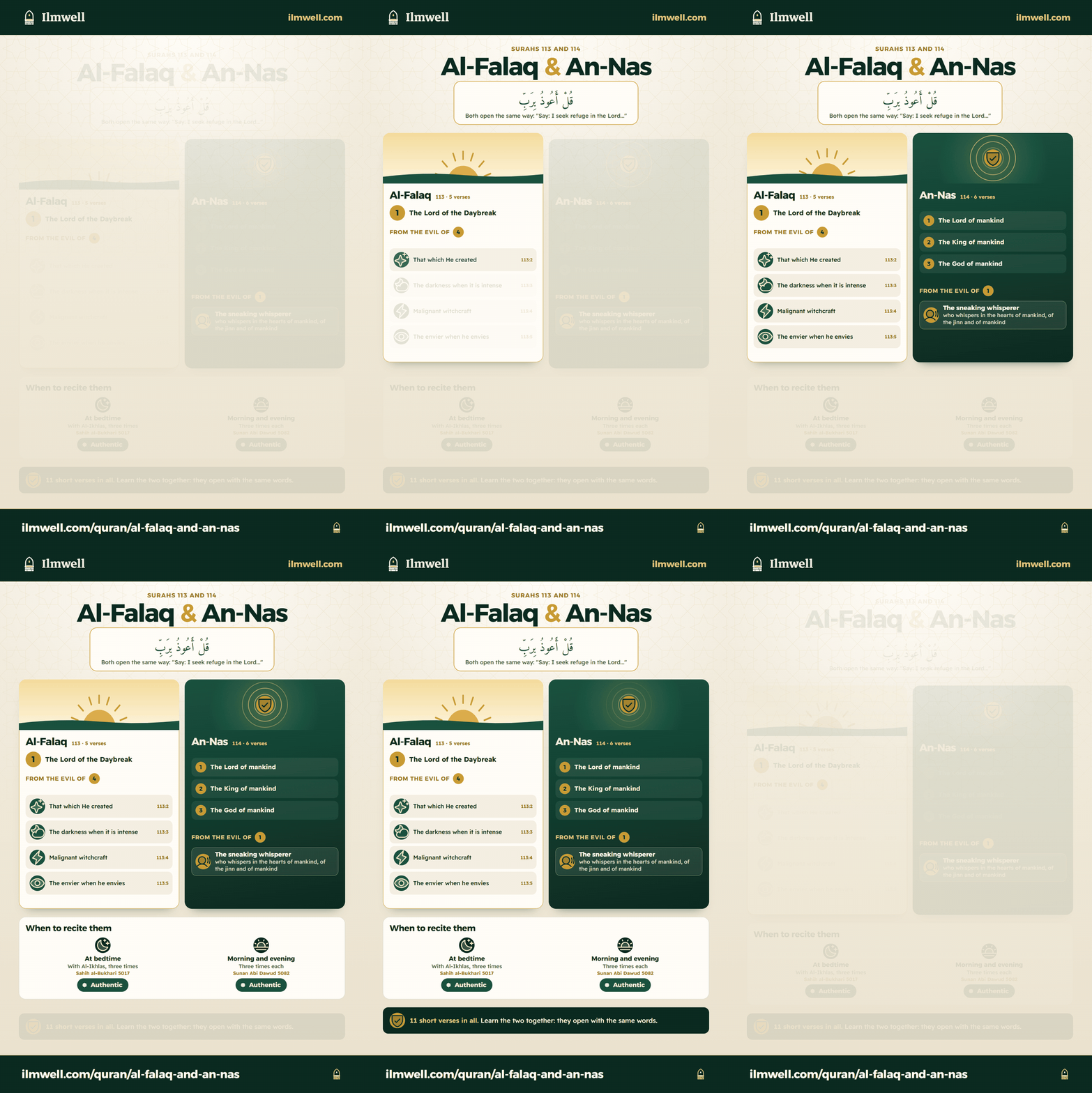
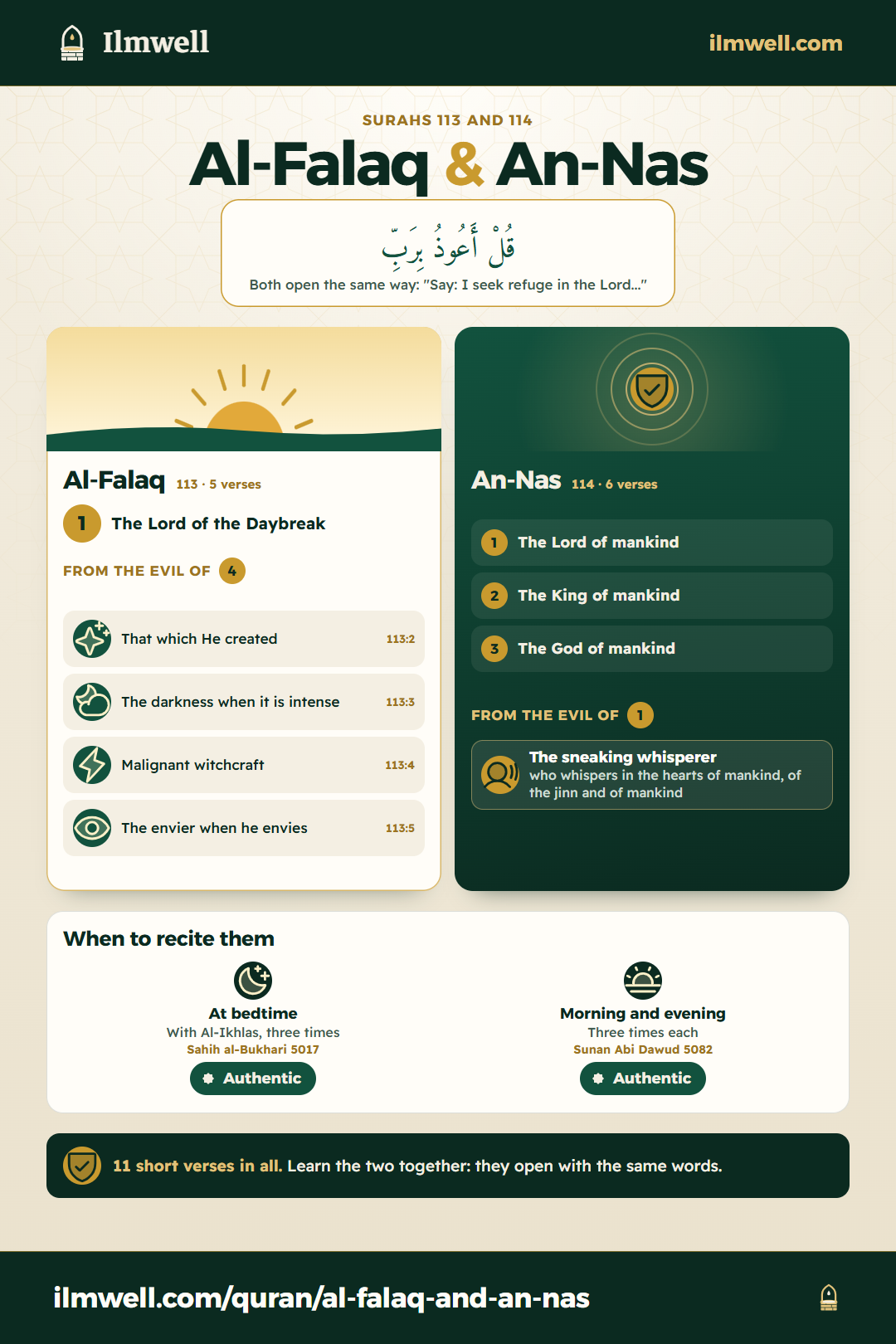
These were the first surahs I learnt, in a mosque classroom in the evenings. I remember being proud of getting them right and slightly bored by the repetition. I am glad now that they were the ones I knew by heart.
Try it: which surah says what?
Four quick questions on the two surahs. Each answer explains itself.
1Which surah asks for refuge from "the evil of the envier when he envies"?
Answer: Al-Falaq. It is the last verse of Al-Falaq (113:5), the fourth of the four evils that surah names.
2In An-Nas, Allah is the Lord of mankind, the King of mankind and the ... of mankind?
Answer: God. Verse 3: ilahin-nas, "the God of mankind". Rabb, malik and ilah: Lord, King and God.
3What does "Qul a'udhu" mean?
Answer: Say: I seek refuge. Qul is "say" and a'udhu is "I seek refuge". Both surahs open with these two words.
4What did the Prophet do with these surahs every night at bedtime?
Answer: Recited them with Al-Ikhlas into his palms, then wiped over his body. Sahih al-Bukhari 5017, graded sahih, reports it: he did that three times. Source 3
What are the benefits of Surah Falaq and Surah Nas?
Six reports about them are graded authentic and one is graded differently, each below with its source and grade. Two use the plural name al-mu'awwidhat, which they do not define. The reports about why the surahs were revealed follow in the next section.
Never seen before
'Uqba ibn 'Amir, may Allah be pleased with him, reported the Prophet's words. "Have you not seen verses revealed tonight, the like of which has never been seen?" he asked, and named them: Qul a'udhu bi rabbil falaq and Qul a'udhu bi rabbin nas.
1AuthenticSahih Muslim 814
'Uqba was also travelling with him between al-Juhfa and al-Abwa' when wind and deep darkness came over them. The Prophet began seeking refuge with the two surahs and said: "'Uqba, seek refuge with them, for no one seeking refuge has sought it with anything like them." 'Uqba heard him lead them in prayer with them too.
2AuthenticSunan Abi Dawud 1463
At bedtime
'Aisha, may Allah be pleased with her, reported that every night, when the Prophet went to bed, he gathered his palms, blew into them and recited into them Al-Ikhlas, Al-Falaq and An-Nas. Then he wiped as much of his body as he could with them, starting with his head, his face and the front of his body. The narration says he did that three times.
3AuthenticSahih al-Bukhari 5017
Morning and evening
Abdullah ibn Khubayb, may Allah be pleased with him, said that on a night of rain and deep darkness they went looking for the Prophet to lead them in prayer. When they found him he asked whether they had prayed, and Abdullah said nothing. The Prophet said "Say", then said it twice more, before Abdullah asked what to say. The answer, in this narration: Qul huwa Allahu ahad and the mu'awwidhatayn, in the evening and the morning, three times; they will suffice you against everything.
4AuthenticSunan Abi Dawud 5082
When ill, and after prayer
'Aisha reported that when the Prophet was ill he recited the mu'awwidhat over himself and blew. When his pain grew severe, she recited over him and wiped with his hand, hoping for its blessing. 'Uqba said the Prophet told him to recite the mu'awwidhat after every prayer. Both narrations use this plural name without listing which surahs it covers.
5AuthenticSahih al-Bukhari 5016
6AuthenticSunan Abi Dawud 1523
A report graded differently says the Prophet sought refuge from the jinn and the human eye until the two surahs were revealed, then took to them and left everything else.
Why were Surah Falaq and Surah Nas revealed?
Sahih Muslim 814 says only that they were revealed "tonight" and gives no reason. Many people link them to the magic worked on the Prophet. The magic itself is in an authentic narration: 'Aisha reported that a man of Banu Zurayq named Labid ibn al-A'sam worked magic on him, until he imagined he had done things he had not done. After he had made dua (personal prayer) again and again, he told her Allah had answered him: two men had come and named the man, what the magic was in and the well where it lay. He said Allah had healed him, and the well was filled in. This narration does not mention the two surahs.
8AuthenticSahih al-Bukhari 5763
The link comes through other reports. One from Zayd ibn Arqam, may Allah be pleased with him, in al-Tahawi's Sharh Mushkil al-Athar, says magic was worked on the Prophet and he fell ill. Jibril (the angel Gabriel) came to him with the mu'awwidhatayn and told him where the magic was. He sent 'Ali, may Allah be pleased with him, who brought it, and told him to untie the knots and recite a verse; he recited and untied until the Prophet stood up as if freed from a tether. It is accepted on the two gradings we found, one of its chain and one of a combined text of its routes.
9AuthenticSharh Mushkil al-Athar 5935
A report from Ibn Abbas, may Allah be pleased with him, adds that a cord with eleven knots was found, the two surahs were revealed, and a knot came undone with each verse he recited. Its chain is graded weak: that detail rests on a weak report.
How do you recite Surah Falaq and Surah Nas?
Both are short enough to learn in a sitting. Read along with the transliteration above, a verse at a time, and slow down for these sounds:
- ʿ in aʿūdhu and al-ʿuqad: a tightening deep in the throat.
- ḥ in ḥāsid and ḥasad: a breathy h from the throat.
- Doubled letters are held: rabbi, sharri, naffāthāti, khannās.
- ṣ in ṣudūr: a heavy s, with the tongue pulled back.
Listen and repeat. A recording by a fluent human reciter is coming. We do not use a synthetic voice for the Quran.
Common mix-ups
- Al-Falaq is surah 113 and An-Nas is 114. An-Nas, not Al-Falaq, is the last surah of the Quran.
- Al-Ikhlas (Qul huwa Allahu ahad) is a separate surah, 112. It is recited with these two in the bedtime and morning narrations; Sahih Muslim 814 names only Al-Falaq and An-Nas.
Questions people ask
What are the three Quls?
A common name for Al-Ikhlas, Al-Falaq and An-Nas, three short surahs that open with qul, "say". The Prophet, peace be upon him, recited the three into his palms every night at bedtime (Sahih al-Bukhari 5017, graded sahih).
Are Surah Falaq and Surah Nas for protection?
They are words of seeking refuge with Allah. In Sunan Abi Dawud 1463, graded sahih or hasan, the Prophet told 'Uqba ibn 'Amir that no one seeking refuge has sought it with anything like them. Reciting them is not medical treatment: if you are unwell, speak to your GP, and for a personal ruling ask a scholar you trust.
Is it Surah Nas or Surah Naas?
Both spellings mean the same surah, An-Nas (mankind). You will also see Surat Nas, Sura Nas, Surah Al Nas and Surah An Nas, and for the other surah Falaq, Surah Al Falaq or Surat al-Falaq.
Sources
Every claim on this page comes from one of these. Gradings are reported with the scholar's name; we do not grade hadith ourselves.
- 1
The Prophet said that verses had been revealed that night the like of which had never been seen: Qul a'udhu bi rabbil falaq and Qul a'udhu bi rabbin nas.
Sahih Muslim 814 Book 6, Hadith 319
Authentic: in Sahih Muslim
- 2
'Uqba ibn 'Amir reported that wind and deep darkness covered them while travelling between al-Juhfa and al-Abwa'. The Prophet sought refuge with A'udhu bi rabbil falaq and A'udhu bi rabbin nas. He told 'Uqba to seek refuge with them, for no one seeking refuge has sought it with anything like them.
Sunan Abi Dawud 1463 Book 8, Hadith 48
Authentic: Sahih (Al-Albani); sahih (Shu'ayb al-Arna'ut); sahih (Al-Albani); sahih through supporting reports (Al-Albani); its chain is sahih through supporting reports (Al-Albani); hasan, as he set out in the introduction (Ibn Hajar al-'Asqalani); hasan (Ibn Muflih). Remarks: silent about it; he said whatever he is silent about is fit (Abu Dawud); silent about it; he said his silence means it is sound when it has no defect ('Abd al-Haqq al-Ishbili); its basis is in Muslim (Ibn Hajar al-'Asqalani); its narrators are trustworthy (Shu'ayb al-Arna'ut)
- 3
'Aisha narrated that every night at bedtime the Prophet gathered his palms, blew into them and recited into them Al-Ikhlas, Al-Falaq and An-Nas, then wiped what he could of his body with them, doing that three times.
Sahih al-Bukhari 5017 Book 66, Hadith 39
Authentic: in Sahih al-Bukhari
- 4
Abdullah ibn Khubayb narrated that on a night of rain and deep darkness the Prophet told him to say Qul huwa Allahu ahad and the mu'awwidhatayn three times, evening and morning. He said they would suffice him against everything.
Sunan Abi Dawud 5082 Book 43, Hadith 310
Authentic: hasan (Al-Albani); its chain is hasan (Shu'ayb al-Arna'ut); hasan (Ibn Hajar al-'Asqalani); its chain is hasan (Ibn Baz); its chain is sahih (Al-Nawawi); hasan, as he set out in the introduction (Ibn Hajar al-'Asqalani); hasan sahih (Al-Albani); sahih (Ibn Daqiq al-'Id); does not fall below hasan, and may meet the conditions of both Sahihs or one of them (Al-Mundhiri); sahih (Al-Albani); hasan sahih, gharib by this route (Al-Tirmidhi); Hasan (Darussalam). Remarks: silent about it; he said whatever he is silent about is fit (Abu Dawud)
- 5
'Aisha reported that when the Prophet was ill he would recite the mu'awwidhat over himself and blow, and when his pain grew severe she recited over him and wiped with his hand, hoping for its blessing.
Sahih al-Bukhari 5016 Book 66, Hadith 38
Authentic: in Sahih al-Bukhari
- 6
'Uqba ibn 'Amir said that the Prophet told him to recite the mu'awwidhat after every prayer.
Sunan Abi Dawud 1523 Book 8, Hadith 108
Authentic: Sahih (Al-Albani); hasan and sahih (Ibn Muflih); sahih (Shu'ayb al-Arna'ut); sahih (Al-Albani); hasan (Muhammad ibn 'Abd al-Wahhab); sahih (Al-Suyuti); a hasan or sahih hadith (Al-Buhuti); hasan gharib (Al-Dhahabi). Remarks: silent about it; he said whatever he is silent about is fit (Abu Dawud)
- 7
Abu Sa'id al-Khudri reported that the Prophet used to seek refuge from the jinn and from the eye of humans until the mu'awwidhatayn were revealed; when they were revealed he took to them and left everything else.
Jami' at-Tirmidhi 2058 Book 28, Hadith 23
Graded differently. Here is who graded it which way:
- SoundAl-Tirmidhi, Ibn Hajar al-'Asqalani, Al-Albani, Al-Suyuti
- WeakDarussalam
- Other remarksAl-Baghawi
See each grading in full, with its wording and where it was given
Scholars disagree about this hadith. Here is how each graded it, so you can follow the scholar you trust.
- Da'if: Darussalam (as shown on sunnah.com)
- حسن غريب (hasan gharib): Al-Tirmidhi, Jami' at-Tirmidhi 2058 (as listed on dorar.net)
- [حسن كما قال في المقدمة] (hasan, as he set out in the introduction): Ibn Hajar al-'Asqalani, Hidayat al-Ruwat 4/282 (as listed on dorar.net)
- صحيح (sahih): Al-Albani, Sahih al-Tirmidhi 2058 (as listed on dorar.net)
- إسناده صحيح (its chain is sahih): Al-Albani, Hidayat al-Ruwat 4488 (as listed on dorar.net)
- صحيح (sahih): Al-Suyuti, al-Jami' al-Saghir 6955 (as listed on dorar.net)
- صحيح (sahih): Al-Albani, Sahih al-Jami' 4902 (as listed on dorar.net)
- حسن (hasan): Al-Albani, al-Kalim al-Tayyib 247 (as listed on dorar.net)
- إسناده غريب (its chain is gharib, singular): Al-Baghawi, Sharh al-Sunna 3/30 (as listed on dorar.net)
- 8
'Aisha reported that Labid ibn al-A'sam, of Banu Zurayq, worked magic on the Prophet until he imagined he had done things he had not done. After long supplication, two men came to him and named the man, the materials and the well. He said Allah had healed him, and the well was filled in.
Sahih al-Bukhari 5763 Book 76, Hadith 77
Authentic: in Sahih al-Bukhari
- 9
A report from Zayd ibn Arqam says that a Jewish man worked magic on the Prophet and he fell ill. Jibril came to him with the mu'awwidhatayn and told him where the magic was. 'Ali was sent to bring it, untied the knots and recited until the Prophet stood up as if freed from a tether.
Sharh Mushkil al-Athar 5935 al-Tahawi, Sharh Mushkil al-Athar 5935, as dorar.net cites it (Shu'ayb al-Arna'ut's numbering)
Authentic: its chain meets the conditions of Muslim (Shu'ayb al-Arna'ut); صحيح (sahih): his combined text of the routes, which includes the line 'Jibril came to him and brought down the mu'awwidhatayn' (Al-Albani)
- 10
A report from Ibn Abbas says that at the end of the story of the magic a cord with eleven knots was found. Al-Falaq and An-Nas were revealed, and each time the Prophet recited a verse a knot came undone.
Fath al-Bari 10/235 Cited by Ibn Hajar al-'Asqalani, Fath al-Bari 10/235, as dorar.net lists it
Weak: its chain is weak (Ibn Hajar al-'Asqalani); its chain is weak (Al-Qastallani). Remarks: its basis has a witness in the Sahih without the revelation of the two surahs, and it has a witness with their revelation (Al-Suyuti)
- Q
Quran Arabic for An-Nas 114:1 to 6 and Al-Falaq 113:1 to 5 (the scrolls, the verse lists and the word cards), without the Bismillah the Tanzil copy prints at the head of verse 1, and their English.
Tanzil Project Uthmani text, CC BY 3.0. English: adapted from Marmaduke Pickthall's translation (1930), modernised and checked against modern translations.
Next
- Al-Ikhlas: meaning, themes and reported virtuesQuran lesson
- Ayat al-Kursi: meaning and reported virtuesQuran lesson
- Surah Fatiha in English: translation, transliteration and meaningQuran lesson
- The last two verses of Surah Baqarah: Arabic, meaning and virtuesQuran lesson
- Bismillah: meaning and when to say it
- Quran and SurahsThe hub
- Dua for the evil eye: beliefs and source contextBelief
For your own situation, ask a scholar you trust.
Join the email list
New guides by email, now and then. No spam, and you can leave at any time.
Ilmwell is free and kept going by readers. See how to support it.