The short answer
Bismillah means "in the name of Allah", the words that open the Quran in Al-Fatihah 1:1. In full, Bismillahir rahmanir rahim means "In the name of Allah, the Beneficent, the Merciful". Muslims say it before eating: the Prophet Muhammad, peace be upon him, said that when one of you eats, he should say Bismillah (Jami' at-Tirmidhi 1858, graded authentic).
How is Bismillah written in Arabic?
Al-Fatihah 1:1
بِسْمِ ٱللَّهِ
bismi llāh
In the name of Allah
The full verse adds two of Allah's names:
Al-Fatihah 1:1
بِسْمِ ٱللَّهِ ٱلرَّحْمَـٰنِ ٱلرَّحِيمِ
bismi llāhi r-raḥmāni r-raḥīm
In the name of Allah, the Beneficent, the Merciful
To copy and paste the Arabic text, use the button under each scroll. The full verse is also written Bismillahirrahmanirrahim, Bismillah hirrahman nirrahim, Bismillah hir rahman nir raheem or Bismillah ar-Rahman ar-Rahim: the same four words.
What does Bismillah mean?
Arabic reads right to left, so the first word is on the right.
- بِسْمِbismiin the name (of)"Bi" (in, with) joined to "ism" (name).
- ٱللَّهِllāhiAllahJoined to the word before: bismi-llāh.
- ٱلرَّحْمَـٰنِar-raḥmānithe BeneficentOne of the names of Allah; Ibn Kathir derives it from rahmah, mercy (source 13).
- ٱلرَّحِيمِar-raḥīmthe MercifulAnother of His names, from the same root (source 13).
How do you pronounce Bismillahir rahmanir rahim?
bismillāhirraḥmānirraḥīm
- mil-lā leans into a doubled l, and the a is long, as in "father".
- ḥ in raḥmān and raḥīm is a breathy h from the throat, stronger than an English h.
- hir-raḥ and nir-ra: the r is doubled, so roll it slightly.
Listen and repeat. A looped recording by a fluent reciter is coming. We do not use a synthetic voice for Arabic.
When do Muslims say Bismillah?
These are moments the narrations name. Say you are about to tuck into a family takeaway: that is the first one.
Before eating
Bismillah
In the name of Allah.
The Prophet also told Umar ibn Abi Salamah, may Allah be pleased with him, a boy whose hand wandered around the dish, to mention Allah's name and eat with his right hand.
1AuthenticJami' at-Tirmidhi 1858
2AuthenticSahih al-Bukhari 5376
If you forgot at the start of a meal
Bismillahi awwalahu wa akhirahu
بِسْمِ اللَّهِ أَوَّلَهُ وَآخِرَهُ
bismillāhi awwalahū wa ākhirah
In the name of Allah, at its beginning and its end.
From a narration of Aisha, may Allah be pleased with her. Jami' at-Tirmidhi 1858 words it "bismillahi fi awwalihi wa akhirihi".
3AuthenticSunan Abi Dawud 3767
1AuthenticJami' at-Tirmidhi 1858
Coming home
Remember Allah as you come in, and at your food
The Prophet said that when a man remembers Allah on entering his house and at his food, the devil says: no place to stay the night for you, and no supper. No fixed words are given.
4AuthenticSahih Muslim 2018
Closing up at night
Mention Allah's name
The Prophet said to close the door, put out the lamp, tie up the waterskin and cover the vessel, mentioning Allah's name with each.
5AuthenticSahih al-Bukhari 3280
When part of your body hurts
Bismillah (three times), and these words seven times:
أَعُوذُ بِاللَّهِ وَقُدْرَتِهِ مِنْ شَرِّ مَا أَجِدُ وَأُحَاذِرُ
a'ūdhu billāhi wa qudratihī min sharri mā ajidu wa uḥādhir
I seek refuge in Allah and His power from the evil of what I feel and what I fear.
The Prophet told Uthman ibn Abi al-As, may Allah be pleased with him, who had a pain in his body, to put his hand on the place and say these words. For pain that lasts, see your GP too.
6AuthenticSahih Muslim 2202
Reciting over someone who is ill
Bismillahi arqika
بِاسْمِ اللَّهِ أَرْقِيكَ مِنْ كُلِّ شَىْءٍ يُؤْذِيكَ مِنْ شَرِّ كُلِّ نَفْسٍ أَوْ عَيْنِ حَاسِدٍ اللَّهُ يَشْفِيكَ بِاسْمِ اللَّهِ أَرْقِيكَ
In the name of Allah I recite over you, from everything that harms you, from the evil of every soul or envious eye. Allah heals you. In the name of Allah I recite over you.
The angel Jibril (Gabriel), peace be upon him, said this to the Prophet when he was ill. Reciting over someone like this is called ruqyah. Also spelt bismillahi arqeek.
7AuthenticSahih Muslim 2186
At the top of a letter
Bismillahir rahmanir rahim
بِسْمِ اللَّهِ الرَّحْمَنِ الرَّحِيمِ. مِنْ مُحَمَّدٍ عَبْدِ اللَّهِ وَرَسُولِهِ إِلَى هِرَقْلَ
The Prophet's letter to Heraclius, "the great one of the Romans", opened with these words, then: from Muhammad, the servant of Allah and His Messenger, to Heraclius.
8AuthenticSahih al-Bukhari 7
What is Bismillahilladhi la yadurru?
A morning and evening dhikr (remembrance) that begins with Bismillah. Uthman ibn Affan, may Allah be pleased with him, reported the Prophet saying that no servant says it three times in the morning of every day and the evening of every night and is then harmed by anything (Jami' at-Tirmidhi 3388). The narration is graded differently.
بِسْمِ اللَّهِ الَّذِي لاَ يَضُرُّ مَعَ اسْمِهِ شَيْءٌ فِي الأَرْضِ وَلاَ فِي السَّمَاءِ وَهُوَ السَّمِيعُ الْعَلِيمُ
bismillāhi lladhī lā yaḍurru maʿa smihī shay'un fi l-arḍi wa lā fi s-samā'i wa huwa s-samīʿu l-ʿalīm
In the name of Allah, with whose name nothing on earth or in the heaven can harm, and He is the All-Hearing, the All-Knowing.
9Graded differently Jami' at-Tirmidhi 3388
Also written bismillahillazi la yadurru ma'asmihi.
Is "every matter not begun with Bismillah is cut off" authentic?
It is graded differently. The report, attributed to Abu Hurayrah, may Allah be pleased with him, says that every important matter not begun with Bismillahir rahmanir rahim is cut off. One grader calls its chain very weak; another says it was narrated mursal (with a link missing) and that a narrator in its chain is criticised; another grades it hasan (acceptable).
كلُّ أمرٍ ذي بالٍ لا يُبدأُ فيهِ ببسمِ اللهِ الرحمنِ الرحيمِ فهو أقطعُ
10Graded differently Irwa' al-Ghalil 1
The narrations graded authentic name particular moments for mentioning Allah's name: meals, coming home, the night, pain. Start with those.
What does Bismillah have to do with halal meat?
Two sources tie Allah's name to food and sacrifice: a verse about eating what Allah's name has been mentioned over, and the Prophet's words at his own sacrifice. In the Quran, Al-An'am 6:118 says:
فَكُلُوا۟ مِمَّا ذُكِرَ ٱسْمُ ٱللَّهِ عَلَيْهِ إِن كُنتُم بِـَٔايَـٰتِهِۦ مُؤْمِنِينَ
When the Prophet sacrificed two rams with his own hand, one narration gives his words as بِاسْمِ اللَّهِ وَاللَّهُ أَكْبَرُ, bismillah wallahu akbar: in the name of Allah, and Allah is the greatest.
11AuthenticSahih Muslim 1966
The rulings of slaughter are not covered here.
Which surah does not start with Bismillah?
Surah At-Tawbah (Surah 9), which begins straight away with بَرَآءَةٌ مِّنَ ٱللَّهِ, "Freedom from obligation (is proclaimed) from Allah". The sources on this page do not say why. Across the 114 surahs of the Tanzil text:
| Surah | Bismillahir rahmanir rahim |
|---|---|
| Al-Fatihah (1) | Verse 1, in the Tanzil numbering |
| At-Tawbah (9) | Not at its head |
| An-Naml (27) | At its head, and again inside verse 30 |
| The other 111 | At the head of the surah |
Which surah has two Bismillahs?
Surah An-Naml (Surah 27). Besides its opening, the words come in verse 30. In 27:29 to 30 the Queen of Sheba says a noble letter has been thrown to her, that it is from Sulayman (Solomon), peace be upon him, and that it is:
إِنَّهُۥ مِن سُلَيْمَـٰنَ وَإِنَّهُۥ بِسْمِ ٱللَّهِ ٱلرَّحْمَـٰنِ ٱلرَّحِيمِ
Bismillah in one picture
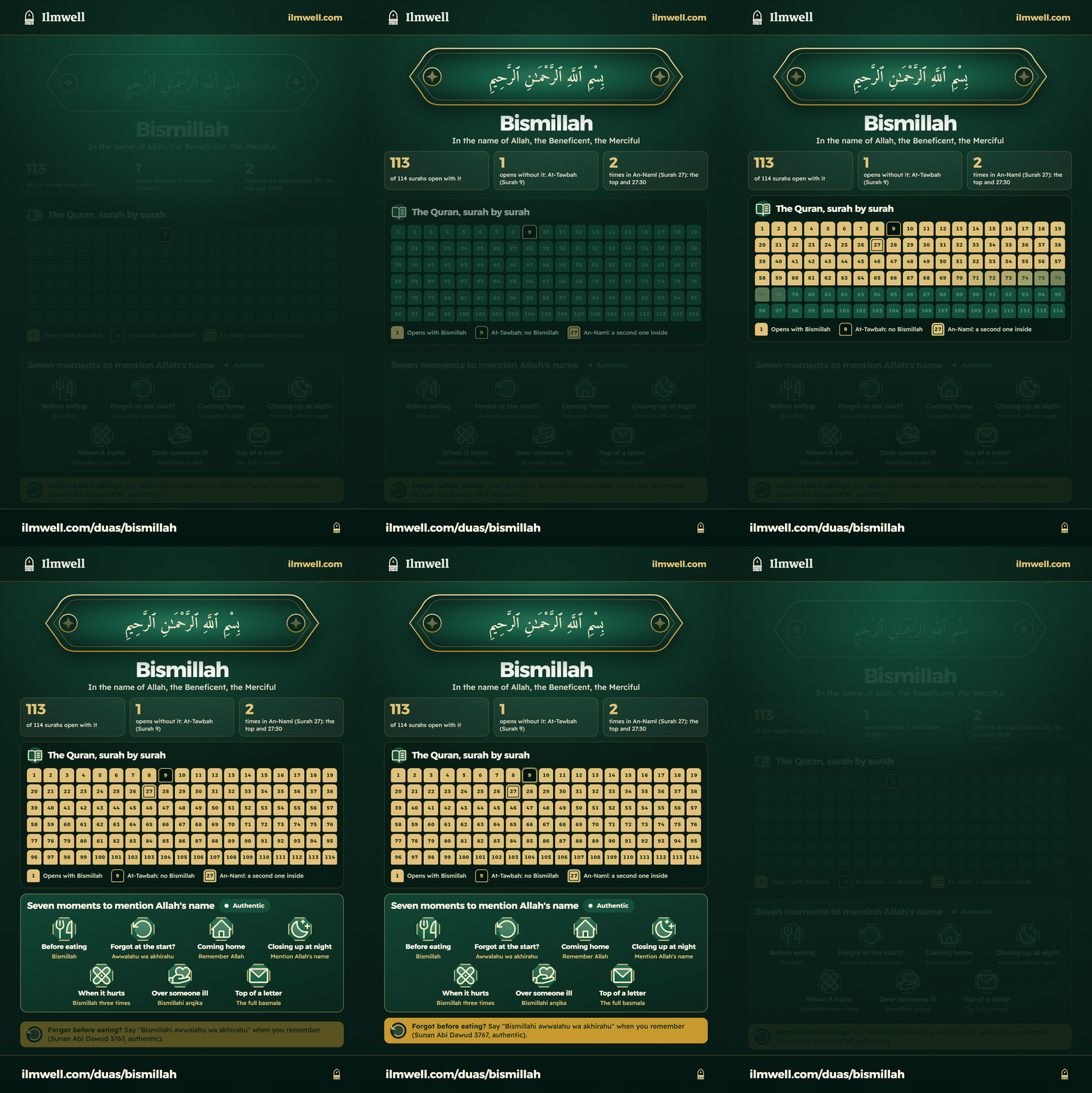
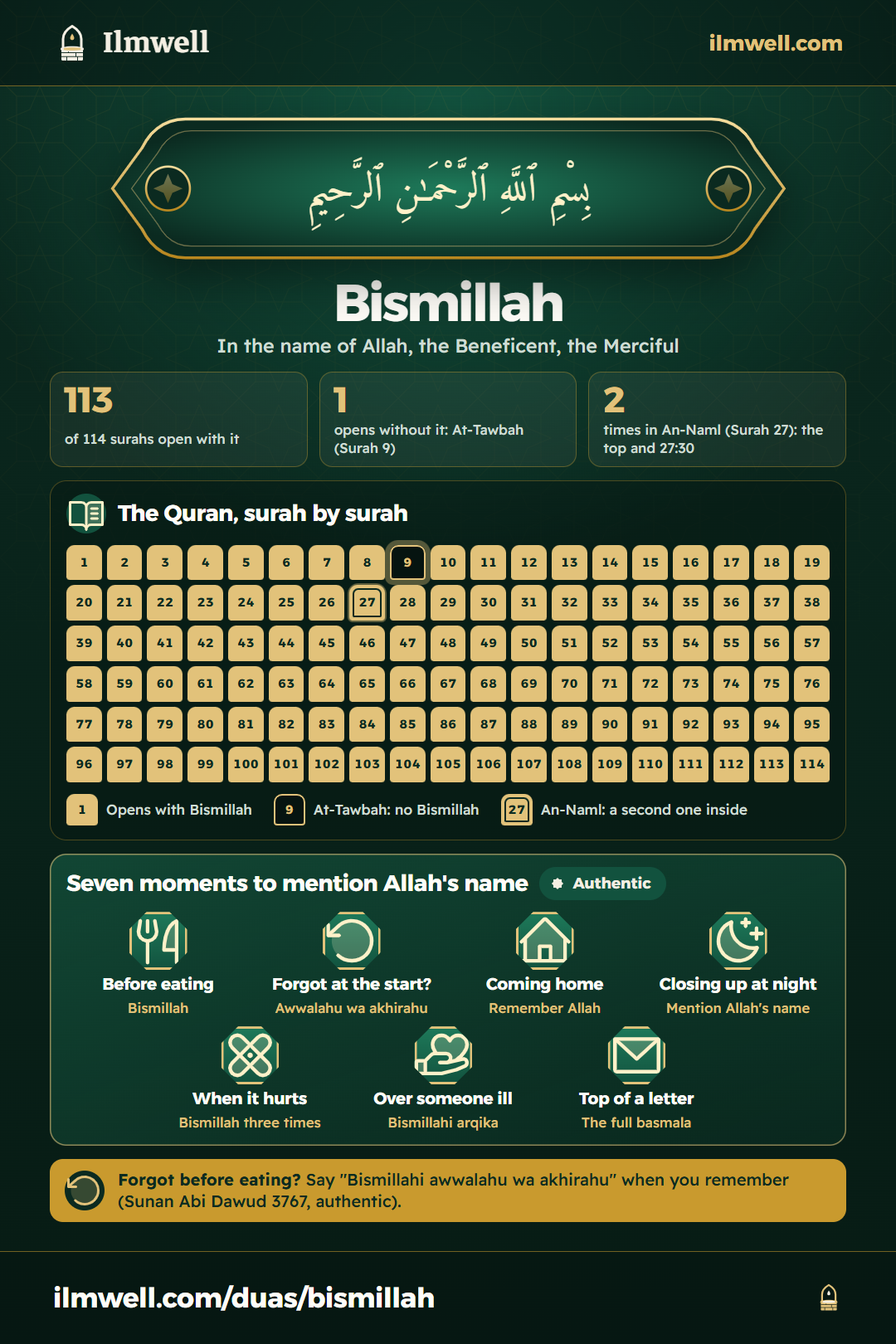
Bismillah infographic: in the name of Allah, the Beneficent, the Merciful. 113 of 114 surahs open with it; one opens without it, At-Tawbah (Surah 9); it comes twice in An-Naml (Surah 27), at the top and in 27:30. A map of all 114 surahs with At-Tawbah dark. Seven moments to mention Allah's name, all graded authentic: before eating; forgot at the start, awwalahu wa akhirahu; coming home, remember Allah; closing up at night, mention Allah's name; when it hurts, Bismillah three times; over someone ill, Bismillahi arqika; at the top of a letter, the full basmala. Forgot before eating? Say Bismillahi awwalahu wa akhirahu when you remember (Sunan Abi Dawud 3767, authentic).
The surah map and the seven moments, in one picture. Save it, print it, or share it.
Posting it on your own site? Link back to this guide; the code under "Use it on your own site" does it in one line.
Is Bismillah part of Al-Fatihah?
Ilmwell follows the Tanzil numbering, where Bismillah is verse 1 of Al-Fatihah; other counts number the verses differently. For more, see the Al-Fatihah lesson and the guide to salah.
My dad used to say Bismillah under his breath before every meal, and before pulling off in the car. I never asked why. Years later I caught myself doing exactly the same thing in the car park at work.
Try it: what would you say?
Three quick questions. Pick an answer; each one explains itself.
1Your food has just arrived and your hand is already reaching for it. What do you say?
Answer: Bismillah. Bismillah, "in the name of Allah", is the word for starting a meal. Source 1
2Part of your body hurts. In Sahih Muslim 2202, what are you told to say three times, with your hand on the place?
Answer: Bismillah. Bismillah three times, and a dua for refuge seven times (Sahih Muslim 2202). Source 6
3Which surah begins without Bismillah?
Answer: At-Tawbah. In the Tanzil text, At-Tawbah (Surah 9) is the only surah that begins without it.
A common mix-up
- "Bismillahi wa 'ala barakatillah" before food: the Ilmwell team searched sunnah.com and dorar.net on 21 October 2026 and found no narration giving these words for a meal (source 12). The narrations give Bismillah, and words for a forgotten start.
Questions people ask
What do you say if you forget to say Bismillah before eating?
Bismillahi awwalahu wa akhirahu: in the name of Allah, at its beginning and its end. It comes from Sunan Abi Dawud 3767, graded hasan or sahih. Jami' at-Tirmidhi 1858, graded authentic, gives it as bismillahi fi awwalihi wa akhirihi.
Sources
Every claim on this page comes from one of these. Gradings are reported with the scholar's name; we do not grade hadith ourselves.
- 1
The Prophet said: when one of you eats food, let him say Bismillah; if he forgets at its beginning, let him say 'Bismillahi fi awwalihi wa akhirihi'.
Jami' at-Tirmidhi 1858 Book 25, Hadith 75
Authentic: Sahih (Darussalam); hasan sahih (At-Tirmidhi); sahih (Al-Albani)
- 2
Umar ibn Abi Salamah, may Allah be pleased with him, said that as a boy in the Prophet's care his hand wandered around the dish, and the Prophet told him: boy, mention Allah's name, eat with your right hand and eat from what is next to you.
Sahih al-Bukhari 5376 Book 70, Hadith 4
Authentic: in Sahih al-Bukhari
- 3
The Prophet said: when one of you eats, let him mention Allah's name; if he forgets to at the beginning, let him say 'Bismillahi awwalahu wa akhirahu'.
Sunan Abi Dawud 3767 Book 28, Hadith 32
Authentic: Sahih (Al-Albani); sahih (Al-Albani); sahih (Shu'ayb al-Arna'ut); hasan, as he states in the introduction (Ibn Hajar al-Asqalani). Remarks: he was silent on it; he said in his letter to the people of Makkah that whatever he was silent on is acceptable (Abu Dawud)
- 4
The Prophet said that when a man enters his house and remembers Allah on entering and at his food, the devil says: no place to stay the night for you, and no supper.
Sahih Muslim 2018 Book 36, Hadith 136
Authentic: in Sahih Muslim
- 5
The Prophet said: when night falls keep your children in, for the devils spread out then; and close your door, put out your lamp, tie up your waterskin and cover your vessel, mentioning Allah's name each time.
Sahih al-Bukhari 3280 Book 59, Hadith 89
Authentic: in Sahih al-Bukhari
- 6
Uthman ibn Abi al-As complained to the Prophet of a pain in his body since he became Muslim, and the Prophet told him to put his hand on the place, say Bismillah three times, and say seven times 'A'udhu billahi wa qudratihi min sharri ma ajidu wa uhadhir'.
Sahih Muslim 2202 Book 39, Hadith 91
Authentic: in Sahih Muslim
- 7
Jibril came to the Prophet and asked if he was ill; he said yes, and Jibril said: 'Bismillahi arqika min kulli shay'in yu'dhika, min sharri kulli nafsin aw 'ayni hasidin, Allahu yashfika, bismillahi arqika'.
Sahih Muslim 2186 Book 39, Hadith 54
Authentic: in Sahih Muslim
- 8
In Abu Sufyan's account of Heraclius, the Prophet's letter to Heraclius opened with 'Bismillahir rahmanir rahim', then 'from Muhammad, the servant of Allah and His Messenger, to Heraclius, the great one of the Romans'.
Sahih al-Bukhari 7 Book 1, Hadith 7
Authentic: in Sahih al-Bukhari
- 9
The Prophet said: no servant says in the morning of every day and the evening of every night 'Bismillahilladhi la yadurru ma'a ismihi shay'un fil-ardi wa la fis-sama'i wa huwas-sami'ul-'alim' three times, and is then harmed by anything.
Jami' at-Tirmidhi 3388 Book 48, Hadith 19
Graded differently. Here is who graded it which way:
- SoundDarussalam, At-Tirmidhi, Al-Albani, Ibn Hajar al-Asqalani, Al-Hakim, Shu'ayb al-Arna'ut
- WeakAl-Nasa'i
See each grading in full, with its wording and where it was given
Scholars disagree about this hadith. Here is how each graded it, so you can follow the scholar you trust.
- Hasan: Darussalam (as shown on sunnah.com)
- حسن صحيح غريب (hasan sahih gharib): At-Tirmidhi, Sunan al-Tirmidhi 3388 (as listed on dorar.net)
- حسن صحيح (hasan sahih): Al-Albani, Sahih al-Tirmidhi 3388 (as listed on dorar.net)
- حسن صحيح (hasan sahih): Ibn Hajar al-Asqalani, Nata'ij al-Afkar 2/367 (as listed on dorar.net)
- صحيح الإسناد (its chain is sahih): Al-Hakim, al-Mustadrak 1919 (as listed on dorar.net)
- إسناده حسن. (its chain is hasan): Shu'ayb al-Arna'ut, takhrij Mushkil al-Athar 3076 (as listed on dorar.net)
- [فيه] عبد الرحمن بن أبي الزناد ضعيف، ويزيد بن فراس مجهول، لا نعرفه (of his own chain, which runs through Yazid ibn Firas: it contains Abd al-Rahman ibn Abi al-Zinad, who is weak, and Yazid ibn Firas, who is unknown): Al-Nasa'i, al-Sunan al-Kubra 10106 (as listed on dorar.net)
- 10
A report attributed to Abu Hurayrah says that every important matter not begun with Bismillahir rahmanir rahim is cut off.
Irwa' al-Ghalil 1 al-Albani, Irwa' al-Ghalil 1 (1/29), where this wording is graded, as dorar.net lists it
Graded differently. Here is who graded it which way:
- SoundAl-'Azim Abadi
- WeakAl-Albani, Al-Zayla'i
- Other remarksAl-Sakhawi
See each grading in full, with its wording and where it was given
Scholars disagree about this hadith. Here is how each graded it, so you can follow the scholar you trust.
- إسناده ضعيف جدا (its chain is very weak): Al-Albani, Irwa' al-Ghalil 1/29 (as listed on dorar.net)
- روي مرسلا وفي إسناده قرة بن عبد الرحمن بن حيويل المعافري وفيه مقال (it was narrated mursal, and its chain has Qurra ibn Abd al-Rahman ibn Hayawil, who is criticised): Al-Zayla'i, takhrij al-Kashshaf 1/24 (as listed on dorar.net)
- حسن (hasan): Al-'Azim Abadi, 'Awn al-Ma'bud 13/82 (as listed on dorar.net)
- غريب وله متابعة (gharib (single-route), and it has a corroborating route): Al-Sakhawi, al-Ajwiba al-Mardiyya 1/189 (as listed on dorar.net)
- 11
The Prophet sacrificed two rams with his own hand, mentioning Allah's name and saying Allahu akbar; in one chain of the narration the words are given as 'bismillah wallahu akbar'.
Sahih Muslim 1966 Book 35, Hadith 27
Authentic: in Sahih Muslim
- Q
Quran Arabic for Al-Fatihah 1:1 (the scrolls and the word cards), Al-An'am 6:118, At-Tawbah 9:1 and An-Naml 27:29 to 30, and their English; the surah count is made from the same text.
Tanzil Project Uthmani text, CC BY 3.0. English: adapted from Marmaduke Pickthall's translation (1930), modernised and checked against modern translations.
- 12
The Ilmwell team's search of sunnah.com and dorar.net on 21 October 2026 found no narration giving 'bismillahi wa 'ala barakatillah' as words to say before eating. A search finding, not a grading.
dorar.net hadith encyclopedia Record: search-bismillah-barakatillah.
- 13
Ibn Kathir on the basmala: al-Rahman and al-Rahim are two names derived from al-rahmah (mercy), in an intensive form, al-Rahman the more intensive. He also reports that some held the name is not derived.
Tafsir al-Qur'an al-'Azim (Tafsir Ibn Kathir), ed. al-Salamah, Dar Tayba, vol. 1, p. 124 Read on 22 October 2026. Record: scholarly-ibnkathir-rahman-name.
Next
For your own situation, ask a scholar you trust.
Join the email list
New guides by email, now and then. No spam, and you can leave at any time.
Ilmwell is free and kept going by readers. See how to support it.