The short answer
Islamic dream interpretation is a subject with clear sources and clear limits. The Quran tells of Yusuf (Joseph), peace be upon him, and his dream (12:4), and Sahih Muslim 2263a sorts dreams into three kinds. The reports below are set out without interpreting any dream.
What we do not do here
- Interpret your dream, or anyone else's.
- Give a symbol list, or say what an object, animal, person or number in a dream stands for.
- Repeat an interpretation from a hadith, or attribute an interpretation book to any named scholar.
- Diagnose a sleep problem, a fear or a distress as spiritual or supernatural.
- Turn an action described in a report into a ritual step.
What kinds of dreams do the hadith describe?
Abu Hurayrah, may Allah be pleased with him, reports that the Prophet Muhammad, peace be upon him, divided dreams into three kinds (source 1). The first is a good dream, which is good tidings from Allah. The second is a dream that saddens, which comes from Satan. The third is a dream from what a person's own mind is occupied with.
1AuthenticSahih Muslim 2263a
Sahih Muslim 2263a
وَالرُّؤْيَا ثَلاَثَةٌ فَرُؤْيَا الصَّالِحَةِ بُشْرَى مِنَ اللَّهِ وَرُؤْيَا تَحْزِينٌ مِنَ الشَّيْطَانِ وَرُؤْيَا مِمَّا يُحَدِّثُ الْمَرْءُ نَفْسَهُ
Our rendering: the good dream is tidings from Allah; the dream that saddens is from Satan; and one kind comes from what a person's own mind is occupied with.
A person who sees something he dislikes, the report continues, should stand up and pray and should not relate it to people (source 1). It does not say how long to pray or what to pray. Whether prayer is a required step is a question for a scholar you trust.
The same report calls a Muslim's dream a part of prophecy. We take that wording as it stands and draw no conclusion from it about any particular dream.
Near its end, the report includes a remark about an image seen in a dream. The narrator says he is not sure that remark belongs to the report, so we do not use it.
These are categories from one report, not a method for reading dreams. They do not say which category any particular dream belongs to.
What does the Quran report about the dream of Yusuf, peace be upon him?
Yusuf, peace be upon him, told his father about a dream he had (12:4). Later in the same story, he says that this was the interpretation of that earlier dream, and that his Lord made it come true (12:100) (source 7).
Yusuf 12:4
إِذْ قَالَ يُوسُفُ لِأَبِيهِ يَـٰٓأَبَتِ إِنِّى رَأَيْتُ أَحَدَ عَشَرَ كَوْكَبًا وَٱلشَّمْسَ وَٱلْقَمَرَ رَأَيْتُهُمْ لِى سَـٰجِدِينَ
When Joseph said to his father: O my father! Indeed, I saw in a dream eleven planets and the sun and the moon, I saw them prostrating themselves to me.
Yusuf 12:100
وَرَفَعَ أَبَوَيْهِ عَلَى ٱلْعَرْشِ وَخَرُّوا۟ لَهُۥ سُجَّدًا ۖ وَقَالَ يَـٰٓأَبَتِ هَـٰذَا تَأْوِيلُ رُءْيَـٰىَ مِن قَبْلُ قَدْ جَعَلَهَا رَبِّى حَقًّا ۖ وَقَدْ أَحْسَنَ بِىٓ إِذْ أَخْرَجَنِى مِنَ ٱلسِّجْنِ وَجَآءَ بِكُم مِّنَ ٱلْبَدْوِ مِنۢ بَعْدِ أَن نَّزَغَ ٱلشَّيْطَـٰنُ بَيْنِى وَبَيْنَ إِخْوَتِىٓ ۚ إِنَّ رَبِّى لَطِيفٌ لِّمَا يَشَآءُ ۚ إِنَّهُۥ هُوَ ٱلْعَلِيمُ ٱلْحَكِيمُ
And he placed his parents on the dais and they fell down before him prostrate, and he said: O my father! This is the interpretation of my dream of old. My Lord has made it true, and He has shown me kindness, since He took me out of the prison and has brought you from the desert after Satan had made strife between me and my brethren. Indeed, my Lord is tender to whom He will. He is the Knower, the Wise.
This is a Quranic account with its own context. It is not a method for reading other people's dreams, and we do not treat any detail of Yusuf's dream as a symbol with a fixed meaning.
What should I do after a dream I dislike?
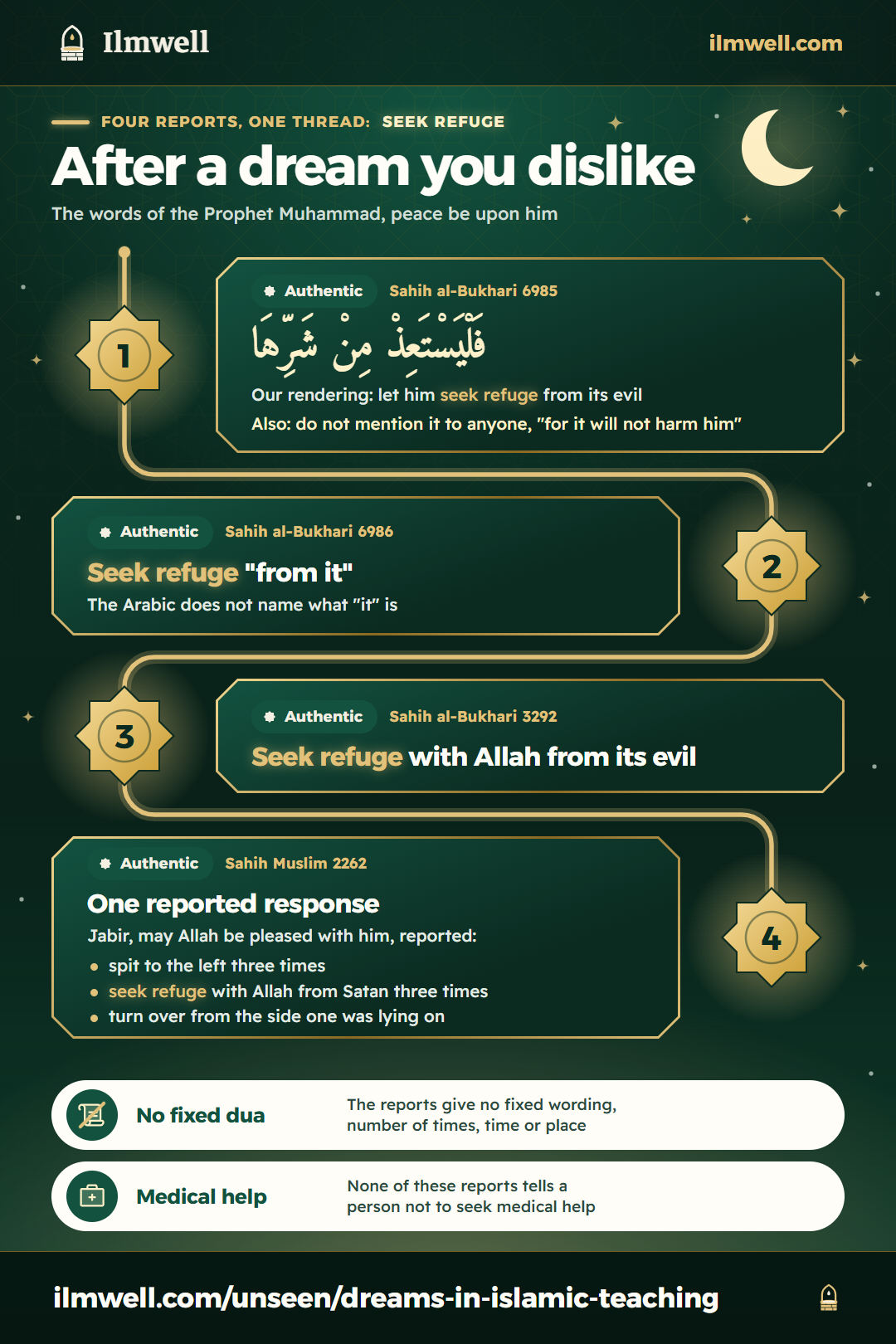
Sahih al-Bukhari 6985 says that a dream a person likes is from Allah, so he should praise Allah for it and tell it. A dream he dislikes is from Satan, so he should seek refuge from its evil and not mention it to anyone, "for it will not harm him" (source 2).
2AuthenticSahih al-Bukhari 6985
Sahih al-Bukhari 6985
فَلْيَسْتَعِذْ مِنْ شَرِّهَا
Our rendering: let him seek refuge from its evil.
None of these reports mentions doctors, and none tells a person not to seek medical help. The NHS advice on regular nightmares is below. If you are unsure how the advice about not mentioning a disliked dream fits with talking to a GP, a scholar you trust can advise.
Two further reports also tell a person to seek refuge: Sahih al-Bukhari 6986 (source 3) and 3292 (source 5).
3AuthenticSahih al-Bukhari 6986
5AuthenticSahih al-Bukhari 3292
Sahih al-Bukhari 6986
فَإِذَا حَلَمَ فَلْيَتَعَوَّذْ مِنْهُ
Our rendering: if he dreams it, he should seek refuge from it.
In 6986 the Arabic says to seek refuge "from it" (minhu) without naming what "it" is; the sunnah.com English gives "from Satan". Both reports also describe spitting to the left. We report that wording as it stands and do not set it out as a ritual step; a teacher you trust can explain it.
Jabir, may Allah be pleased with him, reported the Prophet describing one response to a disliked dream in Sahih Muslim 2262 (source 6). In Sahih Muslim 2262 the response is to spit to the left three times, seek refuge with Allah from Satan three times, and turn over from the side one was lying on. It is one reported response. We do not set it out as a checklist, and whether any step is required is a question for a scholar you trust.
6AuthenticSahih Muslim 2262

Is there a dua for bad dreams or nightmares?
Three of the reports cited here tell a person to seek refuge after a disliked dream: from its evil (source 2), "from it" (source 3), and with Allah from its evil (source 5). They give no fixed Arabic wording, no number of times to repeat it, and no set time or place. Sahih Muslim 2262 adds seeking refuge with Allah from Satan three times, also without a fixed wording (source 6).
So we give no Arabic supplication for bad dreams or nightmares. If you want one, learn it from a teacher you trust and check its source and grading first. The report about the disliked dream says it "will not harm him" (source 2). We do not extend that to any other outcome.
Can a book or website tell me what my dream means?
The sources cited here do not support that kind of answer. Yusuf's dream is part of a Quranic account (source 7). The hadith here name kinds of dream and responses to them, not meanings (sources 1 to 5).
Symbol lists often claim an early interpreter as their author. We have not checked any such claim, so we cite no interpretation book and attribute no list to anyone.
The next section gives a reported case in which an interpretation offered in the Prophet's presence was only partly right.
What does the reported exchange of interpretation show?
Ibn Abbas, may Allah be pleased with them both, reports that a man told the Prophet about a dream, and Abu Bakr, may Allah be pleased with him, asked to interpret it. The Prophet said that he was right about some of it and wrong about some of it (source 4). When Abu Bakr asked which part was wrong, the report gives only the answer "Do not swear".
4AuthenticSahih al-Bukhari 7046
Sahih al-Bukhari 7046
أَصَبْتَ بَعْضًا وَأَخْطَأْتَ بَعْضًا
Our rendering: you were right about some of it and wrong about some of it.
We do not repeat the interpretation that Abu Bakr gave, and we do not work out which part was wrong, because the report does not say.
Even when an interpretation is given in the Prophet's presence, the report shows it can be only partly right. A reader today has no such check, which is why we leave interpretation alone.
When should frequent nightmares be checked?
The NHS advises seeing a GP if you have regular nightmares that affect your sleep and everyday life (source 8). For most people, it says, nightmares get better on their own. Psychological therapies such as cognitive behavioural therapy can help adults who have frequent nightmares.
Not medical advice
We report what the sources say. We do not diagnose, and we do not say whether any particular dream, fear or sleep problem has a spiritual or supernatural cause.
For regular nightmares, or any worry about sleep or mood, see your GP. Call NHS 111 for urgent advice, and 999 in an emergency. Do not stop or change prescribed treatment because of anything you read here.
Religious counsel can sit alongside that care. A scholar you trust can advise you on your own situation, which we cannot do.
A friend rang me early one morning, worried about a dream she had had about her mum. I did not know what to tell her, and I did not pretend to. We talked it through, and later I looked up what the sources say about dreams before saying anything more.
Practice
- Which of the three kinds in Sahih Muslim 2263a comes from a person's own mind? The third kind (source 1).
- After a disliked dream, what does Sahih al-Bukhari 6985 advise about telling it? Not to mention it to anyone (source 2).
- Does Sahih al-Bukhari 7046 say which part of the interpretation was wrong? No. It gives only "Do not swear" (source 4).
Questions people ask about dream meaning
Does a bad dream mean something will happen?
The reports here tell a person how to respond to a disliked dream. They do not authorise a prediction about any future event (sources 1 to 5).
Is every good dream a message from Allah?
A liked dream is said to be from Allah in Sahih al-Bukhari 6985 (source 2). We cannot certify any dream as a message, and we do not turn a dream into a rule.
Can I tell someone about my dream?
Telling is covered in Sahih al-Bukhari 6985: tell a liked dream, and do not mention a disliked one to anyone (source 2). None of the reports here mentions doctors or tells a person not to seek medical help. The NHS advises seeing a GP about regular nightmares (source 8). If you are unsure how the two fit together, ask a scholar you trust.
Sources
Every claim here comes from one of these. Gradings are reported with the scholar's name; we do not grade hadith ourselves. Hadith texts were read on sunnah.com on 28 October 2026 (Sahih Muslim 2262 and 2263a, Sahih al-Bukhari 6985, 6986 and 7046) and 24 October 2026 (3292), and stored in each record. Each grading was also searched on dorar.net, which returns up to fifteen results per search. The English in quotation marks is the sunnah.com translation, except "from it" in source 3, which is our rendering of the Arabic. Three of these reports describe spitting to the left: source 6 is given as one brief reported response, and sources 3 and 5 as wording only. None is set out as a ritual step.
- 1
Abu Hurayrah reported that the Prophet Muhammad, peace be upon him, said that dreams are of three kinds: a good dream that is good tidings from Allah, a distressing dream from the Shaytan, and a dream from what a person's own mind is occupied with; and that whoever sees what he dislikes should stand and pray and not relate it to people.
Sahih Muslim 2263a Book 42, Hadith 9
Authentic: in Sahih Muslim (Muslim); sahih (Muslim)
- 2
Abu Sa'id al-Khudri, may Allah be pleased with him, reported that the Prophet Muhammad, peace be upon him, said that a dream a person likes is from Allah, so he should praise Allah for it and may tell it; and that a dream he dislikes is from the Shaytan, so he should seek refuge from its evil and not mention it to anyone, for it will not harm him.
Sahih al-Bukhari 6985 Book 91, Hadith 4
Authentic: in Sahih al-Bukhari (Al-Bukhari); sahih (Al-Bukhari); its chain is sahih, or hasan, or close to them (Al-Mundhiri); sahih on the conditions of the two Shaykhs, though they did not include it (Al-Hakim); its chain is sahih on the conditions of the two Shaykhs (Shu'ayb al-Arna'ut); sahih (Al-Albani). Remarks: a remark: a single transmission line (Al-Daraqutni)
- 3
Abu Qatada, may Allah be pleased with him, reported that the Prophet Muhammad, peace be upon him, said that the good dream is from Allah and the bad dream from the Shaytan; that whoever has a bad dream should seek refuge from it and spit to his left, and it will not harm him.
Sahih al-Bukhari 6986 Book 91, Hadith 5
Authentic: in Sahih al-Bukhari (Al-Bukhari); sahih (Al-Bukhari)
- 4
Ibn Abbas, may Allah be pleased with them both, reported that a man told the Prophet Muhammad, peace be upon him, about a dream of a cloud dripping ghee and honey and of a rope from earth to sky; Abu Bakr, may Allah be pleased with him, asked to interpret it; the Prophet said he was right about some of it and wrong about some of it; when Abu Bakr asked which part was wrong, the report gives only the answer "Do not swear".
Sahih al-Bukhari 7046 Book 91, Hadith 60
Authentic: in Sahih al-Bukhari (Al-Bukhari); sahih (Al-Bukhari); its chain is sahih on the conditions of al-Bukhari (Shu'ayb al-Arna'ut); its chain is sahih on the conditions of the two Shaykhs (Shu'ayb al-Arna'ut); included in his Sahih (Ibn Hibban); its chain is sahih on the conditions of Muslim (Shu'ayb al-Arna'ut). Remarks: a remark: strange from his narration (Al-Daraqutni)
- 5
Abu Qatada reported that the Prophet said a good dream is from Allah and a bad dream from the shaytan, and that someone who has a bad dream he fears should spit on his left side and seek refuge with Allah from its evil, and then it will not harm him.
Sahih al-Bukhari 3292 Book 59, Hadith 101
Authentic: in Sahih al-Bukhari
- 6
Jabir ibn Abd Allah reported the Prophet saying that when a person sees a dream he dislikes, he should spit to his left three times, seek refuge with Allah from Satan three times, and turn over from the side on which he was lying.
Sahih Muslim 2262 Book 42, Hadith 8
Authentic: in Sahih Muslim (Muslim); sahih (Muslim); he included it in his Sahih (Ibn Hibban); its chain is sahih (Shu'ayb al-Arna'ut); its chain is sahih on the conditions of the two Shaykhs (Shu'ayb al-Arna'ut); sahih (al-Albani); sahih (Ibn al-Mulaqqin)
- 7
Yusuf tells his father about a dream (12:4), and later says it is the interpretation of that earlier dream, which his Lord made come true (12:100).
Quran, Yusuf 12:4 and 12:100 Arabic from the Tanzil copy. English: adapted from Marmaduke Pickthall's translation (1930), modernised and checked against modern translations.
- 8
The NHS advises seeing a GP about regular nightmares that affect sleep and everyday life, and says that psychological therapies such as cognitive behavioural therapy (CBT) can help adults who have frequent nightmares.
NHS, Night terrors and nightmares Read 28 October 2026; the page says it was last reviewed 24 November 2025. A paraphrase. The NHS page also covers night terrors in children, which we do not use.
Next
For your own situation, ask a scholar you trust.
Join the email list
New guides by email, now and then. No spam, and you can leave at any time.
Ilmwell is free and kept going by readers. See how to support it.