The short answer
Jannah is the Arabic word for the Garden the Quran promises to those who believe and do good works (Al-Baqarah 2:82). The Prophet Muhammad, peace be upon him, reported Allah's words that He has prepared what no eye has seen (Sahih al-Bukhari 3244, graded sahih, meaning authentic).
What is Jannah in Islam?
Here is the word jannah as the Quran writes it in Al-Baqarah 2:82, a verse that says who the Garden belongs to:
ٱلْجَنَّةِ
وَٱلَّذِينَ ءَامَنُوا۟ وَعَمِلُوا۟ ٱلصَّـٰلِحَـٰتِ أُو۟لَـٰٓئِكَ أَصْحَـٰبُ ٱلْجَنَّةِ ۖ هُمْ فِيهَا خَـٰلِدُونَ
At-Tawbah 9:72 says it of men and women:
وَعَدَ ٱللَّهُ ٱلْمُؤْمِنِينَ وَٱلْمُؤْمِنَـٰتِ جَنَّـٰتٍ تَجْرِى مِن تَحْتِهَا ٱلْأَنْهَـٰرُ خَـٰلِدِينَ فِيهَا
The dictionary of Ibn Faris (died 395 AH), Mu'jam Maqayis al-Lughah, says the root of the word, j-n-n, means covering or concealment. He says al-jannah is what the Muslims go to in the hereafter, a reward hidden from them today, and that it also means a garden, because trees cover with their leaves 10.
You will also see Jannah called Paradise or heaven in English. The translation on this site renders it "the Garden", and as "paradise" in verses such as 3:133 and 18:107. This page keeps the Arabic word.
The Quran also pairs jannat with a second word:
| Arabic | Said | In our translation (adapted from Pickthall) | Verse |
|---|---|---|---|
| جَنَّـٰتِ عَدْنٍ | jannāt ʿadn | Gardens of Eden | At-Tawbah 9:72 |
| جَنَّـٰتُ ٱلْفِرْدَوْسِ | jannāt al-firdaws | the Gardens of Paradise | Al-Kahf 18:107 |
The word al-Firdaus also appears in a hadith below, which tells people to ask for it by name.
What does the Quran say Jannah is like?
In the Quran the descriptions are short, and each comes in the Quran's own words.
Gardens and rivers
Al-Baqarah 2:25 tells the Prophet to give glad tidings to those who believe and do good works:
لَهُمْ جَنَّـٰتٍ تَجْرِى مِن تَحْتِهَا ٱلْأَنْهَـٰرُ
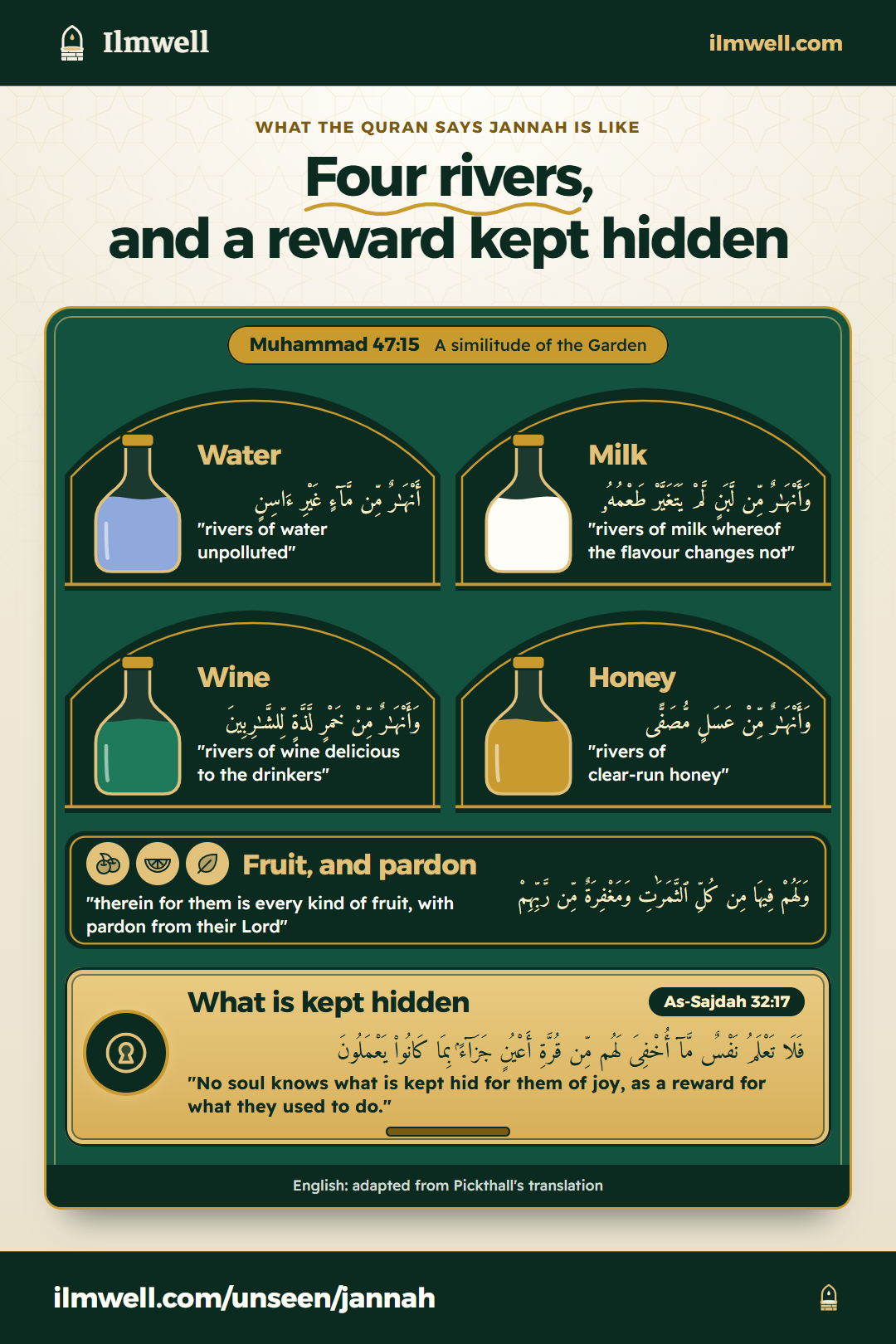
Muhammad 47:15 begins "A similitude of the Garden" promised to those who keep their duty to Allah, and lists what is in it:
| Arabic | In our translation (adapted from Pickthall) |
|---|---|
| أَنْهَـٰرٌ مِّن مَّآءٍ غَيْرِ ءَاسِنٍ | rivers of water unpolluted |
| وَأَنْهَـٰرٌ مِّن لَّبَنٍ لَّمْ يَتَغَيَّرْ طَعْمُهُۥ | rivers of milk whereof the flavour changes not |
| وَأَنْهَـٰرٌ مِّنْ خَمْرٍ لَّذَّةٍ لِّلشَّـٰرِبِينَ | rivers of wine delicious to the drinkers |
| وَأَنْهَـٰرٌ مِّنْ عَسَلٍ مُّصَفًّى | rivers of clear-run honey |
| وَلَهُمْ فِيهَا مِن كُلِّ ٱلثَّمَرَٰتِ وَمَغْفِرَةٌ مِّن رَّبِّهِمْ | therein for them is every kind of fruit, with pardon from their Lord |
What is hidden
As-Sajdah 32:17 says that what is kept hidden for them is known to no soul:
فَلَا تَعْلَمُ نَفْسٌ مَّآ أُخْفِىَ لَهُم مِّن قُرَّةِ أَعْيُنٍ جَزَآءًۢ بِمَا كَانُوا۟ يَعْمَلُونَ
How the people of Jannah are described
Al-Hijr 15:45 to 48 speaks of those who ward off evil:
إِنَّ ٱلْمُتَّقِينَ فِى جَنَّـٰتٍ وَعُيُونٍ ٱدْخُلُوهَا بِسَلَـٰمٍ ءَامِنِينَ وَنَزَعْنَا مَا فِى صُدُورِهِم مِّنْ غِلٍّ إِخْوَٰنًا عَلَىٰ سُرُرٍ مُّتَقَـٰبِلِينَ لَا يَمَسُّهُمْ فِيهَا نَصَبٌ وَمَا هُم مِّنْهَا بِمُخْرَجِينَ
In the verses' own words: they are told to enter in peace, secure; rancour is removed from their breasts; toil does not come to them there; and they will not be expelled.
Who it is prepared for
Al Imran 3:133 to 136 speaks of a paradise as wide as the heavens and the earth, prepared for those who ward off evil, and then describes them:
۞ وَسَارِعُوٓا۟ إِلَىٰ مَغْفِرَةٍ مِّن رَّبِّكُمْ وَجَنَّةٍ عَرْضُهَا ٱلسَّمَـٰوَٰتُ وَٱلْأَرْضُ أُعِدَّتْ لِلْمُتَّقِينَ ٱلَّذِينَ يُنفِقُونَ فِى ٱلسَّرَّآءِ وَٱلضَّرَّآءِ وَٱلْكَـٰظِمِينَ ٱلْغَيْظَ وَٱلْعَافِينَ عَنِ ٱلنَّاسِ ۗ وَٱللَّهُ يُحِبُّ ٱلْمُحْسِنِينَ وَٱلَّذِينَ إِذَا فَعَلُوا۟ فَـٰحِشَةً أَوْ ظَلَمُوٓا۟ أَنفُسَهُمْ ذَكَرُوا۟ ٱللَّهَ فَٱسْتَغْفَرُوا۟ لِذُنُوبِهِمْ وَمَن يَغْفِرُ ٱلذُّنُوبَ إِلَّا ٱللَّهُ وَلَمْ يُصِرُّوا۟ عَلَىٰ مَا فَعَلُوا۟ وَهُمْ يَعْلَمُونَ أُو۟لَـٰٓئِكَ جَزَآؤُهُم مَّغْفِرَةٌ مِّن رَّبِّهِمْ وَجَنَّـٰتٌ تَجْرِى مِن تَحْتِهَا ٱلْأَنْهَـٰرُ خَـٰلِدِينَ فِيهَا ۚ وَنِعْمَ أَجْرُ ٱلْعَـٰمِلِينَ
Verse 134 names those who spend in ease and in adversity, control their wrath and forgive people. Verse 135 names those who remember Allah and ask forgiveness for their sins after doing wrong, and do not knowingly repeat it. Verse 136 gives their reward: forgiveness from their Lord, and Gardens underneath which rivers flow, where they will abide for ever.

What do the hadith add about Jannah?
Three reports add to the Quran's words, each with its collection, number and grade.
What no eye has seen
Abu Hurayrah, may Allah be pleased with him, reported that the Prophet said Allah said this of what He has prepared for His righteous servants (Sahih al-Bukhari 3244, graded sahih):
Sahih al-Bukhari 3244
أَعْدَدْتُ لِعِبَادِي الصَّالِحِينَ مَا لاَ عَيْنَ رَأَتْ، وَلاَ أُذُنَ سَمِعَتْ، وَلاَ خَطَرَ عَلَى قَلْبِ بَشَرٍ
aʿdadtu li-ʿibādī ṣ-ṣāliḥīn mā lā ʿayna raʾat, wa lā udhuna samiʿat, wa lā khaṭara ʿalā qalbi bashar
I have prepared for My righteous servants what no eye has seen, no ear has heard, and no human heart has conceived.
1AuthenticSahih al-Bukhari 3244
Sahih Muslim 2824, graded sahih, has the same report. Both narrations go on to the words of As-Sajdah 32:17, quoted above.
2AuthenticSahih Muslim 2824
A hundred degrees, and al-Firdaus
Abu Hurayrah also reported that the Prophet said Paradise has a hundred degrees that Allah has prepared for the mujahidin, those who strive in His way. The distance between two degrees is like the distance between the heaven and the earth. He said: when you ask Allah, ask Him for al-Firdaus, for it is the awsat (the middle, or best) of Paradise and its a'la (the highest) (Sahih al-Bukhari 2790, graded sahih).
The narration gives no list of the degrees. It also carries a further line, introduced by the narrator's "I think", about the Throne of al-Rahman above al-Firdaus and the rivers of Paradise bursting forth from it. The report does not put that line in the Prophet's mouth, and a variant from Muhammad ibn Fulayh's father gives the Throne line without "I think".
3AuthenticSahih al-Bukhari 2790
Eight gates
Sahl ibn Sa'd, may Allah be pleased with him, reported the Prophet's words on the gates of Paradise (Sahih al-Bukhari 3257, graded sahih):
Sahih al-Bukhari 3257
فِي الْجَنَّةِ ثَمَانِيَةُ أَبْوَابٍ، فِيهَا باب يُسَمَّى الرَّيَّانَ لاَ يَدْخُلُهُ إِلاَّ الصَّائِمُونَ
fī l-jannati thamāniyatu abwāb, fīhā bābun yusammā r-rayyāna lā yadkhuluhu illā ṣ-ṣāʾimūn
Paradise has eight gates, and among them is a gate called al-Rayyan; only the fasting enter it.
4AuthenticSahih al-Bukhari 3257
The report names one gate and not the other seven. The others are on our page on the gates of Jannah.
How far do the sources go?
This page keeps to what the sources say. Al-Baqarah 2:25 also says of the fruit:
كُلَّمَا رُزِقُوا۟ مِنْهَا مِن ثَمَرَةٍ رِّزْقًا ۙ قَالُوا۟ هَـٰذَا ٱلَّذِى رُزِقْنَا مِن قَبْلُ ۖ وَأُتُوا۟ بِهِۦ مُتَشَـٰبِهًا
Ibn Kathir, in his Quran commentary Tafsir al-Qur'an al-'Azim, on that verse, reports that Ibn Abbas, may Allah be pleased with him, said that nothing in Paradise resembles what is in this world except in names 11. It is one saying from one Companion on this verse, Ibn Kathir gives other sayings in the same place, and he gives no grade for this one there.
This page does not cover who will be with whom in Jannah, its levels or its other gates. The Quran and hadith do speak to some of these: see family in Jannah, the levels of Jannah and the gates of Jannah. If you are grieving someone, a scholar you trust can speak to your situation.
How is Jannah entered?
Abu Hurayrah reported hearing the Prophet say that no one's deeds will make him enter Paradise. The companions asked: not even you, Messenger of Allah? He said: not even I, unless Allah covers me with favour and mercy. The narration goes on to advise moderation in deeds and not to wish for death (Sahih al-Bukhari 5673, graded sahih).
5AuthenticSahih al-Bukhari 5673
Sahih Muslim 2816a, graded sahih, has a similar exchange with a different verb: no one's deeds will save (yunjiya) any of you, and not even the Prophet, unless Allah covers him with mercy. One of its routes adds the advice to strive for what is right.
6AuthenticSahih Muslim 2816a
Verses quoted above, such as Al-Baqarah 2:82 and Al Imran 3:136, tie the Garden to believing and doing good. This page sets these reports and verses side by side. It does not reconcile them, and it does not say who will enter.
Who are the ten promised Jannah?
'Abd al-Rahman ibn 'Awf, may Allah be pleased with him, reported that the Prophet named ten men and said of each that he is in Paradise (Jami' at-Tirmidhi 3747, graded differently). In the report's order, the ten are Abu Bakr, 'Umar, 'Uthman and 'Ali, may Allah be pleased with them, then Talha, al-Zubayr, 'Abd al-Rahman ibn 'Awf, Sa'd, Sa'id and Abu 'Ubaydah ibn al-Jarrah, may Allah be pleased with them too. The Arabic gives Sa'd and Sa'id by first name only; the sunnah.com English adds Sa'd ibn Abi Waqqas and Sa'id ibn Zayd.
This report is graded differently. Ten gradings are recorded: nine gradings of this report and its parallel wordings accept it (as sahih, hasan or with a strong chain), and one says its chain appears hasan but calls the report shadh (anomalous). After it, al-Tirmidhi, in Jami' at-Tirmidhi 3747, mentions a route through Sa'id ibn Zayd and says this is more correct than the first.
7Graded differently Jami' at-Tirmidhi 3747
What the report says, and does not say
- It says: ten men are named, and of each it says he is in Paradise.
- The report does not say these ten are the only people promised Paradise.
- No ranking is given; the names come in the report's own order.
What is Riyad al-Jannah?
Riyad al-Jannah (also spelt Riaz ul Jannah, Riyazul Jannah and Riyadh ul Jannah) comes from the report's own words for "the gardens of Paradise". Abu Hurayrah reported that the Prophet said that between his house and his pulpit is a garden of the gardens of Paradise. He added that his pulpit is on his basin (hawd), in Sahih al-Bukhari 1196 and Sahih Muslim 1391, both graded sahih:
Sahih Muslim 1391
مَا بَيْنَ بَيْتِي وَمِنْبَرِي رَوْضَةٌ مِنْ رِيَاضِ الْجَنَّةِ وَمِنْبَرِي عَلَى حَوْضِي
mā bayna baytī wa minbarī rawḍatun min riyāḍi l-jannah, wa minbarī ʿalā ḥawḍī
Between my house and my pulpit is a garden of the gardens of Paradise, and my pulpit is on my basin.
8AuthenticSahih al-Bukhari 1196
9AuthenticSahih Muslim 1391
Al-Nawawi (died 676 AH), in al-Minhaj Sharh Sahih Muslim, quotes al-Tabari on "my house" in the same words in the report of 'Abd Allah ibn Zayd. It has two meanings, the grave (which Zayd ibn Aslam said) or the house he lived in, and al-Tabari said the two agree 12. On what "a garden of the gardens of Paradise" means, al-Nawawi reports that scholars (unnamed) mentioned two views: that this place itself will be moved to Paradise, and that worship in it leads to Paradise 13.
These two passages give no measurements, so this page gives none.
Jannah was described to me as a child in a few short sentences that stayed with me. As an adult I went back to the Quran's own words about it, and found them simpler and more moving than the picture I had in my head.
Try it: four questions
Pick an answer; each one explains itself.
1Which verse says no soul knows what is kept hidden for them?
Answer: As-Sajdah 32:17. The verse says it in those words. The report of the Prophet, peace be upon him, that Allah has prepared what no eye has seen, graded sahih, goes on to it. Source 1
2How many gates does Paradise have in Sahih al-Bukhari 3257?
Answer: Eight. The report names one of them, al-Rayyan, for the fasting. It is graded sahih. Source 4
3How many men are named as in Paradise in Jami' at-Tirmidhi 3747, graded differently?
Answer: Ten. Each is named. The report is graded differently, and it does not say they are the only ones. Source 7
4In the report on Riyad al-Jannah, what lies between the house and the pulpit of the Prophet, peace be upon him?
Answer: A garden of the gardens of Paradise. The words are in Sahih al-Bukhari 1196 and Sahih Muslim 1391, both graded sahih. Source 8
Sources
Every claim on this page comes from one of these. Gradings are reported with the scholar's name; we do not grade hadith ourselves.
- 1
Abu Hurayrah reported that the Prophet said Allah said: I have prepared for My righteous servants what no eye has seen, no ear has heard, and no human heart has conceived; the narration then turns to the words of Al-Sajdah 32:17 ("recite, if you wish").
Sahih al-Bukhari 3244 Book 59, Hadith 55
Authentic: in Sahih al-Bukhari
- 2
Abu Hurayrah reported that the Prophet said Allah the Exalted said: I have prepared for My righteous servants what no eye has seen, no ear has heard and no human heart has conceived; the narration then links it to the words of Al-Sajdah 32:17.
Sahih Muslim 2824 Book 53, Hadith 3
Authentic: in Sahih Muslim
- 3
Abu Hurayrah reported that the Prophet said Paradise has a hundred degrees that Allah prepared for those who strive in His way (al-mujahidin), the distance between two degrees like that between the heaven and the earth; and to ask Allah for al-Firdaus, the awsat and the highest (a'la) of Paradise. A line introduced by 'I think' (urahu) adds that above it is the Throne of al-Rahman and from it the rivers of Paradise burst forth; Muhammad ibn Fulayh from his father gives 'and above it is the Throne of al-Rahman'.
Sahih al-Bukhari 2790 Book 56, Hadith 8
Authentic: in Sahih al-Bukhari
- 4
Sahl ibn Sa'd reported that the Prophet said Paradise has eight gates, and one gate is called al-Rayyan, which only the fasting enter.
Sahih al-Bukhari 3257 Book 59, Hadith 67
Authentic: in Sahih al-Bukhari
- 5
Abu Hurayrah reported hearing the Prophet say that no one's deeds will make him enter Paradise; asked whether that included him, the Prophet said yes, unless Allah covers him with favour and mercy (fadl wa rahmah); the narration continues with advice to be moderate and not to wish for death.
Sahih al-Bukhari 5673 Book 75, Hadith 33
Authentic: in Sahih al-Bukhari
- 6
Abu Hurayrah reported that the Prophet said that no one's deeds will save (yunjiya) any of you; asked whether that included him, he said yes, unless Allah covers him with mercy, but strive for what is right (saddidu).
Sahih Muslim 2816a Book 52, Hadith 65
Authentic: in Sahih Muslim
- 7
Abd al-Rahman ibn Awf reported that the Messenger of Allah said, of ten named men, each is in Paradise: Abu Bakr, Umar, Uthman, Ali, Talha, al-Zubayr, Abd al-Rahman ibn Awf, Sa'd, Sa'id and Abu Ubaydah ibn al-Jarrah. Al-Tirmidhi adds a second route (Abd al-Rahman ibn Humayd from his father from the Prophet, without Abd al-Rahman ibn Awf) and a route through Sa'id ibn Zayd, which he says is more correct (asahh) than the first.
Jami' at-Tirmidhi 3747 Book 49, Hadith 144
Graded differently. Here is who graded it which way:
- SoundDarussalam, Al-Albani, Ibn Hajar al-'Asqalani, Shu'ayb al-Arna'ut, Ahmad Shakir
- WeakAl-Wadi'i
- Other remarksAl-Tirmidhi, Al-Daraqutni, Al-Munawi
See each grading in full, with its wording and where it was given
Scholars disagree about this hadith. Here is how each graded it, so you can follow the scholar you trust.
- Sahih (sahih): Darussalam, as shown on sunnah.com
- صحيح (Sahih): Al-Albani, Sahih al-Tirmidhi 3747 (as listed on dorar.net)
- صحيح (Sahih): Al-Albani, Sahih al-Jami' 50 (as listed on dorar.net)
- صحيح (Sahih): Al-Albani, Hidayat al-Ruwat 6064 (as listed on dorar.net)
- حسن كما قال في المقدمة (hasan, as he says in the introduction): Ibn Hajar al-'Asqalani, Hidayat al-Ruwat 5/436 (as listed on dorar.net)
- إسناده حسن (its chain is hasan): Shu'ayb al-Arna'ut, Takhrij Sharh al-Sunna 3925 (as listed on dorar.net)
- إسناده حسن (its chain is hasan): Shu'ayb al-Arna'ut, Takhrij Sharh al-Sunna 14/129 (as listed on dorar.net)
- إسناده صحيح (its chain is sahih; the Musnad Ahmad wording): Ahmad Shakir, Takhrij al-Musnad 3/136 (as listed on dorar.net)
- إسناده قوي على شرط مسلم (its chain is strong, on Muslim's condition; the Musnad Ahmad wording): Shu'ayb al-Arna'ut, Takhrij al-Musnad 1675 (as listed on dorar.net)
- ظاهر إسناده الحسن ولكنه شاذ (its chain appears hasan, but it is shadh, an anomalous report; the Musnad Ahmad wording): Al-Wadi'i, Ahadith Mu'allah 292 (as listed on dorar.net)
- هذا أصح من الحديث الأول (the route through Sa'id ibn Zayd is more correct than the first route, through 'Abd al-Rahman ibn 'Awf; a remark on the routes, not a graded verdict): Al-Tirmidhi, Jami' at-Tirmidhi 3747 (as on sunnah.com)
- تفرد به عبد العزيز بن محمد الدراوردي عن عبد الرحمن بن حميد عن أبيه (al-Darawardi alone narrated it from 'Abd al-Rahman ibn Humayd from his father; other routes are named): Al-Daraqutni, Atraf al-Gharaib 1/136 (as listed on dorar.net)
- فيه عبد الرحمن بن عوف تابعي ثقة إمام وأبوه حميد أحد سادات التابعين (in its chain 'Abd al-Rahman ibn 'Awf is a trustworthy Follower and an imam, and his father Humayd is one of the leading Followers): Al-Munawi, Fayd al-Qadir 73 (as listed on dorar.net)
Ten gradings of Jami' at-Tirmidhi 3747 are recorded: nine accept it (sahih, hasan or a strong chain), one calls the chain apparently hasan but the report shadh. Three remarks are kept apart and not counted.
- 8
Abu Hurayrah reported that the Prophet said that between his house and his pulpit is a garden (rawdah) of the gardens (riyad) of Paradise, and his pulpit is on his basin (hawd).
Sahih al-Bukhari 1196 Book 20, Hadith 8
Authentic: in Sahih al-Bukhari
- 9
Abu Hurayrah reported that the Messenger of Allah said that between his house and his pulpit is a garden of the gardens of Paradise, and his pulpit is upon his basin (hawd).
Sahih Muslim 1391 Book 15, Hadith 574
Authentic: in Sahih Muslim
- 10
Ibn Faris says the root j-n-n is one root meaning covering and concealment (al-satr, al-tastir); that al-jannah is what the Muslims go to in the hereafter, a reward hidden from them today; and that al-jannah is also the garden (al-bustan), because trees cover with their leaves.
Ahmad ibn Faris (d. 395 AH), Mu'jam Maqayis al-Lughah, ed. 'Abd al-Salam Muhammad Harun, 2nd edition, Mustafa al-Babi al-Halabi, Cairo, 1389 to 1392 AH / 1969 to 1972 (shamela.ws numbering follows the print), vol. 1, p. 421, entry 'jnn' (the first lines of the entry) Read on 24 October 2026. Record: scholarly-ibnfaris-jannah-root.
- 11
Ibn Kathir reports, in his tafsir of Al-Baqarah 2:25, that Ibn Abbas said nothing of what is in Paradise resembles what is in this world except in names (in another wording: nothing of what is in Paradise is in this world except the names). He gives it through Sufyan al-Thawri, from al-A'mash, from Abu Zabyan, from Ibn Abbas, and names Ibn Jarir and Ibn Abi Hatim as having narrated it.
Isma'il ibn 'Umar ibn Kathir (d. 774 AH), Tafsir al-Qur'an al-'Azim (Tafsir Ibn Kathir), Arabic text as published on Quran.com (resource 14); print volume and page not checked, on Al-Baqarah 2:25, in the comment on 'wa utu bihi mutashabihan' Read on 24 October 2026. Record: scholarly-ibnkathir-ibnabbas-names-only.
- 12
Al-Nawawi quotes al-Tabari that 'my house' in that hadith has two meanings, the grave (said by Zayd ibn Aslam) or the house he lived in, taken at its apparent meaning, and that al-Tabari said the two views agree.
Abu Zakariyya Yahya ibn Sharaf al-Nawawi (d. 676 AH), al-Minhaj Sharh Sahih Muslim ibn al-Hajjaj, 2nd edition, Dar Ihya' al-Turath al-'Arabi, Beirut, 1392 AH (shamela.ws numbering follows the print), vol. 9, p. 161, Kitab al-Hajj, bab fadl ma bayna qabrihi wa minbarihi, on the hadith numbered 1390 in his edition Read on 24 October 2026. Record: scholarly-nawawi-rawdah-my-house.
- 13
Al-Nawawi, on the hadith 'between my house and my pulpit is a garden of the gardens of Paradise', reports that they (the scholars, unnamed) mentioned two views of its meaning: that this very place will be moved to Paradise, and that worship in it leads to Paradise.
Abu Zakariyya Yahya ibn Sharaf al-Nawawi (d. 676 AH), al-Minhaj Sharh Sahih Muslim ibn al-Hajjaj, 2nd edition, Dar Ihya' al-Turath al-'Arabi, Beirut, 1392 AH (shamela.ws numbering follows the print), vol. 9, p. 161, Kitab al-Hajj, bab fadl ma bayna qabrihi wa minbarihi, on the hadith numbered 1390 in his edition Read on 24 October 2026. Record: scholarly-nawawi-rawdah-two-views.
- Q
Quran Arabic and English for Al-Baqarah 2:82, As-Sajdah 32:17, Al-Hijr 15:45 to 48 and Al Imran 3:133 to 136; clauses of Al-Baqarah 2:25, Muhammad 47:15, At-Tawbah 9:72 and Al-Kahf 18:107; and the word al-jannah from Al-Baqarah 2:82.
Tanzil Project Uthmani text, CC BY 3.0. English: adapted from Marmaduke Pickthall's translation (1930), modernised and checked against modern translations.
Next
- Surah Waqiah: Arabic, English and the claims about its benefitsQuran lesson
- Surah Rahman: Arabic, English, themes and the refrainQuran lesson
- Jannatul Firdaus: meaning and reported descriptionsExplainer
- The gates of Jannah: references and meaningsExplainer
- Jahannam: meaning, descriptions and contextMeaning explained
- The Unseen and the HereafterThe hub
- Family in Jannah: questions and sourcesBelief
For your own situation, ask a scholar you trust.
Join the email list
New guides by email, now and then. No spam, and you can leave at any time.
Ilmwell is free and kept going by readers. See how to support it.