The short answer
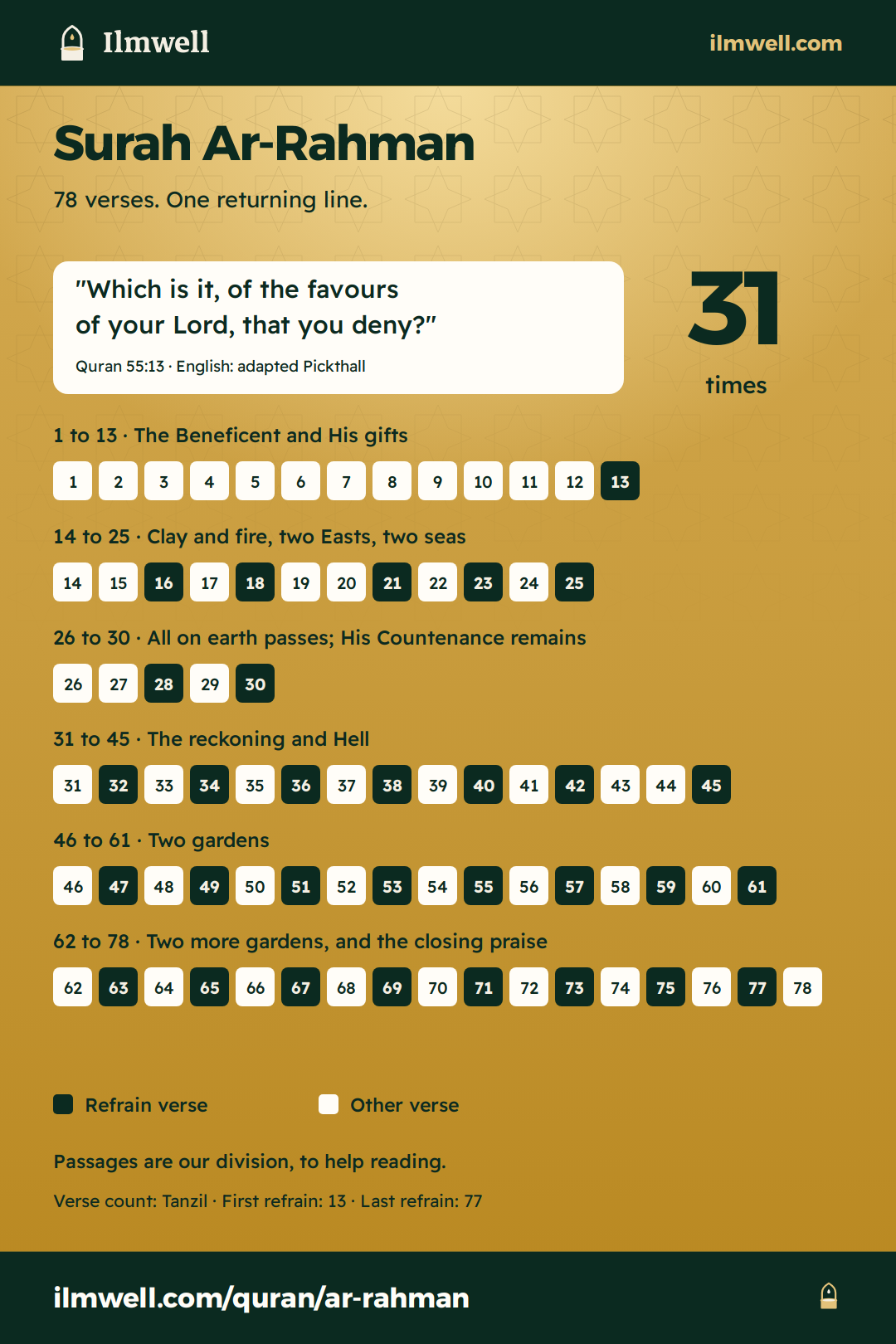
Surah Rahman is Surah Ar-Rahman, surah 55 of the Quran: 78 verses that open with "The Beneficent" (Ar-Rahman 55:1, meaning surah 55, verse 1). One line comes 31 times: "Which is it, of the favours of your Lord, that you deny?" (55:13). A report graded differently says the Prophet Muhammad, peace be upon him, said the jinn (made of smokeless fire, 55:15) answered it better (Jami' at-Tirmidhi 3291).
How many verses are in Surah Rahman?
| Fact | Surah Ar-Rahman |
|---|---|
| Surah number | 55 of 114 |
| Verses (ayat) | 78 in the Tanzil count; al-Qurtubi's commentary gives 76 (source 6) |
| The refrain | 31 times, from verse 13 to verse 77 |
| Juz (para) | Juz 27 |
| Pages | 531 to 534 of the 604-page layout |
| Makkan or Madinan | Sources differ. The Tanzil listing has it as Madinan. Al-Qurtubi reports it as Makkan in the view of al-Hasan, 'Urwa ibn al-Zubayr and others, and Madinan in the view of Ibn Mas'ud, may Allah be pleased with him, and Muqatil. He prefers Makkan (source 6). |
| Name | Ar-Rahman, its first word, rendered "The Beneficent" (55:1) |
What is Surah Rahman about?
The surah moves from the gifts of the Beneficent in creation to the passing of everything on earth, then the reckoning, Hell and two pairs of gardens, with the refrain between. The six passages below are our division by subject, to help reading; the text does not mark them. Detailed meaning belongs to tafsir (Quran commentary).
| Verses | Passage | What the verses say |
|---|---|---|
| 1 to 13 | The Beneficent and His gifts | "Has made known the Quran" (55:2); man created and taught utterance; the sun and moon, the measure (55:7 to 9), and the earth with its fruit and grain. Then the first refrain (55:13). |
| 14 to 25 | Clay and fire, two Easts, two seas | Man made of clay, the jinn of smokeless fire (55:14 to 15); "Lord of the two Easts, and Lord of the two Wests" (55:17); two seas with a barrier between them (55:20); ships like banners (55:24). |
| 26 to 30 | All on earth passes; His Countenance remains | "Everyone that is thereon will pass away" (55:26), and the Countenance of your Lord remains (55:27). All in the heavens and the earth entreat Him (55:29). |
| 31 to 45 | The reckoning and Hell | "We shall deal with you, O you two dependents (man and jinn)" (55:31); "You will never penetrate them except with (Our) sanction" (55:33); the heaven splits (55:37); "This is hell which the guilty deny" (55:43). |
| 46 to 61 | Two gardens | "But for him who fears the standing before his Lord there are two gardens" (55:46): two fountains, fruit in pairs, couches lined with brocade. "Is the reward of goodness anything except goodness?" (55:60) |
| 62 to 78 | Two more gardens, and the closing praise | "And beside them are two other gardens" (55:62): dark green, with springs, palms and pomegranates. It closes: "Blessed be the name of your Lord, Mighty and glorious!" (55:78) |
Surah Rahman in Arabic: the full text
Skip the scroll: verse by verse, with English, or print it or save it as a PDF.
Ar-Rahman 55:1 to 78
ٱلرَّحْمَـٰنُ ١ عَلَّمَ ٱلْقُرْءَانَ ٢ خَلَقَ ٱلْإِنسَـٰنَ ٣ عَلَّمَهُ ٱلْبَيَانَ ٤ ٱلشَّمْسُ وَٱلْقَمَرُ بِحُسْبَانٍ ٥ وَٱلنَّجْمُ وَٱلشَّجَرُ يَسْجُدَانِ ٦ وَٱلسَّمَآءَ رَفَعَهَا وَوَضَعَ ٱلْمِيزَانَ ٧ أَلَّا تَطْغَوْا۟ فِى ٱلْمِيزَانِ ٨ وَأَقِيمُوا۟ ٱلْوَزْنَ بِٱلْقِسْطِ وَلَا تُخْسِرُوا۟ ٱلْمِيزَانَ ٩ وَٱلْأَرْضَ وَضَعَهَا لِلْأَنَامِ ١٠ فِيهَا فَـٰكِهَةٌ وَٱلنَّخْلُ ذَاتُ ٱلْأَكْمَامِ ١١ وَٱلْحَبُّ ذُو ٱلْعَصْفِ وَٱلرَّيْحَانُ ١٢ فَبِأَىِّ ءَالَآءِ رَبِّكُمَا تُكَذِّبَانِ ١٣ خَلَقَ ٱلْإِنسَـٰنَ مِن صَلْصَـٰلٍ كَٱلْفَخَّارِ ١٤ وَخَلَقَ ٱلْجَآنَّ مِن مَّارِجٍ مِّن نَّارٍ ١٥ فَبِأَىِّ ءَالَآءِ رَبِّكُمَا تُكَذِّبَانِ ١٦ رَبُّ ٱلْمَشْرِقَيْنِ وَرَبُّ ٱلْمَغْرِبَيْنِ ١٧ فَبِأَىِّ ءَالَآءِ رَبِّكُمَا تُكَذِّبَانِ ١٨ مَرَجَ ٱلْبَحْرَيْنِ يَلْتَقِيَانِ ١٩ بَيْنَهُمَا بَرْزَخٌ لَّا يَبْغِيَانِ ٢٠ فَبِأَىِّ ءَالَآءِ رَبِّكُمَا تُكَذِّبَانِ ٢١ يَخْرُجُ مِنْهُمَا ٱللُّؤْلُؤُ وَٱلْمَرْجَانُ ٢٢ فَبِأَىِّ ءَالَآءِ رَبِّكُمَا تُكَذِّبَانِ ٢٣ وَلَهُ ٱلْجَوَارِ ٱلْمُنشَـَٔاتُ فِى ٱلْبَحْرِ كَٱلْأَعْلَـٰمِ ٢٤ فَبِأَىِّ ءَالَآءِ رَبِّكُمَا تُكَذِّبَانِ ٢٥ كُلُّ مَنْ عَلَيْهَا فَانٍ ٢٦ وَيَبْقَىٰ وَجْهُ رَبِّكَ ذُو ٱلْجَلَـٰلِ وَٱلْإِكْرَامِ ٢٧ فَبِأَىِّ ءَالَآءِ رَبِّكُمَا تُكَذِّبَانِ ٢٨ يَسْـَٔلُهُۥ مَن فِى ٱلسَّمَـٰوَٰتِ وَٱلْأَرْضِ ۚ كُلَّ يَوْمٍ هُوَ فِى شَأْنٍ ٢٩ فَبِأَىِّ ءَالَآءِ رَبِّكُمَا تُكَذِّبَانِ ٣٠ سَنَفْرُغُ لَكُمْ أَيُّهَ ٱلثَّقَلَانِ ٣١ فَبِأَىِّ ءَالَآءِ رَبِّكُمَا تُكَذِّبَانِ ٣٢ يَـٰمَعْشَرَ ٱلْجِنِّ وَٱلْإِنسِ إِنِ ٱسْتَطَعْتُمْ أَن تَنفُذُوا۟ مِنْ أَقْطَارِ ٱلسَّمَـٰوَٰتِ وَٱلْأَرْضِ فَٱنفُذُوا۟ ۚ لَا تَنفُذُونَ إِلَّا بِسُلْطَـٰنٍ ٣٣ فَبِأَىِّ ءَالَآءِ رَبِّكُمَا تُكَذِّبَانِ ٣٤ يُرْسَلُ عَلَيْكُمَا شُوَاظٌ مِّن نَّارٍ وَنُحَاسٌ فَلَا تَنتَصِرَانِ ٣٥ فَبِأَىِّ ءَالَآءِ رَبِّكُمَا تُكَذِّبَانِ ٣٦ فَإِذَا ٱنشَقَّتِ ٱلسَّمَآءُ فَكَانَتْ وَرْدَةً كَٱلدِّهَانِ ٣٧ فَبِأَىِّ ءَالَآءِ رَبِّكُمَا تُكَذِّبَانِ ٣٨ فَيَوْمَئِذٍ لَّا يُسْـَٔلُ عَن ذَنۢبِهِۦٓ إِنسٌ وَلَا جَآنٌّ ٣٩ فَبِأَىِّ ءَالَآءِ رَبِّكُمَا تُكَذِّبَانِ ٤٠ يُعْرَفُ ٱلْمُجْرِمُونَ بِسِيمَـٰهُمْ فَيُؤْخَذُ بِٱلنَّوَٰصِى وَٱلْأَقْدَامِ ٤١ فَبِأَىِّ ءَالَآءِ رَبِّكُمَا تُكَذِّبَانِ ٤٢ هَـٰذِهِۦ جَهَنَّمُ ٱلَّتِى يُكَذِّبُ بِهَا ٱلْمُجْرِمُونَ ٤٣ يَطُوفُونَ بَيْنَهَا وَبَيْنَ حَمِيمٍ ءَانٍ ٤٤ فَبِأَىِّ ءَالَآءِ رَبِّكُمَا تُكَذِّبَانِ ٤٥ وَلِمَنْ خَافَ مَقَامَ رَبِّهِۦ جَنَّتَانِ ٤٦ فَبِأَىِّ ءَالَآءِ رَبِّكُمَا تُكَذِّبَانِ ٤٧ ذَوَاتَآ أَفْنَانٍ ٤٨ فَبِأَىِّ ءَالَآءِ رَبِّكُمَا تُكَذِّبَانِ ٤٩ فِيهِمَا عَيْنَانِ تَجْرِيَانِ ٥٠ فَبِأَىِّ ءَالَآءِ رَبِّكُمَا تُكَذِّبَانِ ٥١ فِيهِمَا مِن كُلِّ فَـٰكِهَةٍ زَوْجَانِ ٥٢ فَبِأَىِّ ءَالَآءِ رَبِّكُمَا تُكَذِّبَانِ ٥٣ مُتَّكِـِٔينَ عَلَىٰ فُرُشٍۭ بَطَآئِنُهَا مِنْ إِسْتَبْرَقٍ ۚ وَجَنَى ٱلْجَنَّتَيْنِ دَانٍ ٥٤ فَبِأَىِّ ءَالَآءِ رَبِّكُمَا تُكَذِّبَانِ ٥٥ فِيهِنَّ قَـٰصِرَٰتُ ٱلطَّرْفِ لَمْ يَطْمِثْهُنَّ إِنسٌ قَبْلَهُمْ وَلَا جَآنٌّ ٥٦ فَبِأَىِّ ءَالَآءِ رَبِّكُمَا تُكَذِّبَانِ ٥٧ كَأَنَّهُنَّ ٱلْيَاقُوتُ وَٱلْمَرْجَانُ ٥٨ فَبِأَىِّ ءَالَآءِ رَبِّكُمَا تُكَذِّبَانِ ٥٩ هَلْ جَزَآءُ ٱلْإِحْسَـٰنِ إِلَّا ٱلْإِحْسَـٰنُ ٦٠ فَبِأَىِّ ءَالَآءِ رَبِّكُمَا تُكَذِّبَانِ ٦١ وَمِن دُونِهِمَا جَنَّتَانِ ٦٢ فَبِأَىِّ ءَالَآءِ رَبِّكُمَا تُكَذِّبَانِ ٦٣ مُدْهَآمَّتَانِ ٦٤ فَبِأَىِّ ءَالَآءِ رَبِّكُمَا تُكَذِّبَانِ ٦٥ فِيهِمَا عَيْنَانِ نَضَّاخَتَانِ ٦٦ فَبِأَىِّ ءَالَآءِ رَبِّكُمَا تُكَذِّبَانِ ٦٧ فِيهِمَا فَـٰكِهَةٌ وَنَخْلٌ وَرُمَّانٌ ٦٨ فَبِأَىِّ ءَالَآءِ رَبِّكُمَا تُكَذِّبَانِ ٦٩ فِيهِنَّ خَيْرَٰتٌ حِسَانٌ ٧٠ فَبِأَىِّ ءَالَآءِ رَبِّكُمَا تُكَذِّبَانِ ٧١ حُورٌ مَّقْصُورَٰتٌ فِى ٱلْخِيَامِ ٧٢ فَبِأَىِّ ءَالَآءِ رَبِّكُمَا تُكَذِّبَانِ ٧٣ لَمْ يَطْمِثْهُنَّ إِنسٌ قَبْلَهُمْ وَلَا جَآنٌّ ٧٤ فَبِأَىِّ ءَالَآءِ رَبِّكُمَا تُكَذِّبَانِ ٧٥ مُتَّكِـِٔينَ عَلَىٰ رَفْرَفٍ خُضْرٍ وَعَبْقَرِىٍّ حِسَانٍ ٧٦ فَبِأَىِّ ءَالَآءِ رَبِّكُمَا تُكَذِّبَانِ ٧٧ تَبَـٰرَكَ ٱسْمُ رَبِّكَ ذِى ٱلْجَلَـٰلِ وَٱلْإِكْرَامِ ٧٨
This is the full surah, all 78 verses, each ending with its number; copy the Arabic with the button under the scroll. The Bismillah printed above it is not counted among its verses. The name is also written Surah Ar Rahman, Surah Al Rahman, Surat Rahman, Sura Rahman, Surah Rehman, Surah e Rehman, Surat Rehman and Sura Rehman: all are surah 55.
Surah Rahman in English and transliteration, verse by verse
Read Surah Rahman online here in full: each verse in Arabic, a simple transliteration (Roman English: the Arabic sounds in English letters) and the English translation. Apostrophes mark the throat sounds and hamza; doubled letters are held a little longer. The 31 refrain verses are marked Refrain, with a darker edge.
Surah Ar-Rahman (55), 78 verses. ilmwell.com/quran/ar-rahman/
Verses 1 to 13: The Beneficent and His gifts
- Verse 1
ٱلرَّحْمَـٰنُ
Ar-Rahman
The Beneficent
- Verse 2
عَلَّمَ ٱلْقُرْءَانَ
'Allamal-Qur'an
Has made known the Quran.
- Verse 3
خَلَقَ ٱلْإِنسَـٰنَ
Khalaqal-insan
He has created man.
- Verse 4
عَلَّمَهُ ٱلْبَيَانَ
'Allamahul-bayan
He has taught him utterance.
- Verse 5
ٱلشَّمْسُ وَٱلْقَمَرُ بِحُسْبَانٍ
Ash-shamsu wal-qamaru bihusban
The sun and the moon are made punctual.
- Verse 6
وَٱلنَّجْمُ وَٱلشَّجَرُ يَسْجُدَانِ
Wan-najmu wash-shajaru yasjudan
The stars and the trees prostrate.
- Verse 7
وَٱلسَّمَآءَ رَفَعَهَا وَوَضَعَ ٱلْمِيزَانَ
Was-sama'a rafa'aha wa wada'al-mizan
And the sky He has uplifted; and He has set the measure,
- Verse 8
أَلَّا تَطْغَوْا۟ فِى ٱلْمِيزَانِ
Alla tatghaw fil-mizan
That you do not exceed the measure,
- Verse 9
وَأَقِيمُوا۟ ٱلْوَزْنَ بِٱلْقِسْطِ وَلَا تُخْسِرُوا۟ ٱلْمِيزَانَ
Wa aqimul-wazna bil-qisti wa la tukhsirul-mizan
But observe the measure strictly, nor fall short thereof.
- Verse 10
وَٱلْأَرْضَ وَضَعَهَا لِلْأَنَامِ
Wal-arda wada'aha lil-anam
And the earth He has appointed for (His) creatures,
- Verse 11
فِيهَا فَـٰكِهَةٌ وَٱلنَّخْلُ ذَاتُ ٱلْأَكْمَامِ
Fiha fakihatuw-wan-nakhlu dhatul-akmam
Wherein are fruit and sheathed palm-trees,
- Verse 12
وَٱلْحَبُّ ذُو ٱلْعَصْفِ وَٱلرَّيْحَانُ
Wal-habbu dhul-'asfi war-rayhan
Husked grain and scented herb.
- Verse 13Refrain
فَبِأَىِّ ءَالَآءِ رَبِّكُمَا تُكَذِّبَانِ
Fabi-ayyi ala'i rabbikuma tukadhdhiban
Which is it, of the favours of your Lord, that you deny?
Verses 14 to 25: Clay and fire, two Easts, two seas
- Verse 14
خَلَقَ ٱلْإِنسَـٰنَ مِن صَلْصَـٰلٍ كَٱلْفَخَّارِ
Khalaqal-insana min salsalin kal-fakhkhar
He created man of clay like the potter's,
- Verse 15
وَخَلَقَ ٱلْجَآنَّ مِن مَّارِجٍ مِّن نَّارٍ
Wa khalaqal-jaanna mim-marijim-min nar
And the jinn did He create of smokeless fire.
- Verse 16Refrain
فَبِأَىِّ ءَالَآءِ رَبِّكُمَا تُكَذِّبَانِ
Fabi-ayyi ala'i rabbikuma tukadhdhiban
Which is it, of the favours of your Lord, that you deny?
- Verse 17
رَبُّ ٱلْمَشْرِقَيْنِ وَرَبُّ ٱلْمَغْرِبَيْنِ
Rabbul-mashriqayni wa rabbul-maghribayn
Lord of the two Easts, and Lord of the two Wests!
- Verse 18Refrain
فَبِأَىِّ ءَالَآءِ رَبِّكُمَا تُكَذِّبَانِ
Fabi-ayyi ala'i rabbikuma tukadhdhiban
Which is it, of the favours of your Lord, that you deny?
- Verse 19
مَرَجَ ٱلْبَحْرَيْنِ يَلْتَقِيَانِ
Marajal-bahrayni yaltaqiyan
He has loosed the two seas. They meet.
- Verse 20
بَيْنَهُمَا بَرْزَخٌ لَّا يَبْغِيَانِ
Baynahuma barzakhul-la yabghiyan
There is a barrier between them. They do not encroach (one upon the other).
- Verse 21Refrain
فَبِأَىِّ ءَالَآءِ رَبِّكُمَا تُكَذِّبَانِ
Fabi-ayyi ala'i rabbikuma tukadhdhiban
Which is it, of the favours of your Lord, that you deny?
- Verse 22
يَخْرُجُ مِنْهُمَا ٱللُّؤْلُؤُ وَٱلْمَرْجَانُ
Yakhruju minhumal-lu'lu'u wal-marjan
There comes forth from both of them the pearl and coral-stone.
- Verse 23Refrain
فَبِأَىِّ ءَالَآءِ رَبِّكُمَا تُكَذِّبَانِ
Fabi-ayyi ala'i rabbikuma tukadhdhiban
Which is it, of the favours of your Lord, that you deny?
- Verse 24
وَلَهُ ٱلْجَوَارِ ٱلْمُنشَـَٔاتُ فِى ٱلْبَحْرِ كَٱلْأَعْلَـٰمِ
Wa lahul-jawaril-munsha'atu fil-bahri kal-a'lam
His are the ships displayed upon the sea, like banners.
- Verse 25Refrain
فَبِأَىِّ ءَالَآءِ رَبِّكُمَا تُكَذِّبَانِ
Fabi-ayyi ala'i rabbikuma tukadhdhiban
Which is it, of the favours of your Lord, that you deny?
Verses 26 to 30: All on earth passes; His Countenance remains
- Verse 26
كُلُّ مَنْ عَلَيْهَا فَانٍ
Kullu man 'alayha fan
Everyone that is thereon will pass away;
- Verse 27
وَيَبْقَىٰ وَجْهُ رَبِّكَ ذُو ٱلْجَلَـٰلِ وَٱلْإِكْرَامِ
Wa yabqa wajhu rabbika dhul-jalali wal-ikram
There remains but the Countenance of your Lord of Might and Glory.
- Verse 28Refrain
فَبِأَىِّ ءَالَآءِ رَبِّكُمَا تُكَذِّبَانِ
Fabi-ayyi ala'i rabbikuma tukadhdhiban
Which is it, of the favours of your Lord, that you deny?
- Verse 29
يَسْـَٔلُهُۥ مَن فِى ٱلسَّمَـٰوَٰتِ وَٱلْأَرْضِ ۚ كُلَّ يَوْمٍ هُوَ فِى شَأْنٍ
Yas'aluhu man fis-samawati wal-ard, kulla yawmin huwa fi sha'n
All that are in the heavens and the earth entreat Him. Every day He exercises (universal) power.
- Verse 30Refrain
فَبِأَىِّ ءَالَآءِ رَبِّكُمَا تُكَذِّبَانِ
Fabi-ayyi ala'i rabbikuma tukadhdhiban
Which is it, of the favours of your Lord, that you deny?
Verses 31 to 45: The reckoning and Hell
- Verse 31
سَنَفْرُغُ لَكُمْ أَيُّهَ ٱلثَّقَلَانِ
Sanafrughu lakum ayyuhath-thaqalan
We shall deal with you, O you two dependents (man and jinn).
- Verse 32Refrain
فَبِأَىِّ ءَالَآءِ رَبِّكُمَا تُكَذِّبَانِ
Fabi-ayyi ala'i rabbikuma tukadhdhiban
Which is it, of the favours of your Lord, that you deny?
- Verse 33
يَـٰمَعْشَرَ ٱلْجِنِّ وَٱلْإِنسِ إِنِ ٱسْتَطَعْتُمْ أَن تَنفُذُوا۟ مِنْ أَقْطَارِ ٱلسَّمَـٰوَٰتِ وَٱلْأَرْضِ فَٱنفُذُوا۟ ۚ لَا تَنفُذُونَ إِلَّا بِسُلْطَـٰنٍ
Ya ma'sharal-jinni wal-insi inis-tata'tum an tanfudhu min aqtaris-samawati wal-ardi fanfudhu, la tanfudhuna illa bisultan
O company of jinn and men, if you have power to penetrate (all) regions of the heavens and the earth, then penetrate (them)! You will never penetrate them except with (Our) sanction.
- Verse 34Refrain
فَبِأَىِّ ءَالَآءِ رَبِّكُمَا تُكَذِّبَانِ
Fabi-ayyi ala'i rabbikuma tukadhdhiban
Which is it, of the favours of your Lord, that you deny?
- Verse 35
يُرْسَلُ عَلَيْكُمَا شُوَاظٌ مِّن نَّارٍ وَنُحَاسٌ فَلَا تَنتَصِرَانِ
Yursalu 'alaykuma shuwazum-min nariw-wa nuhasun fala tantasiran
There will be sent, against you both, heat of fire and flash of brass, and you will not escape.
- Verse 36Refrain
فَبِأَىِّ ءَالَآءِ رَبِّكُمَا تُكَذِّبَانِ
Fabi-ayyi ala'i rabbikuma tukadhdhiban
Which is it, of the favours of your Lord, that you deny?
- Verse 37
فَإِذَا ٱنشَقَّتِ ٱلسَّمَآءُ فَكَانَتْ وَرْدَةً كَٱلدِّهَانِ
Fa-idhan-shaqqatis-sama'u fakanat wardatan kad-dihan
And when the heaven splits apart and becomes rosy like red hide-
- Verse 38Refrain
فَبِأَىِّ ءَالَآءِ رَبِّكُمَا تُكَذِّبَانِ
Fabi-ayyi ala'i rabbikuma tukadhdhiban
Which is it, of the favours of your Lord, that you deny? -
- Verse 39
فَيَوْمَئِذٍ لَّا يُسْـَٔلُ عَن ذَنۢبِهِۦٓ إِنسٌ وَلَا جَآنٌّ
Fayawma'idhil-la yus'alu 'an dhambihi insuw-wa la jann
On that day neither man nor jinni will be questioned about his sin.
- Verse 40Refrain
فَبِأَىِّ ءَالَآءِ رَبِّكُمَا تُكَذِّبَانِ
Fabi-ayyi ala'i rabbikuma tukadhdhiban
Which is it, of the favours of your Lord, that you deny?
- Verse 41
يُعْرَفُ ٱلْمُجْرِمُونَ بِسِيمَـٰهُمْ فَيُؤْخَذُ بِٱلنَّوَٰصِى وَٱلْأَقْدَامِ
Yu'raful-mujrimuna bisimahum fayu'khadhu bin-nawasi wal-aqdam
The guilty will be known by their marks, and will be taken by the forelocks and the feet.
- Verse 42Refrain
فَبِأَىِّ ءَالَآءِ رَبِّكُمَا تُكَذِّبَانِ
Fabi-ayyi ala'i rabbikuma tukadhdhiban
Which is it, of the favours of your Lord, that you deny?
- Verse 43
هَـٰذِهِۦ جَهَنَّمُ ٱلَّتِى يُكَذِّبُ بِهَا ٱلْمُجْرِمُونَ
Hadhihi jahannamul-lati yukadhdhibu bihal-mujrimun
This is hell which the guilty deny.
- Verse 44
يَطُوفُونَ بَيْنَهَا وَبَيْنَ حَمِيمٍ ءَانٍ
Yatufuna baynaha wa bayna hamimin an
They go circling round between it and fierce, boiling water.
- Verse 45Refrain
فَبِأَىِّ ءَالَآءِ رَبِّكُمَا تُكَذِّبَانِ
Fabi-ayyi ala'i rabbikuma tukadhdhiban
Which is it, of the favours of your Lord, that you deny?
Verses 46 to 61: Two gardens
- Verse 46
وَلِمَنْ خَافَ مَقَامَ رَبِّهِۦ جَنَّتَانِ
Wa liman khafa maqama rabbihi jannatan
But for him who fears the standing before his Lord there are two gardens.
- Verse 47Refrain
فَبِأَىِّ ءَالَآءِ رَبِّكُمَا تُكَذِّبَانِ
Fabi-ayyi ala'i rabbikuma tukadhdhiban
Which is it, of the favours of your Lord, that you deny?
- Verse 48
ذَوَاتَآ أَفْنَانٍ
Dhawata afnan
Of spreading branches.
- Verse 49Refrain
فَبِأَىِّ ءَالَآءِ رَبِّكُمَا تُكَذِّبَانِ
Fabi-ayyi ala'i rabbikuma tukadhdhiban
Which is it, of the favours of your Lord, that you deny?
- Verse 50
فِيهِمَا عَيْنَانِ تَجْرِيَانِ
Fihima 'aynani tajriyan
Wherein are two fountains flowing.
- Verse 51Refrain
فَبِأَىِّ ءَالَآءِ رَبِّكُمَا تُكَذِّبَانِ
Fabi-ayyi ala'i rabbikuma tukadhdhiban
Which is it, of the favours of your Lord, that you deny?
- Verse 52
فِيهِمَا مِن كُلِّ فَـٰكِهَةٍ زَوْجَانِ
Fihima min kulli fakihatin zawjan
Wherein is every kind of fruit in pairs.
- Verse 53Refrain
فَبِأَىِّ ءَالَآءِ رَبِّكُمَا تُكَذِّبَانِ
Fabi-ayyi ala'i rabbikuma tukadhdhiban
Which is it, of the favours of your Lord, that you deny?
- Verse 54
مُتَّكِـِٔينَ عَلَىٰ فُرُشٍۭ بَطَآئِنُهَا مِنْ إِسْتَبْرَقٍ ۚ وَجَنَى ٱلْجَنَّتَيْنِ دَانٍ
Muttaki'ina 'ala furushim bata'inuha min istabraq, wa janal-jannatayni dan
Reclining upon couches lined with silk brocade, the fruit of both the gardens near to hand.
- Verse 55Refrain
فَبِأَىِّ ءَالَآءِ رَبِّكُمَا تُكَذِّبَانِ
Fabi-ayyi ala'i rabbikuma tukadhdhiban
Which is it, of the favours of your Lord, that you deny?
- Verse 56
فِيهِنَّ قَـٰصِرَٰتُ ٱلطَّرْفِ لَمْ يَطْمِثْهُنَّ إِنسٌ قَبْلَهُمْ وَلَا جَآنٌّ
Fihinna qasiratut-tarfi lam yatmithhunna insun qablahum wa la jann
Therein are those of modest gaze, whom neither man nor jinn will have touched before them.
- Verse 57Refrain
فَبِأَىِّ ءَالَآءِ رَبِّكُمَا تُكَذِّبَانِ
Fabi-ayyi ala'i rabbikuma tukadhdhiban
Which is it, of the favours of your Lord, that you deny?
- Verse 58
كَأَنَّهُنَّ ٱلْيَاقُوتُ وَٱلْمَرْجَانُ
Ka-annahunnal-yaqutu wal-marjan
(In beauty) like the ruby and the coral-stone.
- Verse 59Refrain
فَبِأَىِّ ءَالَآءِ رَبِّكُمَا تُكَذِّبَانِ
Fabi-ayyi ala'i rabbikuma tukadhdhiban
Which is it, of the favours of your Lord, that you deny?
- Verse 60
هَلْ جَزَآءُ ٱلْإِحْسَـٰنِ إِلَّا ٱلْإِحْسَـٰنُ
Hal jaza'ul-ihsani illal-ihsan
Is the reward of goodness anything except goodness?
- Verse 61Refrain
فَبِأَىِّ ءَالَآءِ رَبِّكُمَا تُكَذِّبَانِ
Fabi-ayyi ala'i rabbikuma tukadhdhiban
Which is it, of the favours of your Lord, that you deny?
Verses 62 to 78: Two more gardens, and the closing praise
- Verse 62
وَمِن دُونِهِمَا جَنَّتَانِ
Wa min dunihima jannatan
And beside them are two other gardens,
- Verse 63Refrain
فَبِأَىِّ ءَالَآءِ رَبِّكُمَا تُكَذِّبَانِ
Fabi-ayyi ala'i rabbikuma tukadhdhiban
Which is it, of the favours of your Lord, that you deny?
- Verse 64
مُدْهَآمَّتَانِ
Mudhammatan
Dark green with foliage.
- Verse 65Refrain
فَبِأَىِّ ءَالَآءِ رَبِّكُمَا تُكَذِّبَانِ
Fabi-ayyi ala'i rabbikuma tukadhdhiban
Which is it, of the favours of your Lord, that you deny?
- Verse 66
فِيهِمَا عَيْنَانِ نَضَّاخَتَانِ
Fihima 'aynani naddakhatan
Wherein are two abundant springs.
- Verse 67Refrain
فَبِأَىِّ ءَالَآءِ رَبِّكُمَا تُكَذِّبَانِ
Fabi-ayyi ala'i rabbikuma tukadhdhiban
Which is it, of the favours of your Lord, that you deny?
- Verse 68
فِيهِمَا فَـٰكِهَةٌ وَنَخْلٌ وَرُمَّانٌ
Fihima fakihatuw-wa nakhluw-wa rumman
Wherein is fruit, the date-palm and pomegranate.
- Verse 69Refrain
فَبِأَىِّ ءَالَآءِ رَبِّكُمَا تُكَذِّبَانِ
Fabi-ayyi ala'i rabbikuma tukadhdhiban
Which is it, of the favours of your Lord, that you deny?
- Verse 70
فِيهِنَّ خَيْرَٰتٌ حِسَانٌ
Fihinna khayratun hisan
Wherein (are found) the good and beautiful -
- Verse 71Refrain
فَبِأَىِّ ءَالَآءِ رَبِّكُمَا تُكَذِّبَانِ
Fabi-ayyi ala'i rabbikuma tukadhdhiban
Which is it, of the favours of your Lord, that you deny? -
- Verse 72
حُورٌ مَّقْصُورَٰتٌ فِى ٱلْخِيَامِ
Hurum-maqsuratun fil-khiyam
Fair ones, close-guarded in pavilions -
- Verse 73Refrain
فَبِأَىِّ ءَالَآءِ رَبِّكُمَا تُكَذِّبَانِ
Fabi-ayyi ala'i rabbikuma tukadhdhiban
Which is it, of the favours of your Lord, that you deny? -
- Verse 74
لَمْ يَطْمِثْهُنَّ إِنسٌ قَبْلَهُمْ وَلَا جَآنٌّ
Lam yatmithhunna insun qablahum wa la jann
Whom neither man nor jinn will have touched before them -
- Verse 75Refrain
فَبِأَىِّ ءَالَآءِ رَبِّكُمَا تُكَذِّبَانِ
Fabi-ayyi ala'i rabbikuma tukadhdhiban
Which is it, of the favours of your Lord, that you deny?
- Verse 76
مُتَّكِـِٔينَ عَلَىٰ رَفْرَفٍ خُضْرٍ وَعَبْقَرِىٍّ حِسَانٍ
Muttaki'ina 'ala rafrafin khudriw-wa 'abqariyyin hisan
Reclining on green cushions and fair carpets.
- Verse 77Refrain
فَبِأَىِّ ءَالَآءِ رَبِّكُمَا تُكَذِّبَانِ
Fabi-ayyi ala'i rabbikuma tukadhdhiban
Which is it, of the favours of your Lord, that you deny?
- Verse 78
تَبَـٰرَكَ ٱسْمُ رَبِّكَ ذِى ٱلْجَلَـٰلِ وَٱلْإِكْرَامِ
Tabarakas-mu rabbika dhil-jalali wal-ikram
Blessed be the name of your Lord, Mighty and glorious!
Quran text from the Tanzil Project (tanzil.net, CC BY 3.0). English: adapted from Marmaduke Pickthall's translation (1930), modernised and checked against modern translations. Transliteration: Ilmwell.
A recording of Ar-Rahman used to play in the car on long journeys. I did not follow the Arabic, but I knew the repeated line by its sound. When I finally read what it says, I was surprised how personal it felt.
Try it: what does it say?
Three quick questions on the verses. Each answer explains itself.
1How many times does the refrain come in Surah Ar-Rahman?
Answer: 31. The refrain is 31 of its 78 verses, from verse 13 to verse 77.
2Which verse asks "Is the reward of goodness anything except goodness?"
Answer: 55:60. Verse 60. Verse 13 is the first refrain, and verse 78 is the closing praise.
3What does verse 2 say the Beneficent has made known?
Answer: The Quran. "Has made known the Quran" (55:2).
Why does Surah Rahman repeat "Which is it, of the favours of your Lord, that you deny?"
The line comes 31 times. It first follows the opening list at verse 13; after that, one or two verses sit between each repeat, and the last is verse 77, just before the closing verse.
In Arabic the verb is dual, spoken to two. Verse 31 names two: "O you two dependents (man and jinn)".
- Al-Qurtubi gives it as the majority view that the line speaks to mankind and jinn, and says all the commentators take ala' to mean blessings (he also reports "power"). Among the explanations of the repetition he reports three. Al-Hakim al-Tirmidhi said it is for emphasis and to establish the proof against them. Ibn Qutayba said Allah lists His blessings and puts this line between each two, to alert people to them and have them acknowledge them. It is like saying to someone who denies your kindness: "Were you not poor, and I made you rich? Do you deny this?" Al-Husayn ibn al-Fadl said the repetition drives away heedlessness and confirms the proof (source 7).
- Al-Sa'di writes that, having listed many blessings of religion and of this world, Allah has mankind and jinn acknowledge them with this line. What befits a servant when these blessings are recited, he says, is to acknowledge them, give thanks and praise Him (source 9).
What does Ar-Rahman mean?
Ar-Rahman is a name of Allah, from rahmah, mercy, as Ibn Kathir writes (source 11). It is the surah's first word, rendered "The Beneficent" in the translation used here (55:1). Al-Isra 17:110 sets it beside the name Allah: "Cry to Allah, or cry to the Beneficent, to whichsoever you cry (it is the same). His are the most beautiful names." Al-Sa'di writes that the surah opens with this name, which shows the breadth of Allah's mercy and kindness, then lists what shows that mercy (source 9). The same word comes second in Bismillahir rahmanir rahim, explained word by word on the Bismillah page.
Is the hadith of the jinn and Surah Rahman authentic?
It is graded differently. Jabir ibn Abdullah, may Allah be pleased with him, reported that the Prophet came out to his companions and recited Surah Ar-Rahman to them from beginning to end, and they were silent. He said he had recited it to the jinn on the Night of the Jinn, and they were better in their reply: each time he came to the refrain, they said:
Jami' at-Tirmidhi 3291
لاَ بِشَيْءٍ مِنْ نِعَمِكَ رَبَّنَا نُكَذِّبُ فَلَكَ الْحَمْدُ
La bi-shay'in min ni'amika rabbana nukadhdhibu, fa-lakal-hamd
We deny none of Your favours, our Lord, and Yours is the praise.
1Graded differently Jami' at-Tirmidhi 3291
Five graders accept it as hasan or sahih, and five call it weak, rejected or objectionable in at least one book; one grader is in both counts. The collection's own note says it is known through one chain only. The report names no reward and does not tell listeners to reply.
Ibn Kathir, on verse 13, writes "we say as the believing jinn said" and quotes their reply. He also reports that Ibn Abbas, may Allah be pleased with him, used to say "La bi-ayyiha ya rabb", none of them, O Lord (he gives no chain) (source 8).
What are the benefits of Surah Rahman?
Three reports are quoted about Ar-Rahman itself: one is graded differently, one weak and one fabricated. The reward in a report graded sahih or hasan is for reciting any part of the Quran. Ibn Mas'ud reported that the Prophet said each letter recited earns a good deed, and a good deed counts as ten (Jami' at-Tirmidhi 2910, graded sahih or hasan).
4AuthenticJami' at-Tirmidhi 2910
| What is said | Whose words | Source and grade |
|---|---|---|
| When he recited it, the jinn answered the refrain better than the companions: "We deny none of Your favours, our Lord, and Yours is the praise." | The Prophet, reported by Jabir ibn Abdullah | Graded differently Jami' at-Tirmidhi 3291 Source 1 |
| Everything has a bride, and the bride of the Quran is Ar-Rahman. | Attributed to the Prophet through 'Ali, may Allah be pleased with him | Weak Mishkat al-Masabih 2180 Source 2 |
| Whoever recites Ar-Rahman, Allah has mercy on his weakness and he has fulfilled thanks for His blessings. | Attributed to the Prophet through Ubayy ibn Ka'b, may Allah be pleased with him, in a long report giving a reward for each surah in turn | Fabricated Al-Kafi al-Shaf 276 Source 3 |
| It heals illness, should be recited seven times, or cures when listened to. | We found no narration (our search) | Our search Source 10 |
Is Surah Rahman "the bride of the Quran"?
That title comes from a report graded weak. It is attributed to the Prophet through 'Ali: everything has a bride, and the bride of the Quran is Ar-Rahman. Mishkat al-Masabih cites it from al-Bayhaqi's Shu'ab al-Iman. All four gradings we found, from two graders, call it weak, two of them munkar (rejected); two other scholars name a criticised narrator in its chain.
For a reward graded sahih or hasan, see the ten good deeds for each letter above.
Does Surah Rahman heal illness?
Our search of two hadith databases on 22 October 2026 found no narration that ties Ar-Rahman to healing or to curing an illness. It found none for reciting it seven times, or for listening to it for a cure (source 10). Say a message in the family group chat promises that playing Surah Rahman cures disease: the reports above say nothing of the kind, and this page makes no medical claim. For any illness, speak to your GP.
On reciting over someone who is ill, a report graded sahih is narrower. A companion recited Al-Fatihah as a ruqyah (a recitation over someone ill) for a chief who had been stung. The man recovered, and the Prophet approved. It does not promise to heal every illness. More on the Al-Fatihah page.
5AuthenticSahih al-Bukhari 5007
Is there a Surah Rahman PDF or MP3?
We do not offer a PDF file or an MP3 download, but the full surah is here to read online, copy or print. These buttons print the verse list, the Arabic alone or with transliteration and English; Save as PDF in the print window keeps a copy. Or use your browser's Print command.
Audio is not here yet, including Qari Abdul Basit's recitation, which many people search for. A recording by a fluent human reciter is coming; we do not use a synthetic voice for the Quran. The Arabic is not colour coded for tajweed (the rules of recitation).
Common mix-ups
- The refrain is a question in the verses, not a dua. The reply "We deny none of Your favours, our Lord" comes from the jinn report, graded differently (source 1).
Questions people ask
Which juz (para) is Surah Rahman in?
Juz 27, by the Tanzil division. It fills pages 531 to 534 of the 604-page layout in the Tanzil page data, sharing its first page with Al-Qamar and its last with Al-Waqiah.
Is there an Urdu or Bangla translation of Surah Rahman here?
Not yet. Ilmwell is in English, so this page gives the English translation with the Arabic and a transliteration.
Sources
Every claim on this page comes from one of these. Gradings are reported with the scholar's name; we do not grade hadith ourselves.
- 1
Jabir reported that the Prophet recited Surah Ar-Rahman to his companions, who were silent, and said that when he recited it to the jinn on the Night of the Jinn they replied better: each time he reached 'Fa-bi-ayyi ala'i rabbikuma tukadhdhiban' they said 'We deny none of Your favours, our Lord, and Yours is the praise'. It is graded differently.
Jami' at-Tirmidhi 3291 Book 47, Hadith 343
Graded differently. Here is who graded it which way:
- SoundDarussalam, Al-Albani, Al-Hakim, Ahmad Shakir, Ibn 'Asakir
- Weak chain, strengthenedAl-Albani
- WeakAl-Albani, Ibn 'Uthaymin, Ibn 'Adi, Al-Wadi'i, Al-'Uqayli
- Other remarksAl-Tirmidhi, Al-Daraqutni, Al-Mubarakfuri, Al-Dhahabi, Abu Nasr al-Sijzi, Ibn Baz
See each grading in full, with its wording and where it was given
Scholars disagree about this hadith. Here is how each graded it, so you can follow the scholar you trust.
- Hasan: Darussalam (as shown on sunnah.com, tirmidhi:3291)
- غريب لا نعرفه إلا من حديث الوليد بن مسلم عن زهير بن محمد (gharib: we know it only through al-Walid ibn Muslim from Zuhayr ibn Muhammad): Al-Tirmidhi, Jami' at-Tirmidhi 3291 (as listed on dorar.net)
- حسن (hasan): Al-Albani, Sahih al-Tirmidhi 3291 (as listed on dorar.net)
- حسن (hasan): Al-Albani, Sahih al-Jami' 5138 (narrators listed: Jabir and Ibn 'Umar) (as listed on dorar.net)
- حسن لشواهده (hasan through its supporting narrations): Al-Albani, al-Silsila al-Sahiha 2150 (as listed on dorar.net)
- منكر (munkar, rejected): Al-Albani, Hidayat al-Ruwat 822 (as listed on dorar.net)
- صحيح على شرط الشيخين (sahih on the conditions of al-Bukhari and Muslim): Al-Hakim, al-Mustadrak 3812 (as listed on dorar.net)
- غريب من حديثه عنه، تفرد به زهير بن محمد. وتفرد به الوليد بن مسلم عنه (gharib: Zuhayr ibn Muhammad alone narrates it, and al-Walid ibn Muslim alone from him): Al-Daraqutni, Atraf al-Ghara'ib 1/319 (as listed on dorar.net)
- في الحديث ضعف لكن له شاهدا (there is weakness in the hadith, but it has a supporting narration): Al-Mubarakfuri, Tuhfat al-Ahwadhi 8/276 (as listed on dorar.net)
- ضعيف (weak): Ibn 'Uthaymin, Tafsir Surat al-Naml 307 (as listed on dorar.net)
- ضعيف (weak): Ibn 'Uthaymin, Tafsir Surat al-Hujurat ila al-Hadid 307 (as listed on dorar.net)
- [أشار في المقدمة إلى صحته] (he indicated in his introduction that it is sound): Ahmad Shakir, 'Umdat al-Tafsir 1/824 (as listed on dorar.net)
- [فيه] زهير ضعيف (Zuhayr, in its chain, is weak): Al-Dhahabi, Tarikh al-Islam 1/201 (as listed on dorar.net)
- فيه بعض النكرة [فيه] زهير بن محمد أرجو أنه لا بأس به (there is something objectionable in it; of Zuhayr ibn Muhammad: I hope there is no harm in him): Ibn 'Adi, al-Kamil fi al-Du'afa' 4/179 (as listed on dorar.net)
- [فيه] زهير بن محمد قال البخاري أنا أتقيه كأن حديثه موضوع وكان أحمد يضعفه (Zuhayr ibn Muhammad is in its chain: al-Bukhari said he kept away from him, and Ahmad called him weak; listed in a book of reports with hidden defects): Al-Wadi'i, Ahadith Mu'alla Zahiruha al-Sihha 86 (as listed on dorar.net)
- حسن غريب (hasan gharib): Ibn 'Asakir, Mu'jam al-Shuyukh 1/81 (as listed on dorar.net)
- غريب (gharib): Abu Nasr al-Sijzi, al-Ibana 4/315 (as listed on dorar.net)
- فيه نظر (it is open to question): Al-'Uqayli, al-Du'afa' al-Kabir 2/335 (as listed on dorar.net)
- ضعيف (weak): Ibn 'Uthaymin, Liqa' al-Bab al-Maftuh 8/479 (no narrator named) (as listed on dorar.net)
- في صحته نظر (its soundness is open to question): Ibn 'Uthaymin, Sharh Sahih Muslim 3/143 (no narrator named) (as listed on dorar.net)
- الظاهر أنه لا بأس به (apparently there is no harm in it): Ibn Baz, Majmu' Tafsir al-Shaykh 'Abd al-'Aziz ibn Baz 14/143 (the jinn's reply alone, no narrator named) (as listed on dorar.net)
- 2
'Ali reported hearing the Prophet say that everything has a bride ('arus), and the bride of the Quran is Ar-Rahman (al-Bayhaqi, Shu'ab al-Iman, as Mishkat al-Masabih cites it). It is graded weak.
Mishkat al-Masabih 2180 Book 8, Hadith 70
Weak: munkar, rejected (Al-Albani); weak (Al-Suyuti); weak (Al-Albani). Remarks: his study of it was not completed (Al-Albani); in its chain is 'Ali ibn al-Hasan Dubays, whom al-Dhahabi listed among weak and abandoned narrators; al-Daraqutni said he is not trustworthy (Zayn al-Din al-Munawi); in its chain is Ahmad ibn al-Hasan, whom al-Dhahabi listed among weak and abandoned narrators; al-Daraqutni said he is not trustworthy (Al-San'ani)
- 3
A report attributed to the Prophet through Ubayy ibn Ka'b, part of a long report giving a reward for each surah, says that whoever recites Surah Ar-Rahman, Allah has mercy on his weakness and he has fulfilled thanks for what Allah blessed him with. It is graded fabricated.
Al-Kafi al-Shaf 276 Listed by dorar.net from Ibn Hajar's al-Kafi al-Shaf 276 and al-Munawi's al-Fath al-Samawi 916
Fabricated: fabricated (Ibn Hajar al-'Asqalani); fabricated (Zayn al-Din al-Munawi). Remarks: Harun ibn Kathir, in its chain, is unknown; said of the whole surah-by-surah report (Ibn al-Qaysarani)
- 4
Ibn Mas'ud reported that the Prophet said whoever recites a letter of the Book of Allah has a good deed for it, and a good deed counts as ten like it; he gave Alif Lam Mim as three letters: Alif, Lam and Mim.
Jami' at-Tirmidhi 2910 Book 45, Hadith 36
Authentic: Hasan (Darussalam); hasan sahih, gharib by this route (Al-Tirmidhi); Sahih (Al-Albani); Sahih (Shu'ayb al-Arna'ut); its chain is sahih or hasan or close to them, by the key in his introduction (Al-Mundhiri); its chain is hasan (Ibn Baz). Remarks: it has several routes from Ibn Mas'ud (Al-Shawkani)
- 5
A companion recited Umm al-Kitab over a chief who had been stung; he recovered, and the Prophet approved the ruqyah.
Sahih al-Bukhari 5007 Book 66, Hadith 29
Authentic: in Sahih al-Bukhari
- 6
Al-Qurtubi, opening his commentary on Surat al-Rahman: wholly Makkan in the view of al-Hasan, 'Urwa ibn al-Zubayr, 'Ikrima, 'Ata' and Jabir; Ibn Abbas excepted one verse (55:29); wholly Madinan in the view of Ibn Mas'ud and Muqatil; he calls the first view more correct, and gives the surah 76 verses.
al-Jami' li-Ahkam al-Qur'an (Tafsir al-Qurtubi), on 55:1 Read on 22 October 2026. Record: scholarly-qurtubi-rahman-place.
- 7
Al-Qurtubi on 55:13: the line addresses mankind and jinn (the majority view); ala' are blessings (the view of all the commentators; Ibn Zayd: power); among the explanations of the repetition he reports three: al-Hakim al-Tirmidhi's, for emphasis and to establish the proof against them; al-Qutabi's (Ibn Qutayba), to alert people to the blessings and have them acknowledge them; and al-Husayn ibn al-Fadl's, to drive away heedlessness and confirm the proof.
al-Jami' li-Ahkam al-Qur'an (Tafsir al-Qurtubi), on 55:13 Read on 22 October 2026. Record: scholarly-qurtubi-rahman-refrain.
- 8
Ibn Kathir on 55:13: 'which of the blessings, O company of mankind and jinn, do you deny?' (Mujahid and others); 'we say as the believing jinn said', with their reply; Ibn Abbas used to say 'La bi-ayyiha ya rabb' (given without a chain).
Tafsir al-Qur'an al-'Azim (Tafsir Ibn Kathir), on 55:13 Read on 22 October 2026. Record: scholarly-ibnkathir-rahman-refrain.
- 9
Al-Sa'di on 55:1 and 55:13: the surah opens with the name Ar-Rahman, which shows the breadth of Allah's mercy and kindness, then mentions what shows that mercy. On 55:13: having listed many blessings of religion and of this world, Allah has mankind and jinn acknowledge them with this line; what befits a servant when these blessings are recited is to acknowledge them, give thanks and praise Him.
Taysir al-Karim al-Rahman (Tafsir al-Sa'di), on 55:1 and 55:13 Read on 22 October 2026. Record: scholarly-saadi-rahman-opening.
- 10
Our search of sunnah.com and the dorar.net encyclopedia, 22 October 2026, for reports about the virtues of Surah Ar-Rahman, including healing, illness, seven recitations and listening. Found: the three reports listed on this page with the gradings shown; two reports about Ar-Rahman with no reward (the minbar moving, and a Fajr prayer at Nakhla); no narration tying Ar-Rahman to healing, curing illness, a set number of recitations or listening for a cure.
sunnah.com and dorar.net Record: search-rahman-virtues, with every search term and result.
- 11
Ibn Kathir on the basmala: al-Rahman and al-Rahim are two names derived from al-rahmah (mercy), in an intensive form, al-Rahman the more intensive. He also reports that some held the name is not derived.
Tafsir al-Qur'an al-'Azim (Tafsir Ibn Kathir), ed. al-Salamah, Dar Tayba, vol. 1, p. 124 Read on 22 October 2026. Record: scholarly-ibnkathir-rahman-name.
- Q
Quran Arabic for Ar-Rahman 55:1 to 78 (the scroll, the verse list and the refrain count), without the Bismillah the Tanzil copy prints at the head of verse 1, and its English; Al-Isra 17:110 in English. Surah number, verse count, Madinan listing, juz and page divisions from the Tanzil metadata.
Tanzil Project Uthmani text and metadata, CC BY 3.0. English: adapted from Marmaduke Pickthall's translation (1930), modernised and checked against modern translations.
Next
- Al-Mulk: themes, meaning and reported virtuesQuran lesson
- Yasin: themes and the narrations about its virtuesQuran lesson
- Surah Al-Baqarah: meaning, themes and learningQuran lesson
- Al-Fatihah: meaning and understanding what you reciteQuran lesson
- Ayat al-Kursi: meaning and reported virtuesQuran lesson
- Al-Falaq and An-Nas: meaning and contextQuran lesson
- Al-Waqiah: meaning and claims about its benefitsQuran lesson
- Al-Kahf: four accounts and their lessonsQuran lesson
- Quran and SurahsThe hub
For your own situation, ask a scholar you trust.
Join the email list
New guides by email, now and then. No spam, and you can leave at any time.
Ilmwell is free and kept going by readers. See how to support it.