The short answer
Morning and evening adhkar are remembrances said at the start and end of the day. In Sunan Abi Dawud 5082, graded hasan or sahih, the Prophet Muhammad, peace be upon him, tells a companion to say Al-Ikhlas, Al-Falaq and An-Nas three times, morning and evening. Six more sourced remembrances follow.
Which adhkar can a beginner learn?
This is a selection of seven sourced morning and evening remembrances, each with its source and count. It is not every remembrance reported for these times, and Arabic searches for them far outnumber what seven entries can answer. People searching for a morning dua in English, or a morning dua in Islam, will find the Arabic, its English meaning and its source for each entry. Dhikr is the singular and adhkar the plural, also written azkar, as in morning azkar and evening azkar.
Say your phone holds a saved list of forty morning duas that you have never reached the end of. Seven sourced entries are an easier place to begin: learn one with its meaning, then add the next.
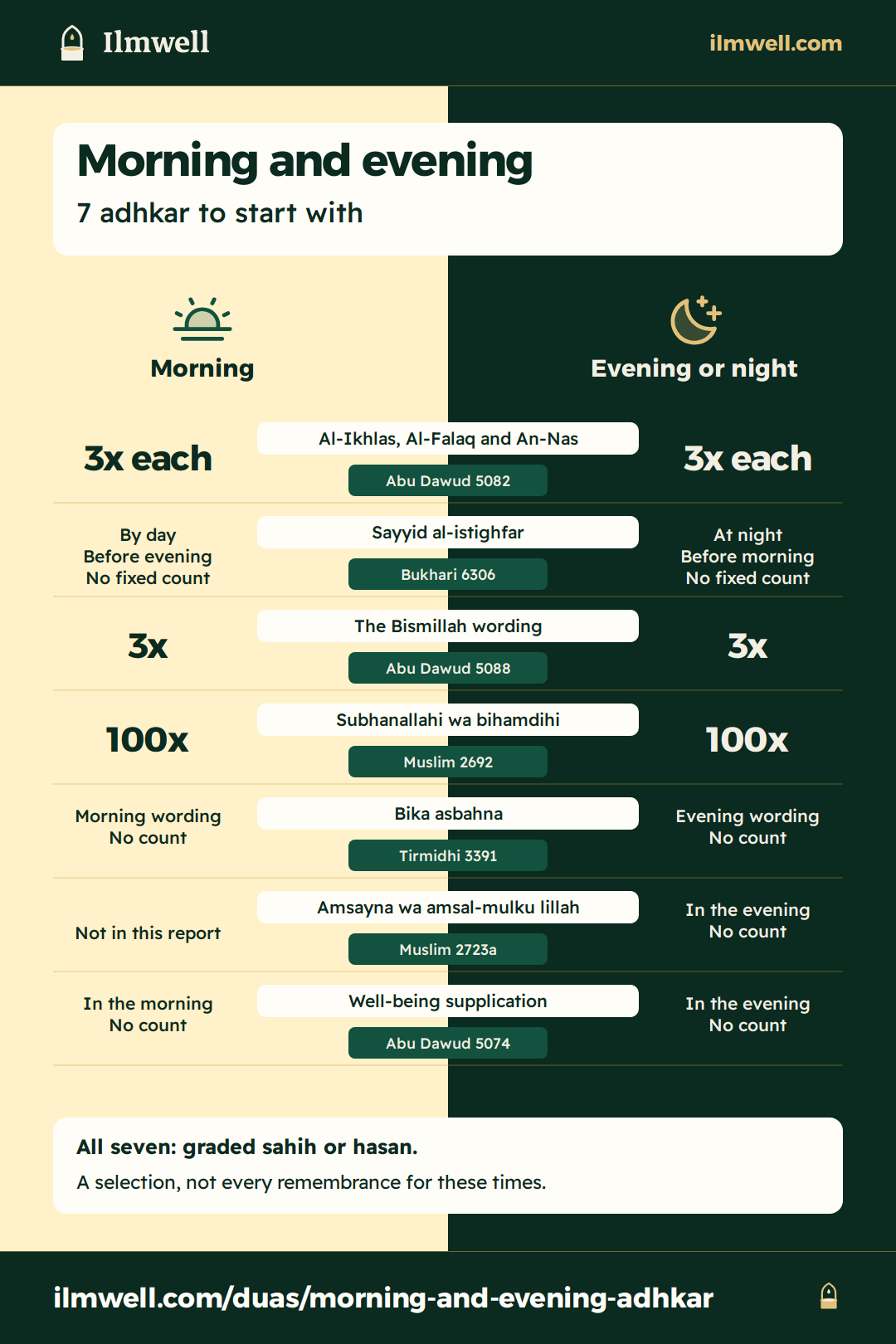
| Entry | Morning | Evening or night | Source |
|---|---|---|---|
| Al-Ikhlas, Al-Falaq and An-Nas | Three times (each surah) | Three times (each surah) | Abu Dawud 5082, hasan or sahih |
| Sayyid al-istighfar | By day, before evening (no fixed count) | At night, before morning (no fixed count) | Bukhari 6306, sahih |
| The Bismillah wording | Three times (no hour named) | Three times (no hour named; protection until morning) | Abu Dawud 5088, sahih or hasan |
| Subhanallahi wa bihamdihi | 100 times | 100 times | Muslim 2692, sahih |
| Bika asbahna | Morning wording (no count) | Evening wording (no count) | Tirmidhi 3391, sahih or hasan |
| Amsayna wa amsal-mulku lillah | Not in this report | Said in the evening (no count) | Muslim 2723a, sahih |
| Well-being supplication | Said in the morning (no count) | Said in the evening (no count) | Abu Dawud 5074, hasan or sahih |
Sahih means authentic and hasan good; both are accepting grades.

When should morning and evening adhkar be said?
Sunan Abi Dawud 5082 (graded hasan or sahih) and Sahih Muslim 2692 (graded sahih) name the morning and the evening and give no clock time. For timing this page relies on scholars' explanations, read as short excerpts in the Dorar compilation Al-Jami' al-Sahih fi al-Adhkar wa al-Ad'iyah and not in the books themselves. They rest on a secondary compilation, and none is a hadith.
| Scholar and work | What the excerpt says |
|---|---|
| Ibn al-Qayyim, Al-Wabil al-Sayyib, p. 93 | Ibn al-Qayyim reads the hadith words for morning and evening as before sunrise and before sunset, and places these remembrances after Fajr (the dawn prayer) and after 'Asr (the afternoon prayer) 10. |
| al-'Adawi, Hashiyah 'ala Kifayat al-Talib al-Rabbani, 2/479 | Al-'Adawi says the morning remembrance's time enters at dawn, but it is better after the dawn prayer until sunrise. He speaks of the morning only 11. |
| Ibn 'Allan, Al-Futuhat al-Rabbaniyyah, 3/73 to 74, quoting al-Haytami | Al-Haytami, as quoted by Ibn 'Allan, says the plain meaning in the hadiths is early night for evening and early day for morning 12. |
Ibn al-Qayyim and al-'Adawi both put the morning after Fajr until sunrise. Only Ibn al-Qayyim's excerpt names a prayer to anchor the evening, and al-Haytami's wording is looser. A simple plan that follows Ibn al-Qayyim: morning remembrances after Fajr and before sunrise, evening ones after 'Asr and before sunset 10. None of the excerpts says what to do once a time has passed.
Which three surahs are said three times?
In Sunan Abi Dawud 5082 (graded hasan or sahih), 'Abdullah ibn Khubayb, may Allah be pleased with him, reports a rainy, intensely dark night. The Prophet told him to say Qul huwa Allahu ahad and the two surahs of refuge (al-mu'awwidhatayn) three times, evening and morning. They would suffice him against everything. The report does not say what "suffice" covers, and it is not clinical advice.
1AuthenticSunan Abi Dawud 5082
- Al-Ikhlas (Qul huwa Allahu ahad): the full text is in Surah Ikhlas.
- Al-Falaq and An-Nas, the two surahs of refuge: the full text is in Al-Falaq and An-Nas.
- The four Quls add Al-Kafirun, which this report does not name.
What is Sayyid al-istighfar?
Sayyid al-istighfar, "the master of seeking forgiveness", is a prayer of repentance. In Sahih al-Bukhari 6306 (graded sahih), Shaddad ibn Aws, may Allah be pleased with him, reports the Prophet teaching this wording. The promise is tied to firm conviction: whoever says it by day and dies before evening, or at night and dies before morning, is among the people of Paradise. The report gives no count and says day and night, not morning and evening. Other reports of it were not examined here.
Sahih al-Bukhari 6306
اللَّهُمَّ أَنْتَ رَبِّي، لاَ إِلَهَ إِلاَّ أَنْتَ، خَلَقْتَنِي وَأَنَا عَبْدُكَ، وَأَنَا عَلَى عَهْدِكَ وَوَعْدِكَ مَا اسْتَطَعْتُ، أَعُوذُ بِكَ مِنْ شَرِّ مَا صَنَعْتُ، أَبُوءُ لَكَ بِنِعْمَتِكَ عَلَىَّ وَأَبُوءُ لَكَ بِذَنْبِي، فَاغْفِرْ لِي، فَإِنَّهُ لاَ يَغْفِرُ الذُّنُوبَ إِلاَّ أَنْتَ
Allāhumma anta rabbī, lā ilāha illā anta, khalaqtanī wa ana ʿabduka, wa ana ʿalā ʿahdika wa waʿdika mastaṭaʿtu. Aʿūdhu bika min sharri mā ṣanaʿtu. Abū'u laka biniʿmatika ʿalayya wa abū'u laka bidhanbī, faghfir lī fa-innahū lā yaghfirudh-dhunūba illā anta.
O Allah, You are my Lord. There is no god but You. You created me and I am Your servant. I hold to Your covenant and promise as far as I can. I seek Your refuge from the evil of what I have done. I acknowledge Your favour upon me and I acknowledge my sin. Forgive me, for no one forgives sins but You.
2AuthenticSahih al-Bukhari 6306
A fuller lesson is in Sayyidul istighfar. For the everyday words, see Astaghfirullah.
What is the Bismillah wording said three times?
In Sunan Abi Dawud 5088 (graded sahih or hasan), 'Uthman ibn Affan, may Allah be pleased with him, reports the Prophet saying that whoever says these words three times will not be struck by sudden affliction until morning. Whoever says them three times in the morning will not be struck until evening. The first part names no hour, only that the protection lasts until morning. For any health concern, see a doctor.
Sunan Abi Dawud 5088, graded sahih or hasan
بِسْمِ اللَّهِ الَّذِي لاَ يَضُرُّ مَعَ اسْمِهِ شَىْءٌ فِي الأَرْضِ وَلاَ فِي السَّمَاءِ وَهُوَ السَّمِيعُ الْعَلِيمُ
Bismillāhilladhī lā yaḍurru maʿasmihī shay'un fil-arḍi wa lā fis-samā'i wa huwas-samīʿul-ʿalīm.
In the name of Allah, with Whose name nothing on earth or in heaven causes harm. He is the All-Hearing, the All-Knowing.
The narrator Aban ibn 'Uthman was later struck by paralysis. He said he had not lied, but that on that day he became angry and forgot to say the words. That is his statement about himself. It gives no reason for anyone else's illness.
3AuthenticSunan Abi Dawud 5088
Which remembrance is said 100 times?
In Sahih Muslim 2692 (graded sahih), Abu Hurayrah, may Allah be pleased with him, reports these words of the Prophet. Whoever says Subhanallahi wa bihamdihi 100 times when he enters the morning and the evening will find that no one comes on the Day of Resurrection with anything better than what he brought. The Arabic ("when he enters the morning and when he enters the evening") reads most naturally as 100 at each time; we cite no scholar on this. The exception is someone who said the same or more. For the wording, see Subhanallah.
Sahih Muslim 2692
سُبْحَانَ اللَّهِ وَبِحَمْدِهِ
Subḥānallāhi wa biḥamdih.
Allah is far above any fault, and I praise Him.
4AuthenticSahih Muslim 2692
What is said on entering the morning and the evening?
In Jami at-Tirmidhi 3391 (graded sahih or hasan), Abu Hurayrah, may Allah be pleased with him, reports that the Prophet used to teach his companions two wordings, one for the morning and one for the evening. They differ in their first words and in their last: in this report the morning wording ends with the return (al-masir) and the evening wording with the resurrection (al-nushur). Other reports and graders give the two endings the other way round, so the order of the endings is not fixed. The report gives no count.
Jami at-Tirmidhi 3391, graded sahih or hasan, the morning wording
اللَّهُمَّ بِكَ أَصْبَحْنَا وَبِكَ أَمْسَيْنَا وَبِكَ نَحْيَا وَبِكَ نَمُوتُ وَإِلَيْكَ الْمَصِيرُ
Allāhumma bika aṣbaḥnā wa bika amsaynā wa bika naḥyā wa bika namūtu wa ilayka l-maṣīr.
Morning: O Allah, by You we enter the morning, by You we enter the evening, by You we live, by You we die, and to You is the return.
Jami at-Tirmidhi 3391, graded sahih or hasan, the evening wording
اللَّهُمَّ بِكَ أَمْسَيْنَا وَبِكَ أَصْبَحْنَا وَبِكَ نَحْيَا وَبِكَ نَمُوتُ وَإِلَيْكَ النُّشُورُ
Allāhumma bika amsaynā wa bika aṣbaḥnā wa bika naḥyā wa bika namūtu wa ilayka n-nushūr.
Evening: O Allah, by You we enter the evening, by You we enter the morning, by You we live, by You we die, and to You is the resurrection.
8AuthenticJami' at-Tirmidhi 3391
What did the Prophet say when the evening came?
In Sahih Muslim 2723a (graded sahih), 'Abdullah ibn Mas'ud, may Allah be pleased with him, reports that when it was evening the Prophet used to say the words below. The report then adds a continuation that comes through a later narrator: al-Zubayd told al-Hasan he had memorised it from Ibrahim. It asks Allah for the good of that night and seeks refuge from its evil, from sloth and the evil of old age, and from torment in the Fire and in the grave. This report gives the evening only. It gives no count and does not say he said it every evening.
Sahih Muslim 2723a, the opening of the evening supplication
أَمْسَيْنَا وَأَمْسَى الْمُلْكُ لِلَّهِ وَالْحَمْدُ لِلَّهِ لاَ إِلَهَ إِلاَّ اللَّهُ وَحْدَهُ لاَ شَرِيكَ لَهُ
Amsaynā wa amsā l-mulku lillāh, wa l-ḥamdu lillāh, lā ilāha illā llāhu waḥdahū lā sharīka lah.
We have entered the evening, and the whole kingdom belongs to Allah. Praise is due to Allah. There is no god but Allah alone, with no partner.
7AuthenticSahih Muslim 2723a
Which supplication for well-being is said morning and evening?
In Sunan Abi Dawud 5074 (graded hasan or sahih), 'Abdullah ibn 'Umar, may Allah be pleased with him, reports that the Prophet never failed to say these words in the evening and in the morning. Of its 28 listed gradings, 22 accept it as sahih or hasan and 6 are remarks; none is a verdict of weakness. The report gives no count and no reward. Only the first two requests are printed here; the report goes on to ask for faults to be concealed, fears to be calmed and protection from every side.
Sunan Abi Dawud 5074, graded hasan or sahih, the first two requests
اللَّهُمَّ إِنِّي أَسْأَلُكَ الْعَافِيَةَ فِي الدُّنْيَا وَالآخِرَةِ اللَّهُمَّ إِنِّي أَسْأَلُكَ الْعَفْوَ وَالْعَافِيَةَ فِي دِينِي وَدُنْيَاىَ وَأَهْلِي وَمَالِي
Allāhumma innī as'aluka l-ʿāfiyata fi d-dunyā wa l-ākhirah. Allāhumma innī as'aluka l-ʿafwa wa l-ʿāfiyata fī dīnī wa dunyāya wa ahlī wa mālī.
O Allah, I ask You for well-being in this world and the next. O Allah, I ask You for forgiveness and well-being in my religion, my worldly affairs, my family and my property.
9AuthenticSunan Abi Dawud 5074
Where do Ayat al-Kursi and the last two verses of Al-Baqarah fit?
Their reports name other times. Sahih al-Bukhari 2311 concerns Ayat al-Kursi on going to bed, and Sahih al-Bukhari 5009 the last two verses of Al-Baqarah in a night. Neither gives a count. The lessons: Ayat al-Kursi and the last two verses of Al-Baqarah.
5AuthenticSahih al-Bukhari 2311
6AuthenticSahih al-Bukhari 5009
I tried a morning routine more than once and gave up each time because the list was too long. What finally worked was one remembrance a week, with its meaning, until it stuck.
Try it: what would you say?
Pick an answer; each one explains itself.
1How often is each of the three surahs said in the report of Abu Dawud 5082?
Answer: Three times. Three times, evening and morning. Source 1
2Which entry on this page carries a count of 100?
Answer: Subhanallahi wa bihamdihi. Sahih Muslim 2692 gives 100 for Subhanallahi wa bihamdihi. Source 4
3In Jami at-Tirmidhi 3391, what does the evening wording end with?
Answer: wa ilayka n-nushur (and to You is the resurrection). In this report the morning wording ends with the return (al-masir) and the evening wording with the resurrection (al-nushur). Other reports give the endings the other way round. Source 8
4Does Sahih al-Bukhari 6306 give a fixed count for Sayyid al-istighfar?
Answer: No fixed count. It names conviction, by day or at night, and no count. Source 2
Questions people ask
Is there a good morning dua?
The sourced morning remembrances are on this page, with the Arabic and a copy button where the wording is printed. A good morning message in your own words is a different kind of text; one sent as a saying of the Prophet needs its hadith reference.
Is transliteration enough to learn the Arabic sounds?
It is a starting aid. Here ā, ī and ū mark long vowels, ḥ a breathy h and ʿ the letter ayn. A fluent teacher can correct sounds Latin letters cannot show.
Sources
Every claim on this page comes from one of these. Gradings are reported with the scholar's name; we do not grade hadith ourselves.
- 1
Abdullah ibn Khubayb narrated that on a night of rain and deep darkness the Prophet told him to say Qul huwa Allahu ahad and the mu'awwidhatayn three times, evening and morning. He said they would suffice him against everything.
Sunan Abi Dawud 5082 Book 43, Hadith 310
Authentic: hasan (Al-Albani); its chain is hasan (Shu'ayb al-Arna'ut); hasan (Ibn Hajar al-'Asqalani); its chain is hasan (Ibn Baz); its chain is sahih (Al-Nawawi); hasan, as he set out in the introduction (Ibn Hajar al-'Asqalani); hasan sahih (Al-Albani); sahih (Ibn Daqiq al-'Id); does not fall below hasan, and may meet the conditions of both Sahihs or one of them (Al-Mundhiri); sahih (Al-Albani); hasan sahih, gharib by this route (Al-Tirmidhi); Hasan (Darussalam). Remarks: silent about it; he said whatever he is silent about is fit (Abu Dawud)
- 2
Shaddad ibn Aws reported the Prophet saying that sayyid al-istighfar (the master of seeking forgiveness) is this wording, and that whoever says it by day with firm conviction and dies that day before evening, or says it at night with firm conviction and dies before morning, is among the people of Paradise.
Sahih al-Bukhari 6306 Book 80, Hadith 3
Authentic: in Sahih al-Bukhari
- 3
'Uthman ibn Affan reported the Prophet saying that whoever says 'In the name of Allah, with Whose name nothing on earth or in heaven causes harm, and He is the All-Hearing, the All-Knowing' three times will not be struck by sudden affliction until morning, and whoever says it three times in the morning will not be struck until evening. The narrator Aban ibn 'Uthman, struck by paralysis, said he had become angry that day and forgotten to say it.
Sunan Abi Dawud 5088 Book 43, Hadith 316
Authentic: sahih (Al-Albani); hasan (Shu'ayb al-Arna'ut); hasan (Al-Wadi'i)
- 4
Abu Hurayrah reported the Prophet saying that whoever says 'Subhan Allah wa bihamdihi' 100 times when he enters the morning and when he enters the evening will find that no one comes on the Day of Resurrection with anything better than what he brought, except someone who said the same or more.
Sahih Muslim 2692 Book 48, Hadith 39
Authentic: in Sahih Muslim
- 5
A thief whom Abu Hurayrah caught three nights running taught him to recite Ayat al-Kursi at bedtime, so that a guardian from Allah stays with him and no devil comes near until morning. The Prophet said the thief had told the truth though he was a liar, and that he was a devil.
Sahih al-Bukhari 2311 Book 40, Hadith 11
Authentic: sahih on the conditions of al-Bukhari (Ibn Hajar al-'Asqalani); sahih, well known (Ibn al-Mulaqqin); Sahih (Al-Albani). Remarks: mu'allaq: recorded with the start of its chain left out (Al-Bukhari)
- 6
The Prophet said that whoever recites the two verses at the end of Surat al-Baqarah in a night, they will suffice him.
Sahih al-Bukhari 5009 Book 66, Hadith 31
Authentic: in Sahih al-Bukhari
- 7
'Abdullah ibn Mas'ud reported that when it was evening the Prophet used to say: 'We have entered the evening and the kingdom belongs to Allah, and praise is for Allah; there is no god but Allah alone, with no partner.' The narrator al-Hasan then says that al-Zubayd told him he had memorised from Ibrahim, in this report, the continuation: His is the sovereignty and the praise and He has power over everything; O Allah, I ask You for the good of this night and seek refuge in You from the evil of this night and of what comes after it; O Allah, I seek refuge in You from sloth and the evil of old age (su' al-kibar); O Allah, I seek refuge in You from a torment in the Fire and a torment in the grave.
Sahih Muslim 2723a Book 48, Hadith 100
Authentic: in Sahih Muslim
- 8
Abu Hurayrah reported that the Prophet used to teach his companions to say in the morning: O Allah, by You we enter the morning, by You we enter the evening, by You we live, by You we die, and to You is the return; and in the evening: O Allah, by You we enter the evening, by You we enter the morning, by You we live and die, and to You is the resurrection (al-nushur).
Jami' at-Tirmidhi 3391 Book 48, Hadith 22
Authentic: Sahih (Darussalam); sahih (Al-Albani); its chain is sahih (Al-Nawawi); sahih (Ibn Daqiq al-'Id); sahih (Ibn Hajar al-'Asqalani); verdict as listed on dorar.net (Shu'ayb al-Arna'ut); its chain is sahih (Shu'ayb al-Arna'ut); sahih (Ibn al-Mulaqqin); hasan sahih (Al-Albani); sahih (Ibn al-Qayyim); verdict as listed on dorar.net (Ibn Hajar al-'Asqalani); hasan (Al-Tirmidhi); its chain is sahih (Ibn Baz); hasan (البغوي); it has witnesses that raise it to sahih (زين الدين المناوي); hasan (Al-Wadi'i). Remarks: silent about it (Abu Dawud); a preference between two wordings: the endings al-nushur / al-masir swapped; not a verdict on the Tirmidhi order (Ibn al-Qayyim); a different report: al-Busiri lists it under 'Abdullah ibn Sa'id ibn Abi Hind al-Fazari, a mursal (Al-Busiri); verdict as listed on dorar.net (محمد ابن يوسف الصالحي); verdict as listed on dorar.net (Al-Wadi'i); the chain is sahih with the endings swapped; about the other order, not the Tirmidhi order (Al-Albani); silent about it (عبد الحق الإشبيلي); verdict as listed on dorar.net (Ibn Hibban); its chain is hasan (Shu'ayb al-Arna'ut)
- 9
Abdullah ibn Umar reported that the Prophet never failed to say these words in the evening and in the morning: O Allah, I ask You for well-being in this world and the next; forgiveness and well-being in my religion, my worldly affairs, my family and my property; conceal my faults and calm my fears; guard me from in front, behind, my right, my left and above; and I seek refuge in Your greatness from being swallowed from below.
Sunan Abi Dawud 5074 Book 43, Hadith 302
Authentic: sahih (Al-Albani); its chain is sahih (Shu'ayb al-Arna'ut); verdict as listed on dorar.net (Ibn Hibban); verdict as listed on dorar.net (Shu'ayb al-Arna'ut); its chain is sahih (Ahmad Shakir); its chain is sahih (Al-Hakim); hasan (البزار); its chain is sahih (Al-Albani); sahih (Ibn al-Mulaqqin); its chain is sahih (Al-Nawawi); hasan (Ibn Hajar al-'Asqalani); verdict as listed on dorar.net (Al-Mundhiri); verdict as listed on dorar.net (صدر الدين المناوي); verdict as listed on dorar.net (Ibn Hajar al-'Asqalani); sahih (Al-Wadi'i). Remarks: verdict as listed on dorar.net (Al-Sakhawi); silent about it (عبد الحق الإشبيلي); verdict as listed on dorar.net (Ahmad Shakir); a verdict on a different report: the Ibn Abbas route with the same wording (Al-Haythami); verdict as listed on dorar.net (عبد الحق الإشبيلي); silent about it (Abu Dawud)
- 10
Ibn al-Qayyim, in Al-Wabil al-Sayyib, reads the hadith wording 'when he enters the morning and when he enters the evening' as meaning before sunrise and before sunset, and says the place of these remembrances is after the Fajr (Subh) prayer and after 'Asr.
Ibn al-Qayyim, Al-Wabil al-Sayyib, p. 93 Read as an excerpt in the Dorar compilation (a secondary source; the edition was not inspected). Record: scholarly-ibnqayyim-wabil-timing.
- 11
Al-'Adawi, in his Hashiyah on Kifayat al-Talib al-Rabbani, says the time of the remembrance asked for in the morning enters at dawn, but that it is best done after the dawn (Subh) prayer until sunrise.
al-'Adawi, Hashiyah 'ala Kifayat al-Talib al-Rabbani, 2/479 Read as an excerpt in the Dorar compilation (a secondary source; the edition was not inspected). Record: scholarly-adawi-hashiyah-morning-timing.
- 12
Ibn 'Allan, in Al-Futuhat al-Rabbaniyyah, quotes Ibn Hajar al-Haytami saying that the apparent meaning of 'evening' in the hadiths is the early part of the night and of 'morning' the early part of the day.
Ibn 'Allan, Al-Futuhat al-Rabbaniyyah, 3/73 to 74, quoting Ibn Hajar al-Haytami Read as an excerpt in the Dorar compilation (a secondary source; the edition was not inspected). Record: scholarly-ibnallan-futuhat-haytami-timing.
Next
- The four Quls: Al-Ikhlas, Al-Falaq, An-Nas and Al-KafirunQuran lesson
- Subhanallah: meaning and everyday contextsPhrase lesson
- Astaghfirullah: meaning and seeking forgivenessPhrase lesson
- Sayyidul istighfar: words, meaning and contextDua lesson
- Manzil dua: Quran passages and the collection explained
- Duas, Remembrance and PhrasesThe hub
For your own situation, ask a scholar you trust.
Join the email list
New guides by email, now and then. No spam, and you can leave at any time.
Ilmwell is free and kept going by readers. See how to support it.