The short answer
The dua for travelling, or travel dua, is what the Prophet Muhammad, peace be upon him, said once mounted for a journey (Sahih Muslim 1342, graded authentic). He said Allahu akbar three times, then subhanalladhi sakhkhara lana hadha, words from the Quran, followed by requests for an easy and righteous journey.
What is the travel dua in Arabic?
Ibn 'Umar, may Allah be pleased with him, taught it in this order. After Allahu akbar three times come words of the Quran:
Quran: Az-Zukhruf 43:13 to 14
سُبْحَـٰنَ ٱلَّذِى سَخَّرَ لَنَا هَـٰذَا وَمَا كُنَّا لَهُۥ مُقْرِنِينَ وَإِنَّآ إِلَىٰ رَبِّنَا لَمُنقَلِبُونَ
subḥāna lladhī sakhkhara lanā hādhā wa mā kunnā lahū muqrinīn, wa innā ilā rabbinā la-munqalibūn
Glorified be He Who has subdued these to us, and we were not capable (of subduing them). And indeed, to our Lord we surely are returning.
The rest is hadith only, the Prophet's words:
Hadith: Sahih Muslim 1342
اللَّهُمَّ إِنَّا نَسْأَلُكَ فِي سَفَرِنَا هَذَا الْبِرَّ وَالتَّقْوَى وَمِنَ الْعَمَلِ مَا تَرْضَى اللَّهُمَّ هَوِّنْ عَلَيْنَا سَفَرَنَا هَذَا وَاطْوِ عَنَّا بُعْدَهُ اللَّهُمَّ أَنْتَ الصَّاحِبُ فِي السَّفَرِ وَالْخَلِيفَةُ فِي الأَهْلِ اللَّهُمَّ إِنِّي أَعُوذُ بِكَ مِنْ وَعْثَاءِ السَّفَرِ وَكَآبَةِ الْمَنْظَرِ وَسُوءِ الْمُنْقَلَبِ فِي الْمَالِ وَالأَهْلِ
allāhumma innā nas'aluka fī safarinā hādhā l-birra wa t-taqwā, wa mina l-ʿamali mā tarḍā. allāhumma hawwin ʿalaynā safaranā hādhā waṭwi ʿannā buʿdah. allāhumma anta ṣ-ṣāḥibu fi s-safari wa l-khalīfatu fi l-ahl. allāhumma innī aʿūdhu bika min waʿthā'i s-safari wa ka'ābati l-manẓari wa sū'i l-munqalabi fi l-māli wa l-ahl
O Allah, on this journey of ours we ask You for righteousness and piety, and for deeds that please You. O Allah, make this journey easy for us and fold up its distance for us. O Allah, You are the Companion on the journey and the One left in charge of the family. O Allah, I seek refuge in You from the hardship of travel, from a sight that brings sorrow, and from an evil return to property and family.
On the way back he said the same words and added:
Hadith: Sahih Muslim 1342
آيِبُونَ تَائِبُونَ عَابِدُونَ لِرَبِّنَا حَامِدُونَ
āyibūna tā'ibūna ʿābidūna li-rabbinā ḥāmidūn
Returning, repenting, worshipping, and praising our Lord.
1AuthenticSahih Muslim 1342
What does the travel dua mean?
Five key phrases:
Arabic reads right to left, so the first word is on the right.
- الْبِرَّ وَالتَّقْوَىal-birra wa t-taqwārighteousness and piety
- الْخَلِيفَةُ فِي الأَهْلِal-khalīfatu fi l-ahlthe One left in charge of the family
- وَعْثَاءِ السَّفَرِwaʿthā'i s-safarthe hardship of travel
- كَآبَةِ الْمَنْظَرِka'ābati l-manẓara sight that brings sorrow
- سُوءِ الْمُنْقَلَبِsū'i l-munqalaban evil return
How do you pronounce the travel dua?
subḥānalladhīsakhkharalanāhādhā
- ḥ in subḥāna is a breathy h from the throat.
- kh is the sound in Scottish "loch", doubled in sakh-khara.
Listen and repeat. A looped recording by a fluent reciter is coming. We do not use a synthetic voice for Arabic.
What order do you say it in?
| When | Say | From |
|---|---|---|
| Once seated, setting off | Allahu akbar, three times | Hadith, Sahih Muslim 1342 |
| Then | Subhanalladhi sakhkhara lana hadha ... la-munqalibun | Quran, Az-Zukhruf 43:13 to 14 |
| Then | Allahumma inna nas'aluka ... fil-mali wal-ahl | Hadith, Sahih Muslim 1342 |
| Coming home | The same words, adding ayibuna ta'ibuna 'abiduna li-rabbina hamidun | As above; added words: hadith, Sahih Muslim 1342 |
The travel dua as a card
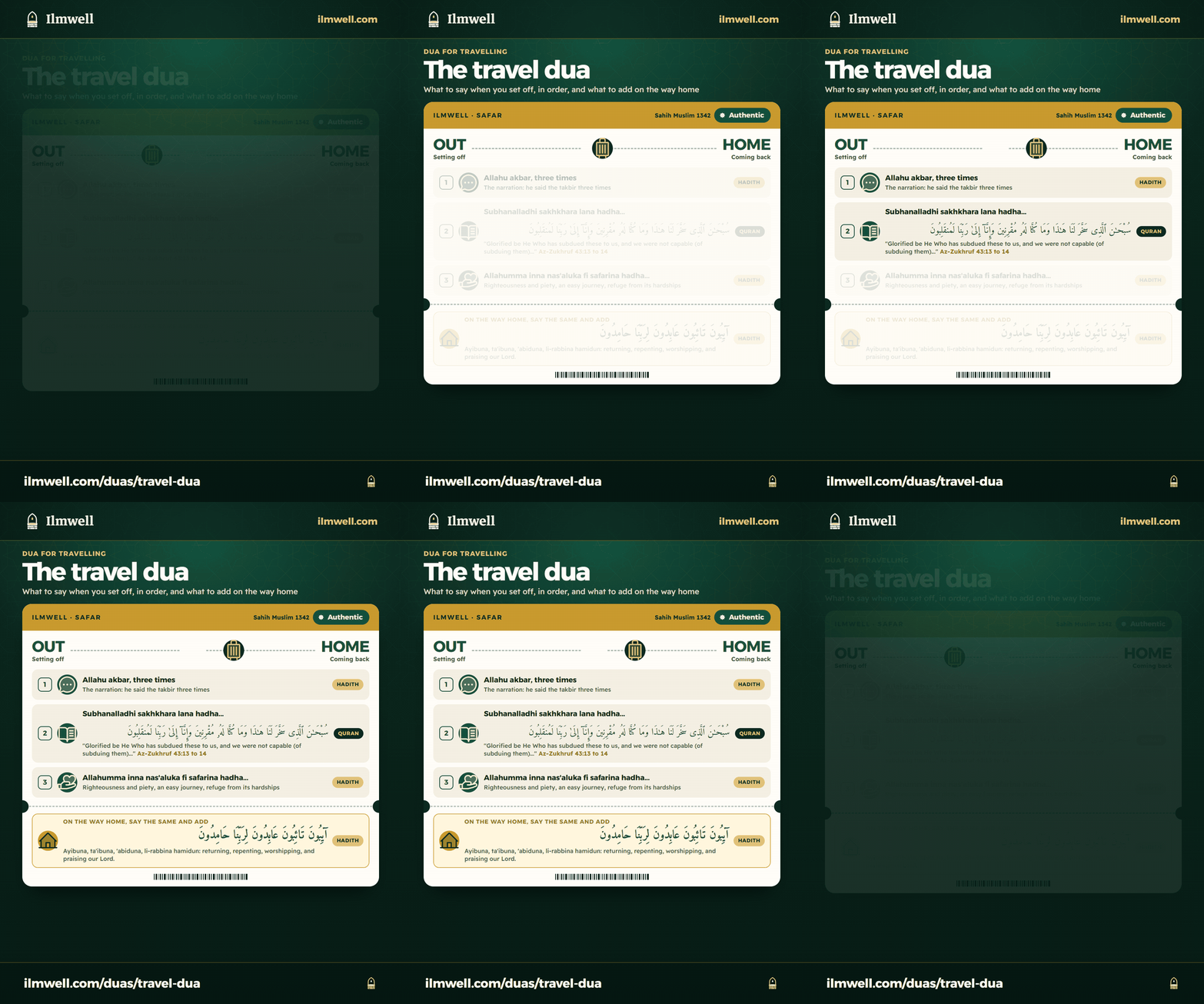
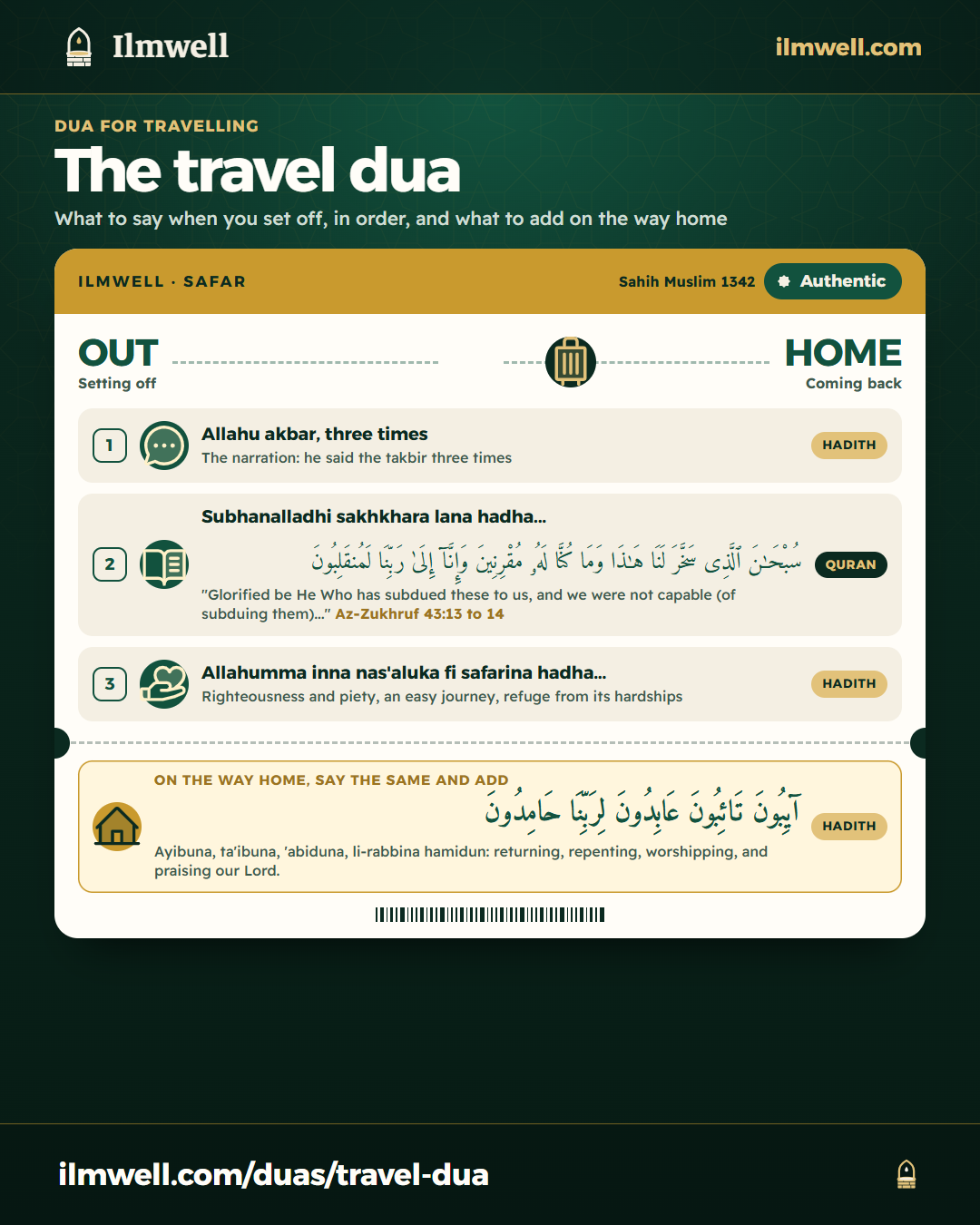
The travel dua as a boarding pass, from Sahih Muslim 1342, graded authentic. Setting off: 1, Allahu akbar three times, hadith; 2, subhanalladhi sakhkhara lana hadha, Quran, Az-Zukhruf 43:13 to 14, glorified be He who has subdued these to us; 3, Allahumma inna nas'aluka fi safarina hadha, hadith: righteousness and piety, an easy journey, refuge from its hardships. On the way home, say the same and add: ayibuna, ta'ibuna, 'abiduna, li-rabbina hamidun, returning, repenting, worshipping, and praising our Lord.
Say the whole family is in the car and nobody can remember what comes after Allahu akbar: this card is for that moment. Print it or keep it on your phone, with each part marked Quran or hadith.
Posting it on your own site? Link back to this guide; the code under "Use it on your own site" does it in one line.
When do you say the dua for travelling?
As a dua before travelling, it belongs to the start, once you are seated: the Prophet said it on settling on his camel to set out, and again on the way home.
Can you say it in a car or on a plane?
The narrations describe a camel and a riding animal; Az-Zukhruf 43:12, just before the Quran words, names ships as well as cattle as things to ride. 'Abd al-'Aziz ibn Baz, asked about hanging the travel dua up in a car, said the traveller says it himself when he mounts his riding animal or his car (source 5). His answer does not mention planes.
What is said when mounting a riding animal?
In a separate narration, 'Ali ibn Rabi'ah watched as a riding animal was brought to 'Ali ibn Abi Talib, may Allah be pleased with him. 'Ali said:
- Bismillah, as he put his foot in the stirrup.
- Alhamdulillah, once seated on its back.
- Subhanalladhi sakhkhara lana hadha ... la-munqalibun, the same Quran words.
- Alhamdulillah three times, then Allahu akbar three times, then:
Hadith: Sunan Abi Dawud 2602, authentic
سُبْحَانَكَ إِنِّي ظَلَمْتُ نَفْسِي فَاغْفِرْ لِي فَإِنَّهُ لاَ يَغْفِرُ الذُّنُوبَ إِلاَّ أَنْتَ
subḥānaka innī ẓalamtu nafsī faghfir lī, fa-innahu lā yaghfiru dh-dhunūba illā ant
Glory be to You. I have wronged myself, so forgive me, for none forgives sins except You.
Then he laughed: he had seen the Prophet do the same and laugh, and say that your Lord is pleased with His servant who says "forgive me my sins", knowing none forgives sins but Him. Jami' at-Tirmidhi 3446 has Bismillah three times.
2AuthenticSunan Abi Dawud 2602
Is there a dua for entering a town?
Yes, in a narration graded differently. Suhayb, may Allah be pleased with him, reported that the Prophet never saw a town he wanted to enter without saying, when he saw it:
Hadith: an-Nasa'i, as-Sunan al-Kubra 10302
اللَّهمَّ ربَّ السَّماواتِ السَّبعِ وما أظلَلنَ ، وربَّ الأرضينَ وما أقلَلنَ، وربَّ الشَّياطينِ وما أضلَلنَ ، وربَّ الرِّياحِ وما ذَرَينَ، فإنَّا نسألُكَ خيرَ هذِهِ القريةِ، وخيرَ أَهْلِها، ونعوذُ بِكَ من شرِّها وشرِّ أَهْلِها وشرِّ ما فيها
O Allah, Lord of the seven heavens and all they shade, Lord of the earths and all they bear, Lord of the devils and all they mislead, Lord of the winds and all they scatter: we ask You for the good of this town and of its people, and we seek Your protection from its evil, the evil of its people and the evil within it.
Most other listings say "the seven earths". Another wording has "I ask You" for "we ask You" and adds wa khayra ma fiha, "and the good of what is in it".
Is the dua of a traveller answered?
A hadith graded differently says so. Abu Hurayrah, may Allah be pleased with him, reported the Prophet saying that three supplications are answered, with no doubt about them: that of the wronged, that of the traveller, and that of a father against his child. It gives no set words for travellers.
Before a long drive to see family, Mum would say the travel dua out loud in the car so all of us heard it. I can still hear it in her voice. I say it quietly at the start of any long journey now.
Try it: what would you say?
Pick an answer; each one explains itself.
1Which part of the travel dua is from the Quran?
Answer: Subhanalladhi sakhkhara lana hadha ... la-munqalibun. Az-Zukhruf 43:13 to 14. The requests after it come from the hadith. Source 1
Questions people ask
What is safar ki dua?
Safar ki dua is Urdu for "the dua of travel". Also written safar dua or travel duaa, it is the travel dua of Sahih Muslim 1342, graded authentic.
Is there a dua for safe travels?
The travel dua asks for an easy journey and refuge from its hardship (Sahih Muslim 1342, graded authentic).
What is the dua for travelling on a plane?
The narrations on this page name no separate plane dua; the travel dua is Sahih Muslim 1342, graded authentic.
Sources
Every claim on this page comes from one of these. Gradings are reported with the scholar's name; we do not grade hadith ourselves.
- 1
Ibn 'Umar taught that when the Prophet settled on his camel to set out for a journey, he said the takbir three times, then subhanalladhi sakhkhara lana hadha (Az-Zukhruf 43:13 to 14) and a set of requests for the journey; on returning he said the same and added ayibuna ta'ibuna 'abiduna li-rabbina hamidun.
Sahih Muslim 1342 Book 15, Hadith 479
Authentic: in Sahih Muslim (Muslim); Sahih (Muslim); its chain is sahih (Ahmad Shakir); its chain is sahih to Muslim's standard (Shu'ayb al-Arna'ut); included in his Sahih (Ibn Hibban); included in his Sahih (Ibn Khuzaymah); sahih (Ibn Jarir al-Tabari). Remarks: it contains 'Ali ibn 'Abdullah al-Azdi, whom Shu'ba used to call weak (Ibn al-Qaysarani)
- 2
'Ali ibn Rabi'ah saw 'Ali ibn Abi Talib mount a riding animal saying Bismillah, alhamdulillah, subhanalladhi sakhkhara lana hadha, alhamdulillah three times, Allahu akbar three times and subhanaka inni zalamtu nafsi faghfir li; 'Ali said he had seen the Prophet do as he did, and the Prophet said Allah is pleased when His servant asks forgiveness knowing only He forgives sins.
Sunan Abi Dawud 2602 Book 15, Hadith 126
Authentic: Sahih (Al-Albani); Sahih (Darussalam); hasan sahih (Al-Tirmidhi); sahih (Al-Albani); hasan sahih (Al-Albani); hasan (Shu'ayb al-Arna'ut); hasan through other routes (Shu'ayb al-Arna'ut); its chain is sahih (Ahmad Shakir); its chain is sahih (Al-Nawawi); its chain is sahih (Ibn al-Qayyim); hasan, by the rule in his introduction (Ibn Hajar al-'Asqalani); included in his Sahih (Ibn Hibban). Remarks: he was silent on it; in his letter to the people of Makkah he said whatever he is silent on is fit to use (Abu Dawud); its narrators are trustworthy, narrators of al-Bukhari and Muslim (Shu'ayb al-Arna'ut); included in his selection of narrations not in al-Bukhari and Muslim (Al-Diya' al-Maqdisi); a note on which narrators alone carry certain routes (Al-Daraqutni)
- 3
Suhayb reported that the Prophet never saw a town he wanted to enter without saying, on seeing it, a dua to the Lord of the heavens, the earths, the devils and the winds, asking for the good of the town and its people and refuge from its evil.
An-Nasa'i, as-Sunan al-Kubra 10302 Al-Nasa'i, al-Sunan al-Kubra, no. 10302, as dorar.net cites it
Graded differently. Here is who graded it which way:
- SoundAl-Hakim, Ibn Khuzaymah, Ibn Hibban, Abu Nu'aym, Al-Albani, Muqbil al-Wadi'i, Ibn Baz, Ibn Hajar al-'Asqalani, Shu'ayb al-Arna'ut
- Weak chain, strengthenedAl-Albani
- WeakAl-Dhahabi
- Other remarksAl-Nasa'i, Al-Bayhaqi, Shu'ayb al-Arna'ut, Muhammad ibn Yusuf al-Salihi, Al-Diya' al-Maqdisi, Al-Haythami
See each grading in full, with its wording and where it was given
Scholars disagree about this hadith. Here is how each graded it, so you can follow the scholar you trust.
- حفص بن ميسرة لا بأس به (Hafs ibn Maysara: there is no harm in him): Al-Nasa'i, al-Sunan al-Kubra 10302 (as listed on dorar.net)
- صحيح الإسناد (sahih in its chain): Al-Hakim, al-Mustadrak 1654 (as listed on dorar.net)
- صحيح الإسناد (sahih in its chain): Al-Hakim, al-Mustadrak 2523 (as listed on dorar.net)
- أخرجه في صحيحه (included in his Sahih): Ibn Khuzaymah, Sahih Ibn Khuzaymah 4/254 (as listed on dorar.net)
- إسناده حسن لغيره وله شواهد يتقوى بها (its chain is hasan through others; it has supporting narrations that strengthen it): Al-Albani, takhrij Sahih Ibn Khuzaymah 2565 (as listed on dorar.net)
- أخرجه في صحيحه (included in his Sahih): Ibn Hibban, Sahih Ibn Hibban 2709 (as listed on dorar.net)
- روي من وجه ضعيف (it was narrated through a weak route): Al-Bayhaqi, al-Sunan al-Kubra 5/252 (as listed on dorar.net)
- له علة (it has a hidden defect): Al-Dhahabi, al-Muhadhdhab fi Ikhtisar al-Sunan 4/2014 (as listed on dorar.net)
- [فيه] أبو مروان والد عطاء ... قال النسائي: ليس بالمعروف، ولا تثبت له صحبة (it contains Abu Marwan, father of 'Ata'; al-Dhahabi lists him and quotes al-Nasa'i: not well known, and his companionship is not established): Shu'ayb al-Arna'ut, takhrij Zad al-Ma'ad 2/411 (as listed on dorar.net)
- ثابت من حديث موسى بن عقبة تفرد به عنه عطاء (established from the narration of Musa ibn 'Uqba; 'Ata' alone narrates it from him): Abu Nu'aym, Hilyat al-Awliya' 6/45 (as listed on dorar.net)
- رجاله ثقات (its narrators are trustworthy): Muhammad ibn Yusuf al-Salihi, Subul al-Huda wa al-Rashad 7/422 (as listed on dorar.net)
- أورده في المختارة (included in his selection of narrations not in al-Bukhari and Muslim): Al-Diya' al-Maqdisi, al-Ahadith al-Mukhtarah 8/72 (as listed on dorar.net)
- حسن (hasan): Al-Albani, Fiqh al-Sira 340 (as listed on dorar.net; the opening in brackets identifies it as this report)
- صحيح (sahih): Muqbil al-Wadi'i, al-Sahih al-Musnad 509 (as listed on dorar.net)
- صحيح (sahih): Al-Albani, Tamam al-Minna 323 (as listed on dorar.net; the opening words only)
- رجاله رجال الصحيح غير عطاء بن أبي مروان وأبيه وكلاهما ثقة (its narrators are those of the Sahih except 'Ata' ibn Abi Marwan and his father, both trustworthy): Al-Haythami, Majma' al-Zawa'id 10/138 (as listed on dorar.net)
- إسناده حسن (its chain is hasan): Ibn Baz, Majmu' al-Fatawa 26/46 (as listed on dorar.net; the "as'aluka" wording)
- إسناده صحيح وله شاهد (its chain is sahih and it has a supporting narration): Al-Albani, al-Kalim al-Tayyib 179 (as listed on dorar.net; the "as'aluka" wording)
- حسن (hasan): Ibn Hajar al-'Asqalani, al-Futuhat al-Rabbaniyya 5/154 (as listed on dorar.net; the "as'aluka" wording)
- إسناده حسن (its chain is hasan): Shu'ayb al-Arna'ut, takhrij Zad al-Ma'ad 1/447 (as listed on dorar.net; the "as'aluka" wording)
- إسناده حسن (its chain is hasan): Shu'ayb al-Arna'ut, takhrij Mushkil al-Athar 1778 (as listed on dorar.net)
- 4
Abu Hurayrah reported the Prophet saying that three supplications are answered, with no doubt about them: the supplication of the wronged, of the traveller, and of a father against his child.
Jami' at-Tirmidhi 1905 Book 27, Hadith 11
Graded differently. Here is who graded it which way:
- SoundDarussalam, Al-Albani, Al-Tirmidhi, Shu'ayb al-Arna'ut, Al-Mundhiri, Ibn Hajar al-'Asqalani, Ibn Hibban
- Weak chain, strengthenedAl-Albani, Shu'ayb al-Arna'ut
- WeakIbn al-Qattan
- Other remarksAbu Dawud, 'Abd al-Haqq al-Ishbili, Ibn al-'Arabi
See each grading in full, with its wording and where it was given
Scholars disagree about this hadith. Here is how each graded it, so you can follow the scholar you trust.
- Hasan: Darussalam, on Jami' at-Tirmidhi 1905 (as shown on sunnah.com)
- Hasan: Al-Albani, on Sunan Abi Dawud 1536 (as shown on sunnah.com)
- حسن (hasan): Al-Tirmidhi, Jami' at-Tirmidhi 3448 (in the Arabic on sunnah.com and as listed on dorar.net)
- Hasan: Darussalam, on Jami' at-Tirmidhi 3448 (as shown on sunnah.com)
- Hasan: Darussalam, on Sunan Ibn Majah 3862 (as shown on sunnah.com)
- حسن (hasan): Al-Albani, Sahih al-Tirmidhi 3448 (as listed on dorar.net)
- حسن (hasan): Al-Albani, Sahih Abi Dawud 1536 (as listed on dorar.net)
- حسن لغيره (hasan through other routes): Al-Albani, al-Silsila al-Sahiha 596 (as listed on dorar.net)
- حسن (hasan): Al-Albani, Sahih al-Targhib 3132 (as listed on dorar.net)
- حسن (hasan): Al-Albani, Hidayat al-Ruwat 2190 (as listed on dorar.net)
- صحيح (sahih): Al-Albani, Sahih al-Adab al-Mufrad 372 (as listed on dorar.net)
- سكت عنه [وقد قال في رسالته لأهل مكة كل ما سكت عنه فهو صالح] (he was silent on it; in his letter to the people of Makkah he said whatever he is silent on is fit to use): Abu Dawud, Sunan Abi Dawud 1536 (as listed on dorar.net)
- حسن لغيره (hasan through other routes): Shu'ayb al-Arna'ut, takhrij Sunan Abi Dawud 1536 (as listed on dorar.net)
- إسناده صحيح (its chain is sahih): Shu'ayb al-Arna'ut, takhrij Sunan Abi Dawud 2/639, under 'ittaqu da'wat al-mazlum', which dorar.net identifies as this hadith (as listed on dorar.net)
- حسن لغيره (hasan through other routes): Shu'ayb al-Arna'ut, takhrij al-Musnad 10196 (as listed on dorar.net)
- حسن لغيره (hasan through other routes): Shu'ayb al-Arna'ut, takhrij al-Musnad 9606 (as listed on dorar.net)
- [إسناده صحيح أو حسن أو ما قاربهما] (its chain is sahih, hasan or close to them): Al-Mundhiri, al-Targhib wa al-Tarhib 4/116 (as listed on dorar.net)
- [حسن كما قال في المقدمة] (hasan, by the rule in his introduction): Ibn Hajar al-'Asqalani, Hidayat al-Ruwat 2/415 (as listed on dorar.net)
- أخرجه في صحيحه (included in his Sahih): Ibn Hibban, Sahih Ibn Hibban 2699 (as listed on dorar.net)
- سكت عنه (he was silent about it, which by his stated rule indicates soundness if he names no defect): 'Abd al-Haqq al-Ishbili, al-Ahkam al-Wusta 4/255 (as listed on dorar.net)
- [معلول] (defective): Ibn al-Qattan, as cited in al-Badr al-Munir 5/153 (as listed on dorar.net)
- الحديث مجهول وربما شهدت له الأصول (the hadith is unknown, and perhaps general principles support it): Ibn al-'Arabi, as cited in Fayd al-Qadir 3/301 (as listed on dorar.net)
- Q
Quran Arabic for Az-Zukhruf 43:13 to 14 (the first scroll and its English) and the reference to 43:12.
Tanzil Project Uthmani text, CC BY 3.0. English: adapted from Marmaduke Pickthall's translation (1930), modernised and checked against modern translations.
- 5
'Abd al-'Aziz ibn Baz, asked about hanging the travel dua up in a car, said the traveller says it with his own tongue when he mounts his riding animal or his car. One scholar's answer; it does not mention planes.
Ibn Baz, Fatawa al-Durus, fatwa 24521 (official site) Record: scholarly-travel-dua-car.
Next
For your own situation, ask a scholar you trust.
Join the email list
New guides by email, now and then. No spam, and you can leave at any time.
Ilmwell is free and kept going by readers. See how to support it.