The short answer
The Janazah prayer (also spelt janaza) is the funeral prayer; to perform it, you say four takbirs (the words Allahu akbar) with a supplication for the deceased. Sahih al-Bukhari 1333 (graded sahih) records the Prophet Muhammad, peace be upon him, saying four takbirs over al-Najashi. The four schools differ on the recitation, the fourth takbir and the salam.
How do you pray Janazah?
If you are learning the order before a funeral, the steps below give it in one place. They follow the school texts cited in the table, as those texts describe them. They are not a ruling from us. To go straight to the words, see the Janazah dua.
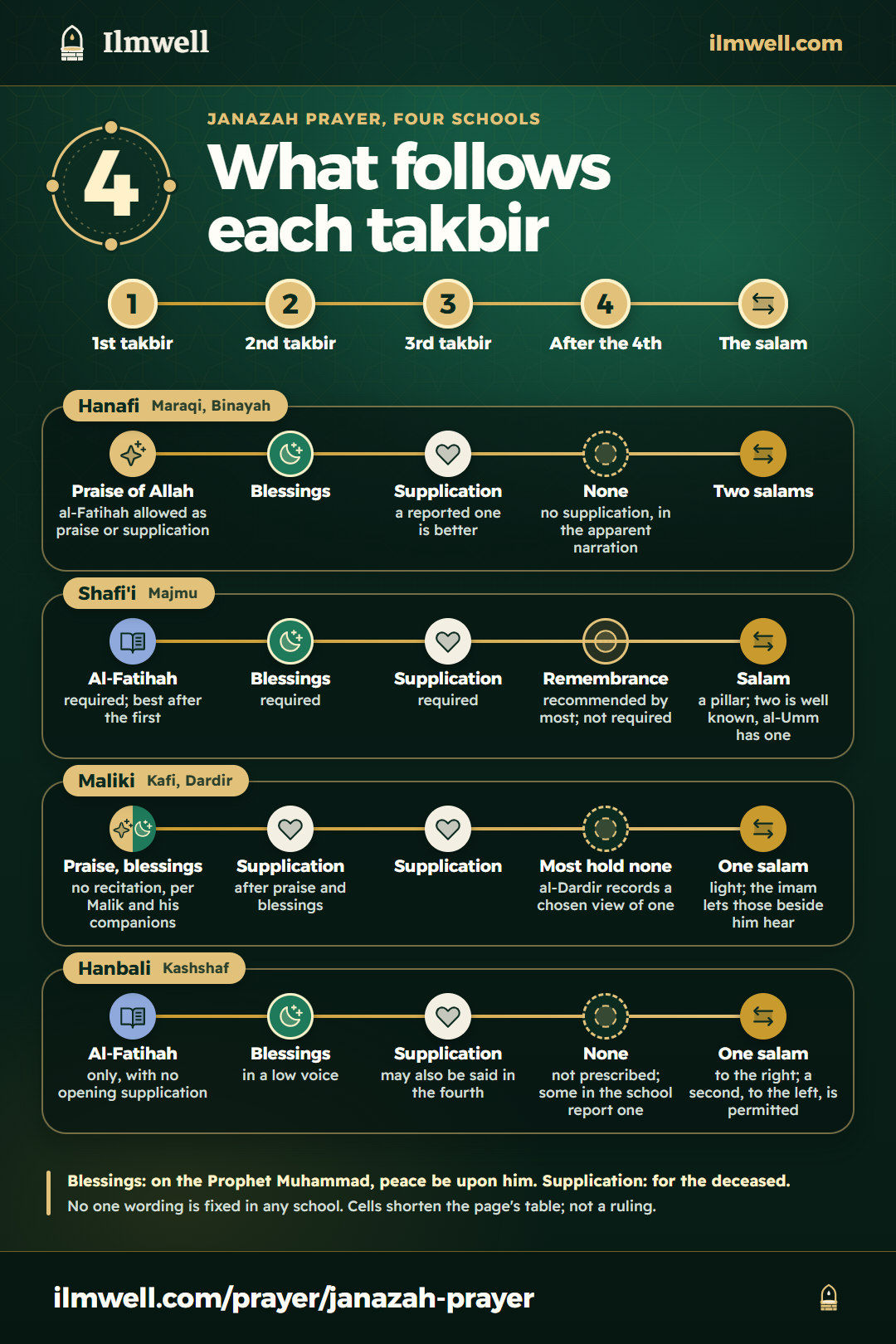
- First takbir. The Hanafi text has praise of Allah, the Maliki passage praise of Allah and blessings on the Prophet, and the Shafi'i and Hanbali texts al-Fatihah. 581217
- Second takbir. The Hanafi, Shafi'i and Hanbali texts place blessings on the Prophet here. The Maliki passage has a supplication for the deceased after the second and third takbirs. 513178
- Third takbir. The Hanafi, Shafi'i and Hanbali texts place the supplication for the deceased here. A reported wording is in the dua section below. 51417
- Fourth takbir. The texts differ on whether anything is said after it (see the table). 615819
- The salam. The Hanafi text has two. The Maliki and Hanbali texts have one, and the Hanbali text permits a second. The Shafi'i text calls two the well-known recommendation, and al-Umm has one. 681916
The number of takbirs comes from the report of Abu Hurayrah, may Allah be pleased with him. He says the Prophet announced the death of al-Najashi on the day he died, went out with them to the prayer place, arranged them in rows and said four takbirs over him (Sahih al-Bukhari 1333, graded sahih). The report gives the number and does not say what was said between the takbirs or how the prayer ended.
1AuthenticSahih al-Bukhari 1333
What do the four schools' texts say, takbir by takbir?
Each column follows the named works of one school. A cell gives what that work says, in short. It is not a ruling from us and it does not cover every view inside a school. Find your school's name in each block.
| HanafiMaraqi, Binayah | Shafi'iMajmu | MalikiKafi, Dardir | HanbaliKashshaf | |
|---|---|---|---|---|
| First takbir | Praise of Allah, among the sunan (sunnah acts) in Maraqi. Al-Fatihah is allowed when recited with the intention of praise or supplication. Al-'Ayni says reciting the Quran as such is not part of the funeral prayer; al-Shurunbulali adds there is no objection to intending Quranic recitation, to leave the disagreement 567 | Al-Fatihah, required in this school. Best after the first takbir; valid if said after another 12 | Praise of Allah and blessings on the Prophet, as the passage reads. No recitation, according to Malik and his companions 89 | Al-Fatihah only, with no opening supplication; al-Buhuti lists it among the pillars 1718 |
| Second takbir | Blessings on the Prophet, among the sunan 5 | Blessings on the Prophet, required, straight after the second takbir 13 | Supplication for the deceased, with praise and blessings before it, after the second and third takbirs 810 | Blessings on the Prophet, in a low voice, as in the tashahhud 17 |
| Third takbir | Supplication for the deceased, among the sunan. No one wording is fixed, and a reported supplication is better 5 | Supplication for the deceased, required here. No one wording is fixed 14 | Supplication again. Ibn Abd al-Barr says nothing is fixed for it. Al-Dardir counts a supplication after each takbir and says the best wording follows praise of Allah and blessings on His Prophet 910 | Supplication for the deceased, in a low voice and in the best words at hand. No time or wording is fixed. It may also be said in the fourth 1718 |
| After the fourth takbir, and the salam | The salam, with no supplication after the fourth takbir in the apparent narration. Two salams, with the intention for the deceased along with the people 67 | A remembrance is not required, and most of the school hold it recommended. The salam is a pillar: two are the well-known recommendation, and al-Umm has one salam 1516 | One light salam; the imam lets those beside him hear. Al-Dardir records a chosen view that there is a supplication after the fourth, and that most hold there is none 810 | No supplication is prescribed after the fourth takbir, though a group in the school, and others who chose it, report one. One salam to the right; a second to the left is permitted 19 |
Al-Buhuti (Hanbali) lists al-Fatihah among the requirements for the imam and for one praying alone, and adds that the imam carries it for the follower 18. This page reports that provision only for the Hanbali text, and only as that sentence.
Ibn Abd al-Barr (Maliki) also reports that a group of the elders of Medina recite Umm al-Qur'an (al-Fatihah) after the first takbir, send blessings on the Prophet after the second and supplicate after the third. He gives it as their practice, separately from what he says of Malik and his companions 9.
For the blessings on the Prophet, the Durood Ibrahim lesson gives one wording and its meaning, and the tashahhud lesson the wording said in sitting.
What is the Janazah dua?
'Awf ibn Malik, may Allah be pleased with him, says the Prophet, peace be upon him, prayed over a funeral and that he memorised part of his supplication. Sahih Muslim 963a (graded sahih) gives it. Sahih Muslim 963b is a second chain to the same hadith and adds no words.
اللَّهُمَّ اغْفِرْ لَهُ وَارْحَمْهُ وَعَافِهِ وَاعْفُ عَنْهُ وَأَكْرِمْ نُزُلَهُ وَوَسِّعْ مُدْخَلَهُ وَاغْسِلْهُ بِالْمَاءِ وَالثَّلْجِ وَالْبَرَدِ وَنَقِّهِ مِنَ الْخَطَايَا كَمَا نَقَّيْتَ الثَّوْبَ الأَبْيَضَ مِنَ الدَّنَسِ وَأَبْدِلْهُ دَارًا خَيْرًا مِنْ دَارِهِ وَأَهْلاً خَيْرًا مِنْ أَهْلِهِ وَزَوْجًا خَيْرًا مِنْ زَوْجِهِ وَأَدْخِلْهُ الْجَنَّةَ وَأَعِذْهُ مِنْ عَذَابِ الْقَبْرِ أَوْ مِنْ عَذَابِ النَّارِ
Allāhumma ighfir lahu warḥamhu, wa ʿāfihi waʿfu ʿanhu, wa akrim nuzulahu, wa wassiʿ mudkhalahu, waghsilhu bi l-mā'i wa th-thalji wa l-barad, wa naqqihi mina l-khaṭāyā kamā naqqayta th-thawba l-abyaḍa mina d-danas, wa abdilhu dāran khayran min dārihi, wa ahlan khayran min ahlihi, wa zawjan khayran min zawjihi, wa adkhilhu l-jannah, wa aʿidh-hu min ʿadhābi l-qabri aw min ʿadhābi n-nār.
Meaning (our rendering): O Allah, forgive him and have mercy on him, grant him wellbeing and pardon him. Honour his reception and widen his entrance. Wash him with water, snow and hail, and cleanse him of wrongs as the white garment is cleansed of dirt. Give him in exchange a home better than his home, a family better than his family and a spouse better than his spouse. Admit him to Paradise, and protect him from the torment of the grave or from the torment of the Fire.
2AuthenticSahih Muslim 963a
In the Arabic of 963a the last request joins the grave and the Fire with aw (or). A common English translation of 963a reads "and". Sahih Muslim 963d is a different narration of the supplication, and its last request reads "and protect him from the trial of the grave and the torment of the Fire" (wa qihi fitnata l-qabri wa ʿadhāba n-nār). Keep each wording as its own report.
3AuthenticSahih Muslim 963d
The report does not say at which takbir the supplication is said. A request to be admitted to Paradise is a prayer for the deceased, not a statement about where a particular person is.
Each of the four school works read says something is not fixed for the supplication for the deceased:
- Al-Shurunbulali (Hanafi) says a reported supplication is better, and names the one 'Awf memorised 5.
- Al-Nawawi (Shafi'i) places the supplication in the third takbir and says no one wording is fixed 14.
- Ibn Abd al-Barr (Maliki) says nothing is fixed for the supplication for the deceased 9.
- Al-Buhuti (Hanbali) says nothing is fixed for it 17.
What does Sahih al-Bukhari report about al-Fatihah?
Talha ibn 'Abd Allah ibn 'Awf, a Follower (one of the generation after the Companions), says he prayed a funeral prayer behind Ibn Abbas, may Allah be pleased with him, who recited the opening of the Book. The Arabic adds "so that they would know it is sunnah" (Sahih al-Bukhari 1335, graded sahih). It is a report of a Companion's action. It is not a saying of the Prophet, and it does not say after which takbir he recited.
4AuthenticSahih al-Bukhari 1335
Al-'Ayni (Hanafi) answers the evidence from the reports of Jabir, may Allah be pleased with him, and Ibn Abbas by saying the Prophet recited it in the manner of praise, not as recitation 7. Al-Nawawi (Shafi'i) says reciting al-Fatihah is required in the funeral prayer 12. The report does not settle between them. The table sets out what each text places where.
If you are unsure what to say
If you want to know which method the congregation will follow, ask the imam before the prayer. Raising the hands, joining late, praying for a child or for several people, and prayer for someone who is not present each have their own discussion in the school works, and this page does not cover them.
Al-Dardir (Maliki) gives different opening words for a woman and for a boy 11. This page does not give them. For your own situation, ask a scholar you trust.
I went to my first Janazah prayer without knowing what was coming, and followed the people beside me. Learning the sequence afterwards, and why teachers differ on the recitation, made the next one feel less strange.
Try it: the reports
Three checks, each with its source.
1How many takbirs does Sahih al-Bukhari 1333 report the Prophet Muhammad, peace be upon him, saying over al-Najashi?
Answer: Four. Four. The report gives the number and does not say what was said between the takbirs. Source 1
2How does the Arabic of Sahih Muslim 963a join the grave and the Fire in the last request?
Answer: With "or". With "aw" (or): "protect him from the torment of the grave or from the torment of the Fire". Sahih Muslim 963d is a different narration that reads "and". Source 2
3Does Sahih al-Bukhari 1335 say after which takbir Ibn Abbas, may Allah be pleased with him, recited al-Fatihah?
Answer: It does not say. It says he recited it in a funeral prayer. Where it comes in the sequence is taken from the school texts in the table. Source 4
Questions people ask
Is the dua different for a woman or a child?
The wording in Sahih Muslim 963a uses masculine pronouns. The Maliki work read here gives different opening words for a woman and for a boy, and this page does not give them. Ask the imam or a scholar you trust which words to use.
What is namaz e janaza?
The same prayer. Namaz e janaza (also written namaz janaza) is the Urdu name for the Janazah prayer, and janaza ki dua is its supplication, which this page gives from Sahih Muslim 963a.
What if I arrive after the Janazah prayer has begun, or the prayer is for someone who is not present?
The school works discuss joining late and prayer for an absent person as separate questions, and this page does not cover them. Ask the imam or a scholar you trust about your own situation.
Sources
Every claim on this page comes from one of these. Gradings are reported with the scholar's name; we do not grade hadith ourselves.
- 1
Abu Hurayrah, may Allah be pleased with him, reports that the Prophet Muhammad, peace be upon him, announced the death of al-Najashi on the day he died. He went out with them to the prayer place, arranged them in rows and said four takbirs over him.
Sahih al-Bukhari 1333 Book 23, Hadith 88
Authentic: in Sahih al-Bukhari
- 2
'Awf ibn Malik, may Allah be pleased with him, says the Prophet Muhammad, peace be upon him, prayed over a funeral and that he memorised part of his supplication. It begins 'O Allah, forgive him and have mercy on him'. In the Arabic of 963a the last request is 'protect him from the torment of the grave or from the torment of the Fire' (aw, or). 963b is a second chain to the same hadith with no separate wording.
Sahih Muslim 963a Book 11, Hadith 109
Authentic: in Sahih Muslim
- 3
A narration of the supplication of 'Awf ibn Malik, may Allah be pleased with him, with its own chain. The Prophet Muhammad, peace be upon him, says it while praying over a funeral, and its last request is 'and protect him from the trial of the grave and the torment of the Fire'.
Sahih Muslim 963d Book 11, Hadith 111
Authentic: in Sahih Muslim
- 4
Talha ibn 'Abd Allah ibn 'Awf, a Follower, reports that he prayed a funeral prayer behind Ibn Abbas, may Allah be pleased with him, who recited Fatihat al-Kitab. The Arabic adds 'he said: so that they would know it is sunnah'.
Sahih al-Bukhari 1335 Book 23, Hadith 90
Authentic: in Sahih al-Bukhari
- 5
Al-Shurunbulali (Hanafi), in Maraqi al-Falah, counts praise after the first takbir, blessings on the Prophet after the second and a supplication for the deceased after the third among the sunan of the funeral prayer. He says no particular supplication is fixed and a reported one is better, naming the one 'Awf ibn Malik memorised.
al-Shurunbulali, Maraqi al-Falah, p. 218 (the sequence) Read on shamela.ws on 24 October 2026. Record: scholarly-janazah-hanafi-maraqi.
- 6
Al-Shurunbulali (Hanafi), in Maraqi al-Falah, says reciting al-Fatihah with the intention of praise is permitted. He says the salam is made after the fourth takbir without a supplication in the apparent narration, with the intention of both salams for the deceased along with the people.
al-Shurunbulali, Maraqi al-Falah, pp. 218 to 219 (al-Fatihah, the salam) Read on shamela.ws on 24 October 2026. Record: scholarly-janazah-hanafi-maraqi-ending.
- 7
Al-'Ayni (Hanafi), commenting on al-Marghinani's text in al-Hidayah, says reciting al-Fatihah with the intention of supplication is permitted and that reciting the Quran as such is not part of the funeral prayer among them. He reads the reports of Jabir and Ibn Abbas on al-Fatihah as said in the manner of praise, not as recitation, and explains the salam as to the right and to the left.
al-'Ayni, al-Binayah sharh al-Hidayah 3/215 to 3/217 Read on shamela.ws on 24 October 2026. Record: scholarly-janazah-hanafi-binayah.
- 8
Ibn 'Abd al-Barr (Maliki), in al-Kafi, has four takbirs. Praise of Allah and blessings on the Prophet come after the first, supplication for the deceased after the second and third, then the fourth takbir and one light salam that he hears himself.
Ibn 'Abd al-Barr, al-Kafi 1/276 Read on shamela.ws on 24 October 2026. Record: scholarly-janazah-maliki-kafi-sequence.
- 9
Ibn 'Abd al-Barr (Maliki), in al-Kafi, says there is no recitation in the funeral prayer according to Malik and his companions. He reports that a group of Medina's elders recite Umm al-Qur'an after the first takbir, and says no time is fixed for the supplication for the deceased.
Ibn 'Abd al-Barr, al-Kafi 1/277 Read on shamela.ws on 24 October 2026. Record: scholarly-janazah-maliki-kafi-recitation.
- 10
Al-Dardir (Maliki), in al-Sharh al-Kabir, counts a supplication after each takbir as a pillar and says the best wording is Abu Hurayrah's, said after praise of Allah and blessings on His Prophet. He records that most hold there is no supplication after the fourth takbir, and counts a light salam as the fourth pillar.
al-Dardir, al-Sharh al-Kabir, with al-Dasuqi, 1/411 to 1/413 Read on shamela.ws on 24 October 2026. Record: scholarly-janazah-maliki-dardir.
- 11
Al-Dardir (Maliki), in al-Sharh al-Kabir, gives the supplication of Abu Hurayrah and then different opening words for a woman and for a boy.
al-Dardir, al-Sharh al-Kabir, 1/412 (the wording for a woman and a boy) Read on shamela.ws on 24 October 2026. Record: scholarly-janazah-maliki-dardir-forms.
- 12
Al-Nawawi (Shafi'i), in his own commentary, says reciting al-Fatihah is required (fard) in the funeral prayer, with no dispute in his school, that it is best after the first takbir, and that it is valid after another takbir.
al-Nawawi, al-Majmu' 5/233 Read on shamela.ws on 24 October 2026. Record: scholarly-janazah-shafii-majmu-fatihah.
- 13
Al-Nawawi (Shafi'i), in his commentary, reports that al-Shirazi (the author of the text) and the great majority of the school say blessings on the Prophet are required in the funeral prayer. They are valid only if made straight after the second takbir.
al-Nawawi, al-Majmu' 5/235 Read on shamela.ws on 24 October 2026. Record: scholarly-janazah-shafii-majmu-blessings.
- 14
Al-Nawawi (Shafi'i), in his commentary, says the supplication for the deceased belongs to the third takbir, is required there and is not valid elsewhere without dispute, and that his school agrees no one supplication is fixed for it.
al-Nawawi, al-Majmu' 5/236 Read on shamela.ws on 24 October 2026. Record: scholarly-janazah-shafii-majmu-dua.
- 15
Al-Nawawi (Shafi'i), in his commentary, says his school agrees no remembrance is required after the fourth takbir, while most hold one is recommended.
al-Nawawi, al-Majmu' 5/239 Read on shamela.ws on 24 October 2026. Record: scholarly-janazah-shafii-majmu-fourth.
- 16
Al-Nawawi (Shafi'i), in his commentary, says the salam is a pillar of the funeral prayer and that the best-known text of al-Shafi'i makes two salams recommended while al-Umm has one.
al-Nawawi, al-Majmu' 5/239 to 5/240 Read on shamela.ws on 24 October 2026. Record: scholarly-janazah-shafii-majmu-salam.
- 17
Al-Buhuti (Hanbali) has al-Fatihah only in the first takbir, with no opening supplication. He has blessings on the Prophet in a low voice in the second, as in the tashahhud, and a supplication for the deceased in a low voice in the third, in the best words that come to him.
al-Buhuti, Kashshaf al-Qina' 4/128 to 4/131 Read on shamela.ws on 24 October 2026. Record: scholarly-janazah-hanbali-kashshaf-sequence.
- 18
Al-Buhuti (Hanbali), listing the pillars, makes al-Fatihah required of the imam and of one praying alone and says the imam carries it for the follower. He adds that the supplication for the deceased need not be in the third takbir and may be in the fourth.
al-Buhuti, Kashshaf al-Qina' 4/142 to 4/143 Read on shamela.ws on 24 October 2026. Record: scholarly-janazah-hanbali-kashshaf-pillars.
- 19
Al-Buhuti (Hanbali) says no supplication is prescribed after the fourth takbir and reports that a group of scholars of the school have one there, as in the third. He has one salam to the right and permits a second to the left.
al-Buhuti, Kashshaf al-Qina' 4/137 to 4/140 Read on shamela.ws on 24 October 2026. Record: scholarly-janazah-hanbali-kashshaf-salam.
Next
- Al-Fatihah: Arabic and meaningQuran lesson
- Durood Ibrahim: Arabic and meaningWords lesson
- The tashahhud: words and meaningWords lesson
- How to do ghusl: a practical guideGuide
- How to pray Salah: the whole prayerGuide
- Tayammum: when and how it is performedGuide
- Prayer and PurificationThe hub
- 40 days after death in IslamExplainer
- Islamic inheritance calculatorTool
For your own situation, ask a scholar you trust.
Join the email list
New guides by email, now and then. No spam, and you can leave at any time.
Ilmwell is free and kept going by readers. See how to support it.