The short answer
Attahiyat, also called the tashahhud, is the set of words said when sitting in the prayer, opening "At-tahiyyatu lillah" ("the greetings are for Allah"). The Prophet Muhammad, peace be upon him, taught it to Ibn Mas'ud, may Allah be pleased with him (Sahih al-Bukhari 6265; Sahih Muslim 402 gives the sitting; both graded sahih). The four schools do not all take the same wording.
What are the words of Attahiyat in Arabic, transliteration and English?
The full Attahiyat dua, also searched as the tashahhud dua, in three wordings, each given by who reported it and never mixed. Ibn Abbas and 'Umar ibn al-Khattab, may Allah be pleased with them both, report the second and third. Transliteration and English are our own.
Ibn Mas'ud's wording: Attahiyat lillahi wa salawatu wa tayyibat
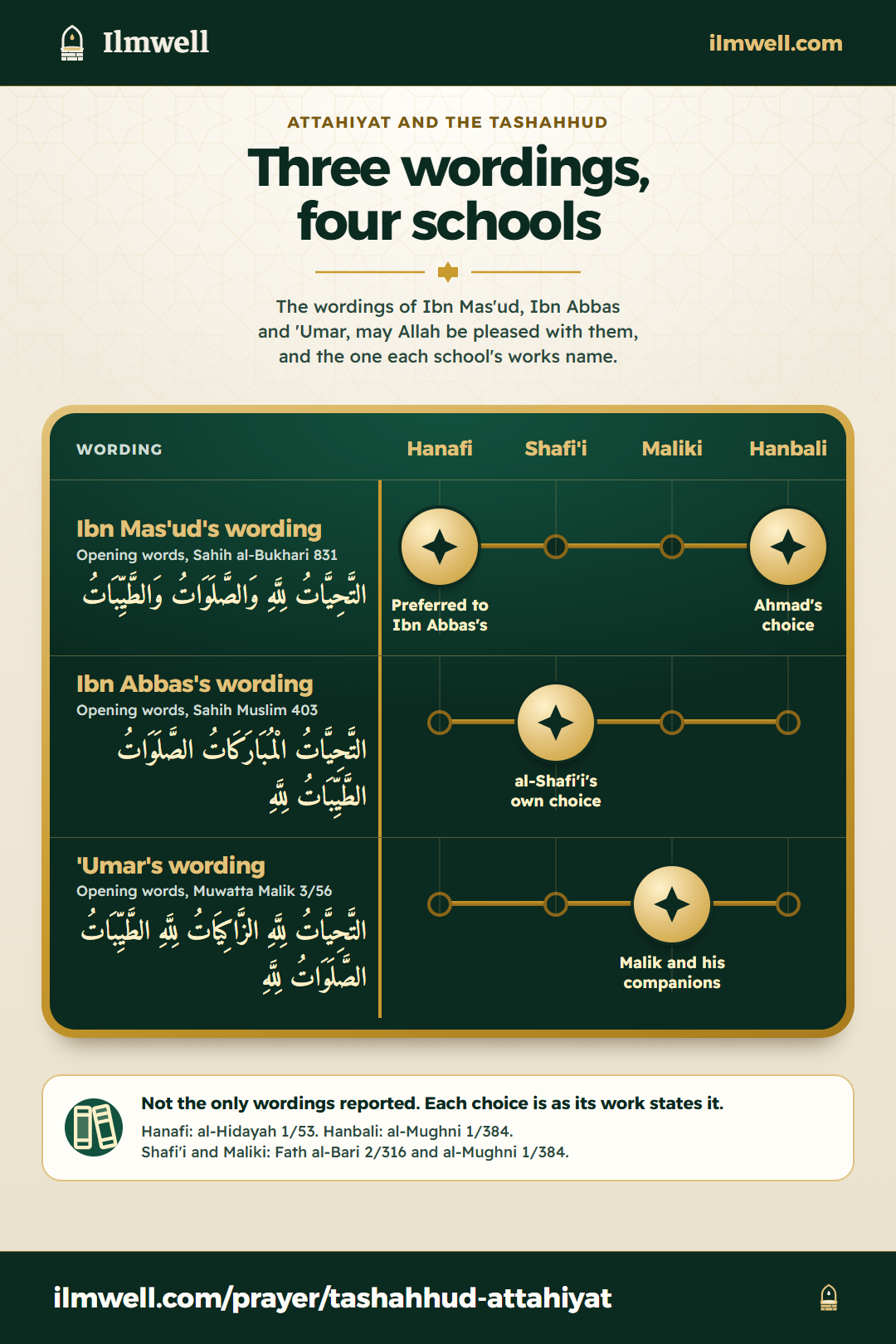
التَّحِيَّاتُ لِلَّهِ، وَالصَّلَوَاتُ وَالطَّيِّبَاتُ، السَّلاَمُ عَلَيْكَ أَيُّهَا النَّبِيُّ وَرَحْمَةُ اللَّهِ وَبَرَكَاتُهُ، السَّلاَمُ عَلَيْنَا وَعَلَى عِبَادِ اللَّهِ الصَّالِحِينَ أَشْهَدُ أَنْ لاَ إِلَهَ إِلاَّ اللَّهُ، وَأَشْهَدُ أَنَّ مُحَمَّدًا عَبْدُهُ وَرَسُولُهُ
Transliteration: at-taḥiyyātu lillāhi wa-ṣ-ṣalawātu wa-ṭ-ṭayyibāt. as-salāmu ʿalayka ayyuha n-nabiyyu wa raḥmatu llāhi wa barakātuh. as-salāmu ʿalaynā wa ʿalā ʿibādi llāhi ṣ-ṣāliḥīn. ashhadu an lā ilāha illā llāh, wa ashhadu anna Muḥammadan ʿabduhu wa rasūluh.
Meaning: The greetings are for Allah, and the prayers, and the good things. Peace be on you, O Prophet, and the mercy of Allah and His blessings. Peace be on us and on the righteous servants of Allah. I testify that there is no god but Allah, and I testify that Muhammad is His servant and Messenger.
1AuthenticSahih al-Bukhari 831
2AuthenticSahih Muslim 402same wording
Ibn Abbas's wording
التَّحِيَّاتُ الْمُبَارَكَاتُ الصَّلَوَاتُ الطَّيِّبَاتُ لِلَّهِ السَّلاَمُ عَلَيْكَ أَيُّهَا النَّبِيُّ وَرَحْمَةُ اللَّهِ وَبَرَكَاتُهُ السَّلاَمُ عَلَيْنَا وَعَلَى عِبَادِ اللَّهِ الصَّالِحِينَ أَشْهَدُ أَنْ لاَ إِلَهَ إِلاَّ اللَّهُ وَأَشْهَدُ أَنَّ مُحَمَّدًا رَسُولُ اللَّهِ
Transliteration: at-taḥiyyātu l-mubārakātu ṣ-ṣalawātu ṭ-ṭayyibātu lillāh. as-salāmu ʿalayka ayyuha n-nabiyyu wa raḥmatu llāhi wa barakātuh. as-salāmu ʿalaynā wa ʿalā ʿibādi llāhi ṣ-ṣāliḥīn. ashhadu an lā ilāha illā llāh, wa ashhadu anna Muḥammadan rasūlu llāh.
Meaning: The blessed greetings, the prayers, the good things are for Allah. Peace be on you, O Prophet, and the mercy of Allah and His blessings. Peace be on us and on the righteous servants of Allah. I testify that there is no god but Allah, and I testify that Muhammad is the Messenger of Allah.
4AuthenticSahih Muslim 403
Of 21 gradings, 17 accept it and four are remarks; one is al-Tahawi's: he did not accept the one added word al-mubarakat (Sharh Ma'ani al-Athar 1/263). Sources differ on the ending. The sunnah.com text of Sahih Muslim 403, which the Copy button copies, ends rasulu llah, as Ibn Hajar gives it (Fath al-Bari 2/315). Ibn Qudamah says Muslim's report has 'abduhu wa rasuluh (al-Mughni 1/384).
'Umar's wording
التَّحِيَّاتُ لِلَّهِ الزَّاكِيَاتُ لِلَّهِ الطَّيِّبَاتُ الصَّلَوَاتُ لِلَّهِ السَّلاَمُ عَلَيْكَ أَيُّهَا النَّبِيُّ وَرَحْمَةُ اللَّهِ وَبَرَكَاتُهُ السَّلاَمُ عَلَيْنَا وَعَلَى عِبَادِ اللَّهِ الصَّالِحِينَ أَشْهَدُ أَنْ لاَ إِلَهَ إِلاَّ اللَّهُ وَأَشْهَدُ أَنَّ مُحَمَّدًا عَبْدُهُ وَرَسُولُهُ
Transliteration: at-taḥiyyātu lillāhi z-zākiyātu lillāhi ṭ-ṭayyibātu ṣ-ṣalawātu lillāh. as-salāmu ʿalayka ayyuha n-nabiyyu wa raḥmatu llāhi wa barakātuh. as-salāmu ʿalaynā wa ʿalā ʿibādi llāhi ṣ-ṣāliḥīn. ashhadu an lā ilāha illā llāh, wa ashhadu anna Muḥammadan ʿabduhu wa rasūluh.
Meaning: The greetings are for Allah, the pure things are for Allah, the good things and the prayers are for Allah. Peace be on you, O Prophet, and the mercy of Allah and His blessings. Peace be on us and on the righteous servants of Allah. I testify that there is no god but Allah, and I testify that Muhammad is His servant and Messenger.
5AuthenticMuwatta Malik 3/56
This is a Companion's teaching, not a hadith of the Prophet: 'Umar taught it from the minbar (pulpit), and it is graded sahih as his words. "The pure things" for az-zakiyat is our own translation.
How the three differ
- Ibn Abbas's adds al-mubarakat, drops the wa that Ibn Mas'ud's has, and has one lillah, at the end.
- 'Umar's adds az-zakiyat, drops the wa, says lillah after each item, and puts at-tayyibat before as-salawat, the reverse of the other two.
- Ibn Mas'ud's and 'Umar's end 'abduhu wa rasuluh; for Ibn Abbas's see above. Al-Hidayah quotes Ibn Abbas's wording with salamun; the Muslim text reads as-salamu.
What does Attahiyat mean in English, word by word?
If you have ever learnt a school song by sound alone, a line can sit in your head for years before you know what it means. Here is the Ibn Mas'ud wording a phrase at a time; several meanings are views reported in Fath al-Bari (source 11).
Arabic reads right to left, so the first word is on the right.
- التَّحِيَّاتُ لِلَّهِat-taḥiyyātu lillāhthe greetings are for AllahPlural of tahiyyah. Fath al-Bari reports it means salam, and also everlastingness, greatness, safety from faults or kingship.
- وَالصَّلَوَاتُwa-ṣ-ṣalawātand the prayersSaid to mean the five prayers, all worship, supplications or mercy.
- وَالطَّيِّبَاتُwa-ṭ-ṭayyibātand the good thingsWhat is good in speech and fit to praise Allah with; also remembrance or righteous deeds.
- السَّلاَمُ عَلَيْكَ أَيُّهَا النَّبِيُّas-salāmu ʿalayka ayyuha n-nabiyyupeace be on you, O ProphetAl-Salam is one of Allah's names. "Peace be on you" is reported as a supplication: may you be safe from what is disliked.
- وَرَحْمَةُ اللَّهِ وَبَرَكَاتُهُwa raḥmatu llāhi wa barakātuhand the mercy of Allah and His blessings
- السَّلاَمُ عَلَيْنَاas-salāmu ʿalaynāpeace be on us
- وَعَلَى عِبَادِ اللَّهِ الصَّالِحِينَwa ʿalā ʿibādi llāhi ṣ-ṣāliḥīnand on the righteous servants of AllahThe Prophet adds that saying it reaches every righteous servant of Allah in the heaven and the earth.
- أَشْهَدُ أَنْ لاَ إِلَهَ إِلاَّ اللَّهُashhadu an lā ilāha illā llāhI testify that there is no god but Allah
- وَأَشْهَدُ أَنَّ مُحَمَّدًا عَبْدُهُ وَرَسُولُهُwa ashhadu anna Muḥammadan ʿabduhu wa rasūluhand I testify that Muhammad is His servant and Messenger
See also the names of Allah and the Shahada.
How do you pronounce Attahiyat?
attaḥiyyātulillāh
- at-ta: the l of al is not said but doubles the next letter, so say at-taḥiyyāt with the t held for a beat.
- ḥ is a breathy h from the throat, softer than clearing the throat, stronger than an English h.
- ʿ in ʿalayka and ʿalaynā is the letter ʿayn, a tight sound from the throat.
Listen and repeat. A recording by a fluent reciter is coming. We do not use a synthetic voice for Arabic.
Where is the tashahhud said in the prayer, and what do you say after it?
You say it while sitting in the prayer (salah, also called namaz). In Sahih Muslim 402 (source 2, graded sahih) the Prophet says: when any one of you sits in the prayer, let him say: at-tahiyyatu lillahi, and the rest.
Al-Hidayah quotes Ibn Mas'ud saying the Prophet taught him the tashahhud for the middle of the prayer and its end: a hadith quoted in a fiqh book, not graded here (source 6). Which sitting is required differs by school: see the table.
Sahih Muslim 402 ends the Prophet's words: then let him choose whatever request he likes. It does not mention the blessings on the Prophet; a lesson on them is in Durood Ibrahim. The whole prayer is in how to pray salah.
Which wording does each school take, and is the tashahhud required?
Terms, as the cited works use them. In these works, a pillar or fard part is one the prayer is not valid without. In Hanafi usage a wajib act left out by mistake calls for two extra prostrations (the prostrations of forgetfulness) (al-Hidayah 1/47; al-Mughni 2/6 says the same of the Hanbali eight acts if wajib). The first sitting is after the second rak'ah (a cycle of standing, bowing and prostrating); the last is before the salam, the greeting that ends the prayer.
| Hanafi | Shafi'i | Maliki | Hanbali | |
|---|---|---|---|---|
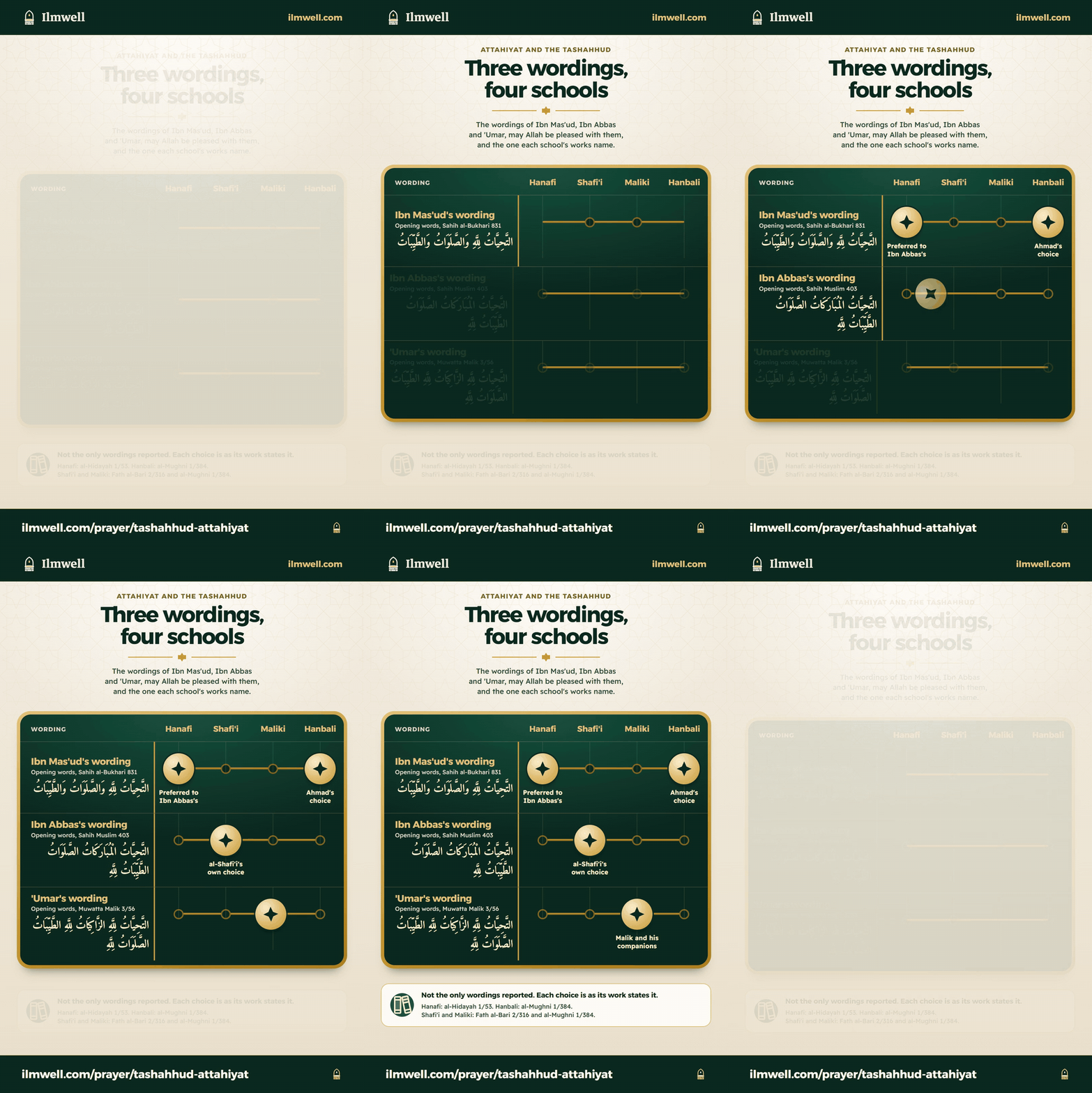
| Wording taken | Ibn Mas'ud's, preferred to Ibn Abbas's (al-Marghinani, al-Hidayah 1/53) | Ibn Abbas's: al-Shafi'i's own choice, reported in Fath al-Bari 2/316 and al-Mughni 1/384 | 'Umar's: the choice of Malik and his companions, reported in Fath al-Bari 2/316 and al-Mughni 1/384 | Ibn Mas'ud's: Ahmad's choice (Ibn Qudamah, al-Mughni 1/384) |
| First sitting | The first sitting is wajib (al-Hidayah 1/47) | The tashahhud is a sunnah when no salam follows it (al-Nawawi, Minhaj p. 28) | The first tashahhud and sitting are sunnahs; al-Lakhmi reported a view that the tashahhud is wajib (al-Sharh al-Kabir 1/243, in the Hashiya, a commentary note) | The first tashahhud is among eight acts called wajib; there are two narrations on whether these are wajib (al-Mughni 2/5 to 6) |
| Last sitting | Sitting for the length of the tashahhud is fard; reciting it is wajib (al-Hidayah 1/47) | The tashahhud and its sitting are pillars when a salam follows (al-Nawawi, Minhaj p. 28) | The last tashahhud is a sunnah; the Hashiya notes a view that it is wajib; sitting for the salam is wajib (al-Sharh al-Kabir 1/243 to 244) | The tashahhud and its sitting are pillars (al-Mughni 1/387) |
Sources 6 to 10 give each page.
I learnt Attahiyat as a sound before I learnt it as words. I would sit at the end of every prayer reciting it at speed, and only noticed when I read the English that it begins with greetings to Allah. I slowed right down after that.
Try it: which wording is it?
1Which wording runs: at-tahiyyatu lillahi, wa-s-salawatu, wa-t-tayyibat?
Answer: Ibn Mas'ud's. A wa joins the three in Ibn Mas'ud's; Ibn Abbas's has none. Source 1
2In Sahih Muslim 402, when does the Prophet say to say the tashahhud?
Answer: When one sits in the prayer. He says: when any one of you sits in the prayer, let him say: at-tahiyyatu lillahi, and the rest. Source 2
Questions people ask
Is Attahiyat a surah?
We found no surah named Attahiyat. The Ilmwell team's check of the Tanzil Quran text (23 October 2026) found none of its distinctive words. Two reports say the Prophet taught the tashahhud as he taught a surah (Sahih al-Bukhari 6265, Sahih Muslim 403), which compares how it was taught, not what it is.
Why is it called the tashahhud, and is tashahud the same word?
Yes, tashahud is another English spelling. Fath al-Bari explains the name as taken from the testimony of truth in the wording (2/310). Attahiyat, also written Attahiyatu, is its first word.
Sources
Every claim on this page comes from one of these. Gradings are reported with the scholar's name; we do not grade hadith ourselves.
- 1
'Abdullah ibn Mas'ud reported that the Companions used to say 'peace be on Jibril and Mika'il, peace be on so and so' behind the Prophet; the Prophet turned to them, said Allah Himself is al-Salam, and told them that when one of them prays he should say: al-tahiyyatu lillahi wa al-salawatu wa al-tayyibat; al-salamu 'alayka ayyuha al-nabiyyu wa rahmatu Allahi wa barakatuh; al-salamu 'alayna wa 'ala 'ibadi Allahi al-salihin; ashhadu an la ilaha illa Allah wa ashhadu anna Muhammadan 'abduhu wa rasuluh.
Sahih al-Bukhari 831 Book 10, Hadith 225
Authentic: in Sahih al-Bukhari
- 2
'Abdullah ibn Mas'ud reported that the Companions used to say 'peace be on Allah, peace be on so and so' in the prayer behind the Prophet; the Prophet told them Allah Himself is al-Salam and that when one of them sits in the prayer he should say the tashahhud (al-tahiyyatu lillahi wa al-salawatu wa al-tayyibat ... 'abduhu wa rasuluh), and then choose any request he likes.
Sahih Muslim 402 Book 4, Hadith 59
Authentic: in Sahih Muslim
- 3
Ibn Mas'ud said the Messenger of Allah taught him the tashahhud, with his hand between the Prophet's hands, as he taught him a surah of the Quran, and gave its words (al-tahiyyatu lillahi wa al-salawatu wa al-tayyibat ... wa anna Muhammadan 'abduhu wa rasuluh).
Sahih al-Bukhari 6265 Book 79, Hadith 39
Authentic: in Sahih al-Bukhari
- 4
Ibn Abbas reported that the Messenger of Allah used to teach them the tashahhud as he taught them a surah of the Quran, and said: al-tahiyyatu al-mubarakatu al-salawatu al-tayyibatu lillah; al-salamu 'alayka ayyuha al-nabiyyu wa rahmatu Allahi wa barakatuh; al-salamu 'alayna wa 'ala 'ibadi Allahi al-salihin; ashhadu an la ilaha illa Allah, wa ashhadu anna Muhammadan rasulu Allah.
Sahih Muslim 403 Book 4, Hadith 64
Authentic: in Sahih Muslim (Muslim); sahih (Al-Albani); its chain is sahih (Al-Daraqutni); its chain is good (Al-Khattabi); its chain is sahih (Al-'Ayni); sahih (Al-Bayhaqi); sahih (Al-Shafi'i); sahih (Al-Buhuti); hasan gharib (Al-Tirmidhi); its chain is hasan, and the hadith is sahih (Shu'ayb al-Arna'ut); its chain is sahih on the condition of the two shaykhs (Shu'ayb al-Arna'ut); its chain is sahih (Shu'ayb al-Arna'ut); sahih (Shu'ayb al-Arna'ut); its chain is sahih on the condition of Muslim (Shu'ayb al-Arna'ut); he included it in his Sahih (Ibn Khuzaymah). Remarks: the addition of al-mubarakat is not accepted (Al-Tahawi); Abu al-Zubayr alone narrated it (Ibn Hibban); he was silent on it; in his letter to the people of Makkah he says what he is silent on is acceptable (Abu Dawud); it may be established (Al-Shafi'i)
- 5
'Abd al-Rahman ibn 'Abd al-Qari heard 'Umar ibn al-Khattab, on the minbar, teaching people the tashahhud: qulu, al-tahiyyatu lillahi, al-zakiyatu lillahi, al-tayyibatu al-salawatu lillah; al-salamu 'alayka ayyuha al-nabiyyu wa rahmatu Allahi wa barakatuh; al-salamu 'alayna wa 'ala 'ibadi Allahi al-salihin; ashhadu an la ilaha illa Allah wa ashhadu anna Muhammadan 'abduhu wa rasuluh.
Muwatta Malik 3/56 Book 3, Hadith 56 (sunnah.com numbering; Arabic reference Book 3, Hadith 203), Yahya ibn Yahya's narration of the Muwatta
Authentic: sahih (Shu'ayb al-Arna'ut); its chain is sahih on the condition of the two shaykhs (Shu'ayb al-Arna'ut); its chain is sahih on the condition of the two (Shu'ayb al-Arna'ut); its chain is sahih (Al-Nawawi); its chain is sahih (Al-Zayla'i); its chain is sahih (Al-Albani); sahih (Ibn al-Mulaqqin); we have not heard a chain for the tashahhud, differing from it or agreeing with it, firmer with us than this one (Al-Shafi'i). Remarks: it is narrated from Umar as the Prophet's words through routes that are not established (Ibn Rajab); they did not differ that it is mawquf on Umar; some later narrators made it the Prophet's words, which is a mistake (Al-Daraqutni)
- 6
al-Marghinani, in al-Hidayah, counts the sitting at the end of the prayer for the length of the tashahhud among the six fard parts of the prayer; lists the first sitting and the reciting of the tashahhud in the last sitting among the acts he calls wajib (leaving one by mistake calls for the two prostrations of forgetfulness); gives the tashahhud as Ibn Mas'ud's (al-tahiyyatu lillahi wa al-salawatu wa al-tayyibat ...), takes it as better than Ibn Abbas's, and says nothing is added to it in the first sitting.
al-Marghinani, al-Hidayah 1/47 and 1/53 Record: scholarly-tashahhud-hanafi. Read on shamela.ws.
- 7
al-Nawawi, in Minhaj al-Talibin, counts the tashahhud and its sitting as two pillars (arkan) of the prayer when a salam follows them, and as two sunnahs otherwise; so the tashahhud in the first sitting is a sunnah and the one before the salam is a pillar.
al-Nawawi, Minhaj al-Talibin, pp. 28 to 29 Record: scholarly-tashahhud-shafii. Read on shamela.ws.
- 8
al-Dardir, in al-Sharh al-Kabir, counts every tashahhud (each one, and the sunnah is reached only with all of it, ending 'wa rasuluh') and the first sitting among the sunnahs of the prayer; al-Dasuqi's Hashiya adds that Ibn Bazizah gave this as the well-known view, against those who say the last tashahhud is wajib, and that al-Lakhmi reported a view that the first is wajib.
al-Dardir, al-Sharh al-Kabir 1/243 to 244, with al-Dasuqi's Hashiya Record: scholarly-tashahhud-maliki. Read on shamela.ws.
- 9
Ibn Qudamah, in al-Mughni, says Ibn Mas'ud's tashahhud is the one Imam Ahmad chose and any tashahhud that is sound from the Prophet is allowed; counts the last tashahhud and its sitting among the pillars (arkan) of the prayer; and lists the first tashahhud among eight wajib acts, on which there are two narrations about whether they are wajib, adding that if they are wajib, leaving one deliberately voids the prayer and forgetting it calls for the two prostrations of forgetfulness.
Ibn Qudamah, al-Mughni 1/384, 1/385, 1/387, 2/5 and 2/6 Record: scholarly-tashahhud-hanbali. Read on shamela.ws.
- 10
Ibn Hajar, in Fath al-Bari, reports that al-Shafi'i took Ibn Abbas's tashahhud (and in al-Umm said he preferred it, adding that he did not blame anyone who takes another sound one), that Malik and his companions chose 'Umar's because he taught it from the minbar and no one objected, and that a group of scholars transmitted agreement that any established wording is allowed; Ibn Qudamah, in al-Mughni, reports Ahmad choosing Ibn Mas'ud's, Malik 'Umar's and al-Shafi'i Ibn Abbas's.
Ibn Hajar, Fath al-Bari 2/315 to 316; Ibn Qudamah, al-Mughni 1/384 Record: scholarly-tashahhud-choices. Read on shamela.ws.
- 11
Ibn Hajar, in Fath al-Bari, says tashahhud is a verbal noun of tashahhada, named so because it includes saying the testimony of truth; gathers the views on the opening words (al-tahiyyat: the plural of tahiyyah, whose meaning is salam, also said to be everlastingness, greatness, safety from faults and shortcoming, or kingship; al-salawat: said to be the five prayers, or all prayers, or all acts of worship, or supplications, or mercy; al-tayyibat: what is good in speech and fit to praise Allah with, also said to be remembrance of Allah, righteous words or righteous deeds); and quotes that al-Salam is one of Allah's names and that 'al-salamu 'alayka' is a supplication, 'may you be safe from what is disliked'.
Ibn Hajar, Fath al-Bari 2/310 and 2/312 to 314 Record: scholarly-tashahhud-meanings. Read on shamela.ws.
- 12
The Ilmwell team's check of the Tanzil Quran text on 23 October 2026 found that the distinctive words of the tashahhud (at-tahiyyat, az-zakiyat, 'alayka ayyuha an-nabi, 'abduhu wa rasuluh, ashhadu an la ilaha) do not occur anywhere in the Quran. A search finding, not a ruling.
Tanzil Project Quran text Record: search-tashahhud-surah, with every search term and result.
Next
- How to pray salah: the whole prayer, step by stepPractical guide
- The blessings on the Prophet (Durood Ibrahim)Words lesson
- Dua qunoot: words, meaning and when to say itDua lesson
- How to pray Tahajjud: a clear guidePractical guide
- Istikhara dua and how to pray istikharaPractical guide
- Al-Fatihah: meaning and understanding what you reciteQuran lesson
- How to perform wudu: illustrated stepsPractical guide
- Dua after salah and a simple dhikr guideWords lesson
- Prayer and PurificationThe hub
For your own situation, ask a scholar you trust.
Join the email list
New guides by email, now and then. No spam, and you can leave at any time.
Ilmwell is free and kept going by readers. See how to support it.