The short answer
The 99 names of Allah come from a hadith (a reported saying) in Sahih al-Bukhari 2736 and Sahih Muslim 2677, both graded sahih (authentic). Al-A'raf 7:180 gives "the fairest names". Both hadith give ninety-nine, and al-Nawawi reports the scholars' agreement that this does not limit His names. The list people share is in Jami' at-Tirmidhi 3507, graded differently (scholars disagree).
ٱلْأَسْمَآءُ ٱلْحُسْنَىٰ
How many names does Allah have, and where does the number 99 come from?
The number in the hadith is ninety-nine, and al-Nawawi, below, reports that it does not limit Allah's names to that number. The Quran calls them al-asma' al-husna (also written asma ul husna), and tells people to call on Allah by them:
وَلِلَّهِ ٱلْأَسْمَآءُ ٱلْحُسْنَىٰ فَٱدْعُوهُ بِهَا ۖ وَذَرُوا۟ ٱلَّذِينَ يُلْحِدُونَ فِىٓ أَسْمَـٰٓئِهِۦ ۚ سَيُجْزَوْنَ مَا كَانُوا۟ يَعْمَلُونَ
The same Arabic phrase is in 17:110, 20:8 and 59:24, where our translation has "the most beautiful names".
Abu Hurayrah, may Allah be pleased with him, reported that the Prophet Muhammad, peace be upon him, said Allah has ninety-nine names, one hundred less one. He said that whoever keeps count of them (ahsaha) will enter Paradise (Sahih al-Bukhari 2736, graded sahih).
1AuthenticSahih al-Bukhari 2736
Sahih Muslim 2677, graded sahih, has "whoever memorises them" (hafizaha), and, in the narration of one of the three narrators Muslim names, ahsaha.
2AuthenticSahih Muslim 2677
Neither hadith lists the names.
The hadith scholar al-Nawawi (died 676 AH), commenting on Sahih Muslim 2677, reports the agreement of the scholars that it does not limit His names to ninety-nine: its point, he says, is that whoever ahsaha these ninety-nine enters Paradise. He adds that al-Bukhari and others took ahsaha to mean memorising (hafiza), which he calls the most evident reading 5. More on the word Allah, and the names in Al-Hashr 59:22 to 24, is in Who is Allah?
What are the 99 names of Allah? Allah's names in Arabic and English
This is the list in Jami' at-Tirmidhi 3507, set out as that narration gives it. It is graded differently (see the third section), so it is one narration's list. Reading "He is Allah, besides whom there is no god" as the first name, and Malik al-Mulk and Dhu al-Jalal wa al-Ikram as one name each, its text gives ninety-nine.
The Arabic is from that text. Each meaning is a standard English translation of the name. Where it begins "Al-Zajjaj explains", it is our short wording of what al-Zajjaj (died 311 AH) says in his Tafsir Asma' Allah al-Husna, which explains the names of this narration in its order 6. If you are looking for a book, that is the one these explanations come from; books differ on lists and on meanings. Several names are in Ayat al-Kursi (Al-Baqarah 2:255), and ar-Rahman and ar-Rahim are in Al-Fatihah 1:1 and 1:3.
Names 1 to 33
| No. | Name: Arabic, then how to say it | Meaning, then the Quran |
|---|---|---|
| 1 | اللَّهُAllāh | Al-Zajjaj explains: the One who deserves worship, and none else does.In the Quran: 59:22 |
| 2 | الرَّحْمَنُar-raḥmān | The BeneficentIn the Quran: 59:22 |
| 3 | الرَّحِيمُar-raḥīm | The MercifulIn the Quran: 59:22 |
| 4 | الْمَلِكُal-malik | The SovereignIn the Quran: 59:23 |
| 5 | الْقُدُّوسُal-quddūs | The Holy OneIn the Quran: 59:23 |
| 6 | السَّلاَمُas-salām | The PeaceIn the Quran: 59:23 |
| 7 | الْمُؤْمِنُal-muʾmin | The Granter of SecurityIn the Quran: 59:23 |
| 8 | الْمُهَيْمِنُal-muhaymin | Al-Zajjaj explains: it is interpreted several ways, among them the Witness, and the Watcher and Guardian.In the Quran: 59:23 |
| 9 | الْعَزِيزُal-ʿazīz | The MightyIn the Quran: 59:23 |
| 10 | الْجَبَّارُal-jabbār | The CompellerIn the Quran: 59:23 |
| 11 | الْمُتَكَبِّرُal-mutakabbir | The SupremeIn the Quran: 59:23 |
| 12 | الْخَالِقُal-khāliq | The CreatorIn the Quran: 59:24 |
| 13 | الْبَارِئُal-bāriʾ | The MakerIn the Quran: 59:24 |
| 14 | الْمُصَوِّرُal-muṣawwir | The FashionerIn the Quran: 59:24 |
| 15 | الْغَفَّارُal-ghaffār | The PardoningIn the Quran: 38:66 |
| 16 | الْقَهَّارُal-qahhār | The SubduerIn the Quran: 13:16 |
| 17 | الْوَهَّابُal-wahhāb | The BestowerIn the Quran: 3:8 |
| 18 | الرَّزَّاقُar-razzāq | The ProviderIn the Quran: 51:58 |
| 19 | الْفَتَّاحُal-fattāḥ | The OpenerIn the Quran: 34:26 |
| 20 | الْعَلِيمُal-ʿalīm | The KnowerIn the Quran: 2:32 |
| 21 | الْقَابِضُal-qābiḍ | The One who straitensVerb only: 2:245 (yaqbiḍu) |
| 22 | الْبَاسِطُal-bāsiṭ | The One who enlargesVerb only: 2:245 (yabsuṭu) |
| 23 | الْخَافِضُal-khāfiḍ | The One who lowersNot found as a name |
| 24 | الرَّافِعُar-rāfiʿ | The One who raisesRelated form: 3:55 (rāfiʿuka) |
| 25 | الْمُعِزُّal-muʿizz | The One who honoursVerb only: 3:26 (tuʿizzu) |
| 26 | الْمُذِلُّal-mudhill | The One who humblesVerb only: 3:26 (tudhillu) |
| 27 | السَّمِيعُas-samīʿ | The HearerIn the Quran: 2:127 |
| 28 | الْبَصِيرُal-baṣīr | The SeerIn the Quran: 17:1 |
| 29 | الْحَكَمُal-ḥakam | The JudgeVerb only: 22:69 (yaḥkumu) |
| 30 | الْعَدْلُal-ʿadl | The JustNot found as a name |
| 31 | اللَّطِيفُal-laṭīf | The SubtleIn the Quran: 6:103 |
| 32 | الْخَبِيرُal-khabīr | The AwareIn the Quran: 6:18 |
| 33 | الْحَلِيمُal-ḥalīm | The ForbearingIn the Quran: 2:225 |
Names 34 to 66
| No. | Name: Arabic, then how to say it | Meaning, then the Quran |
|---|---|---|
| 34 | الْعَظِيمُal-ʿaẓīm | The Most GreatIn the Quran: 2:255 |
| 35 | الْغَفُورُal-ghafūr | The ForgivingIn the Quran: 10:107 |
| 36 | الشَّكُورُash-shakūr | The AppreciativeIn the Quran: 35:30 |
| 37 | الْعَلِيُّal-ʿaliyy | The Most HighIn the Quran: 2:255 |
| 38 | الْكَبِيرُal-kabīr | The GreatIn the Quran: 13:9 |
| 39 | الْحَفِيظُal-ḥafīẓ | The GuardianIn the Quran: 11:57 |
| 40 | الْمُقِيتُal-muqīt | Al-Zajjaj explains: the One with power over a thing.In the Quran: 4:85 |
| 41 | الْحَسِيبُal-ḥasīb | The ReckonerIn the Quran: 4:86 |
| 42 | الْجَلِيلُal-jalīl | The MajesticNot found as a name |
| 43 | الْكَرِيمُal-karīm | The GenerousIn the Quran: 82:6 |
| 44 | الرَّقِيبُar-raqīb | The WatcherIn the Quran: 5:117 |
| 45 | الْمُجِيبُal-mujīb | The ResponsiveIn the Quran: 11:61 |
| 46 | الْوَاسِعُal-wāsiʿ | The All-EmbracingIn the Quran: 2:115 |
| 47 | الْحَكِيمُal-ḥakīm | The WiseIn the Quran: 2:32 |
| 48 | الْوَدُودُal-wadūd | The LovingIn the Quran: 85:14 |
| 49 | الْمَجِيدُal-majīd | The GloriousIn the Quran: 11:73 |
| 50 | الْبَاعِثُal-bāʿith | The ResurrectorVerb only: 22:7 (yabʿathu) |
| 51 | الشَّهِيدُash-shahīd | The WitnessIn the Quran: 5:117 |
| 52 | الْحَقُّal-ḥaqq | The TruthIn the Quran: 20:114 |
| 53 | الْوَكِيلُal-wakīl | The TrusteeIn the Quran: 3:173 |
| 54 | الْقَوِيُّal-qawiyy | The StrongIn the Quran: 42:19 |
| 55 | الْمَتِينُal-matīn | The FirmIn the Quran: 51:58 |
| 56 | الْوَلِيُّal-waliyy | The Protecting FriendIn the Quran: 42:9 |
| 57 | الْحَمِيدُal-ḥamīd | The PraiseworthyIn the Quran: 42:28 |
| 58 | الْمُحْصِيal-muḥṣī | The CounterVerb only: 58:6 (aḥṣāhu) |
| 59 | الْمُبْدِئُal-mubdiʾ | The One who begins creationVerb only: 85:13 (yubdiʾu) |
| 60 | الْمُعِيدُal-muʿīd | The RestorerVerb only: 85:13 (yuʿīdu) |
| 61 | الْمُحْيِيal-muḥyī | The Giver of lifeRelated form: 30:50 (muḥyī) |
| 62 | الْمُمِيتُal-mumīt | The Giver of deathVerb only: 15:23 (numītu) |
| 63 | الْحَىُّal-ḥayy | The LivingIn the Quran: 2:255 |
| 64 | الْقَيُّومُal-qayyūm | The Self-SustainingIn the Quran: 2:255 |
| 65 | الْوَاجِدُal-wājid | Al-Zajjaj explains: the Rich, who needs nothing.Verb only: 93:7 (wajadaka) |
| 66 | الْمَاجِدُal-mājid | Al-Zajjaj explains: the same sense as al-Majid, repeated with added force.Not found as a name |
Names 67 to 99
| No. | Name: Arabic, then how to say it | Meaning, then the Quran |
|---|---|---|
| 67 | الْوَاحِدُal-wāḥid | The OneIn the Quran: 13:16 |
| 68 | الصَّمَدُaṣ-ṣamad | The Eternal RefugeIn the Quran: 112:2 |
| 69 | الْقَادِرُal-qādir | The AbleIn the Quran: 6:65 |
| 70 | الْمُقْتَدِرُal-muqtadir | The PowerfulIn the Quran: 54:42 |
| 71 | الْمُقَدِّمُal-muqaddim | The One who brings forwardVerb only: 50:28 (qaddamtu) |
| 72 | الْمُؤَخِّرُal-muʾakhkhir | The One who puts backVerb only: 14:42 (yuʾakhkhiruhum) |
| 73 | الأَوَّلُal-awwal | The FirstIn the Quran: 57:3 |
| 74 | الآخِرُal-ākhir | The LastIn the Quran: 57:3 |
| 75 | الظَّاهِرُaẓ-ẓāhir | The ManifestIn the Quran: 57:3 |
| 76 | الْبَاطِنُal-bāṭin | The HiddenIn the Quran: 57:3 |
| 77 | الْوَالِيal-wālī | The GovernorNot found as a name |
| 78 | الْمُتَعَالِيal-mutaʿālī | The High ExaltedIn the Quran: 13:9 |
| 79 | الْبَرُّal-barr | The BenignIn the Quran: 52:28 |
| 80 | التَّوَّابُat-tawwāb | The RelentingIn the Quran: 2:37 |
| 81 | الْمُنْتَقِمُal-muntaqim | Al-Zajjaj explains: Allah dislikes and is displeased with certain things, so He is al-Muntaqim.Related form: 32:22 (muntaqimūn) |
| 82 | الْعَفُوُّal-ʿafuww | The PardonerIn the Quran: 4:43 |
| 83 | الرَّءُوفُar-raʾūf | The CompassionateIn the Quran: 2:143 |
| 84 | مَالِكُ الْمُلْكِmālik al-mulk | The Owner of SovereigntyIn the Quran: 3:26 |
| 85 | ذُو الْجَلاَلِ وَالإِكْرَامِdhū l-jalāli wa l-ikrām | The Lord of Might and GloryIn the Quran: 55:27 |
| 86 | الْمُقْسِطُal-muqsiṭ | The EquitableNot found as a name |
| 87 | الْجَامِعُal-jāmiʿ | The GathererRelated form: 3:9 (jāmiʿu) |
| 88 | الْغَنِيُّal-ghaniyy | The RichIn the Quran: 47:38 |
| 89 | الْمُغْنِيal-mughnī | The EnricherVerb only: 9:28 (yughnīkum) |
| 90 | الْمَانِعُal-māniʿ | The PreventerNot found as a name |
| 91 | الضَّارُّaḍ-ḍārr | Al-Zajjaj explains: Allah harms and benefits, gives and withholds; he takes the two names together, as showing power and perfect wisdom.Not found as a name |
| 92 | النَّافِعُan-nāfiʿ | Al-Zajjaj explains: Allah benefits and harms, gives and withholds; he takes the two names together, as showing power and perfect wisdom.Not found as a name |
| 93 | النُّورُan-nūr | The LightRelated form: 24:35 (nūr) |
| 94 | الْهَادِيal-hādī | The GuideRelated form: 22:54 (lahādī) |
| 95 | الْبَدِيعُal-badīʿ | Al-Zajjaj explains: He brings what is unique, which none shares in making.Related form: 2:117 (badīʿ) |
| 96 | الْبَاقِيal-bāqī | The EverlastingNot found as a name |
| 97 | الْوَارِثُal-wārith | The InheritorRelated form: 15:23 (al-wārithūn) |
| 98 | الرَّشِيدُar-rashīd | Al-Zajjaj explains: He guided all creation to their good, and His friends to Paradise.Not found as a name |
| 99 | الصَّبُورُaṣ-ṣabūr | The PatientNot found as a name |
This Quran line comes from the Ilmwell team's search of the Tanzil text 8. A verse number means Allah is described by that word. "Related form" is a participle, plural or construct of the name used of Allah, and "Verb only" means the Quran uses a verb of the same root of Allah but not the name. "Not found as a name" means the search found none of these. Of the 99, 65 are the same word, 8 a related form, 14 verb only and 12 not found. A name can also come from a hadith, so this line is not a verdict on any name.
Why do the lists of the 99 names differ?
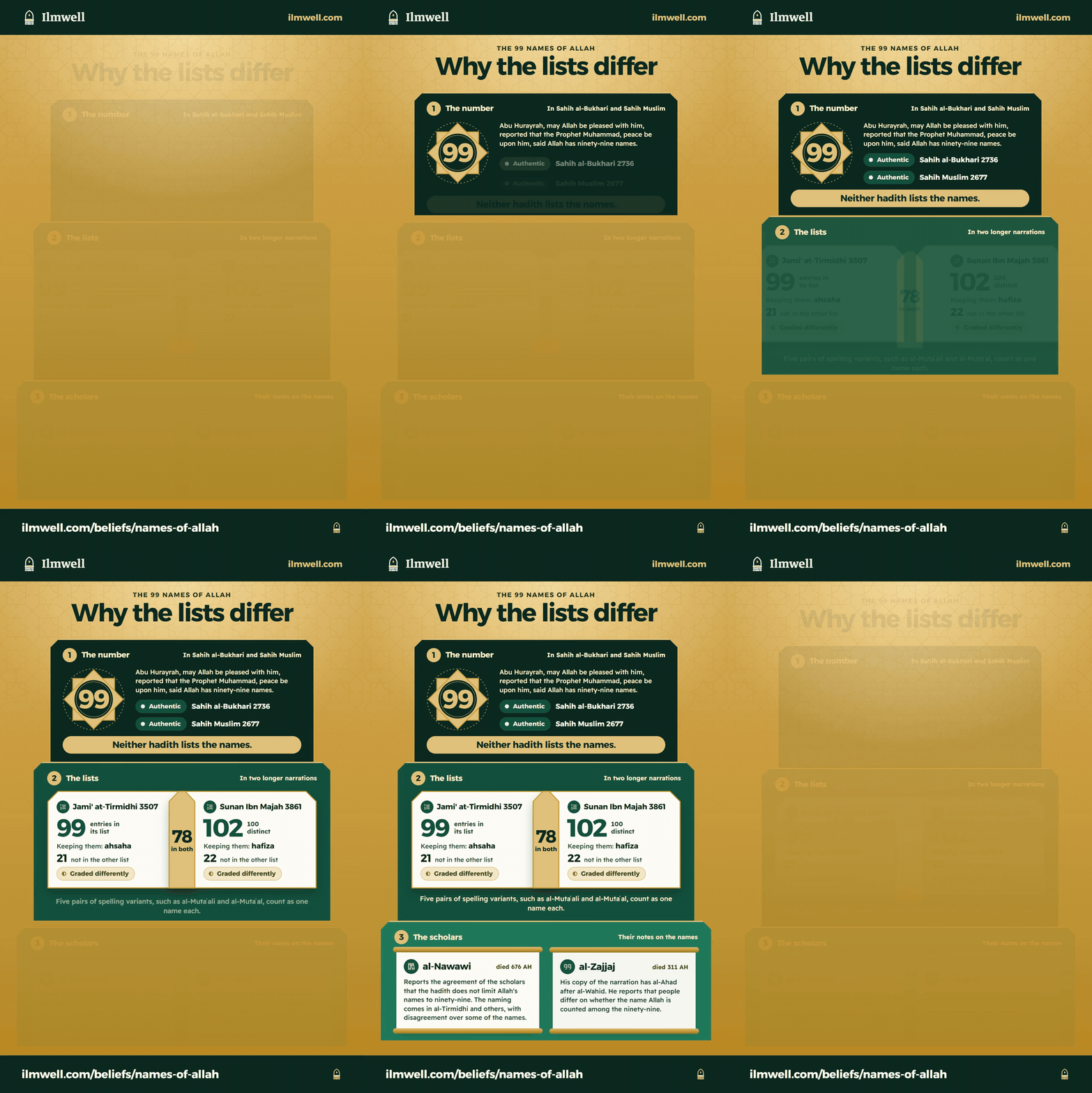
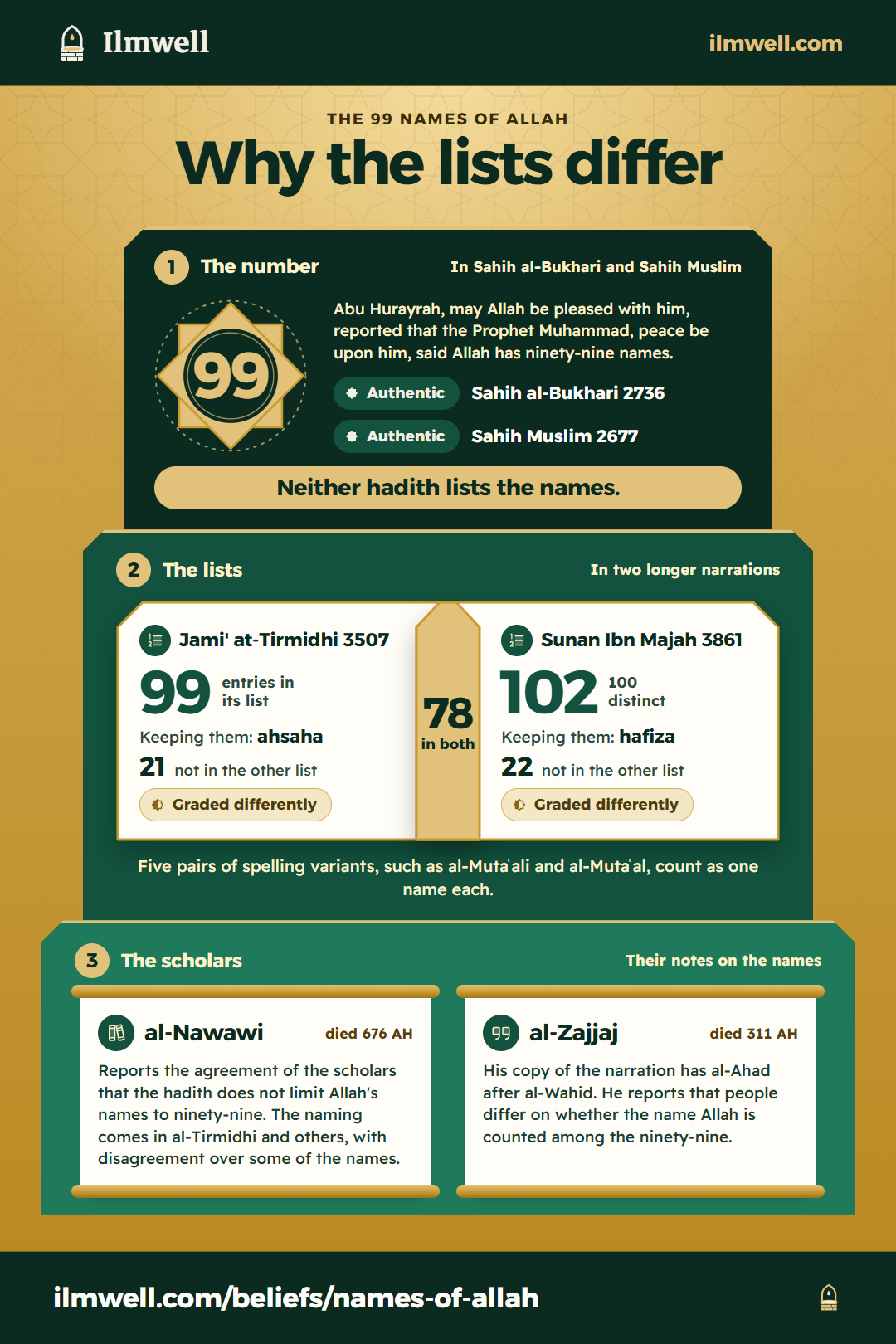
The hadith in Sahih al-Bukhari and Sahih Muslim give the number without a list. The lists come from longer narrations, and they are not the same.
Jami' at-Tirmidhi 3507 holds the list above. It is graded differently: one grading calls it sahih, others grade it weak, and some say a narrator added the list. Remarks note that it is gharib (reported through one chain), that al-Walid ibn Muslim narrated it alone, or defend the chain.
3Graded differently Jami' at-Tirmidhi 3507
A second list is in Sunan Ibn Majah 3861, also graded differently: of the verdicts recorded, one is sahih and three are weak, and the sahih verdict and two of the weak ones are by the same scholar.
4Graded differently Sunan Ibn Majah 3861
| Jami' at-Tirmidhi 3507 | Sunan Ibn Majah 3861 | |
|---|---|---|
| Arabic word for keeping the names | ahsaha | hafiza |
| Entries in its list | 99 | 102 (100 distinct) |
| Names not in the other list | 21 | 22 |
| Grade | Graded differently | Graded differently |
Counting five pairs of spelling variants (such as al-Mutaʿali and al-Mutaʿal) as one name each, 78 names are in both lists. Ibn Majah's text has ar-Rahim and as-Samad twice each. The gradings concern the list as a list.
Even one narration's text varies: al-Zajjaj's copy has al-Ahad after al-Wahid, and he reports that people differ on whether the name Allah is counted among the ninety-nine 7. Al-Nawawi adds that the naming comes in al-Tirmidhi and others, with disagreement over some of the names 5.
How can you learn the names of Allah?
The hadith does not lay down a method. The sources give these readings, any of which the table supports:
- Count them. Al-Zajjaj lists "to count them often" as one meaning of ahsaha 7.
- Understand them. He lists "to be able to tell them apart and understand them" and "to take them in with the mind and reflect on their meanings". Read each meaning in the table.
- Gather them from the Quran. He reports this reading from al-Mubarrad, since these names are scattered through the Quran. The table gives the verses.
- Memorise them. Sahih Muslim 2677 has hafizaha, and al-Nawawi reports that al-Bukhari and others read ahsaha this way.
- Call on Allah by them. Al-A'raf 7:180: "Invoke Him by them."
The reward the hadith names is entry to Paradise, in its own words. For your own practice, ask a scholar you trust.
At primary school we had to memorise a list of the names of Allah. I could recite it, but honestly I couldn't have told you what half of them meant. Years later, reading just one name slowly in the Quran stayed with me far longer than the whole list had.
Try it: three questions
Pick an answer; each one explains itself.
1Which verse tells people to call on Allah by His fairest names?
Answer: Al-A'raf 7:180. Al-A'raf 7:180: "Invoke Him by them."
2Which two collections give the hadith of ninety-nine names without a list?
Answer: Sahih al-Bukhari 2736 and Sahih Muslim 2677. Both give the number without a list, and both are graded sahih. The two lists are in longer narrations, graded differently. Source 1
3According to al-Nawawi, does the hadith limit Allah's names to ninety-nine?
Answer: No: he reports the agreement of the scholars that it does not. Al-Nawawi on Sahih Muslim 2677 (source 5): its point is that whoever ahsaha these ninety-nine enters Paradise.
Questions people ask
Do the 99 names of Allah have other benefits?
The reward in Sahih al-Bukhari 2736 and Sahih Muslim 2677 is entry to Paradise, for whoever ahsaha the names or, in Muslim's wording, memorises them. Neither states another benefit. For any other claimed benefit, ask for its source and its grade.
Sources
Every claim on this page comes from one of these. Gradings are reported with the scholar's name; we do not grade hadith ourselves.
- 1
Abu Hurayrah reported that the Prophet said Allah has ninety-nine names, one hundred less one, and whoever keeps count of them (ahsaha) will enter Paradise.
Sahih al-Bukhari 2736 Book 54, Hadith 23
Authentic: in Sahih al-Bukhari
- 2
Abu Hurayrah reported that the Prophet said Allah has ninety-nine names, whoever memorises them (hafizaha) will enter Paradise, and Allah is witr (single, odd) and loves what is witr; one narrator's wording has 'whoever keeps count of them' (ahsaha).
Sahih Muslim 2677 Book 48, Hadith 5
Authentic: in Sahih Muslim
- 3
Abu Hurayrah reported that the Prophet said Allah has ninety-nine names and whoever keeps count of them will enter Paradise, followed by a list of names beginning 'He is Allah, besides whom there is no god, ar-Rahman, ar-Rahim'; this longer narration with the list is graded differently.
Jami' at-Tirmidhi 3507 Book 48, Hadith 138
Graded differently. Here is who graded it which way:
- SoundAl-Suyuti
- WeakDarussalam, Al-Albani, Ibn Baz, Ibn Taymiyya, Al-Shawkani, Shu'ayb al-Arna'ut
- Other remarksAl-Tirmidhi, Al-Bayhaqi, Al-Hakim
See each grading in full, with its wording and where it was given
Scholars disagree about this hadith. Here is how each graded it, so you can follow the scholar you trust.
- Da'if: Darussalam (as shown on sunnah.com)
- غريب (gharib: known through one chain; he adds that Safwan ibn Salih is trustworthy and that, of the reports naming the names, he knows a sahih chain only for this one): Al-Tirmidhi, Jami' at-Tirmidhi 3507 (as on sunnah.com and dorar.net)
- ضعيف بسرد الأسماء (weak, with the list of names): Al-Albani, Da'if al-Tirmidhi 3507 (as listed on dorar.net)
- ضعيف (Da'if): Al-Albani, Hidayat al-Ruwat 2228 and Da'if al-Jami' 1945 (as listed on dorar.net)
- صحيح (Sahih): Al-Suyuti, al-Jami' al-Saghir 2351 (as listed on dorar.net)
- مدرج عند أهل التحقيق، ليس بثابت عن النبي (inserted, according to the careful scholars; not established from the Prophet): Ibn Baz, Majmu' Tafsir al-Shaykh Ibn Baz 9/365 (as listed on dorar.net)
- ليس من كلام النبي (the list is not the Prophet's words): Ibn Baz, Majmu' al-Shuruh al-Fiqhiyya 111/33 (as listed on dorar.net)
- حفاظ أهل الحديث يقولون هذه الزيادة مما جمعه الوليد بن مسلم عن شيوخه (the hadith masters say this addition is something al-Walid ibn Muslim compiled from his teachers): Ibn Taymiyya, al-Fatawa al-Kubra 2/380 (as listed on dorar.net)
- في إسناده مقال (its chain has been criticised): Al-Shawkani, Nayl al-Awtar 2/108 (as listed on dorar.net)
- رجاله ثقات، وأعل بالاضطراب واحتمال أن يكون التعيين مدرجا من بعض الرواة، وبالوقف (its narrators are trustworthy, but it has been faulted for inconsistency, for the possibility that the naming was inserted by some narrators, and as stopping at the companion): Shu'ayb al-Arna'ut, Takhrij Sahih Ibn Hibban 808 (as listed on dorar.net)
- تفرد بالرواية مع ذكر الأسامي الوليد بن مسلم (al-Walid ibn Muslim alone narrated it with the names): Al-Bayhaqi, al-I'tiqad 56 (as listed on dorar.net)
- العلة فيه عندهما أن الوليد بن مسلم تفرد بسياقته بطوله وذكر الأسامي فيه ولم يذكرها غيره، وليس هذا بعلة (the defect in it, for al-Bukhari and Muslim, is that al-Walid ibn Muslim alone narrated it in full with the names; and this is not a defect): Al-Hakim, al-Mustadrak 41 (as listed on dorar.net)
- 4
Abu Hurayrah reported that the Prophet said Allah has ninety-nine names, one hundred less one, that He is witr (single) and loves what is witr, and that whoever memorises them (man hafizaha) will enter Paradise; the narration then gives a list of names that differs from the list in Jami' at-Tirmidhi 3507. It is graded differently.
Sunan Ibn Majah 3861 Book 34, Hadith 35
Graded differently. Here is who graded it which way:
- SoundAl-Albani
- WeakDarussalam, Al-Albani
See each grading in full, with its wording and where it was given
Scholars disagree about this hadith. Here is how each graded it, so you can follow the scholar you trust.
- Da'if: Darussalam (as shown on sunnah.com)
- ضعيف بهذا التمام (weak, with this completeness): Al-Albani, Da'if Ibn Majah 776 (as listed on dorar.net)
- ضعيف (Da'if): Al-Albani, Da'if al-Jami' 1943 (as listed on dorar.net)
- صحيح (Sahih): Al-Albani, Sahih Ibn Majah 3128 (as listed on dorar.net)
- 5
Al-Nawawi reports the agreement of the scholars that the ninety-nine names hadith does not limit Allah's names: it does not mean He has no names besides these ninety-nine; its point is that whoever ahsaha these ninety-nine enters Paradise. He adds that the naming of the ninety-nine comes in al-Tirmidhi and others, with disagreement over some of the names, and that al-Bukhari and other careful scholars took ahsaha to mean memorising them (hafizaha), which he calls the most evident reading.
Abu Zakariyya Yahya ibn Sharaf al-Nawawi (d. 676 AH), al-Minhaj Sharh Sahih Muslim ibn al-Hajjaj, 2nd edition, Dar Ihya' al-Turath al-'Arabi, Beirut, 1392 AH (shamela.ws numbering follows the print), vol. 17, p. 5, Kitab al-Dhikr, bab fi asma' Allah ta'ala wa fadl man ahsaha, on hadith 2677 Read on 23 October 2026. Record: scholarly-nawawi-names-not-limited.
- 6
Al-Zajjaj explains the names of the narration in the Tirmidhi 3507 list in its order, giving each name's root or sense. Cells in the table beginning "Al-Zajjaj explains" are the Ilmwell team's wording of his explanation; the other cells are standard English translations of the names.
Abu Ishaq Ibrahim ibn al-Sari al-Zajjaj (d. 311 AH), Tafsir Asma' Allah al-Husna (Tafsir asma' Allah ta'ala al-tis'a wa al-tis'in), edited by Ahmad Yusuf al-Daqqaq, Dar al-Thaqafa al-'Arabiyya, as published on shamela.ws (book 6468) Read on 23 October 2026, Shamela pages 5 to 45 (the page numbers of the Shamela web edition). Record: scholarly-zajjaj-ninety-nine-meanings.
- 7
Al-Zajjaj gives four things the Arabic word ahsaha can mean, reports that people differ on whether the name Allah is counted among the ninety-nine, and gives his own text of the narration, which has al-Ahad after al-Wahid.
Abu Ishaq Ibrahim ibn al-Sari al-Zajjaj (d. 311 AH), Tafsir Asma' Allah al-Husna (Tafsir asma' Allah ta'ala al-tis'a wa al-tis'in), edited by Ahmad Yusuf al-Daqqaq, Dar al-Thaqafa al-'Arabiyya, as published on shamela.ws (book 6468) Read on 23 October 2026, Shamela pages 1 to 7. Record: scholarly-zajjaj-ahsaha-and-counting.
- 8
The Ilmwell team's search of the Tanzil Quran text for each of the 99 names in the Tirmidhi 3507 list: 65 the same word used of Allah, 8 a related form, 14 only as a verb and 12 not found as a name. Each verse shown was read.
Ilmwell team search of the Tanzil Quran text Searched on 23 October 2026. Record: search-names-of-allah-quran.
- Q
Quran Arabic and English for Al-A'raf 7:180, and the phrase al-asma' al-husna with its English from Al-Isra 17:110, Ta-Ha 20:8 and Al-Hashr 59:24.
Tanzil Project Uthmani text, CC BY 3.0. English: adapted from Marmaduke Pickthall's translation (1930), modernised and checked against modern translations.
Next
- Who is Allah? The one God in Islam, in the Quran's wordsBelief
- Shahada: meaning, Arabic and contextThe testimony of faith
- The five pillars of Islam explainedWhat Muslims do
- What is Islam? The Muslim religion explainedStart here
- How to pray salahPractical guide
- Jazakallah khairPhrase lesson
For your own situation, ask a scholar you trust.
Join the email list
New guides by email, now and then. No spam, and you can leave at any time.
Ilmwell is free and kept going by readers. See how to support it.