The short answer
The last two verses of Surah Baqarah are Al-Baqarah 2:285 and 2:286 (surah 2, verses 285 and 286), known by the opening words of verse 285, Amanar Rasul. In Sahih al-Bukhari 5009, graded sahih, the Prophet Muhammad, peace be upon him, said that whoever recites them in a night, they will suffice him. The Arabic, transliteration and meaning follow.
What are the last two verses of Surah Baqarah in Arabic and English?
Al-Baqarah 2:285 to 286
ءَامَنَ ٱلرَّسُولُ بِمَآ أُنزِلَ إِلَيْهِ مِن رَّبِّهِۦ وَٱلْمُؤْمِنُونَ ۚ كُلٌّ ءَامَنَ بِٱللَّهِ وَمَلَـٰٓئِكَتِهِۦ وَكُتُبِهِۦ وَرُسُلِهِۦ لَا نُفَرِّقُ بَيْنَ أَحَدٍ مِّن رُّسُلِهِۦ ۚ وَقَالُوا۟ سَمِعْنَا وَأَطَعْنَا ۖ غُفْرَانَكَ رَبَّنَا وَإِلَيْكَ ٱلْمَصِيرُ لَا يُكَلِّفُ ٱللَّهُ نَفْسًا إِلَّا وُسْعَهَا ۚ لَهَا مَا كَسَبَتْ وَعَلَيْهَا مَا ٱكْتَسَبَتْ ۗ رَبَّنَا لَا تُؤَاخِذْنَآ إِن نَّسِينَآ أَوْ أَخْطَأْنَا ۚ رَبَّنَا وَلَا تَحْمِلْ عَلَيْنَآ إِصْرًا كَمَا حَمَلْتَهُۥ عَلَى ٱلَّذِينَ مِن قَبْلِنَا ۚ رَبَّنَا وَلَا تُحَمِّلْنَا مَا لَا طَاقَةَ لَنَا بِهِۦ ۖ وَٱعْفُ عَنَّا وَٱغْفِرْ لَنَا وَٱرْحَمْنَآ ۚ أَنتَ مَوْلَىٰنَا فَٱنصُرْنَا عَلَى ٱلْقَوْمِ ٱلْكَـٰفِرِينَ
Āmana r-rasūlu bimā unzila ilayhi mir rabbihī wa l-muʾminūn, kullun āmana bi-llāhi wa malāʾikatihī wa kutubihī wa rusulih, lā nufarriqu bayna aḥadim mir rusulih, wa qālū samiʿnā wa aṭaʿnā, ghufrānaka rabbanā wa ilayka l-maṣīr. Lā yukallifu llāhu nafsan illā wusʿahā, lahā mā kasabat wa ʿalayhā ma ktasabat, rabbanā lā tuʾākhidhnā in nasīnā aw akhṭaʾnā, rabbanā wa lā taḥmil ʿalaynā iṣran kamā ḥamaltahū ʿala lladhīna min qablinā, rabbanā wa lā tuḥammilnā mā lā ṭāqata lanā bih, waʿfu ʿannā waghfir lanā warḥamnā, anta mawlānā fanṣurnā ʿala l-qawmi l-kāfirīn.
The messenger believes in that which has been revealed to him from his Lord and (so do) believers. Each one believes in Allah and His angels and His scriptures and His messengers - We make no distinction between any of His messengers - and they say: We hear, and we obey. (Grant us) Your forgiveness, our Lord. To You is the journeying. Allah does not burden a soul beyond its scope. For it (is only) that which it has earned, and against it (only) that which it has deserved. Our Lord! Do not condemn us if we forget, or miss the mark! Our Lord! Do not lay on us such a burden as You laid on those before us! Our Lord! Do not impose on us that which we do not have the strength to bear! Pardon us, absolve us and have mercy on us. You are our Protector, so give us victory over the disbelieving folk.
Al-Baqarah, the second surah, has 286 verses, so these are verses 285 and 286. The last ayat of Surah Baqarah is verse 286, which opens "La yukallifullahu nafsan illa wus'aha". To copy and paste the Arabic, use the button under the scroll.
You will see the passage searched for as Surah Baqarah last 2 ayat, the last two ayat or the last 2 verses of Surah Baqarah. Ayah, ayat and ayats are all ways of writing "verse" and "verses".
What do the last two verses of Al-Baqarah mean?
Verse 285 describes the messenger and the believers: what they believe in, and the words they say. Verse 286 opens with "Allah does not burden a soul beyond its scope", then turns into requests to Allah. Here are both verses in their 11 lines, cut where the Arabic carries a small pause mark (the marks are left out of the list).
- 1
ءَامَنَ ٱلرَّسُولُ بِمَآ أُنزِلَ إِلَيْهِ مِن رَّبِّهِۦ وَٱلْمُؤْمِنُونَ
Amanar-rasulu bima unzila ilayhi mir-rabbihi wal-mu'minun
The messenger believes in that which has been revealed to him from his Lord and (so do) believers.
2:285 Amana is "believes". Ar-rasul is the messenger; al-mu'minun, the believers.
- 2
كُلٌّ ءَامَنَ بِٱللَّهِ وَمَلَـٰٓئِكَتِهِۦ وَكُتُبِهِۦ وَرُسُلِهِۦ لَا نُفَرِّقُ بَيْنَ أَحَدٍ مِّن رُّسُلِهِۦ
Kullun amana billahi wa mala'ikatihi wa kutubihi wa rusulih, la nufarriqu bayna ahadim mir-rusulih
Each one believes in Allah and His angels and His scriptures and His messengers - We make no distinction between any of His messengers -
2:285 Four things believed in: Allah, His angels, His scriptures (kutub) and His messengers (rusul).
- 3
وَقَالُوا۟ سَمِعْنَا وَأَطَعْنَا
Wa qalu sami'na wa ata'na
and they say: We hear, and we obey.
2:285 In Sahih Muslim 125 the Prophet told his companions to say the words of this line and the next.
- 4
غُفْرَانَكَ رَبَّنَا وَإِلَيْكَ ٱلْمَصِيرُ
Ghufranaka rabbana wa ilaykal-masir
(Grant us) Your forgiveness, our Lord. To You is the journeying.
2:285 Ghufranaka: Your forgiveness. Al-masir: the journeying, the return.
- 5
لَا يُكَلِّفُ ٱللَّهُ نَفْسًا إِلَّا وُسْعَهَا
La yukallifullahu nafsan illa wus'aha
Allah does not burden a soul beyond its scope.
2:286 Yukallifu is to place a duty on someone. Wus' is capacity: what a soul can manage.
- 6
لَهَا مَا كَسَبَتْ وَعَلَيْهَا مَا ٱكْتَسَبَتْ
Laha ma kasabat wa 'alayha mak-tasabat
For it (is only) that which it has earned, and against it (only) that which it has deserved.
2:286 Kasabat and iktasabat share the root k-s-b, to earn.
- 7
رَبَّنَا لَا تُؤَاخِذْنَآ إِن نَّسِينَآ أَوْ أَخْطَأْنَا
Rabbana la tu'akhidhna in nasina aw akhta'na
Our Lord! Do not condemn us if we forget, or miss the mark!
2:286 Nasina: we forget. Akhta'na: we make a mistake.
- 8
رَبَّنَا وَلَا تَحْمِلْ عَلَيْنَآ إِصْرًا كَمَا حَمَلْتَهُۥ عَلَى ٱلَّذِينَ مِن قَبْلِنَا
Rabbana wa la tahmil 'alayna isran kama hamaltahu 'alal-ladhina min qablina
Our Lord! Do not lay on us such a burden as You laid on those before us!
2:286 Isr is a heavy load; this translation gives "burden".
- 9
رَبَّنَا وَلَا تُحَمِّلْنَا مَا لَا طَاقَةَ لَنَا بِهِۦ
Rabbana wa la tuhammilna ma la taqata lana bih
Our Lord! Do not impose on us that which we do not have the strength to bear!
2:286 Taqah is strength: what we have no strength to bear.
- 10
وَٱعْفُ عَنَّا وَٱغْفِرْ لَنَا وَٱرْحَمْنَآ
Wa'fu 'anna waghfir lana warhamna
Pardon us, absolve us and have mercy on us.
2:286 Three requests in a row: pardon, forgiveness, mercy.
- 11
أَنتَ مَوْلَىٰنَا فَٱنصُرْنَا عَلَى ٱلْقَوْمِ ٱلْكَـٰفِرِينَ
Anta mawlana fansurna 'alal-qawmil-kafirin
You are our Protector, so give us victory over the disbelieving folk.
2:286 Mawla is protector or patron.
Listen and repeat. A recording by a fluent human reciter is coming. We do not use a synthetic voice for the Quran. Until then, learn one line at a time from the list above.
A friend at a game of football told me he read the last two verses of Al-Baqarah before sleeping. I bookmarked the page on my phone but it was a while before I could say them from memory.
Try it: what do they say?
Four quick questions on the lines and the reports. Each answer explains itself.
1What does "La yukallifullahu nafsan illa wus'aha" mean?
Answer: Allah does not burden a soul beyond its scope. Yukallifu is to place a duty on someone, and wus' is capacity. It opens verse 286.
2What did the Prophet tell his companions to say when verse 284 felt too hard?
Answer: "We hear and we obey". He told them not to say "we hear and we disobey" but "we hear and we obey, Your forgiveness, our Lord, and to You is the journeying". Source 2
3Which verses are the last two of Al-Baqarah?
Answer: 2:285 and 2:286. Al-Baqarah has 286 verses, so the last two are 285 and 286.
4In Sahih al-Bukhari 5009, when are they recited?
Answer: In a night. Whoever recites them in a night, they will suffice him. The narration names no hour of the night. Source 1
Why were the last two verses of Al-Baqarah revealed?
Sahih Muslim records that they came after the verse before them, verse 284, troubled the companions. That verse says "whether you make known what is in your minds or hide it, Allah will bring you to account for it".
لِّلَّهِ مَا فِى ٱلسَّمَـٰوَٰتِ وَمَا فِى ٱلْأَرْضِ ۗ وَإِن تُبْدُوا۟ مَا فِىٓ أَنفُسِكُمْ أَوْ تُخْفُوهُ يُحَاسِبْكُم بِهِ ٱللَّهُ ۖ فَيَغْفِرُ لِمَن يَشَآءُ وَيُعَذِّبُ مَن يَشَآءُ ۗ وَٱللَّهُ عَلَىٰ كُلِّ شَىْءٍ قَدِيرٌ
If you were looking for the last three ayat of Surah Baqarah, this is the third.
We hear and we obey
Abu Hurayrah, may Allah be pleased with him, reported that when it was revealed, the companions found it hard. They came to the Prophet, knelt and said they had been given duties they could manage, prayer, fasting, striving (jihad) and charity, but this verse they could not manage.
He asked whether they wanted to say what the people of the two earlier scriptures said, "we hear and we disobey". Instead, he said, say: "We hear and we obey. Your forgiveness, our Lord, and to You is the journeying."
They said it, and once their tongues had grown used to the words, Allah revealed verse 285, which carries those same words. When they had done that, the narration says, Allah abrogated it (nasakhaha) and revealed verse 286. In the narration's frame, "it" is the verse they had found too hard. After each of the four parts of verse 286 it quotes, the narration records: "He said: Yes." What exactly was lifted is a question for tafsir (Quran commentary), which a separate page will set out with its sources.
2AuthenticSahih Muslim 125
I have done so
Ibn Abbas, may Allah be pleased with him, tells it more briefly. Something entered their hearts from that verse unlike anything before, and the Prophet told them to say: "We hear, we obey and we submit." Allah put faith into their hearts and revealed verse 286. After each of the three parts it quotes, the narration records: "He said: I have done so."
3AuthenticSahih Muslim 126
The story behind the verses, in one picture
The last two verses of Al-Baqarah, Al-Baqarah 2:285 to 286, and the story behind them from Sahih Muslim 125. 1: verse 284 felt too hard; the companions said they could not bear it. 2: we hear, and we obey; what the Prophet told them to say. 3: verse 285 came, carrying those same words. 4: then verse 286, and after each part the narration says, He said: Yes. Our Lord! Do not condemn us if we forget, or miss the mark. Do not lay on us such a burden as You laid on those before us. Do not impose on us that which we do not have the strength to bear. Pardon us, absolve us and have mercy on us; You are our Protector, so give us victory over the disbelieving folk. Recited in a night, they suffice him (Sahih al-Bukhari 5009); given on the Night Journey (Sahih Muslim 173); one of two lights, with Al-Fatihah (Sahih Muslim 806); all graded authentic.
The worry, the reply and the answer, in one picture. Save it, print it, or share it.
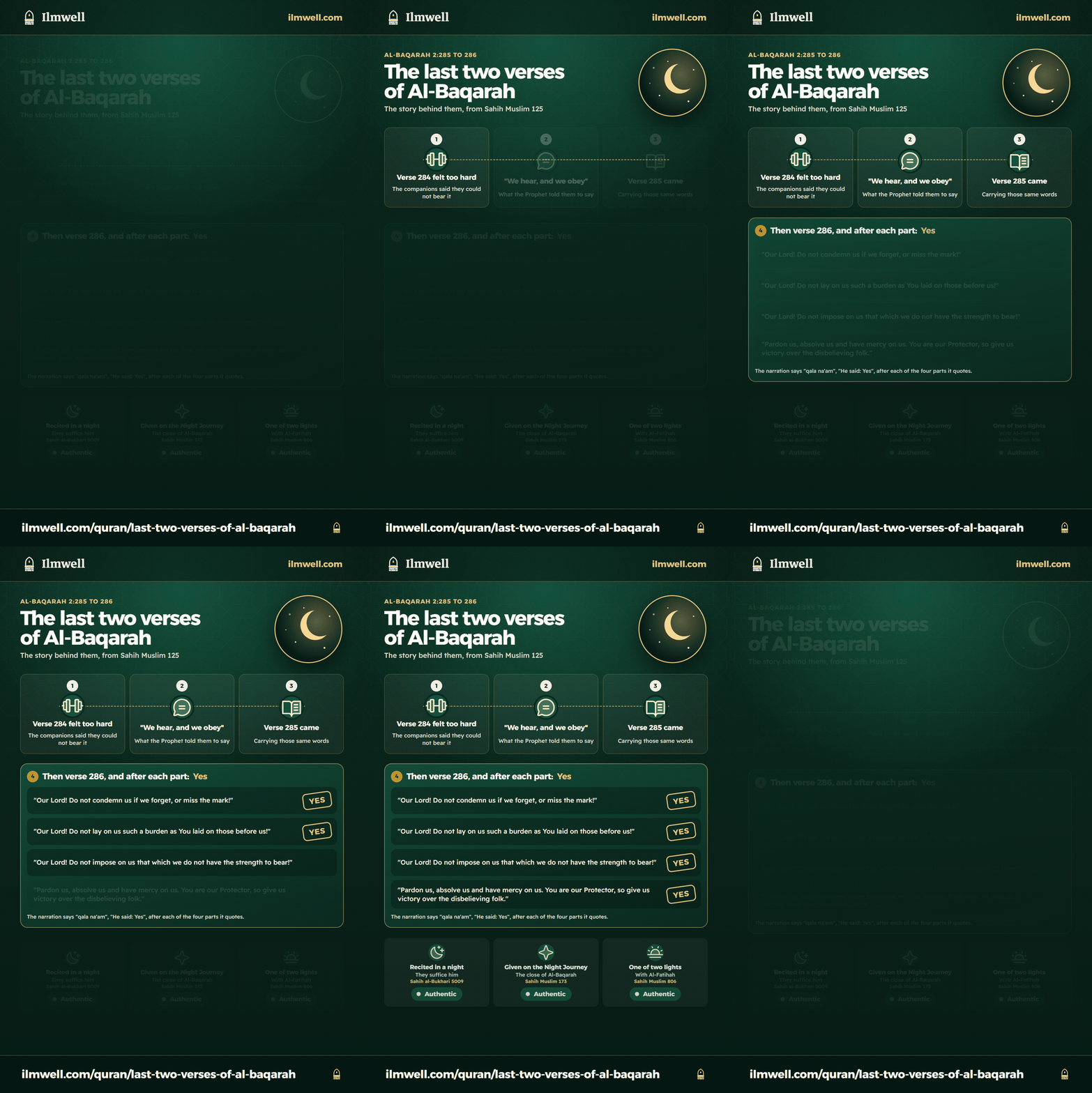
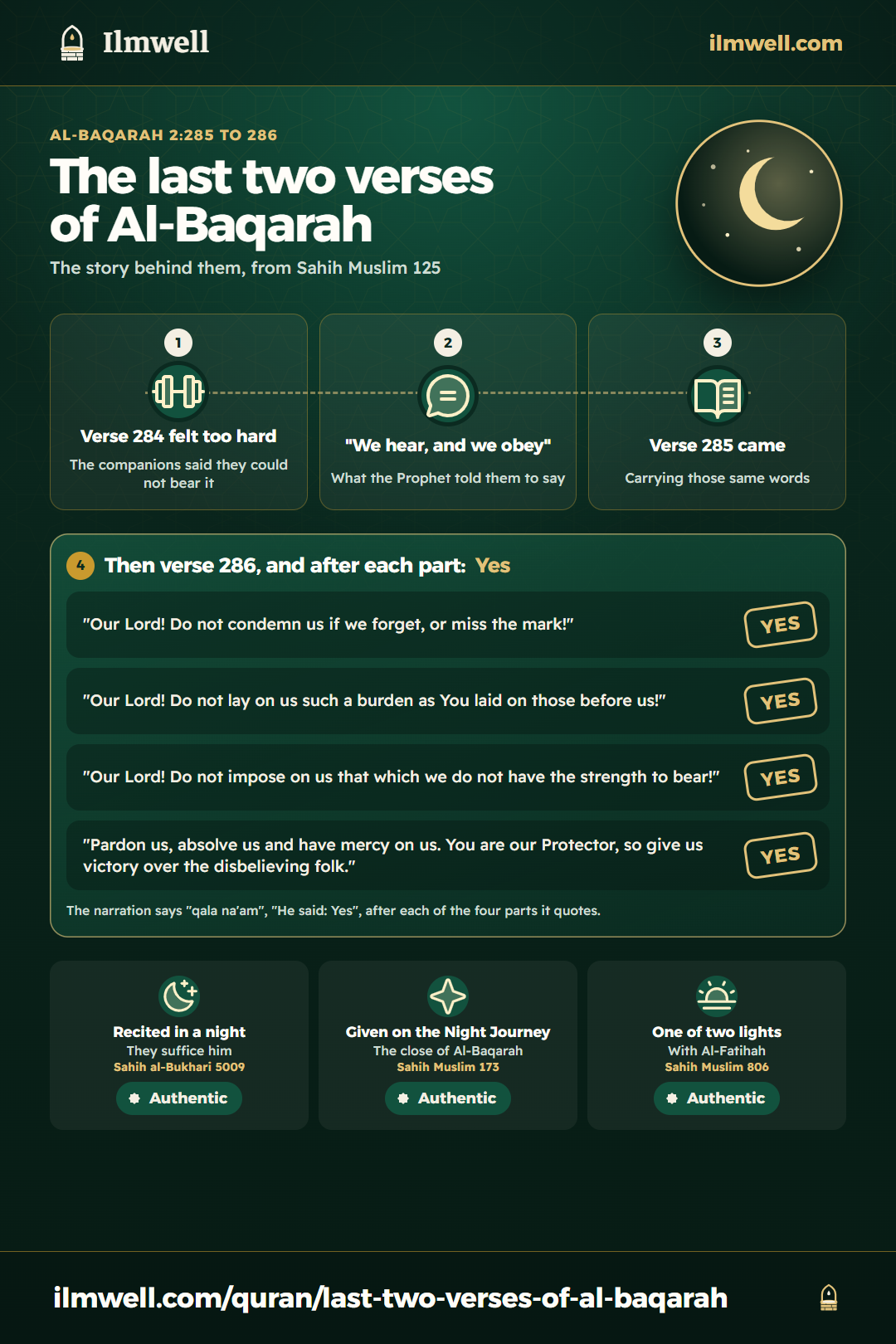
Posting it on your own site? Link back to this guide; the code under "Use it on your own site" does it in one line.
What are the benefits of the last two verses of Surah Baqarah?
Each report in the table is graded sahih or hasan.
| What is said about these verses | Source and grade |
|---|---|
| Whoever recites them in a night, they will suffice him (what "suffice" means). | 1AuthenticSahih al-Bukhari 5009 |
| An angel came down through a gate of heaven opened that day for the first time and told the Prophet to rejoice in two lights given to no prophet before him: Al-Fatihah and the closing verses of Al-Baqarah. He will not recite a letter of them without being given it. | 4AuthenticSahih Muslim 806 |
| On the Night Journey, brought to Sidrat al-Muntaha (the Lote Tree of the Utmost Boundary), the Prophet was given three things: the five prayers, the closing verses of Al-Baqarah, and forgiveness of the grave sins for those of his community who associate nothing with Allah. | 5AuthenticSahih Muslim 173 |
| The Prophet said Allah wrote a book two thousand years before creating the heavens and the earth, and sent down from it the two verses that close Al-Baqarah. If they are recited in a house for three nights, no devil comes near it. | 6AuthenticJami' at-Tirmidhi 2882 |
What does "they will suffice him" mean?
Abu Mas'ud al-Ansari, may Allah be pleased with him, reported that the Prophet said whoever recites the two verses at the end of Surah Al-Baqarah in a night, they will suffice him. The Arabic word is kafatahu. The narration does not say what they suffice him from, and it names no hour of the night.
1AuthenticSahih al-Bukhari 5009also Sahih Muslim 807 and 808
Al-Nawawi, in his book al-Adhkar, says scholars differed over its meaning: one view is that they suffice him against harms through his night, another that they suffice him for standing in prayer that night. He adds that both may be meant (source 7). He places the hadith in his chapter on what to say when going to sleep.
Common mix-ups
- The pair is known by the opening words of verse 285, Amanar Rasul. It is two verses, not a surah; "La yukallifullahu nafsan" opens verse 286.
- Sahih Muslim 806 (the two lights) and 173 (the Night Journey) say "the closing verses" of Al-Baqarah without giving a number. The two-verse wording is in Sahih al-Bukhari 5009 and Jami' at-Tirmidhi 2882.
Questions people ask
Can you recite the last 2 verses of Surah Baqarah before sleeping?
The hadith in Sahih al-Bukhari 5009, graded sahih, speaks of reciting them "in a night" and names no hour. Al-Nawawi places the hadith in the chapter on what to say when going to sleep in his book al-Adhkar.
Is there a PDF of the last 2 or last 3 ayat of Surah Baqarah?
Not yet. The Arabic, transliteration and English of verses 285 and 286 are on this page, with a copy button for the Arabic. Verse 284, which makes the last three ayat, is shown in the section on why they were revealed.
Sources
Every claim on this page comes from one of these. Gradings are reported with the scholar's name; we do not grade hadith ourselves.
- 1
The Prophet said that whoever recites the two verses at the end of Surat al-Baqarah in a night, they will suffice him.
Sahih al-Bukhari 5009 Book 66, Hadith 31
Authentic: in Sahih al-Bukhari
- 2
When Al-Baqarah 2:284 was revealed the companions found it hard and told the Prophet they could not bear it; he told them to say 'we hear and we obey'. After they said it Allah revealed 2:285; then, the narration says, Allah abrogated (nasakha) the verse they had found too hard and revealed 2:286, with 'He said: Yes' after each of the four parts of it quoted.
Sahih Muslim 125 Book 1, Hadith 236
Authentic: in Sahih Muslim
- 3
When 2:284 was revealed something entered the companions' hearts unlike anything before; the Prophet told them to say 'we hear, we obey and we submit', Allah put faith in their hearts and revealed 2:286, with 'He said: I have done so' after the requests.
Sahih Muslim 126 Book 1, Hadith 237
Authentic: in Sahih Muslim
- 4
An angel told the Prophet to rejoice in two lights given to no prophet before him: Al-Fatihah and the end of Al-Baqarah.
Sahih Muslim 806 Book 6, Hadith 305
Authentic: in Sahih Muslim
- 5
When the Prophet was taken on the Night Journey to Sidrat al-Muntaha, he was given three things: the five prayers, the closing verses of Surat al-Baqarah, and forgiveness of the grave sins for those of his community who associate nothing with Allah.
Sahih Muslim 173 Book 1, Hadith 336
Authentic: in Sahih Muslim
- 6
The Prophet said Allah wrote a book two thousand years before creating the heavens and the earth and sent down from it two verses with which He closed Surat al-Baqarah; they are not recited in a house for three nights and a devil then comes near it.
Jami' at-Tirmidhi 2882 Book 45, Hadith 8
Authentic: Hasan (Darussalam); hasan gharib (Al-Tirmidhi); its chain is sahih, hasan or close to them (Al-Mundhiri); sahih on the conditions of Muslim (Al-Hakim); hasan (Ibn Hajar al-'Asqalani); Sahih (Al-Albani). Remarks: gharib: reported through a single chain (Al-Baghawi); reported from al-Nu'man only by this chain; Hammad ibn Salamah alone narrates it (Al-Tabarani)
- 7
Al-Nawawi reports that scholars differed over "kafatahu": that the two verses suffice the reciter against harms (al-afat) through his night, or that they suffice him for standing in prayer that night; he says both may be meant. He gives the hadith (no. 496) in his chapter on what to say when going to sleep.
Yahya ibn Sharaf al-Nawawi, al-Adhkar (Kitab al-Adhkar), chapter on what to say when going to sleep, no. 497, Ibn Hazm edition, p. 178, no. 497 (read on shamela.ws); the hadith itself is no. 496, p. 177 Read on 21 October 2026. Record: scholarly-nawawi-kafatahu.
- Q
Quran Arabic for Al-Baqarah 2:284 to 286 (the scroll, the 11 lines and the verse 284 card) and its English.
Tanzil Project Uthmani text, CC BY 3.0. English: adapted from Marmaduke Pickthall's translation (1930), modernised and checked against modern translations.
Next
- Ayat al-Kursi: meaning and reported virtuesQuran lesson
- Al-Fatihah: meaning and understanding what you reciteQuran lesson
- Al-Falaq and An-Nas: meaning and contextQuran lesson
- Al-Ikhlas: meaning, themes and reported virtuesQuran lesson
- Al-Mulk: themes, meaning and reported virtuesQuran lesson
- Al-Kahf: four accounts and their lessonsQuran lesson
- Quran and SurahsThe hub
For your own situation, ask a scholar you trust.
Join the email list
New guides by email, now and then. No spam, and you can leave at any time.
Ilmwell is free and kept going by readers. See how to support it.