The short answer
How to pray Witr: at night after 'Isha, pray three rak'ahs with one salam (the Hanafi text) or two rak'ahs, a salam, then one (the other schools' texts). Sahih al-Bukhari 990 (graded sahih) records the Prophet Muhammad, peace be upon him, saying night prayer is two by two, and one fearing dawn prays one rak'ah to make it odd.
How do you pray Witr step by step?
Witr uses the same standing, bowing and prostration as any prayer (see how to pray Salah). What differs is its shape and the qunoot, a supplication said standing. Each list below follows its named texts from start to finish. The steps follow the school texts cited; they are not a ruling from us.
Three rak'ahs with one salam (the Hanafi text)
- First rak'ah: al-Fatihah and a surah, then bow and prostrate. 6
- Second rak'ah: al-Fatihah and a surah. Sit and recite the tashahhud only, with no salam. 6
- Stand for the third without the opening supplication (the dua said after the opening takbir), and recite al-Fatihah and a surah. 6
- Raise your hands level with your ears, say Allahu akbar, and make the qunoot standing (the dua). 6
- Bow, prostrate, sit for the final tashahhud and end the whole prayer with one salam. 6
These steps are Maraqi al-Falah's (Hanafi): three rak'ahs with one salam, al-Fatihah and a surah in each, and qunoot before bowing in the third, all year 6.
Two rak'ahs, then one (the Maliki, Shafi'i and Hanbali texts)
- Pray two rak'ahs and end them with a salam. 101114
- Stand for one rak'ah as a prayer of its own: recite, then bow. 81114
- Qunoot, if your school's text has it here: the Hanbali text puts it after rising from bowing, all year; the Shafi'i text after bowing, in the last half of Ramadan; the Maliki text has none in witr. 15129
- Rise, then prostrate, sit for the tashahhud and end with a salam. 1114
Al-Majmu' and Kashshaf al-Qina' also allow the three to be joined with one salam 1114.
The pairs-then-one shape is in the report of Ibn 'Umar, may Allah be pleased with him. A man asked the Prophet about the night prayer. He said it is two by two, and when one of you fears the dawn, he prays one rak'ah, which makes what he has prayed odd (Sahih al-Bukhari 990, graded sahih). The report sets no total number of rak'ahs and says nothing about qunoot.
1AuthenticSahih al-Bukhari 990
Is Witr wajib or sunnah, and what do the four schools' texts say?
Maraqi al-Falah (Hanafi) calls Witr wajib; al-Kafi, al-Majmu' and Kashshaf al-Qina' do not. Each column follows one named work, in short. It is not a ruling from us and does not cover every view inside a school.
| HanafiMaraqi al-Falah | Malikial-Kafi | Shafi'ial-Majmu' | HanbaliKashshaf | |
|---|---|---|---|---|
| Status | Wajib, in the more correct view, which was Abu Hanifa's last. It is also narrated from him that it is sunnah, the view of his two students, Abu Yusuf and Muhammad al-Shaybani 6 | Among the most emphasised sunnahs, with the Eid, rain and eclipse prayers 8 | Sunnah, with no disagreement in the school 11 | Not wajib for the community. Al-Mughni reports Ahmad calling it sunnah mu'akkadah (an emphasised sunnah) 1417 |
| Three rak'ahs | Three with one salam, sitting for the tashahhud only after the second 6 | A prayer of at least two rak'ahs before the witr. Behind an imam who prays three without a salam between them, do not go against him 8 | Two salams (two, then one) is best on the sahih view. Joining them is allowed 11 | Two salams is better. Three with one salam is allowed 14 |
| One rak'ah | Witr is three rak'ahs in this text 6 | Some scholars disliked a lone rak'ah with nothing before it and others allowed it. Ibn 'Abd al-Barr prefers Malik's choice of a prayer before it 8 | One rak'ah is the minimum 11 | One rak'ah is the minimum, and praying it alone is not disliked 14 |
| Surahs, if three | Al-Fatihah and a surah in every rak'ah. The commentary cites a report of al-A'la, al-Kafirun and al-Ikhlas 6 | No fixed limit. Malik liked al-Ikhlas, al-Falaq and al-Nas after al-Fatihah in the third 8 | Al-A'la, al-Kafirun, then al-Ikhlas with al-Falaq and al-Nas, as the school's scholars recommend 11 | Al-A'la, al-Kafirun, then al-Ikhlas 14 |
| Time | From the twilight until just before true dawn, never before 'Isha. Delay it to the end of the night if you trust yourself to wake 7 | From after 'Isha until the Subh (Fajr) prayer; delaying it until dawn is disliked. The end of the night is better for one able 8 | From the end of 'Isha until dawn. Delay it if you pray at night or trust yourself to wake 11 | From after 'Isha until the second dawn (true dawn). Best at the end of the night if you trust yourself to rise, otherwise before sleeping 14 |
| Praying after Witr | This page gives no Hanafi position on this | Al-Dardir: an early witr is not repeated, and voluntary prayer after it is allowed 10 | The witr is not undone or repeated. Pray in twos 13 | The witr is not undone. Pray in twos until dawn 16 |
So, can you pray one rak'ah of Witr? Al-Majmu' and Kashshaf al-Qina' give one rak'ah as the minimum, Kashshaf adding that it is not disliked alone 1114. Al-Kafi reports scholars on both sides and prefers a prayer before it 8; Maraqi al-Falah describes Witr as three 6. For the surahs, see Al-Kafirun, Al-Ikhlas and Al-Falaq and An-Nas.
Is qunoot in Witr before or after bowing?
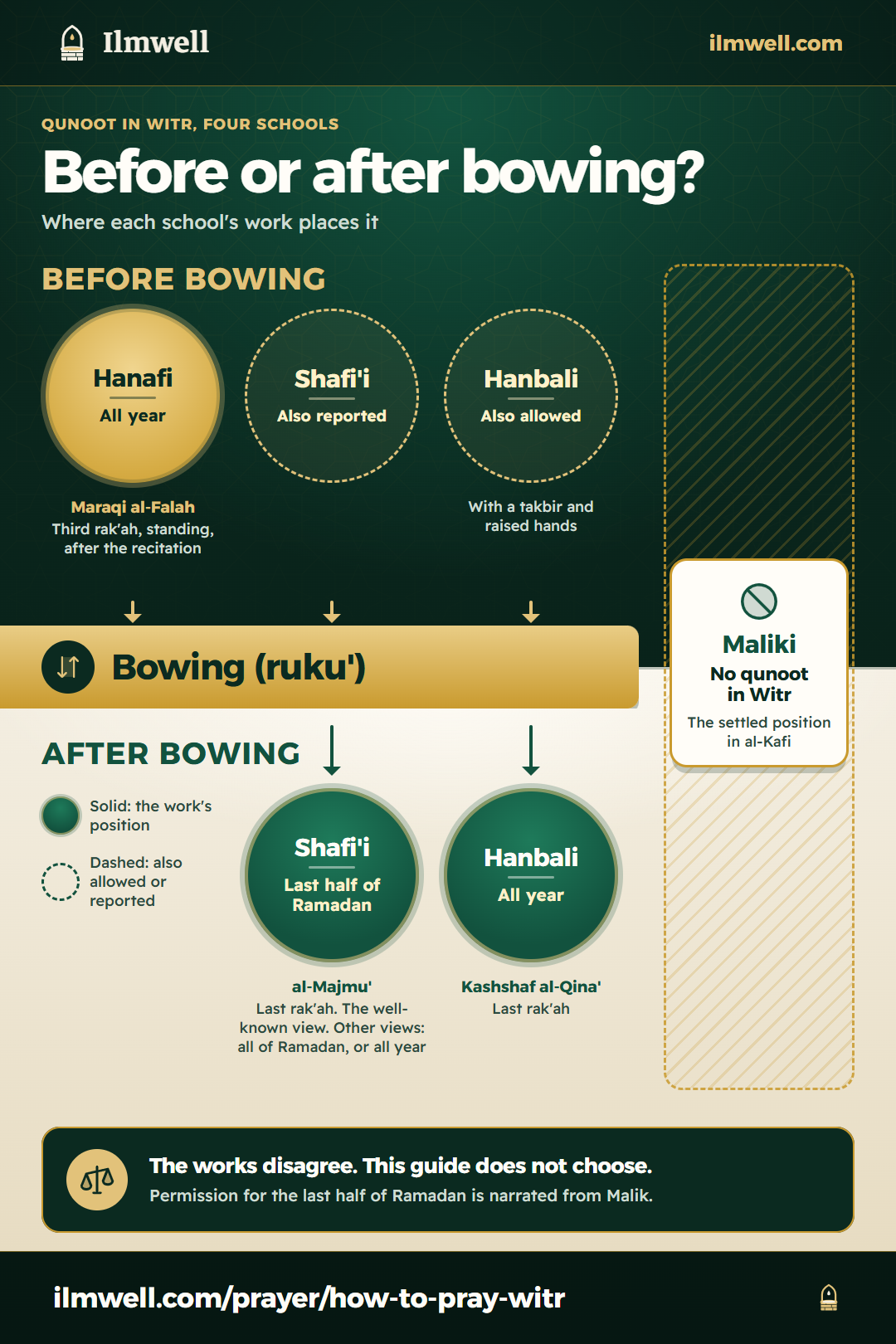
It depends on the school: the Hanafi text says before, the Shafi'i and Hanbali texts say after, and the Maliki text (al-Kafi) gives no qunoot in Witr as the school's settled view. The schools' works disagree here, and this page does not choose between them.
| School | Position and season |
|---|---|
| Hanafi | Third rak'ah, standing, before bowing, all year. After the recitation, raise the hands level with the ears and say Allahu akbar first 6 |
| Maliki | No qunoot in witr: in this work qunoot is for Subh alone. Permission for the last half of Ramadan is narrated from Malik, but no qunoot in witr is his school's settled position 9 |
| Shafi'i | Last rak'ah, after bowing, in the last half of Ramadan (the well-known view). Other views: all of Ramadan, or all year; before bowing is also reported 12 |
| Hanbali | Last rak'ah, after bowing, all year. Before bowing, with a takbir and raised hands, is allowed 15 |
Where sources differ: al-Nawawi gives qunoot through all of Ramadan as Malik's view 12, while Ibn 'Abd al-Barr says no witr qunoot is the settled Maliki position and permission for qunoot in the last half of Ramadan is narrated from Malik 9. Each is reported in its own words.

What is the Witr dua?
Al-Hasan ibn 'Ali, may Allah be pleased with him, said the Prophet taught him words to say in the witr. Jami' at-Tirmidhi 464 gives them, and it is graded differently: thirteen gradings from ten graders accept al-Tirmidhi's wording as hasan or sahih, and one says it is not authentic.
Taught to al-Hasan (Jami' at-Tirmidhi 464, graded differently)
اللَّهُمَّ اهْدِنِي فِيمَنْ هَدَيْتَ وَعَافِنِي فِيمَنْ عَافَيْتَ وَتَوَلَّنِي فِيمَنْ تَوَلَّيْتَ وَبَارِكْ لِي فِيمَا أَعْطَيْتَ وَقِنِي شَرَّ مَا قَضَيْتَ فَإِنَّكَ تَقْضِي وَلاَ يُقْضَى عَلَيْكَ وَإِنَّهُ لاَ يَذِلُّ مَنْ وَالَيْتَ تَبَارَكْتَ رَبَّنَا وَتَعَالَيْتَ
Allāhumma-hdinī fīman hadayt, wa ʿāfinī fīman ʿāfayt, wa tawallanī fīman tawallayt, wa bārik lī fīmā aʿṭayt, wa qinī sharra mā qaḍayt, fa-innaka taqḍī wa lā yuqḍā ʿalayk, wa innahu lā yadhillu man wālayt, tabārakta rabbanā wa taʿālayt.
Meaning (our rendering): O Allah, guide me among those You have guided, grant me well-being among those You have granted well-being, take me into Your care among those You have taken into Your care, bless me in what You have given, and protect me from the evil of what You have decreed. For You decree, and none decrees over You. The one You befriend is not humbled. Blessed are You, our Lord, and exalted.
2Graded differently Jami' at-Tirmidhi 464
The hadith does not say whether the dua comes before or after bowing, or in which part of the year: those come from the schools' texts in the table above. Sunan Abi Dawud 1425 adds wa la yaʿizzu man ʿadayt (and the one You take as an enemy is not honoured), a phrase graded differently on its own. The Dua qunoot lesson gives it line by line, with the other wording, Allahumma inna nastaʿinuka.
What each work says to recite:
- Maraqi al-Falah (Hanafi) gives Allahumma inna nastaʿinuka as the qunoot, and its commentary says it is better to recite the al-Hasan dua after it 6.
- Al-Kafi (Maliki) has no qunoot in Witr as the settled view 9.
- Al-Majmu' (Shafi'i) gives the same wording as in the Fajr qunoot: the al-Hasan dua and the qunoot of 'Umar, may Allah be pleased with him, with the al-Hasan dua first, which al-Nawawi prefers 12.
- Kashshaf al-Qina' (Hanbali) reports that Ahmad chose the al-Hasan dua, recommended but not fixed, and that one may add other supplications 15.
When is Witr prayed, and can you pray Tahajjud after it?
All four works place Witr after 'Isha; three end its time at dawn, and al-Kafi at the Subh prayer (see the table). Jabir, may Allah be pleased with him, reports the Prophet's words in Sahih Muslim 755a (graded sahih). Whoever fears he will not rise at the end of the night should pray witr at its beginning. Whoever hopes to rise at its end should pray witr at the end of the night, for prayer at the end of the night is witnessed, and that is better.
3AuthenticSahih Muslim 755a
Ibn 'Umar also reports the Prophet saying: make the last of your prayer at night witr (Sahih al-Bukhari 998, graded sahih).
4AuthenticSahih al-Bukhari 998
Neither report says what to do if you prayed Witr early and then wake. Al-Majmu' and Kashshaf al-Qina' say the witr is not undone and you pray in twos 1316, and al-Dardir (Maliki) says an early witr is not repeated 10. This page gives no Hanafi position on this point. The Tahajjud guide covers the night prayer itself.
If you are unsure
If the imam's method differs from yours, al-Kafi (Maliki) says not to go against an imam who prays three without a salam between them 8. Missing Witr, forgetting the qunoot and joining late each have their own discussion in the school works, and this page does not cover them. For your own situation, ask a scholar you trust.
I learnt Witr one way at home and saw it prayed another way at the masjid, and for a while I assumed one of them was wrong. Seeing how each school describes it, from its own books, settled that for me.
Try it: the reports
Three checks, each with its source.
1In Sahih Muslim 755a, who is told to pray witr at the beginning of the night?
Answer: Whoever fears he will not wake at the end of it. Whoever fears not waking prays it early; whoever hopes to wake prays it at the end of the night, and the report calls that better. Source 3
2Does the wording of Jami' at-Tirmidhi 464 (graded differently) say whether qunoot is before or after bowing?
Answer: It does not say. The words of the dua give no position. Before or after bowing comes from the schools' works in the qunoot table. Source 2
3In Sahih al-Bukhari 990, when does one pray a single rak'ah?
Answer: When he fears the dawn is near. Night prayer is two by two, and when one fears the dawn he prays one rak'ah, which makes what he prayed odd. Source 1
Questions people ask
How do you pray Witr if you do not know dua qunoot?
Maraqi al-Falah, a Hanafi work, gives three options for someone who cannot say the qunoot well. They are Allahumma ighfir li (O Allah, forgive me) three times, Rabbana atina fi d-dunya hasanah wa fi l-akhirati hasanah wa qina ʿadhaba n-nar, or Ya Rabb three times. This page reports that only for the Hanafi text. For your own school, ask a scholar you trust.
What do you say after Witr?
Al-Nawawi's al-Majmu' (Shafi'i) and al-Buhuti's Kashshaf al-Qina' (Hanbali) both recommend saying subhana l-maliki l-quddus (glory be to the King, the Most Holy) three times after the salam of Witr, and al-Buhuti adds raising the voice on the third. This page gives no Hanafi or Maliki position on this.
Sources
Every claim on this page comes from one of these. Gradings are reported with the scholar's name; we do not grade hadith ourselves.
- 1
Ibn 'Umar reported that a man asked the Prophet about the night prayer and he said: the night prayer is two by two (mathna mathna), and when one of you fears the dawn (al-subh), he prays one rak'ah, which makes what he has prayed odd (witr).
Sahih al-Bukhari 990 Book 14, Hadith 1
Authentic: in Sahih al-Bukhari
- 2
Al-Hasan ibn 'Ali said the Messenger of Allah taught him words to say in the witr: Allahumma ihdini fiman hadayt ... tabarakta rabbana wa ta'alayt (al-Tirmidhi's wording, without 'wa la ya'izzu man 'adayt').
Jami' at-Tirmidhi 464 Book 3, Hadith 12
Graded differently. Here is who graded it which way:
- SoundDarussalam, Al-Tirmidhi, Al-Albani, Ahmad Shakir, Al-Nawawi, Ibn al-Mulaqqin, Al-Qastallani, Ibn Hajar al-'Asqalani, Shu'ayb al-Arna'ut, Al-Shawkani
- WeakIbn al-'Arabi
See each grading in full, with its wording and where it was given
Scholars disagree about this hadith. Here is how each graded it, so you can follow the scholar you trust.
- Sahih: Darussalam, on Jami' at-Tirmidhi 464 (as shown on sunnah.com)
- حسن لا نعرفه إلا من هذا الوجه (hasan; we know it only through this route): Al-Tirmidhi, Jami' at-Tirmidhi 464 (as listed on dorar.net)
- صحيح (sahih): Al-Albani, Sahih al-Tirmidhi 464 (as listed on dorar.net)
- صحيح (sahih): Ahmad Shakir, takhrij Jami' at-Tirmidhi 2/328 (as listed on dorar.net)
- إسناده صحيح (its chain is sahih): Al-Nawawi, Khulasat al-Ahkam 1/455 (as listed on dorar.net)
- إسناده صحيح (its chain is sahih): Al-Nawawi, al-Majmu' 3/496 (as listed on dorar.net)
- إسناده صحيح (its chain is sahih): Al-Nawawi, al-Adhkar 86 (as listed on dorar.net)
- إسناده على شرط الصحيح (its chain meets the condition of the Sahih): Ibn al-Mulaqqin, Tuhfat al-Muhtaj 1/409 (as listed on dorar.net)
- [إسناده] صحيح ([its chain is] sahih): Al-Qastallani, al-Mawahib al-Ladunniyya 3/247 (as listed on dorar.net)
- حسن صحيح (hasan sahih): Ibn Hajar al-'Asqalani, as given in al-Futuhat al-Rabbaniyya 2/294 (as listed on dorar.net)
- إسناده صحيح (its chain is sahih): Shu'ayb al-Arna'ut, takhrij Zad al-Ma'ad 1/323 (as listed on dorar.net)
- إسناده صحيح (its chain is sahih): Shu'ayb al-Arna'ut, takhrij Sharh al-Sunnah 640 (as listed on dorar.net)
- صحيح (sahih): Al-Shawkani, al-Fath al-Rabbani 1/400 (as listed on dorar.net)
- لم يصح (it is not authentic): Ibn al-'Arabi, 'Aridat al-Ahwadhi 1/455, his commentary on Jami' at-Tirmidhi (as listed on dorar.net)
- 3
Jabir reports that the Prophet said: whoever fears he will not rise at the end of the night should pray witr at its beginning, and whoever hopes to rise at its end should pray witr at the end of the night, for prayer at the end of the night is witnessed, and that is better.
Sahih Muslim 755a Book 6, Hadith 195
Authentic: in Sahih Muslim
- 4
Ibn 'Umar reported that the Prophet said: make the last of your prayer at night witr.
Sahih al-Bukhari 998 Book 14, Hadith 9
Authentic: in Sahih al-Bukhari
- 5
The phrase 'wa la ya'izzu man 'adayt' (and the one You take as an enemy is not honoured), which Sunan Abi Dawud 1425 has in the al-Hasan qunoot and al-Tirmidhi 464, al-Nasa'i 1745 and Ibn Majah 1178 do not, is graded differently on its own.
Sunan Abi Dawud 1425 Book 8, Hadith 10
Graded differently. Here is who graded it which way:
- SoundIbn Hajar al-'Asqalani, Shu'ayb al-Arna'ut, Ibn Baz, Al-Albani
- WeakIbn Baz, Al-Nawawi
See each grading in full, with its wording and where it was given
Scholars disagree about this hadith. Here is how each graded it, so you can follow the scholar you trust.
- هذه الزيادة ثابتة (this addition is established): Ibn Hajar al-'Asqalani, al-Talkhis al-Habir 1/405 (as listed on dorar.net)
- زيادة صحيحة (a sahih addition): Shu'ayb al-Arna'ut, takhrij Zad al-Ma'ad 1/324 (as listed on dorar.net)
- زيادة حسنة (a hasan addition): Shu'ayb al-Arna'ut, takhrij Zad al-Ma'ad 1/275 (as listed on dorar.net)
- [زيادة] صحيحة (a sahih addition): Ibn Baz, Masa'il Ibn Baz 97 (as listed on dorar.net)
- زيادة صحيحة ثابتة لا شك فيها (a sahih, established addition, without doubt): Al-Albani, Asl Sifat al-Salah 3/974 (as listed on dorar.net)
- هذه الزيادة ثابتة (this addition is established): Al-Albani, Sifat al-Salah 180 (as listed on dorar.net)
- في إسناده نظر (its chain is open to question): Ibn Baz, Majmu' al-Shuruh al-Fiqhiyya 22/449 (as listed on dorar.net)
- إسناده منقطع (its chain is disconnected): Ibn Baz, Majmu' al-Shuruh al-Fiqhiyya 25/259 (as listed on dorar.net)
- وجاء في رواية ضعيفة زيادة: ولا يعز من عاديت (the addition wa la ya'izzu man 'adayt came in a weak narration): Al-Nawawi, Khulasat al-Ahkam 1/455 (as listed on dorar.net)
- 6
Al-Shurunbulali (Hanafi), in Maraqi al-Falah: witr is wajib (in the more correct view, the last of Abu Hanifa's views), three rak'ahs with one salam, al-Fatihah and a surah in each, a sitting with the tashahhud only after two; in the third, after the surah, the hands are raised to the ears, a takbir is said and qunoot is made standing before ruku', all year.
al-Shurunbulali, Maraqi al-Falah, pp. 139, 140, 142 and 143 Read on shamela.ws. Record: scholarly-witr-hanafi-maraqi.
- 7
Al-Shurunbulali (Hanafi), in Maraqi al-Falah: the time of 'Isha and witr runs from the twilight until just before true dawn, witr is not put before 'Isha, and delaying witr to the end of the night is recommended for one confident of waking.
al-Shurunbulali, Maraqi al-Falah, pp. 72, 73 and 75 Read on shamela.ws. Record: scholarly-witr-hanafi-maraqi-time.
- 8
Ibn 'Abd al-Barr (Maliki), in al-Kafi: witr is among the most emphasised sunnahs; its time is from after 'Isha until the Subh prayer; there should be a prayer before witr, at least two rak'ahs; a group of scholars disliked a single rak'ah with nothing before it and others allowed it, and Ibn 'Abd al-Barr prefers what Malik chose, since no one preserved from the Prophet a witr of one rak'ah; behind an imam who prays three without a salam between them, do not go against him.
Ibn 'Abd al-Barr, al-Kafi 1/255, 1/257 and 1/259 Read on shamela.ws. Record: scholarly-witr-maliki-kafi.
- 9
Ibn 'Abd al-Barr (Maliki), in al-Kafi: there is no qunoot in Ramadan or at any other time of the year except in Subh alone; permission for qunoot in the last half of Ramadan is narrated from Malik, but the first view is his school's settled position among his companions.
Ibn 'Abd al-Barr, al-Kafi 1/256 Read on shamela.ws. Record: scholarly-witr-maliki-kafi-qunoot.
- 10
Al-Dardir's al-Sharh al-Kabir on Mukhtasar Khalil (Maliki): witr is a sunnah, the most emphasised of the sunnahs Khalil lists after it (Eid, eclipse, rain); its chosen time is after a valid 'Isha and the twilight, until dawn; doing it at the end of the night is recommended for one who usually wakes then; one who prayed it early and then prays later does not repeat it, and voluntary prayer after witr is allowed.
al-Dardir, al-Sharh al-Kabir 1/316 to 1/317 Read on shamela.ws. Record: scholarly-tahajjud-maliki.
- 11
Al-Nawawi (Shafi'i), in al-Majmu': witr is sunnah in the school without disagreement, at least one rak'ah, three the lowest complete form; three are best prayed separated with two salams on the sahih view, and joining them is allowed; its time begins after the obligatory 'Isha and ends at dawn; delaying it is recommended for one with a night prayer habit or confident of waking.
al-Nawawi, al-Majmu' 4/12 to 4/14 and 4/16 Read on shamela.ws. Record: scholarly-witr-shafii-majmu.
- 12
Al-Nawawi (Shafi'i), in al-Majmu': the school's well-known view is that qunoot is sunnah in the last rak'ah of witr in the last half of Ramadan; other views: all of Ramadan, or all year; its place is after ruku' on the sahih well-known view, with before ruku' and a free choice also reported; its wording is as in the Subh qunoot.
al-Nawawi, al-Majmu' 4/15 to 4/16 Read on shamela.ws. Record: scholarly-witr-shafii-majmu-qunoot.
- 13
Al-Nawawi (Shafi'i), in al-Majmu': one who prayed witr before sleeping and then rises for Tahajjud does not undo his witr on the sahih well-known view, but prays in twos; voluntary prayer after witr is allowed without dislike and witr is not repeated; it is recommended to say 'subhana l-maliki l-quddus' three times after witr.
al-Nawawi, al-Majmu' 4/15 to 4/16 Read on shamela.ws. Record: scholarly-witr-shafii-majmu-after.
- 14
Al-Buhuti (Hanbali), in Kashshaf al-Qina': witr is not wajib on the community; its time is after 'Isha until the second dawn, best at the end of the night for one confident of rising; at least one rak'ah, not disliked alone; three is the lowest complete form, best with two salams; three with one salam is allowed.
al-Buhuti, Kashshaf al-Qina' 3/19 to 3/29 Read on shamela.ws. Record: scholarly-witr-hanbali-kashshaf.
- 15
Al-Buhuti (Hanbali), in Kashshaf al-Qina': qunoot is sunnah in the last rak'ah of witr all year, after ruku'; if he says the takbir, raises his hands and makes qunoot before ruku', that is allowed. He may use the al-Hasan dua, which Ahmad chose, without a fixed wording.
al-Buhuti, Kashshaf al-Qina' 3/30, 3/31 and 3/38 Read on shamela.ws. Record: scholarly-witr-hanbali-kashshaf-qunoot.
- 16
Al-Buhuti (Hanbali), in Kashshaf al-Qina': one who prayed witr and then wants to pray voluntary prayer after it does not undo his witr with a rak'ah, and prays in twos as he wishes until the second dawn; after the salam of witr it is sunnah to say 'subhana l-maliki l-quddus' three times.
al-Buhuti, Kashshaf al-Qina' 3/39 and 3/57 Read on shamela.ws. Record: scholarly-witr-hanbali-kashshaf-after.
- 17
Ibn Qudamah's al-Mughni (Hanbali): night voluntary prayer is only two by two (Abu Hanifa allowed up to eight; he reports Malik and al-Shafi'i as holding two by two); unrestricted voluntary prayer is prescribed through the whole night; Ahmad said nothing after the obligatory prayers is better than standing at night; witr is not wajib, a sunnah mu'akkadah in Ahmad's words; its time is between 'Isha and dawn and it is best at the end of the night; one who prayed witr and then wakes for Tahajjud prays two by two and does not undo his witr; one who missed his Tahajjud may make it up between Fajr and Zuhr.
Ibn Qudamah, al-Mughni 2/117 to 2/120 Read on shamela.ws. Record: scholarly-tahajjud-hanbali.
Next
- Dua qunoot: words, meaning and learning practiceWords lesson
- How to pray TahajjudGuide
- How to pray Salah: the whole prayerGuide
- The tashahhud: words and meaningWords lesson
- Al-Ikhlas: Arabic and meaningQuran lesson
- How many rak'ahs in each prayerGuide
- How to pray Fajr: steps and recitationsGuide
- Sunnah and nafl prayers: how they fit togetherGuide
- Prayer and PurificationThe hub
For your own situation, ask a scholar you trust.
Join the email list
New guides by email, now and then. No spam, and you can leave at any time.
Ilmwell is free and kept going by readers. See how to support it.