The short answer
Surah Fatah, also spelt Surah Al-Fath, is the 48th surah of the Quran, with 29 verses, and is classed as Medinan (from after the move to Madinah) by Tanzil. Ibn Kathir links its "clear victory" to the Hudaybiyyah treaty of the Prophet Muhammad, peace be upon him.
What is Surah Al-Fath?
Al-Fath is the 48th surah in the Mushaf, the written Quran in its standard order, with 29 verses (source 1). The Tanzil metadata names it Al-Fath, The Victory (source 2), and Surah Fath is the same surah. It is not Al-Fatihah, the opening chapter of the Quran.
Tanzil classes it as Medinan (source 3). Ibn Kathir's commentary dates the revelation to the return from Hudaybiyyah in year six after the Hijrah (source 4).
Surah Al-Fath in full: Arabic and English
Al-Fath 48:1 to 29
إِنَّا فَتَحْنَا لَكَ فَتْحًا مُّبِينًا ١ لِّيَغْفِرَ لَكَ ٱللَّهُ مَا تَقَدَّمَ مِن ذَنۢبِكَ وَمَا تَأَخَّرَ وَيُتِمَّ نِعْمَتَهُۥ عَلَيْكَ وَيَهْدِيَكَ صِرَٰطًا مُّسْتَقِيمًا ٢ وَيَنصُرَكَ ٱللَّهُ نَصْرًا عَزِيزًا ٣ هُوَ ٱلَّذِىٓ أَنزَلَ ٱلسَّكِينَةَ فِى قُلُوبِ ٱلْمُؤْمِنِينَ لِيَزْدَادُوٓا۟ إِيمَـٰنًا مَّعَ إِيمَـٰنِهِمْ ۗ وَلِلَّهِ جُنُودُ ٱلسَّمَـٰوَٰتِ وَٱلْأَرْضِ ۚ وَكَانَ ٱللَّهُ عَلِيمًا حَكِيمًا ٤ لِّيُدْخِلَ ٱلْمُؤْمِنِينَ وَٱلْمُؤْمِنَـٰتِ جَنَّـٰتٍ تَجْرِى مِن تَحْتِهَا ٱلْأَنْهَـٰرُ خَـٰلِدِينَ فِيهَا وَيُكَفِّرَ عَنْهُمْ سَيِّـَٔاتِهِمْ ۚ وَكَانَ ذَٰلِكَ عِندَ ٱللَّهِ فَوْزًا عَظِيمًا ٥ وَيُعَذِّبَ ٱلْمُنَـٰفِقِينَ وَٱلْمُنَـٰفِقَـٰتِ وَٱلْمُشْرِكِينَ وَٱلْمُشْرِكَـٰتِ ٱلظَّآنِّينَ بِٱللَّهِ ظَنَّ ٱلسَّوْءِ ۚ عَلَيْهِمْ دَآئِرَةُ ٱلسَّوْءِ ۖ وَغَضِبَ ٱللَّهُ عَلَيْهِمْ وَلَعَنَهُمْ وَأَعَدَّ لَهُمْ جَهَنَّمَ ۖ وَسَآءَتْ مَصِيرًا ٦ وَلِلَّهِ جُنُودُ ٱلسَّمَـٰوَٰتِ وَٱلْأَرْضِ ۚ وَكَانَ ٱللَّهُ عَزِيزًا حَكِيمًا ٧ إِنَّآ أَرْسَلْنَـٰكَ شَـٰهِدًا وَمُبَشِّرًا وَنَذِيرًا ٨ لِّتُؤْمِنُوا۟ بِٱللَّهِ وَرَسُولِهِۦ وَتُعَزِّرُوهُ وَتُوَقِّرُوهُ وَتُسَبِّحُوهُ بُكْرَةً وَأَصِيلًا ٩ إِنَّ ٱلَّذِينَ يُبَايِعُونَكَ إِنَّمَا يُبَايِعُونَ ٱللَّهَ يَدُ ٱللَّهِ فَوْقَ أَيْدِيهِمْ ۚ فَمَن نَّكَثَ فَإِنَّمَا يَنكُثُ عَلَىٰ نَفْسِهِۦ ۖ وَمَنْ أَوْفَىٰ بِمَا عَـٰهَدَ عَلَيْهُ ٱللَّهَ فَسَيُؤْتِيهِ أَجْرًا عَظِيمًا ١٠ سَيَقُولُ لَكَ ٱلْمُخَلَّفُونَ مِنَ ٱلْأَعْرَابِ شَغَلَتْنَآ أَمْوَٰلُنَا وَأَهْلُونَا فَٱسْتَغْفِرْ لَنَا ۚ يَقُولُونَ بِأَلْسِنَتِهِم مَّا لَيْسَ فِى قُلُوبِهِمْ ۚ قُلْ فَمَن يَمْلِكُ لَكُم مِّنَ ٱللَّهِ شَيْـًٔا إِنْ أَرَادَ بِكُمْ ضَرًّا أَوْ أَرَادَ بِكُمْ نَفْعًۢا ۚ بَلْ كَانَ ٱللَّهُ بِمَا تَعْمَلُونَ خَبِيرًۢا ١١ بَلْ ظَنَنتُمْ أَن لَّن يَنقَلِبَ ٱلرَّسُولُ وَٱلْمُؤْمِنُونَ إِلَىٰٓ أَهْلِيهِمْ أَبَدًا وَزُيِّنَ ذَٰلِكَ فِى قُلُوبِكُمْ وَظَنَنتُمْ ظَنَّ ٱلسَّوْءِ وَكُنتُمْ قَوْمًۢا بُورًا ١٢ وَمَن لَّمْ يُؤْمِنۢ بِٱللَّهِ وَرَسُولِهِۦ فَإِنَّآ أَعْتَدْنَا لِلْكَـٰفِرِينَ سَعِيرًا ١٣ وَلِلَّهِ مُلْكُ ٱلسَّمَـٰوَٰتِ وَٱلْأَرْضِ ۚ يَغْفِرُ لِمَن يَشَآءُ وَيُعَذِّبُ مَن يَشَآءُ ۚ وَكَانَ ٱللَّهُ غَفُورًا رَّحِيمًا ١٤ سَيَقُولُ ٱلْمُخَلَّفُونَ إِذَا ٱنطَلَقْتُمْ إِلَىٰ مَغَانِمَ لِتَأْخُذُوهَا ذَرُونَا نَتَّبِعْكُمْ ۖ يُرِيدُونَ أَن يُبَدِّلُوا۟ كَلَـٰمَ ٱللَّهِ ۚ قُل لَّن تَتَّبِعُونَا كَذَٰلِكُمْ قَالَ ٱللَّهُ مِن قَبْلُ ۖ فَسَيَقُولُونَ بَلْ تَحْسُدُونَنَا ۚ بَلْ كَانُوا۟ لَا يَفْقَهُونَ إِلَّا قَلِيلًا ١٥ قُل لِّلْمُخَلَّفِينَ مِنَ ٱلْأَعْرَابِ سَتُدْعَوْنَ إِلَىٰ قَوْمٍ أُو۟لِى بَأْسٍ شَدِيدٍ تُقَـٰتِلُونَهُمْ أَوْ يُسْلِمُونَ ۖ فَإِن تُطِيعُوا۟ يُؤْتِكُمُ ٱللَّهُ أَجْرًا حَسَنًا ۖ وَإِن تَتَوَلَّوْا۟ كَمَا تَوَلَّيْتُم مِّن قَبْلُ يُعَذِّبْكُمْ عَذَابًا أَلِيمًا ١٦ لَّيْسَ عَلَى ٱلْأَعْمَىٰ حَرَجٌ وَلَا عَلَى ٱلْأَعْرَجِ حَرَجٌ وَلَا عَلَى ٱلْمَرِيضِ حَرَجٌ ۗ وَمَن يُطِعِ ٱللَّهَ وَرَسُولَهُۥ يُدْخِلْهُ جَنَّـٰتٍ تَجْرِى مِن تَحْتِهَا ٱلْأَنْهَـٰرُ ۖ وَمَن يَتَوَلَّ يُعَذِّبْهُ عَذَابًا أَلِيمًا ١٧ ۞ لَّقَدْ رَضِىَ ٱللَّهُ عَنِ ٱلْمُؤْمِنِينَ إِذْ يُبَايِعُونَكَ تَحْتَ ٱلشَّجَرَةِ فَعَلِمَ مَا فِى قُلُوبِهِمْ فَأَنزَلَ ٱلسَّكِينَةَ عَلَيْهِمْ وَأَثَـٰبَهُمْ فَتْحًا قَرِيبًا ١٨ وَمَغَانِمَ كَثِيرَةً يَأْخُذُونَهَا ۗ وَكَانَ ٱللَّهُ عَزِيزًا حَكِيمًا ١٩ وَعَدَكُمُ ٱللَّهُ مَغَانِمَ كَثِيرَةً تَأْخُذُونَهَا فَعَجَّلَ لَكُمْ هَـٰذِهِۦ وَكَفَّ أَيْدِىَ ٱلنَّاسِ عَنكُمْ وَلِتَكُونَ ءَايَةً لِّلْمُؤْمِنِينَ وَيَهْدِيَكُمْ صِرَٰطًا مُّسْتَقِيمًا ٢٠ وَأُخْرَىٰ لَمْ تَقْدِرُوا۟ عَلَيْهَا قَدْ أَحَاطَ ٱللَّهُ بِهَا ۚ وَكَانَ ٱللَّهُ عَلَىٰ كُلِّ شَىْءٍ قَدِيرًا ٢١ وَلَوْ قَـٰتَلَكُمُ ٱلَّذِينَ كَفَرُوا۟ لَوَلَّوُا۟ ٱلْأَدْبَـٰرَ ثُمَّ لَا يَجِدُونَ وَلِيًّا وَلَا نَصِيرًا ٢٢ سُنَّةَ ٱللَّهِ ٱلَّتِى قَدْ خَلَتْ مِن قَبْلُ ۖ وَلَن تَجِدَ لِسُنَّةِ ٱللَّهِ تَبْدِيلًا ٢٣ وَهُوَ ٱلَّذِى كَفَّ أَيْدِيَهُمْ عَنكُمْ وَأَيْدِيَكُمْ عَنْهُم بِبَطْنِ مَكَّةَ مِنۢ بَعْدِ أَنْ أَظْفَرَكُمْ عَلَيْهِمْ ۚ وَكَانَ ٱللَّهُ بِمَا تَعْمَلُونَ بَصِيرًا ٢٤ هُمُ ٱلَّذِينَ كَفَرُوا۟ وَصَدُّوكُمْ عَنِ ٱلْمَسْجِدِ ٱلْحَرَامِ وَٱلْهَدْىَ مَعْكُوفًا أَن يَبْلُغَ مَحِلَّهُۥ ۚ وَلَوْلَا رِجَالٌ مُّؤْمِنُونَ وَنِسَآءٌ مُّؤْمِنَـٰتٌ لَّمْ تَعْلَمُوهُمْ أَن تَطَـُٔوهُمْ فَتُصِيبَكُم مِّنْهُم مَّعَرَّةٌۢ بِغَيْرِ عِلْمٍ ۖ لِّيُدْخِلَ ٱللَّهُ فِى رَحْمَتِهِۦ مَن يَشَآءُ ۚ لَوْ تَزَيَّلُوا۟ لَعَذَّبْنَا ٱلَّذِينَ كَفَرُوا۟ مِنْهُمْ عَذَابًا أَلِيمًا ٢٥ إِذْ جَعَلَ ٱلَّذِينَ كَفَرُوا۟ فِى قُلُوبِهِمُ ٱلْحَمِيَّةَ حَمِيَّةَ ٱلْجَـٰهِلِيَّةِ فَأَنزَلَ ٱللَّهُ سَكِينَتَهُۥ عَلَىٰ رَسُولِهِۦ وَعَلَى ٱلْمُؤْمِنِينَ وَأَلْزَمَهُمْ كَلِمَةَ ٱلتَّقْوَىٰ وَكَانُوٓا۟ أَحَقَّ بِهَا وَأَهْلَهَا ۚ وَكَانَ ٱللَّهُ بِكُلِّ شَىْءٍ عَلِيمًا ٢٦ لَّقَدْ صَدَقَ ٱللَّهُ رَسُولَهُ ٱلرُّءْيَا بِٱلْحَقِّ ۖ لَتَدْخُلُنَّ ٱلْمَسْجِدَ ٱلْحَرَامَ إِن شَآءَ ٱللَّهُ ءَامِنِينَ مُحَلِّقِينَ رُءُوسَكُمْ وَمُقَصِّرِينَ لَا تَخَافُونَ ۖ فَعَلِمَ مَا لَمْ تَعْلَمُوا۟ فَجَعَلَ مِن دُونِ ذَٰلِكَ فَتْحًا قَرِيبًا ٢٧ هُوَ ٱلَّذِىٓ أَرْسَلَ رَسُولَهُۥ بِٱلْهُدَىٰ وَدِينِ ٱلْحَقِّ لِيُظْهِرَهُۥ عَلَى ٱلدِّينِ كُلِّهِۦ ۚ وَكَفَىٰ بِٱللَّهِ شَهِيدًا ٢٨ مُّحَمَّدٌ رَّسُولُ ٱللَّهِ ۚ وَٱلَّذِينَ مَعَهُۥٓ أَشِدَّآءُ عَلَى ٱلْكُفَّارِ رُحَمَآءُ بَيْنَهُمْ ۖ تَرَىٰهُمْ رُكَّعًا سُجَّدًا يَبْتَغُونَ فَضْلًا مِّنَ ٱللَّهِ وَرِضْوَٰنًا ۖ سِيمَاهُمْ فِى وُجُوهِهِم مِّنْ أَثَرِ ٱلسُّجُودِ ۚ ذَٰلِكَ مَثَلُهُمْ فِى ٱلتَّوْرَىٰةِ ۚ وَمَثَلُهُمْ فِى ٱلْإِنجِيلِ كَزَرْعٍ أَخْرَجَ شَطْـَٔهُۥ فَـَٔازَرَهُۥ فَٱسْتَغْلَظَ فَٱسْتَوَىٰ عَلَىٰ سُوقِهِۦ يُعْجِبُ ٱلزُّرَّاعَ لِيَغِيظَ بِهِمُ ٱلْكُفَّارَ ۗ وَعَدَ ٱللَّهُ ٱلَّذِينَ ءَامَنُوا۟ وَعَمِلُوا۟ ٱلصَّـٰلِحَـٰتِ مِنْهُم مَّغْفِرَةً وَأَجْرًا عَظِيمًۢا ٢٩
The Arabic above can be copied. Below, our own division into seven parts, for reading and not marked in the text, gives each verse in Arabic and English.
Verses 1 to 3: the victory and its purposes
It opens with "a signal victory" and "strong help" (48:1 to 3, meaning surah 48, verses 1 to 3) (source 8).
- 1
إِنَّا فَتَحْنَا لَكَ فَتْحًا مُّبِينًا
Indeed, We have given you (O Muhammad) a signal victory.
- 2
لِّيَغْفِرَ لَكَ ٱللَّهُ مَا تَقَدَّمَ مِن ذَنۢبِكَ وَمَا تَأَخَّرَ وَيُتِمَّ نِعْمَتَهُۥ عَلَيْكَ وَيَهْدِيَكَ صِرَٰطًا مُّسْتَقِيمًا
That Allah may forgive you of your sin that which is past and that which is to come, and may perfect His favour to you, and may guide you on a right path.
- 3
وَيَنصُرَكَ ٱللَّهُ نَصْرًا عَزِيزًا
And that Allah may help you with strong help -.
Verses 4 to 7: peace of reassurance in the hearts
Allah "sent down peace of reassurance into the hearts of the believers" (48:4); Gardens are promised, and a warning goes to the hypocrites and idolaters (source 10).
- 4
هُوَ ٱلَّذِىٓ أَنزَلَ ٱلسَّكِينَةَ فِى قُلُوبِ ٱلْمُؤْمِنِينَ لِيَزْدَادُوٓا۟ إِيمَـٰنًا مَّعَ إِيمَـٰنِهِمْ ۗ وَلِلَّهِ جُنُودُ ٱلسَّمَـٰوَٰتِ وَٱلْأَرْضِ ۚ وَكَانَ ٱللَّهُ عَلِيمًا حَكِيمًا
He it is Who sent down peace of reassurance into the hearts of the believers that they might add faith to their faith. Allah's are the hosts of the heavens and the earth, and Allah is ever Knower, Wise -.
- 5
لِّيُدْخِلَ ٱلْمُؤْمِنِينَ وَٱلْمُؤْمِنَـٰتِ جَنَّـٰتٍ تَجْرِى مِن تَحْتِهَا ٱلْأَنْهَـٰرُ خَـٰلِدِينَ فِيهَا وَيُكَفِّرَ عَنْهُمْ سَيِّـَٔاتِهِمْ ۚ وَكَانَ ذَٰلِكَ عِندَ ٱللَّهِ فَوْزًا عَظِيمًا
That He may bring the believing men and the believing women into Gardens underneath which rivers flow, wherein they will abide, and may remit from them their evil deeds - That, in the sight of Allah, is the supreme triumph -.
- 6
وَيُعَذِّبَ ٱلْمُنَـٰفِقِينَ وَٱلْمُنَـٰفِقَـٰتِ وَٱلْمُشْرِكِينَ وَٱلْمُشْرِكَـٰتِ ٱلظَّآنِّينَ بِٱللَّهِ ظَنَّ ٱلسَّوْءِ ۚ عَلَيْهِمْ دَآئِرَةُ ٱلسَّوْءِ ۖ وَغَضِبَ ٱللَّهُ عَلَيْهِمْ وَلَعَنَهُمْ وَأَعَدَّ لَهُمْ جَهَنَّمَ ۖ وَسَآءَتْ مَصِيرًا
And may punish the hypocritical men and the hypocritical women, and the idolatrous men and the idolatrous women, who think an evil thought concerning Allah. For them is the evil turn of fortune, and Allah is angry against them and has cursed them, and has made ready for them hell, a hapless journey's end.
- 7
وَلِلَّهِ جُنُودُ ٱلسَّمَـٰوَٰتِ وَٱلْأَرْضِ ۚ وَكَانَ ٱللَّهُ عَزِيزًا حَكِيمًا
Allah's are the hosts of the heavens and the earth, and Allah is ever Mighty, Wise.
Verses 8 to 10: the messenger and the allegiance
Those who swear allegiance to the messenger "swear allegiance only to Allah" (48:10) (source 13).
- 8
إِنَّآ أَرْسَلْنَـٰكَ شَـٰهِدًا وَمُبَشِّرًا وَنَذِيرًا
Indeed, We have sent you (O Muhammad) as a witness and a bearer of good tidings and a warner.
- 9
لِّتُؤْمِنُوا۟ بِٱللَّهِ وَرَسُولِهِۦ وَتُعَزِّرُوهُ وَتُوَقِّرُوهُ وَتُسَبِّحُوهُ بُكْرَةً وَأَصِيلًا
That you (mankind) may believe in Allah and His messenger, and may honour Him, and may revere Him, and may glorify Him at early dawn and at the close of day.
- 10
إِنَّ ٱلَّذِينَ يُبَايِعُونَكَ إِنَّمَا يُبَايِعُونَ ٱللَّهَ يَدُ ٱللَّهِ فَوْقَ أَيْدِيهِمْ ۚ فَمَن نَّكَثَ فَإِنَّمَا يَنكُثُ عَلَىٰ نَفْسِهِۦ ۖ وَمَنْ أَوْفَىٰ بِمَا عَـٰهَدَ عَلَيْهُ ٱللَّهَ فَسَيُؤْتِيهِ أَجْرًا عَظِيمًا
Indeed, those who swear allegiance to you (Muhammad), swear allegiance only to Allah. The Hand of Allah is above their hands. So whoever breaks his oath, breaks it only to his soul's hurt; while whoever keeps his covenant with Allah, on him will He bestow immense reward.
Verses 11 to 17: those who were left behind
The wandering Arabs "left behind" give excuses; the verse says they "speak with their tongues that which is not in their hearts" (source 14).
- 11
سَيَقُولُ لَكَ ٱلْمُخَلَّفُونَ مِنَ ٱلْأَعْرَابِ شَغَلَتْنَآ أَمْوَٰلُنَا وَأَهْلُونَا فَٱسْتَغْفِرْ لَنَا ۚ يَقُولُونَ بِأَلْسِنَتِهِم مَّا لَيْسَ فِى قُلُوبِهِمْ ۚ قُلْ فَمَن يَمْلِكُ لَكُم مِّنَ ٱللَّهِ شَيْـًٔا إِنْ أَرَادَ بِكُمْ ضَرًّا أَوْ أَرَادَ بِكُمْ نَفْعًۢا ۚ بَلْ كَانَ ٱللَّهُ بِمَا تَعْمَلُونَ خَبِيرًۢا
Those of the wandering Arabs who were left behind will tell you: Our possessions and our households occupied us, so ask forgiveness for us! They speak with their tongues that which is not in their hearts. Say: Who can avail you anything against Allah, if He intend you hurt or intend you profit? No, but Allah is ever Aware of what you do.
- 12
بَلْ ظَنَنتُمْ أَن لَّن يَنقَلِبَ ٱلرَّسُولُ وَٱلْمُؤْمِنُونَ إِلَىٰٓ أَهْلِيهِمْ أَبَدًا وَزُيِّنَ ذَٰلِكَ فِى قُلُوبِكُمْ وَظَنَنتُمْ ظَنَّ ٱلسَّوْءِ وَكُنتُمْ قَوْمًۢا بُورًا
No, but you deemed that the messenger and the believers would never return to their own folk, and that was made fairseeming in your hearts, and you did think an evil thought, and you were worthless folk.
- 13
وَمَن لَّمْ يُؤْمِنۢ بِٱللَّهِ وَرَسُولِهِۦ فَإِنَّآ أَعْتَدْنَا لِلْكَـٰفِرِينَ سَعِيرًا
And so for him who believes not in Allah and His messenger - indeed, We have prepared a flame for disbelievers.
- 14
وَلِلَّهِ مُلْكُ ٱلسَّمَـٰوَٰتِ وَٱلْأَرْضِ ۚ يَغْفِرُ لِمَن يَشَآءُ وَيُعَذِّبُ مَن يَشَآءُ ۚ وَكَانَ ٱللَّهُ غَفُورًا رَّحِيمًا
And Allah's is the Sovereignty of the heavens and the earth. He forgives whom He will, and punishes whom He will. And Allah is ever Forgiving, Merciful.
- 15
سَيَقُولُ ٱلْمُخَلَّفُونَ إِذَا ٱنطَلَقْتُمْ إِلَىٰ مَغَانِمَ لِتَأْخُذُوهَا ذَرُونَا نَتَّبِعْكُمْ ۖ يُرِيدُونَ أَن يُبَدِّلُوا۟ كَلَـٰمَ ٱللَّهِ ۚ قُل لَّن تَتَّبِعُونَا كَذَٰلِكُمْ قَالَ ٱللَّهُ مِن قَبْلُ ۖ فَسَيَقُولُونَ بَلْ تَحْسُدُونَنَا ۚ بَلْ كَانُوا۟ لَا يَفْقَهُونَ إِلَّا قَلِيلًا
Those who were left behind will say, when you set forth to capture booty: Let us go with you. They fain would change the verdict of Allah. Say (to them, O Muhammad): You shall not go with us. Thus has Allah said beforehand. Then they will say: You are envious of us. No, but they do not understand, except a little.
- 16
قُل لِّلْمُخَلَّفِينَ مِنَ ٱلْأَعْرَابِ سَتُدْعَوْنَ إِلَىٰ قَوْمٍ أُو۟لِى بَأْسٍ شَدِيدٍ تُقَـٰتِلُونَهُمْ أَوْ يُسْلِمُونَ ۖ فَإِن تُطِيعُوا۟ يُؤْتِكُمُ ٱللَّهُ أَجْرًا حَسَنًا ۖ وَإِن تَتَوَلَّوْا۟ كَمَا تَوَلَّيْتُم مِّن قَبْلُ يُعَذِّبْكُمْ عَذَابًا أَلِيمًا
Say to those of the wandering Arabs who were left behind: You will be called against a folk of mighty prowess, to fight them until they surrender; and if you obey, Allah will give you a fair reward; but if you turn away as you did turn away before, He will punish you with a painful doom.
- 17
لَّيْسَ عَلَى ٱلْأَعْمَىٰ حَرَجٌ وَلَا عَلَى ٱلْأَعْرَجِ حَرَجٌ وَلَا عَلَى ٱلْمَرِيضِ حَرَجٌ ۗ وَمَن يُطِعِ ٱللَّهَ وَرَسُولَهُۥ يُدْخِلْهُ جَنَّـٰتٍ تَجْرِى مِن تَحْتِهَا ٱلْأَنْهَـٰرُ ۖ وَمَن يَتَوَلَّ يُعَذِّبْهُ عَذَابًا أَلِيمًا
There is no blame for the blind, nor is there blame for the lame, nor is there blame for the sick (that they do not go forth to war). And whoever obeys Allah and His messenger, He will make him enter Gardens underneath which rivers flow; and whoever turns back, him will He punish with a painful doom.
Verses 18 to 26: beneath the tree
Allah "was well pleased with the believers when they swore allegiance to you beneath the tree" (48:18) (source 15).
- 18
۞ لَّقَدْ رَضِىَ ٱللَّهُ عَنِ ٱلْمُؤْمِنِينَ إِذْ يُبَايِعُونَكَ تَحْتَ ٱلشَّجَرَةِ فَعَلِمَ مَا فِى قُلُوبِهِمْ فَأَنزَلَ ٱلسَّكِينَةَ عَلَيْهِمْ وَأَثَـٰبَهُمْ فَتْحًا قَرِيبًا
Allah was well pleased with the believers when they swore allegiance to you beneath the tree, and He knew what was in their hearts, and He sent down peace of reassurance on them, and has rewarded them with a near victory.
- 19
وَمَغَانِمَ كَثِيرَةً يَأْخُذُونَهَا ۗ وَكَانَ ٱللَّهُ عَزِيزًا حَكِيمًا
And much booty that they will capture. Allah is ever Mighty, Wise.
- 20
وَعَدَكُمُ ٱللَّهُ مَغَانِمَ كَثِيرَةً تَأْخُذُونَهَا فَعَجَّلَ لَكُمْ هَـٰذِهِۦ وَكَفَّ أَيْدِىَ ٱلنَّاسِ عَنكُمْ وَلِتَكُونَ ءَايَةً لِّلْمُؤْمِنِينَ وَيَهْدِيَكُمْ صِرَٰطًا مُّسْتَقِيمًا
Allah promises you much booty that you will capture, and has given you this in advance, and has withheld men's hands from you, that it may be a token for the believers, and that He may guide you on a right path.
- 21
وَأُخْرَىٰ لَمْ تَقْدِرُوا۟ عَلَيْهَا قَدْ أَحَاطَ ٱللَّهُ بِهَا ۚ وَكَانَ ٱللَّهُ عَلَىٰ كُلِّ شَىْءٍ قَدِيرًا
And other (gain), which you have not been able to achieve, Allah will compass it, Allah is Able to do all things.
- 22
وَلَوْ قَـٰتَلَكُمُ ٱلَّذِينَ كَفَرُوا۟ لَوَلَّوُا۟ ٱلْأَدْبَـٰرَ ثُمَّ لَا يَجِدُونَ وَلِيًّا وَلَا نَصِيرًا
And if those who disbelieve join battle with you they will take to flight, and afterward they will find no protecting friend nor helper.
- 23
سُنَّةَ ٱللَّهِ ٱلَّتِى قَدْ خَلَتْ مِن قَبْلُ ۖ وَلَن تَجِدَ لِسُنَّةِ ٱللَّهِ تَبْدِيلًا
It is the law of Allah which has taken course aforetime. You will not find for the law of Allah anything of power to change.
- 24
وَهُوَ ٱلَّذِى كَفَّ أَيْدِيَهُمْ عَنكُمْ وَأَيْدِيَكُمْ عَنْهُم بِبَطْنِ مَكَّةَ مِنۢ بَعْدِ أَنْ أَظْفَرَكُمْ عَلَيْهِمْ ۚ وَكَانَ ٱللَّهُ بِمَا تَعْمَلُونَ بَصِيرًا
And He it is Who has withheld men's hands from you, and has withheld your hands from them, in the valley of Mecca, after He had made you victors over them. Allah is Seer of what you do.
- 25
هُمُ ٱلَّذِينَ كَفَرُوا۟ وَصَدُّوكُمْ عَنِ ٱلْمَسْجِدِ ٱلْحَرَامِ وَٱلْهَدْىَ مَعْكُوفًا أَن يَبْلُغَ مَحِلَّهُۥ ۚ وَلَوْلَا رِجَالٌ مُّؤْمِنُونَ وَنِسَآءٌ مُّؤْمِنَـٰتٌ لَّمْ تَعْلَمُوهُمْ أَن تَطَـُٔوهُمْ فَتُصِيبَكُم مِّنْهُم مَّعَرَّةٌۢ بِغَيْرِ عِلْمٍ ۖ لِّيُدْخِلَ ٱللَّهُ فِى رَحْمَتِهِۦ مَن يَشَآءُ ۚ لَوْ تَزَيَّلُوا۟ لَعَذَّبْنَا ٱلَّذِينَ كَفَرُوا۟ مِنْهُمْ عَذَابًا أَلِيمًا
These it was who disbelieved and debarred you from the Inviolable Place of Worship, and debarred the offering from reaching its goal. And if it had not been for believing men and believing women, whom you do not know - lest you should tread them under foot and thus incur guilt for them unknowingly; that Allah might bring into His mercy whom He will - If (the believers and the disbelievers) had been clearly separated We truly had punished those of them who disbelieved with painful punishment.
- 26
إِذْ جَعَلَ ٱلَّذِينَ كَفَرُوا۟ فِى قُلُوبِهِمُ ٱلْحَمِيَّةَ حَمِيَّةَ ٱلْجَـٰهِلِيَّةِ فَأَنزَلَ ٱللَّهُ سَكِينَتَهُۥ عَلَىٰ رَسُولِهِۦ وَعَلَى ٱلْمُؤْمِنِينَ وَأَلْزَمَهُمْ كَلِمَةَ ٱلتَّقْوَىٰ وَكَانُوٓا۟ أَحَقَّ بِهَا وَأَهْلَهَا ۚ وَكَانَ ٱللَّهُ بِكُلِّ شَىْءٍ عَلِيمًا
When those who disbelieve had set up in their hearts zealotry, the zealotry of the Age of Ignorance, then Allah sent down His peace of reassurance upon His messenger and upon the believers and imposed on them the word of self-restraint, for they were worthy of it and meet for it. And Allah is Aware of all things.
Verses 27 and 28: the vision, and the religion of truth
The verse says "Allah has fulfilled the vision for His messenger in very truth" (48:27) (source 19).
- 27
لَّقَدْ صَدَقَ ٱللَّهُ رَسُولَهُ ٱلرُّءْيَا بِٱلْحَقِّ ۖ لَتَدْخُلُنَّ ٱلْمَسْجِدَ ٱلْحَرَامَ إِن شَآءَ ٱللَّهُ ءَامِنِينَ مُحَلِّقِينَ رُءُوسَكُمْ وَمُقَصِّرِينَ لَا تَخَافُونَ ۖ فَعَلِمَ مَا لَمْ تَعْلَمُوا۟ فَجَعَلَ مِن دُونِ ذَٰلِكَ فَتْحًا قَرِيبًا
Allah has fulfilled the vision for His messenger in very truth. You shall indeed enter the Inviolable Place of Worship, if Allah wills, secure, (having your hair) shaven and cut, not fearing. But He knows that which you do not know, and has given you a near victory beforehand.
- 28
هُوَ ٱلَّذِىٓ أَرْسَلَ رَسُولَهُۥ بِٱلْهُدَىٰ وَدِينِ ٱلْحَقِّ لِيُظْهِرَهُۥ عَلَى ٱلدِّينِ كُلِّهِۦ ۚ وَكَفَىٰ بِٱللَّهِ شَهِيدًا
He it is Who has sent His messenger with the guidance and the religion of truth, that He may cause it to prevail over all religion. And Allah suffices as a Witness.
Verse 29: those with him
Verse 29 describes "those with him" (source 21).
- 29
مُّحَمَّدٌ رَّسُولُ ٱللَّهِ ۚ وَٱلَّذِينَ مَعَهُۥٓ أَشِدَّآءُ عَلَى ٱلْكُفَّارِ رُحَمَآءُ بَيْنَهُمْ ۖ تَرَىٰهُمْ رُكَّعًا سُجَّدًا يَبْتَغُونَ فَضْلًا مِّنَ ٱللَّهِ وَرِضْوَٰنًا ۖ سِيمَاهُمْ فِى وُجُوهِهِم مِّنْ أَثَرِ ٱلسُّجُودِ ۚ ذَٰلِكَ مَثَلُهُمْ فِى ٱلتَّوْرَىٰةِ ۚ وَمَثَلُهُمْ فِى ٱلْإِنجِيلِ كَزَرْعٍ أَخْرَجَ شَطْـَٔهُۥ فَـَٔازَرَهُۥ فَٱسْتَغْلَظَ فَٱسْتَوَىٰ عَلَىٰ سُوقِهِۦ يُعْجِبُ ٱلزُّرَّاعَ لِيَغِيظَ بِهِمُ ٱلْكُفَّارَ ۗ وَعَدَ ٱللَّهُ ٱلَّذِينَ ءَامَنُوا۟ وَعَمِلُوا۟ ٱلصَّـٰلِحَـٰتِ مِنْهُم مَّغْفِرَةً وَأَجْرًا عَظِيمًۢا
Muhammad is the messenger of Allah. And those with him are hard against the disbelievers and merciful among themselves. You (O Muhammad) see them bowing and falling prostrate (in worship), seeking bounty from Allah and (His) acceptance. The mark of them is on their foreheads from the traces of prostration. Such is their likeness in the Torah and their likeness in the Gospel - like as sown corn that sends forth its shoot and strengthens it and rises firm upon its stalk, delighting the sowers - that He may enrage the disbelievers with (the sight of) them. Allah has promised, to such of them as believe and do good works, forgiveness and immense reward.
What is the context of Surah Al-Fath?
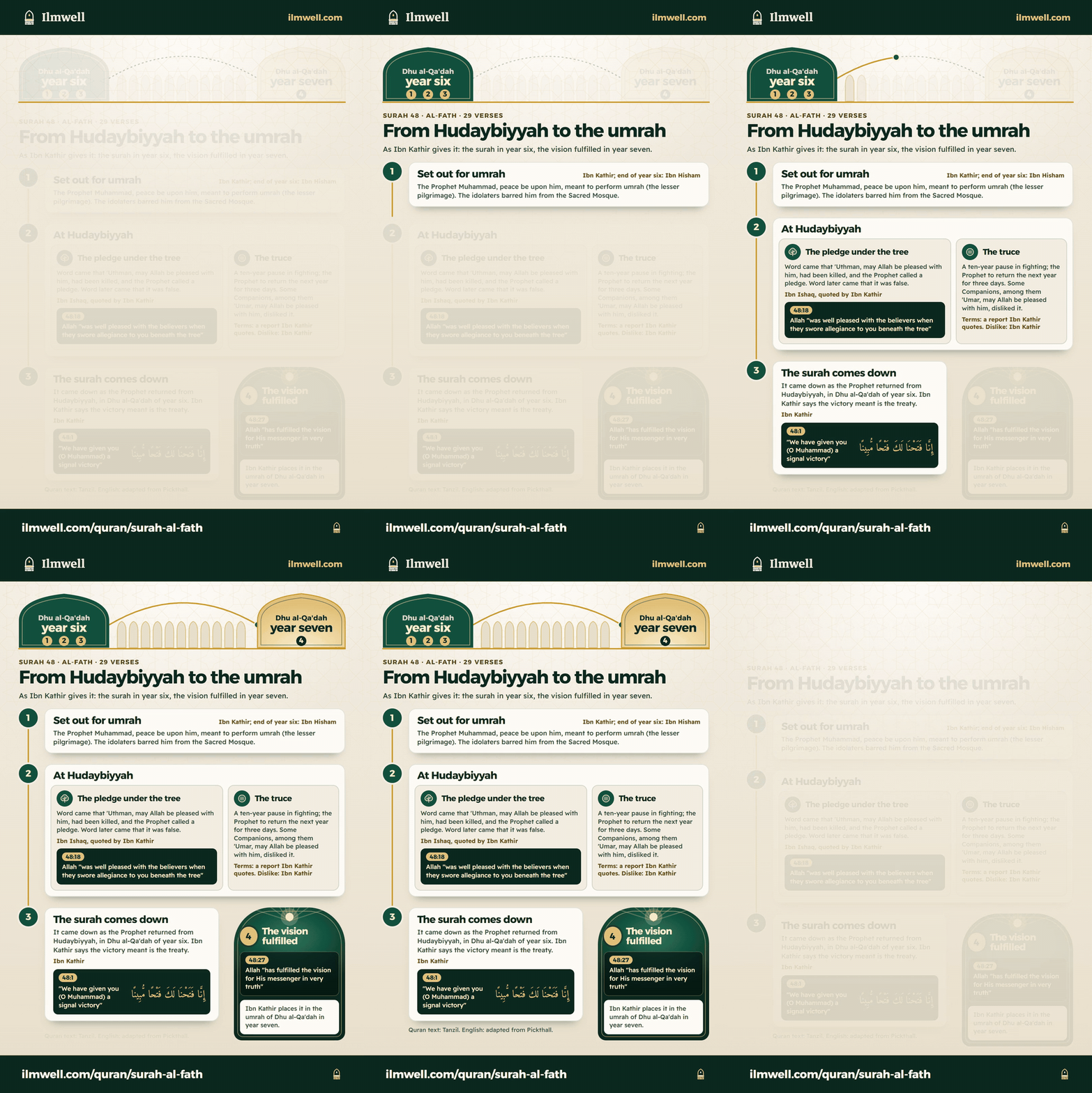
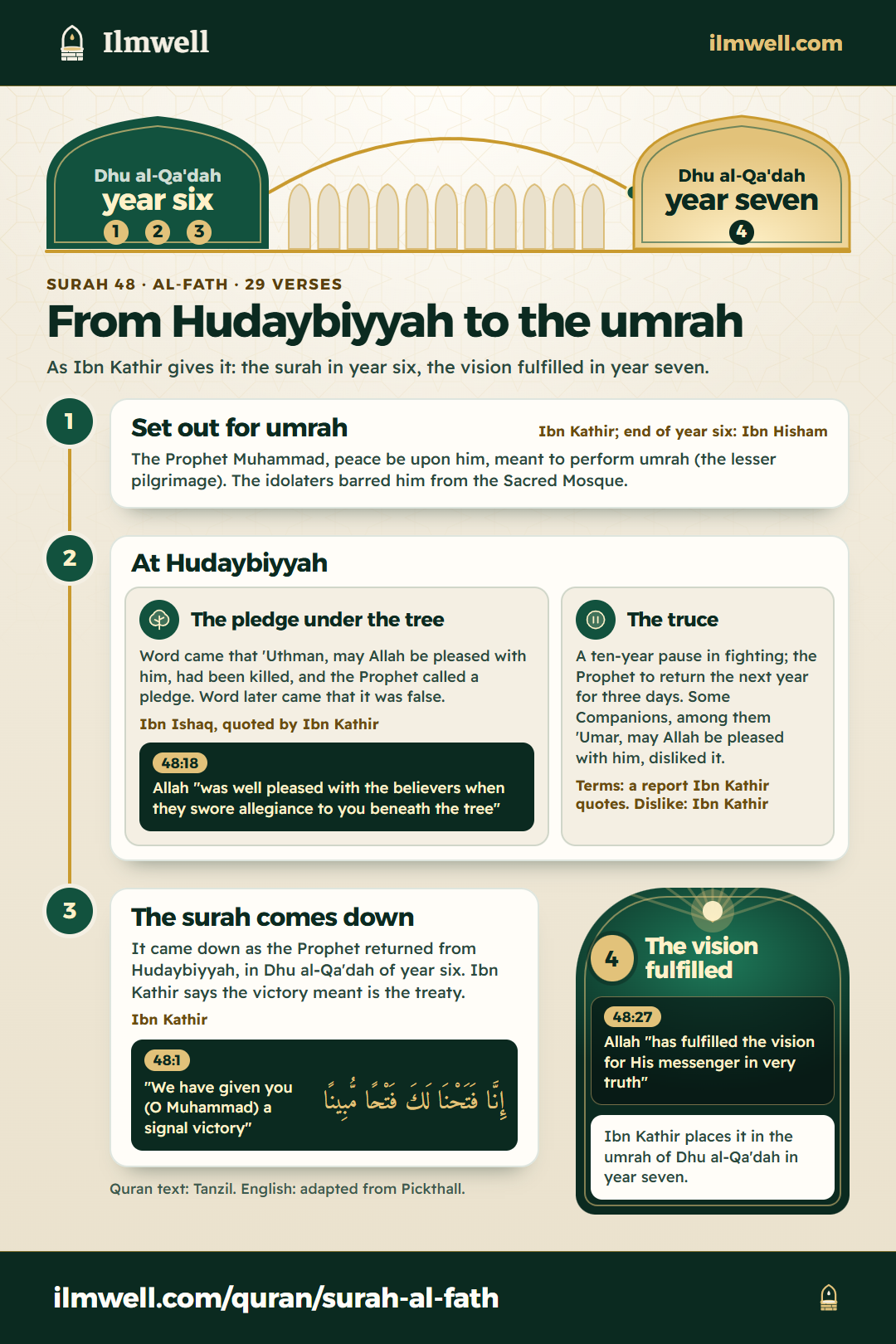
Ibn Kathir says it came down as the Prophet returned from Hudaybiyyah in Dhu al-Qa'dah (the eleventh month) of year six. The idolaters had barred him from the Sacred Mosque, where he meant to perform umrah (the lesser pilgrimage), then inclined to a truce: he would return that year and come the next. Some Companions, among them 'Umar ibn al-Khattab, may Allah be pleased with him, disliked it (source 4). Ibn Hisham also dates the expedition to the end of year six (source 5), as the Seerah timeline lists.
In Ibn Ishaq's account, quoted by Ibn Kathir, the Prophet sent 'Uthman ibn 'Affan, may Allah be pleased with him, to Quraysh to say he came to visit the House, not to fight. Quraysh kept 'Uthman, word came that he had been killed, and the Prophet called the people to a pledge. In the same account, word later reached the Prophet that the report about 'Uthman was false (source 6).
A report Ibn Kathir quotes has the treaty set a ten-year pause in fighting, and the Prophet was to return the next year for three days. The same report gives a number of men that Ibn Kathir counts as a mistake (see the table below) (source 7, source 16).
What is the clear victory in Surah Al-Fath (48:1)?
Verse 1 reads: "We have given you (O Muhammad) a signal victory" (source 8). "Signal" is this translation's word. Ibn Kathir glosses the Arabic mubin, "clear", as evident, and says the victory meant is the Hudaybiyyah treaty, because much good came through it: people felt safe, met one another, and beneficial knowledge and faith spread (source 9). Other counts are in the table below.
What is the sakinah in Surah Al-Fath (48:4 and 48:18)?
Sakinah ("peace of reassurance" here) comes three times (48:4, 48:18 and 48:26): into the believers' hearts, on those beneath the tree and, as "His peace of reassurance", on the messenger and the believers (source 10, source 15).
On 48:4 Ibn Kathir glosses sakinah as tranquillity, as Ibn Abbas, may Allah be pleased with him, said; Qatada said dignity. He says the believers meant are the Companions at Hudaybiyyah (source 11). On 48:26 he ties the idolaters' zealotry to their refusing to write "In the name of Allah, the Beneficent, the Merciful" in the treaty (source 12).
What was the pledge under the tree in Surah Al-Fath?
Verse 18 says Allah "was well pleased with the believers when they swore allegiance to you beneath the tree" (source 15). Ibn Kathir identifies it, and the allegiance of 48:10, with Bay'at al-Ridwan (the pledge of good pleasure), taken by the Companions with the Prophet at Hudaybiyyah under a samura tree (source 13, source 16). On "He knew what was in their hearts" he names truthfulness, loyalty, hearing and obeying (source 17).
What was the vision in Surah Al-Fath (48:27)?
In 48:27 Allah "has fulfilled the vision for His messenger in very truth", and the verse goes on: "You shall indeed enter the Inviolable Place of Worship, if Allah wills" (source 19).
Ibn Kathir says the Prophet had been shown in a dream that he entered Makkah and circled the House. When they set out for Hudaybiyyah, some Companions did not doubt it would be that year. After the treaty 'Umar asked whether he had not been telling them they would circle the House. The Prophet replied that he had, but had not said it would be this year, and that they would come to it and circle it. Abu Bakr, may Allah be pleased with him, answered the same. Ibn Kathir places the fulfilment in the umrah of Dhu al-Qa'dah in year seven (source 20).
How does Surah Al-Fath describe those with the Prophet (48:29)?
Verse 29 describes "those with him" as "hard against the disbelievers and merciful among themselves", seen "bowing and falling prostrate" and "seeking bounty from Allah and (His) acceptance". The verse closes with Allah's promise of forgiveness and a great reward to such of them as believe and do good works (source 21).
Ibn Kathir reads this as praise of the Companions: many in prayer, and sincere in it for Allah. For "the mark of them is on their foreheads" he quotes Ibn Abbas as saying good bearing, and Mujahid and others reverence and humility. He reads the closing promise as forgiveness of their sins and a great reward (source 22). This page quotes and attributes only, draws no ruling and makes no comparison between groups.
Where do the sources differ?
| Question | What the sources say | Source |
|---|---|---|
| What is the victory? | Ibn Kathir: the Hudaybiyyah treaty. He quotes a saying reported from Ibn Mas'ud, may Allah be pleased with him, and others, that some counted the conquest of Makkah while they counted the treaty, and al-Bara', may Allah be pleased with him, counting the pledge. | source 9 |
| How many pledged? | Ibn Kathir quotes 1,300, 1,400 and 1,500 as reported, and calls the middle figure more correct. He quotes Ibn Ishaq's account as saying seven hundred, which he counts among Ibn Ishaq's errors. | source 16 |
| What did they pledge? | Ibn Kathir quotes Jabir ibn Abdullah, may Allah be pleased with him: not to flee, not to the death. Salama ibn al-Akwa', may Allah be pleased with him: to the death. | source 18 |
Does this page cover benefits of Surah Al-Fath?
This page covers none. A reward for reciting a surah needs a hadith whose grading has been checked, and none has been checked here for Al-Fath, so the page states no reward, time or number of recitations. That is this page's rule, not a claim about what exists.
I once trained for months for an archery competition, and it was called off the morning we were due to travel. I was gutted. When I later read about Hudaybiyyah and turning back after setting out, that morning came straight back to me.
Try it: Surah Al-Fath in three questions
1How many verses does Surah Al-Fath have?
Answer: 29. Surah Muhammad before it has 38 verses and Al-Hujuraat after it has 18.
2Which verse speaks of those who swore allegiance beneath the tree?
Answer: 48:18. Verse 18 names the tree. Verse 10 speaks of allegiance without naming it.
3What does Ibn Kathir say the clear victory of 48:1 is?
Answer: The Hudaybiyyah treaty. He also quotes a saying that others counted the conquest of Makkah.
Questions people ask
Which part (juz) of the Quran is Surah Al-Fath in?
The 26th. In the Tanzil listing the 26th part begins at 46:1 and the 27th at 51:31, so Surah Al-Fath, surah 48, falls inside the 26th (source 23).
Which surahs come before and after Surah Al-Fath?
Surah Muhammad (47, with 38 verses) comes before it and Al-Hujuraat (49, with 18 verses) after it, by the Tanzil numbering (source 23).
Sources
Every claim on this page comes from one of these. Gradings are reported with the scholar's name; we do not grade hadith ourselves.
- 1
Surah Al-Fath, surah 48 and the 48th surah in the Mushaf order, has 29 verses.
- 2
The Tanzil metadata names Surah 48 Al-Fath, which it translates as The Victory, and gives its Arabic name as al-Fath.
- 3
The Tanzil metadata classes Surah 48, Al-Fath, as Medinan.
- 4
Ibn Kathir says Surah Al-Fath came down when the Prophet Muhammad, peace be upon him, returned from Hudaybiyyah in Dhu al-Qa'dah of the sixth year after the Hijrah, after the idolaters had barred him from the Sacred Mosque, where he meant to perform his 'umrah; they then inclined to a truce that he would return that year and come the next; he agreed, though a group of the Companions, among them 'Umar ibn al-Khattab, may Allah be pleased with him, disliked it; and after he sacrificed his animal where he had been held back and returned, Allah sent down the surah.
Ibn Kathir, Tafsir al-Qur'an al-'Azim (al-Salama edition), vol. 7, p. 325 Electronic copy: not checked against print. The reports he quotes are not graded here.
- 5
Ibn Hisham's al-Sirah dates the Hudaybiyyah expedition to the end of year six, when the Prophet set out in Dhu al-Qa'dah for 'umrah, not intending war.
Ibn Hisham, al-Sirah al-Nabawiyyah, vol. 2, p. 308 Electronic copy on shamela.ws.
- 6
Ibn Kathir, quoting Ibn Ishaq, reports that the Prophet sent 'Uthman ibn 'Affan, may Allah be pleased with him, to Abu Sufyan and the leaders of Quraysh to tell them he had not come for war but to visit the House and honour its sanctity; that Quraysh kept 'Uthman; that word reached the Prophet and the Muslims that 'Uthman had been killed; and that the Prophet called the people to the pledge, which was the Pledge of Ridwan under the tree; and that word then came to the Prophet that the matter of 'Uthman was false.
Ibn Kathir, Tafsir al-Qur'an al-'Azim (al-Salama edition), vol. 7, pp. 331 to 332 Electronic copy: not checked against print. The reports he quotes are not graded here.
- 7
Ibn Kathir quotes a report through al-Miswar ibn Makhrama and Marwan ibn al-Hakam that the Prophet set out in the year of Hudaybiyyah wishing to visit the House, not to fight, with seventy sacrificial animals; and that the treaty laid down a pause in fighting for ten years, in which people would be safe; that whoever came to the Prophet without his guardian's permission would be sent back to them, while a man who went to Quraysh from those with the Prophet would not be sent back; and that the Prophet would turn back that year and come the next year, staying three days with only a rider's weapons and swords sheathed.
Ibn Kathir, Tafsir al-Qur'an al-'Azim (al-Salama edition), vol. 7, pp. 346 to 349 Electronic copy: not checked against print. The reports he quotes are not graded here.
- 8
Al-Fath 48:1 to 3 says Allah has given the messenger a signal victory, so that Allah may forgive him of his sin that which is past and that which is to come, perfect His favour to him, guide him on a right path, and help him with strong help.
- 9
Ibn Kathir says the 'clear victory' (fath mubin) of 48:1 is the Hudaybiyyah treaty, because much good came through it (people felt safe, met one another, a believer spoke with a disbeliever, and beneficial knowledge and faith spread); he says Allah made that truce a fath for the good in it and where it led, quotes a saying reported from Ibn Mas'ud, may Allah be pleased with him, and others that 'you count the fath as the conquest of Makkah and we count it as the Hudaybiyyah truce', and quotes al-Bara', may Allah be pleased with him, as saying that they counted the fath as the Pledge of Ridwan on the day of Hudaybiyyah, though the conquest of Makkah was also a fath.
Ibn Kathir, Tafsir al-Qur'an al-'Azim (al-Salama edition), vol. 7, pp. 325 and 328 Electronic copy: not checked against print. The reports he quotes are not graded here.
- 10
Al-Fath 48:4 to 7 says Allah sent down peace of reassurance into the hearts of the believers that they might add faith to their faith; promises the believing men and women Gardens; and names the hypocritical and idolatrous men and women who think an evil thought concerning Allah, for whom the evil turn of fortune and Hell are made ready.
- 11
Ibn Kathir explains the sakinah of 48:4 as Allah placing tranquillity (tuma'ninah) in the believers' hearts, which Ibn Abbas, may Allah be pleased with him, is quoted as saying (and, in another report from him, mercy), while Qatada said dignity; he says the believers meant are the Companions on the day of Hudaybiyyah, who answered Allah and His messenger and submitted to their ruling, and that when their hearts were calmed and settled it added faith to their faith.
Ibn Kathir, Tafsir al-Qur'an al-'Azim (al-Salama edition), vol. 7, p. 328 Electronic copy: not checked against print. The reports he quotes are not graded here.
- 12
Ibn Kathir, on 48:26, says the zealotry of the Age of Ignorance showed when the idolaters refused to write 'In the name of Allah, the Beneficent, the Merciful' and 'This is what Muhammad, the messenger of Allah, agreed', and that then Allah sent down His sakinah on His messenger and on the believers.
Ibn Kathir, Tafsir al-Qur'an al-'Azim (al-Salama edition), vol. 7, p. 345 Electronic copy: not checked against print. The reports he quotes are not graded here.
- 13
Al-Fath 48:8 to 10 says the messenger is sent as a witness, a bearer of good tidings and a warner, and that those who swear allegiance to him swear allegiance only to Allah, whose Hand is above their hands; whoever breaks his oath breaks it to his own hurt, and whoever keeps his covenant with Allah will have a great reward.
- 14
Al-Fath 48:11 to 17 tells of those of the wandering Arabs who were left behind and gave excuses, says they speak with their tongues what is not in their hearts, warns that they will ask to go with the Muslims to capture booty, says they will be called against a folk of mighty prowess, and says there is no blame for the blind, the lame or the sick.
- 15
Al-Fath 48:18 to 26 says Allah was well pleased with the believers when they swore allegiance beneath the tree, knew what was in their hearts, sent down peace of reassurance on them and rewarded them with a near victory; promises booty; says He withheld men's hands from the believers and their hands from the others in the valley of Mecca; speaks of those who debarred them from the Inviolable Place of Worship and of the zealotry of the Age of Ignorance; and says Allah then sent down His peace of reassurance upon His messenger and upon the believers.
- 16
Ibn Kathir says the pledge of 48:10 is the Pledge of Ridwan, taken beneath a samura tree at Hudaybiyyah; that the number of the Companions who pledged is said to be 1,300, 1,400 and 1,500, the middle figure being the more correct; and that a report in Ibn Ishaq's account which gives seven hundred men is counted among Ibn Ishaq's errors, since what is preserved in the two Sahih collections is a figure of more than a thousand.
Ibn Kathir, Tafsir al-Qur'an al-'Azim (al-Salama edition), vol. 7, pp. 330 and 331 Electronic copy: not checked against print. The reports he quotes are not graded here.
- 17
Ibn Kathir, on 48:18, says Allah tells of His pleasure with the believers who pledged the messenger beneath the tree, that they were 1,400 and the tree was a samura in the land of Hudaybiyyah, that 'He knew what was in their hearts' means their truthfulness, loyalty, hearing and obeying, and that the 'near victory' is the treaty Allah brought about at their hands and the general, continuing good that followed it, connected with the conquests of Khaybar and Makkah.
Ibn Kathir, Tafsir al-Qur'an al-'Azim (al-Salama edition), vol. 7, pp. 339 and 340 Electronic copy: not checked against print. The reports he quotes are not graded here.
- 18
Ibn Kathir records that people said the Prophet took the pledge on death, that Jabir ibn 'Abdullah, may Allah be pleased with him, said it was not on death but on not fleeing, and that Salama ibn al-Akwa', may Allah be pleased with him, asked on what they had pledged on that day, answered 'on death'.
Ibn Kathir, Tafsir al-Qur'an al-'Azim (al-Salama edition), vol. 7, pp. 332 and 334 Electronic copy: not checked against print. The reports he quotes are not graded here.
- 19
Al-Fath 48:27 and 28 says Allah has fulfilled the vision for His messenger in very truth, that they shall indeed enter the Inviolable Place of Worship if Allah wills, secure, with hair shaven or cut, not fearing, that He knows what they do not know and has given a near victory beforehand, and that He sent His messenger with the guidance and the religion of truth that He may cause it to prevail over all religion.
- 20
Ibn Kathir, on 48:27, says the Prophet had been shown in a dream that he entered Makkah and circled the House and told his Companions in Madinah; that when they set out in the year of Hudaybiyyah a group of them did not doubt the dream would be fulfilled that year; that 'Umar ibn al-Khattab, may Allah be pleased with him, asked whether he had not been telling them they would come to the House and circle it, and the Prophet replied, 'Yes, but did I tell you that you would come this year?', 'No', 'Then you will come to it and circle it'; that Abu Bakr, may Allah be pleased with him, answered the same; that the fulfilment was the 'umrah of Dhu al-Qa'dah in year seven; and that the 'near victory' of 48:27 is the treaty.
Ibn Kathir, Tafsir al-Qur'an al-'Azim (al-Salama edition), vol. 7, pp. 356 and 360 Electronic copy: not checked against print. The reports he quotes are not graded here.
- 21
Al-Fath 48:29 says Muhammad is the messenger of Allah, describes those with him as hard against the disbelievers and merciful among themselves, seen bowing and falling prostrate and seeking bounty from Allah and His acceptance, with the mark of them on their foreheads from the traces of prostration, gives their likeness in the Torah and in the Gospel as sown corn, and says Allah has promised such of them as believe and do good works forgiveness and a great reward.
- 22
Ibn Kathir, on 48:29, presents the praise of 'those with him' as praise of his Companions; describes them as given to much prayer and sincere in it for Allah; quotes Ibn Abbas, may Allah be pleased with him, as saying that the mark in their faces is good bearing, and Mujahid and others that it is reverence and humility; and explains the simile of the sown corn as the Companions supporting the Prophet as shoots stand with the plant; and reads the verse's closing promise as forgiveness of their sins and a great reward.
Ibn Kathir, Tafsir al-Qur'an al-'Azim (al-Salama edition), vol. 7, pp. 360 to 363 Electronic copy: not checked against print. The reports he quotes are not graded here.
- 23
In the Tanzil metadata, Surah 47 is Muhammad (38 verses) and Surah 49 is Al-Hujuraat (18 verses), and the 26th part (juz) of the Quran begins at 46:1 while the 27th begins at 51:31, so Surah 48 lies within the 26th part.
- Q
Quran Arabic on this page is the Tanzil Uthmani text, and the English is the adapted Pickthall translation (1930).
Tanzil Project English: adapted from Marmaduke Pickthall's translation (1930), modernised and checked against modern translations.
Next
- The Seerah timelineSeerah
- The Prophet Muhammad: life and sourcesBiography
- How to perform UmrahGuide
- Surah Tawbah: themes, verses and reading guideQuran lesson
- Al-Fatihah: meaning and understanding what you reciteQuran lesson
- How to understand the QuranQuran guide
- Surah Muhammad: meaning, themes and learningQuran lesson
- Quran and SurahsThe hub
Join the email list
New guides by email, now and then. No spam, and you can leave at any time.
Ilmwell is free and kept going by readers. See how to support it.